

CSL frames FY26 as a “reset year” as transformation drives $176m in cost savings
In its FY26 results presentation delivered on 18 August 2026, CSL Limited framed the full year ended 30 June 2026 as a “reset year,” with Interim CEO Gordon Naylor and CFO Ken Lim outlining an underlying business that remained solidly profitable beneath a reported statutory loss.
The distinction was central to the presentation. CSL recorded a reported NPAT loss of ($2.6b), driven by one-off non-cash impairments, while underlying NPATA held at $3.1b, down just 2%. Revenue came in at $15.8b, down 1%, with underlying NPAT of $2.8b, down 3%.
Management noted the interim CEO appointment was intended to accelerate CSL’s strategic transformation, with an enhanced focus on commercial execution and operational simplification. The transformation program delivered $176m in cost savings, above target.
Cashflow from operations reached $3.5b, down 1%. The company reported one-off pre-tax restructuring costs of $0.8b and impairment and related costs of $7.1b. The dividend was maintained at $2.92 per share, and a buyback of approximately A$1b was completed during the year.
When big ASX news breaks, our subscribers know first
FY26 group performance at a glance
The headline group financials, which management noted were consistent with the May 2026 update, are summarised below.
The FY26 guidance revision flagged three discrete revenue headwinds totalling $650 million, covering U.S. immunoglobulin channel inventory normalisation, China albumin price compression, and Vifor iron competition, each of which management characterised as timing or structural in nature rather than signs of underlying demand deterioration.
| Metric | FY25 Reported | FY26 Reported | Change % (CC) | Note |
|---|---|---|---|---|
| Total Revenue | $15,558m | $15,797m | (1%) | Broadly stable |
| Underlying NPATA | $3,219m | $3,098m | (2%) | Operating profitability retained |
| Underlying NPAT | $2,972m | $2,837m | (3%) | Excludes one-offs |
| Reported NPAT | $3,002m | ($2,579m) | (184%) | Impairment-driven loss |
| Cashflow from Ops | $3,561m | $3,512m | (1%) | Strong cash generation |
| DPS | $2.92 | $2.92 | – | Maintained |
Segment performance — Behring steady, Vifor grows, Seqirus dips
CSL Behring — robust Ig demand and standout new launches
CSL Behring recorded revenue of $11,387m, down 1%. Immunoglobulin (Ig) demand remained robust, though management flagged a Medicare Part D impact and normalised channel inventory during the period.
New launches stood out. HEMGENIX® grew 25%, while the hereditary angioedema (HAE) portfolio rose 14%, driven by strong uptake of ANDEMBRY®, having launched in 19 markets in a rollout management said exceeded expectations. Albumin declined 17%, attributed to government cost containment measures in China.
The company also detailed a $100m upfront payment received in FY26 from licensing clazakizumab to Eli Lilly for additional indications, outside the prevention of cardiovascular events in end stage kidney disease (ESKD).
The clazakizumab licensing deal with Eli Lilly is structured so that CSL retains exclusive development rights for cardiovascular indications in end stage kidney disease while gaining milestone and royalty exposure to any additional indications Lilly pursues, making it a capital-efficient way to monetise the asset without surrendering the core therapeutic thesis.
CSL Vifor — 3% growth despite portfolio headwinds
CSL Vifor delivered revenue of $2,379m, up 3%. Nephrology Dialysis grew 18% and Nephrology Non-Dialysis rose 17%, while Iron declined 16% on increased generic competition in the EU and US.
Management flagged notable headwinds. The TAVNEOS® marketing authorisation was revoked, and the VELPHORO® TDAPA inclusion is set to conclude on 31 December 2026. The presentation also detailed the integration of CSL Vifor with CSL Behring commercial and medical affairs functions.
CSL Seqirus — the only global player to grow seasonal influenza revenue
CSL Seqirus reported revenue of $2,031m, down 8%. Total seasonal influenza revenue rose 4%. The In-license / Other category declined 47%, which management attributed to non-recurring revenue relating to the avian influenza threat in FY25.
The presentation described CSL Seqirus as the “only global company to grow year over year in seasonal influenza revenue.” Geographic expansion included a successful first season in Germany and market entry in France, while AUJEMFLU® received UK approval and a positive CHMP recommendation from the EMA.
Understanding the impairments — why CSL reported a loss on a profitable year
The single most important point from the presentation was the distinction between a statutory loss and the underlying operating performance. A non-cash impairment is an accounting write-down of the carrying value of assets, such as goodwill and intellectual property. No cash leaves the business, and operating cashflow is unaffected.
This matters to investors because it explains how CSL posted a reported loss while still generating $3.5b in operating cashflow and $3.1b in underlying NPATA. The write-down, not the day-to-day business, drove the headline loss.
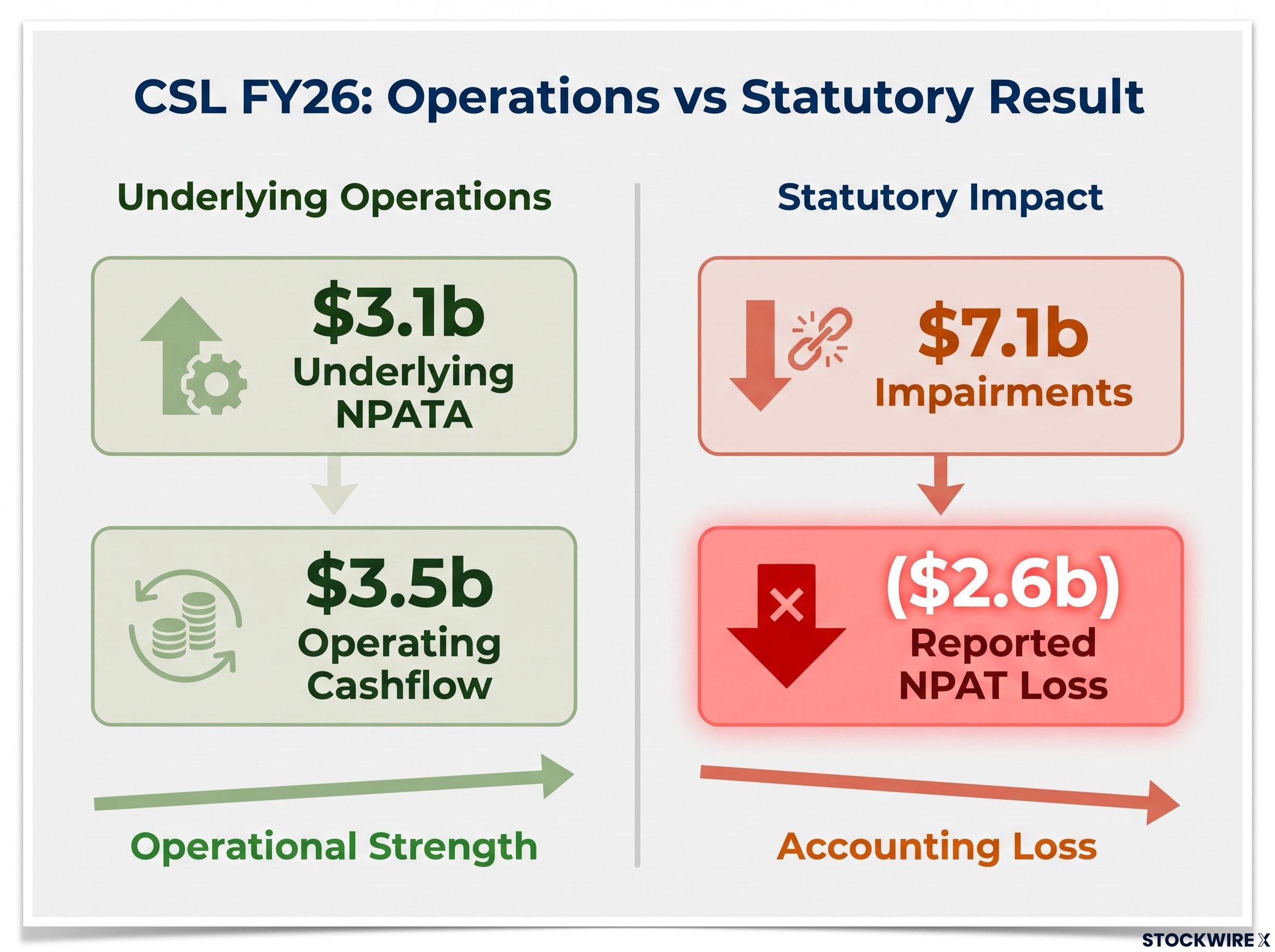
The FY26 impairment totalled $7.1b, concentrated in the second half at $5.5b. The bulk was tied to CSL Vifor, reflecting a change in competitor dynamics, generic competition, the VELPHORO® TDAPA conclusion, the TAVNEOS® authorisation revocation, and goodwill.
Key components of the 2H26 non-cash impairment charges were:
-
CSL Vifor: $4.1b — competitor dynamics, generics and goodwill
-
Other assets: $1.4b — primarily property, plant and equipment (PPE) impairments
Management noted that anticipated FY27 impairments are only around $200m, subject to further analysis and Board approval, signalling that the bulk of the write-down is largely behind the company.
Transformation program and balance sheet strength
Management framed the transformation program as the engine of the reset. Cost savings of $176m were delivered in FY26, above target, with the majority across R&D, Commercial and Medical, and Operations. Savings are expected to rise to $400m in FY27 and up to approximately $550m in FY28.
The company recorded FY26 one-off pre-tax restructuring costs of $799m and applied a disciplined approach to reinvestment, directing approximately $30m to commercial initiatives and around $50m to VMX-C001.
On the balance sheet, Net Debt to EBITDA held at 1.8x, within the target range of 1.5x–2.0x. FY26 capex was $766m, with FY27 capex anticipated at approximately $1b. The buyback of A$1b completed in FY26 is set to be followed by a planned A$1.1b buyback in FY27.
Interim CEO Commentary
Naylor characterised FY26 as a reset year, with the interim leadership appointment intended to accelerate CSL’s strategic transformation and position the company to return to sustainable growth. (Attributed commentary, paraphrased.)
FY27 outlook — Behring and Seqirus return to growth
Management outlined FY27 guidance centred on a return-to-growth thesis for two of its three segments, with CSL Behring and CSL Seqirus expected to grow while CSL Vifor absorbs continued portfolio headwinds.
| Segment | FY27 Guidance | Key Drivers |
|---|---|---|
| CSL Behring | Mid-single digit revenue growth | Ig mid-to-high single digits, ANDEMBRY®, HEMGENIX® |
| CSL Vifor | Revenue decline ~25% | Iron generics, VELPHORO® TDAPA, TAVNEOS® |
| CSL Seqirus | Low single digit growth | New markets, stabilising immunisation rates |
At group level, revenue is guided to be in line with FY26 at constant currency, with underlying NPAT growth of approximately 5% at constant currency. Management flagged an FX headwind of around $50m if current rates hold, and anticipated FY27 impairments of approximately $200m. The A$1.1b buyback is set to continue.
On the strength of its transformation program and de-levered balance sheet, management positioned CSL to return to sustainable growth heading into FY27.
Don’t Miss the Next Healthcare Breakout
Big News Blast delivers FREE breaking ASX healthcare news directly to your inbox within minutes of release, with in-depth analysis already done. Join 20,000+ subscribers who stay ahead of market-moving announcements the moment they drop. Click the “Free Alerts” button to start receiving real-time coverage across ASX healthcare and beyond.