

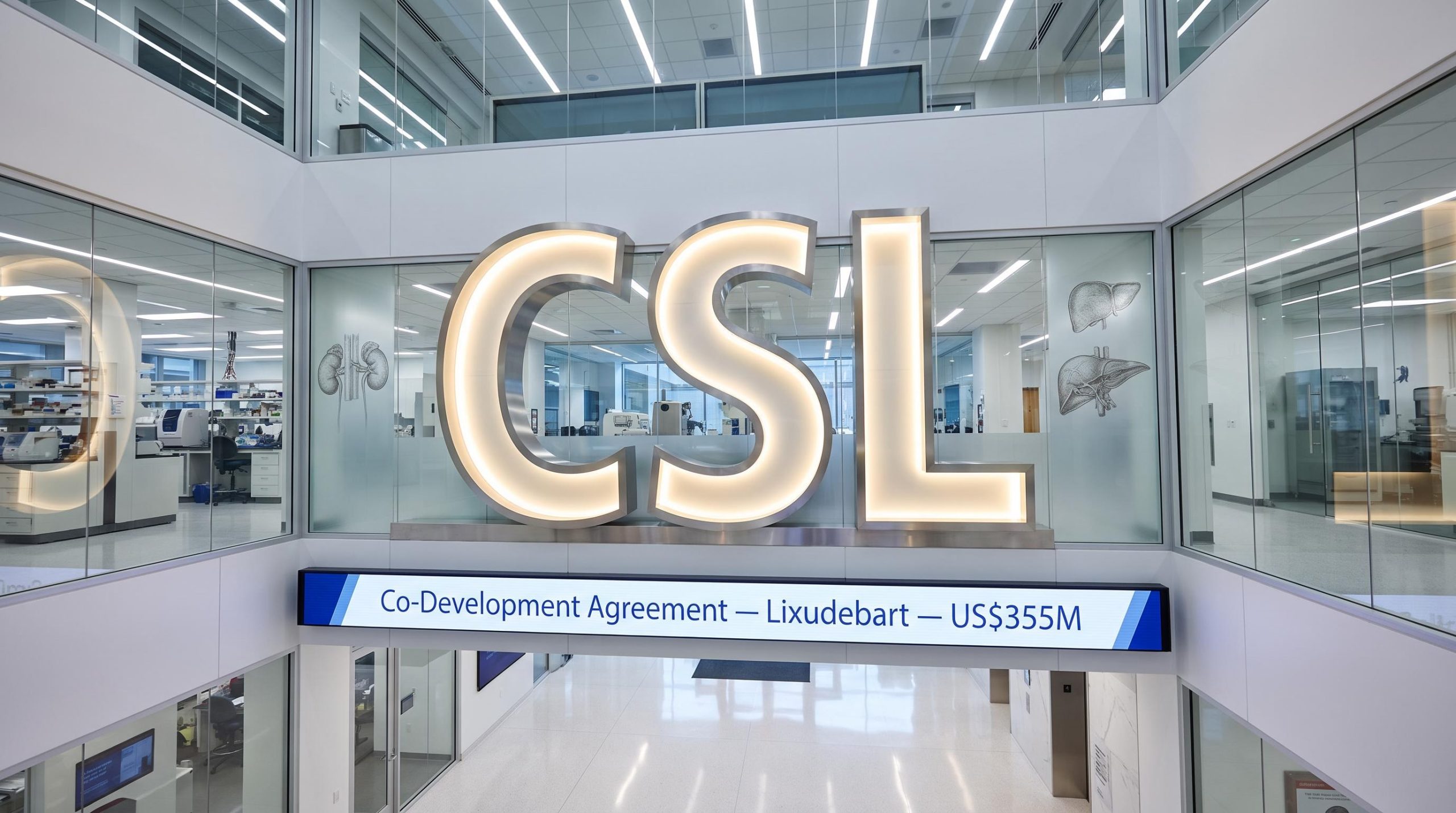
CSL commits US$355 million to rare disease drug collaboration with Alentis Therapeutics
CSL Limited has entered into an agreement with Alentis Therapeutics to co-develop and co-promote lixudebart, a potential first-in-class treatment for rare kidney and liver disease. The deal involves an upfront payment of US$355 million, with Alentis eligible to receive up to an additional US$1.2 billion in commercial milestone payments.
The agreement targets three indications: AAV-RPGN (a rare autoimmune kidney disease), focal segmental glomerulosclerosis (FSGS, a chronic kidney disease), and primary sclerosing cholangitis (PSC, a chronic liver disease for which there is currently no available therapy). Once commercialised, global profits will be shared 55% to CSL and 45% to Alentis.
The milestone payments to Alentis are performance-gated, triggered only upon commercial success rather than paid upfront, a structure that limits CSL’s near-term financial exposure beyond the initial payment.
When big ASX news breaks, our subscribers know first
What is lixudebart and why does it matter?
Lixudebart (formerly known as ALE.F02) is an investigational monoclonal antibody that selectively targets exposed claudin-1, a protein that drives both inflammatory and fibrotic signalling pathways across multiple organs, including the kidney, liver, lung, and intestine. Its dual mechanism, addressing both inflammation and fibrosis simultaneously, forms the basis for its description as a potential first-in-class therapy.
The three target indications are:
- AAV-RPGN (ANCA-associated vasculitis with rapidly progressive glomerulonephritis): A rare, severe autoimmune disease in which the immune system attacks small blood vessels in the kidney, causing rapid loss of kidney function over days to weeks. Despite potent immunosuppressive treatment, most patients develop significant or total kidney loss.
- FSGS (focal segmental glomerulosclerosis): A chronic kidney disease that causes scarring of the kidney’s filtering units.
- PSC (primary sclerosing cholangitis): A chronic liver disease that causes progressive bile duct damage; currently no approved therapy exists for this condition.
Lixudebart has also been granted Orphan Drug designation by the US Food and Drug Administration (FDA) for the treatment of Idiopathic Pulmonary Fibrosis (IPF), providing an additional signal of regulatory recognition across its broader potential application.
Clinical evidence and trial programme
Existing clinical data across two studies provides the evidentiary basis for CSL’s commitment.
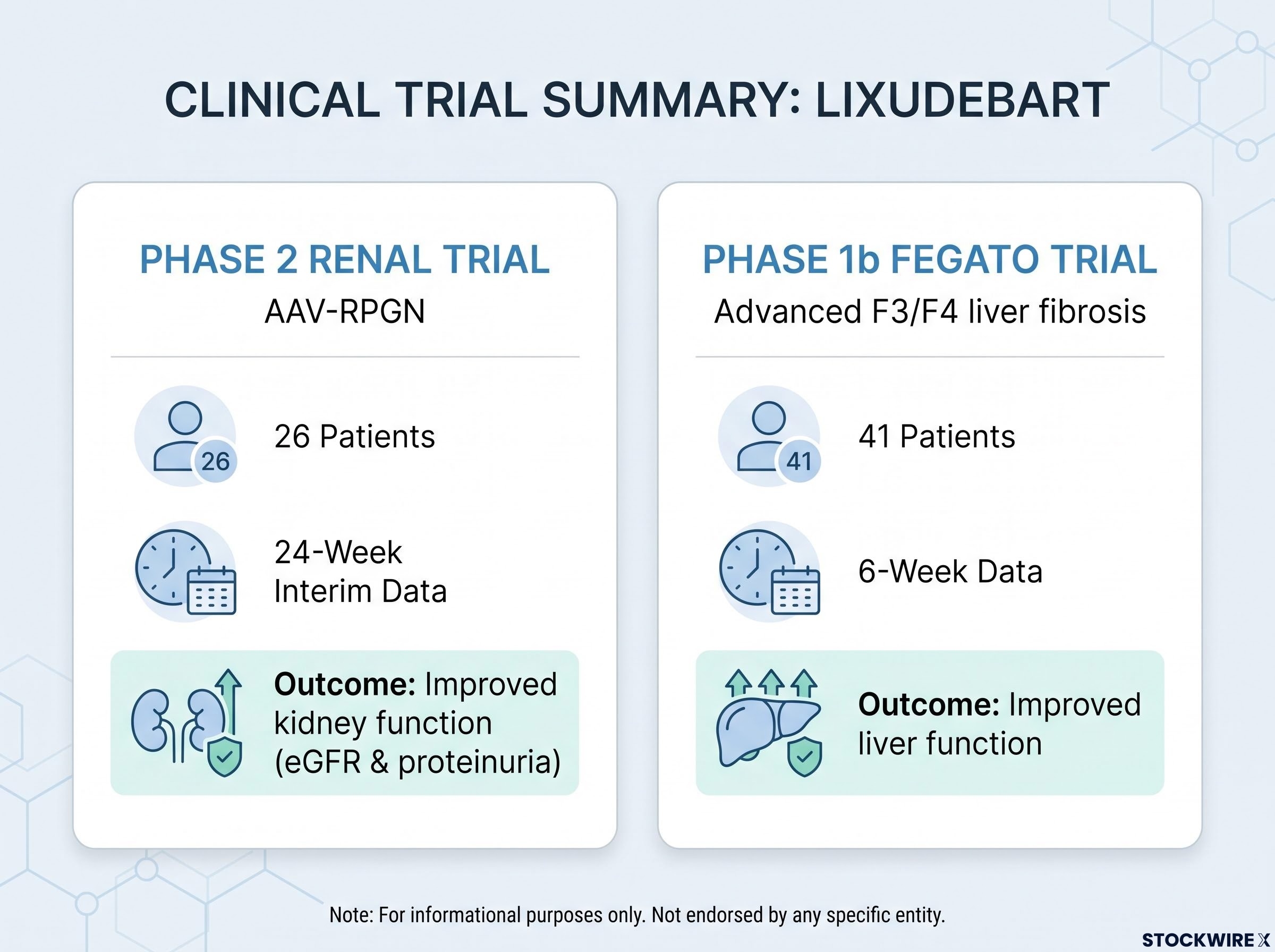
In an interim analysis of 26 patients with AAV-RPGN in the ongoing Phase 2 RENAL trial, lixudebart showed promising improvement in kidney function as assessed by eGFR and proteinuria at 24 weeks. In the Phase 1b FEGATO trial involving 41 patients with advanced F3/F4 liver fibrosis, lixudebart demonstrated improved liver function at 6 weeks. Both studies showed dose-dependent claudin-1 target engagement and a favourable safety and tolerability profile.
As part of the agreement, CSL will fully fund the following development activities:
- Completion of the ongoing Phase 2 RENAL trial in AAV-RPGN
- A planned Phase 3 trial in AAV-RPGN
- Phase 2 trials in FSGS and PSC
- Other supporting development activities
| Indication | Disease Type | Current Trial Phase | CSL Trial Commitment | Status |
|---|---|---|---|---|
| AAV-RPGN | Rare autoimmune kidney disease | Phase 2 (RENAL trial, ongoing) | Complete Phase 2; fund planned Phase 3 | Interim data reported (26 patients) |
| FSGS | Chronic kidney disease | Phase 2 (planned) | Fund Phase 2 trial | Planned |
| PSC | Chronic liver disease | Phase 2 (planned) | Fund Phase 2 trial | Planned; no existing approved therapy |
Strategic fit and investment implications
CSL’s decision to deploy US$355 million upfront signals a high level of internal conviction in lixudebart’s differentiated mechanism and its clinical data to date.
CSL’s FY26 financial position provides important context for the scale of the Alentis commitment: underlying NPATA of $3.1 billion and operating cashflow of $3.5 billion mean the US$355 million upfront payment represents a meaningful but manageable single-period outlay against a business generating substantial recurring cash.
Dr Bill Mezzanotte, Executive Vice President, Head of R&D, CSL
“We believe lixudebart has the potential to become an important new therapeutic option to help improve kidney function and prevent progression to end-stage kidney disease… Our collaboration with Alentis reflects CSL’s commitment to building a leading global nephrology franchise, and our strategic intent to create high-value external partnerships.”
The deal is explicitly positioned as part of CSL’s broader strategy to build a leading global nephrology franchise, rather than a standalone transaction. Lixudebart’s potential to address multiple rare indications, including PSC where no approved therapy currently exists, gives the asset a broad commercial runway if clinical development succeeds.
The Alentis collaboration is not the first time CSL has structured a rare disease partnership around upfront payments and milestone gates; the clazakizumab licensing deal with Eli Lilly, which delivered a $100 million upfront payment while CSL retained cardiovascular development rights in ESKD, established a similar template of non-dilutive capital capture alongside retained programme upside.
From a financial structure perspective, CSL retains the majority profit share (55%) upon commercialisation, while the additional milestone payments of up to US$1.2 billion are linked to commercial performance rather than development progress. In addition to the upfront payment, CSL is committed to fully funding the completion of the ongoing Phase 2 RENAL trial and planned Phase 3 trial in AAV-RPGN, the Phase 2 trials in FSGS and PSC, and other supporting development activities — incremental costs that are non-contingent and must be borne during development, ahead of any commercialisation.
For investors monitoring this programme, the key near-term catalysts are progression of the Phase 2 RENAL trial in AAV-RPGN and any announcement regarding Phase 3 trial timelines. The announcement does not disclose specific timelines for Phase 3 initiation or readout, and no completion dates have been indicated at this stage.
Don’t Miss the Next ASX Healthcare Breakthrough
Big News Blast delivers FREE breaking ASX healthcare news directly to your inbox within minutes of release, complete with in-depth analysis already done for you. Join 20,000+ subscribers who stay ahead of the market on moves like this. Click the “Free Alerts” button at Big News Blast to start receiving alerts the moment news breaks.