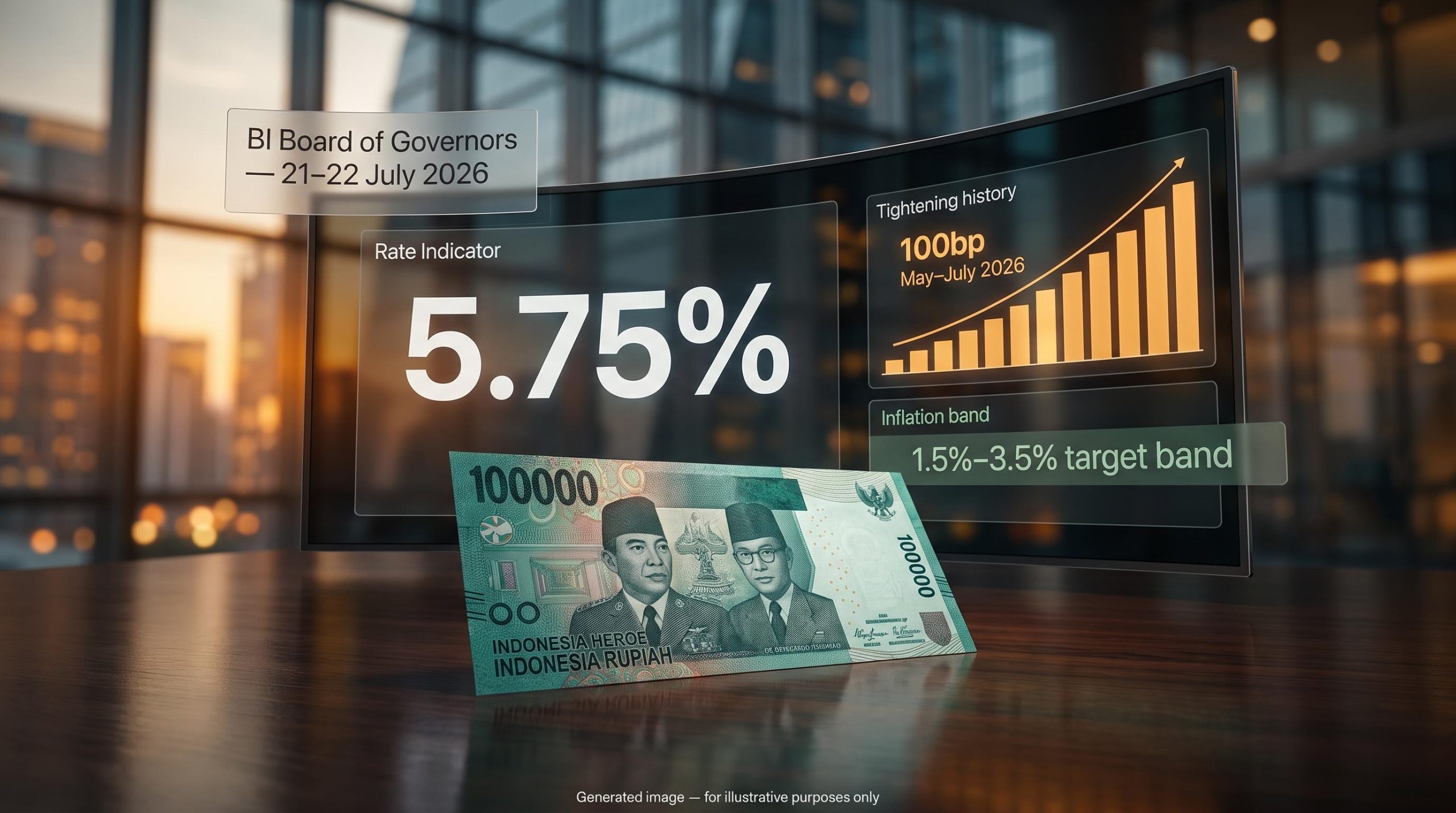
Bank Indonesia’s decision to hold rates at 5.75% is the least interesting half of this story. A central bank that has just completed 100 basis points of tightening in under three months, now entering a deliberate pause under a brand-new governor, is where the real market intelligence sits.
The hold, confirmed at the 21-22 July 2026 Board of Governors meeting, caps a rapid defensive cycle that began in May 2026. Destry Damayanti’s arrival at the top of Indonesia’s central bank coincides with a precise inflection point: tightening is done, but the conditions for easing have not yet been met. That gap is where the analytical tension lives.
Here is what the rate hold achieves, what Damayanti’s first meeting signals about future direction, and which specific variables in the rupiah, bonds, and equities deserve attention now. If you have Indonesian exposure or an emerging markets mandate, this is the read you need this week.
Why Bank Indonesia stopped hiking after 100 basis points
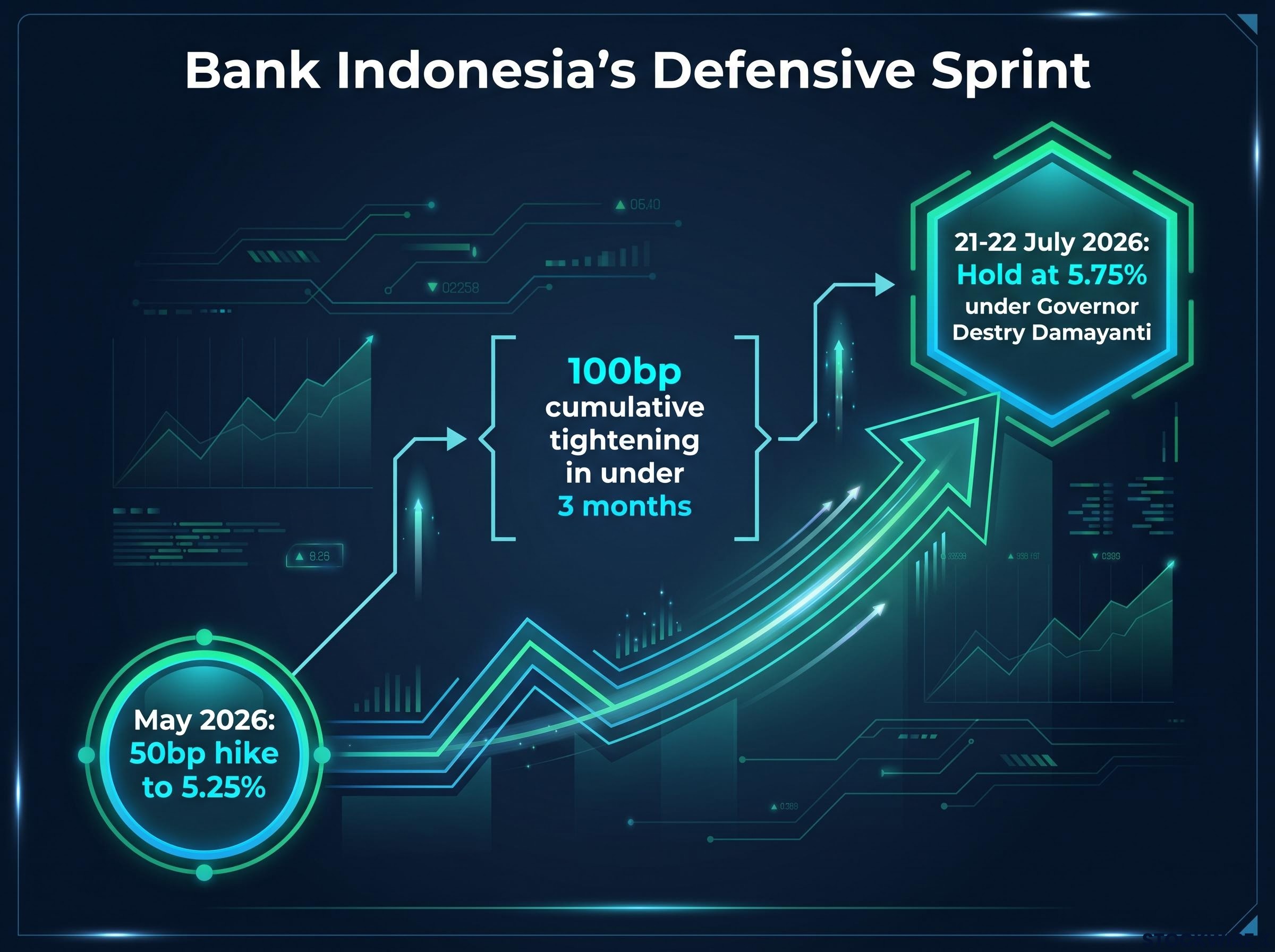
Bank Indonesia executed 100bp of cumulative tightening since May 2026, including a 50bp move to 5.25% in May followed by further increases reaching 5.75%. The pace alone was a signal: this was not a measured hiking cycle. It was a defensive sprint.
The defensive sprint that brought BI to 5.75% began with the shock 50bp move on 20 May 2026, a decision that triggered a broader Asian rate tightening cycle as Goldman Sachs projected the Bank of Korea, the Reserve Bank of India, and Taiwan’s Central Bank would follow suit through H2 2026.
Three converging pressures gave BI sufficient justification to stop:
- Easing pressure on the Indonesian rupiah reduced the urgency for further monetary tightening
- Domestic inflation held well inside BI’s official band of 1.5%-3.5%, with the central point target set at 2.5% (plus or minus 1%) for 2025-2027
- The cumulative tightening already delivered was assessed as sufficient to stabilise external conditions
Bank Indonesia’s inflation targeting framework sets the official target at 2.5% for 2025, 2026, and 2027 within a plus or minus 1% corridor, meaning the 1.5%-3.5% band the article references carries formal institutional weight rather than serving as an informal guide.
Elias Haddad of Brown Brothers Harriman characterised BI as having sufficient justification to maintain its current rate stance after completing a significant tightening phase.
BI’s official framing centres on macroeconomic and external stability alongside growth support. That language matters. It signals the bank believes it can afford to shift its attention from defensive rate moves to growth considerations. The distinction is material: a pause built on converging fundamentals is a different risk environment from one built on political hesitation or exhaustion.
When big ASX news breaks, our subscribers know first
What 5.75% actually means in the context of Asian monetary policy
Treated in isolation, 5.75% is just a number. Placed against Asian peers, it tells you something specific about Indonesia’s positioning.
BI’s rate is comparatively high within the region, making Indonesian assets a carry-trade destination for yield-seeking investors. A credible anti-inflation stance at this level reinforces rupiah demand beyond the mechanical carry argument, because investors are not just chasing yield; they are pricing in the discipline of the institution behind it.
BI has also expanded its non-rate toolkit to complement the rate level rather than substitute for it:
- Incentive policies designed to attract foreign portfolio inflows
- Measures to strengthen rupiah exchange rate stability
- Liquidity measures in money and banking markets
For a global investor scanning Asia, 5.75% with anchored inflation and a credible pause is a relatively rare combination in the current environment. That is what makes Indonesian assets worth watching even in a risk-off quarter.
The carry case and its limits
Carry trades on the rupiah remain contingent on forward guidance clarity from Damayanti. An easing signal without explicit rupiah and inflation thresholds would reprice the risk of lower real yields quickly. The yield looks attractive on paper; its durability depends on what the new governor says next.
Destry Damayanti and what a continuity governor actually signals
Governor Perry Warjiyo’s exit from the role came in late July 2026, with personal reasons given as the basis for his decision, leaving roughly two years remaining on his second five-year term. An unexpected exit from a sitting central bank governor creates market uncertainty by default. The question is how that uncertainty gets managed.
Indonesian authorities answered it with a continuity appointment. Damayanti had occupied the position of senior deputy governor, functioning as Warjiyo’s principal deputy, and shaped the current policy framework alongside him. She was appointed acting governor following his resignation, then nominated as the sole candidate for the governorship. The 21-22 July 2026 meeting was the first Board of Governors meeting she presided over.
The distinction between a continuity figure and a reform figure matters here. A reform appointment would have signalled that the government wanted a directional change, potentially calling the entire post-tightening framework into question. A continuity appointment signals the opposite: the framework stays, the gains are preserved, and the new governor’s job is to manage what comes next within the existing architecture.
“Continuity appointment” is not a passive label. It is an active policy signal that Indonesian authorities chose stability of framework over a directional reset at one of the most sensitive moments in the current monetary cycle. For investors, that reduces the tail risk of abrupt policy reversal. It also means Damayanti’s communication style and threshold clarity become the primary source of new information about future direction.
What the rupiah does next depends on what Damayanti says, not what she did
The hold at 5.75% was fully anticipated. That means the rupiah’s reaction function has already moved past the rate decision itself. What FX markets are trading now is the language of the central bank, not the rate level.
The USD/IDR trajectory entering the July meeting carried its own analytical weight: the pair had retreated from a July all-time high of 18,279 to the 17,760-17,803 range, with the Damayanti nomination itself credited as one of two catalysts that removed the leadership uncertainty premium priced into the rupiah.
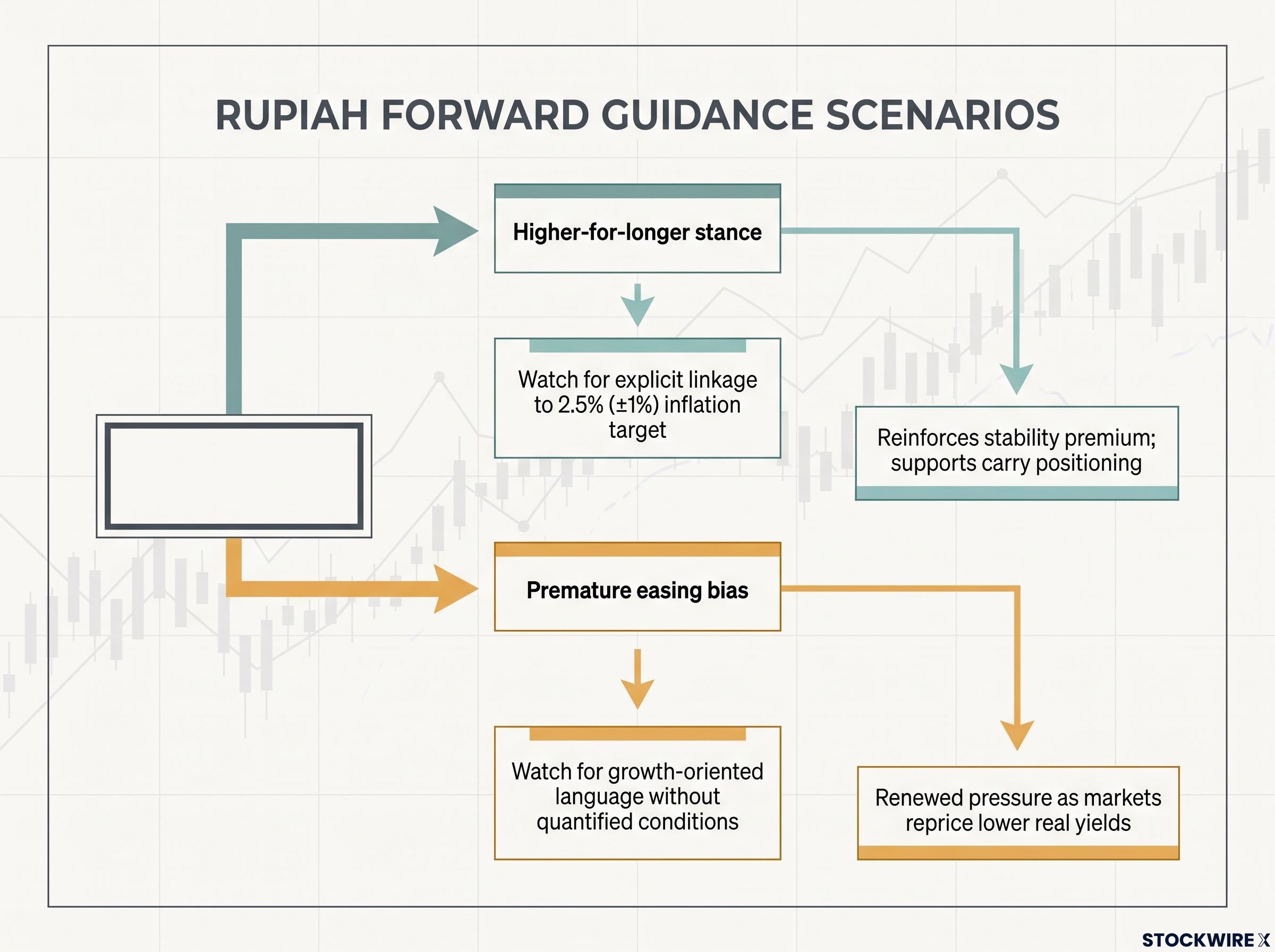
Two forward guidance scenarios frame the near-term outlook:
| Scenario | Likely rupiah outcome | Signal to watch |
|---|---|---|
| Higher-for-longer stance tied explicitly to inflation target and rupiah performance | Reinforces stability premium; supports carry positioning | Explicit linkage to 2.5% (±1%) inflation target in BI statements |
| Premature easing bias without clear inflation or FX thresholds | Renewed pressure as markets reprice lower real yields | Growth-oriented language without quantified conditions for adjustment |
BI’s broader shift toward a mixed policy toolkit (incentive policies for foreign portfolio inflows, FX market deepening, and liquidity measures) adds another dimension. Rupiah stability will increasingly depend on the coherence of the full policy package, not just the rate.
If you hold rupiah exposure, the next significant move in the currency will likely be triggered by a central bank statement or press conference, not a data release. Positions should be sized accordingly.
Indonesian bonds and equities in a post-tightening pause
The rate hold does not affect all Indonesian assets equally. The fixed income case and the equity case are distinct, and they respond to different mechanisms.
| Asset class | Primary mechanism | Key risk | Signal to watch |
|---|---|---|---|
| Local currency government bonds | Credible pause compresses risk premia, particularly at the belly and long end of the curve | Premature easing signal undermines the credibility premium | BI communication tone on rate path |
| Equities | Stable rates reduce funding uncertainty and support corporate liquidity | Growth conditions may not improve even with stable rates | Domestic economic data, earnings revisions |
BI’s explicit incentive measures targeting foreign portfolio inflows into bonds and money market instruments are designed to lower funding costs over time and support broader asset valuations. That policy intent is clear. Whether it translates into durable flows depends on the credibility signals discussed above.
The fixed income case is the stronger near-term call from this decision. The equity case requires watching growth signals that the rate decision alone does not resolve.
Four variables that will define Indonesia’s monetary trajectory under Damayanti
The analytical threads above converge on a concrete investor watchlist. These are sequenced by priority:
- BI communication tone and threshold clarity. The bullish signal is structured, transparent language explicitly linking future rate decisions to the 1.5%-3.5% inflation target band and rupiah performance. The bearish signal is vague, growth-oriented language that markets cannot price, leaving forward guidance as a source of uncertainty rather than stability.
- Evolution of the non-rate policy toolkit. Watch for expansion or modification of incentive and prudential measures alongside the policy rate. A broadening toolkit signals institutional confidence. A toolkit that quietly narrows signals the rate may need to do more work than BI currently intends.
- Indonesia’s current account and commodity export performance. These shape the underlying resilience of the rupiah independent of monetary policy. Deterioration here would force BI’s hand regardless of Damayanti’s preferred pace.
- The Federal Reserve’s rate path. The timing and scale of any Fed easing will influence how long BI needs to maintain its own rate at 5.75% or higher. A hawkish Fed extends the hold; a dovish Fed gives Damayanti room to move.
The Fed rate path is the external variable with the most direct bearing on BI’s timing: ING’s FX strategy team argues markets are embedding a hawkish premium in the dollar that rate differentials alone do not justify, and if that premium compresses as the Fed signals cuts, the external constraint on BI easing narrows materially.
The overall risk profile is asymmetric in the near term. The base case is stability: a credible hold, a continuity governor, and contained inflation. The tail risk is a rupiah shock triggered by an external event (a Fed pivot, a commodity price collapse) before the non-rate toolkit has been fully deployed.
What the July hold changes, and what it leaves unresolved
The 100bp tightening cycle has achieved its defensive purpose. The hold preserves those gains. The transition to Damayanti has been handled in the least disruptive way available to Indonesian authorities. Those are the settled questions.
What remains genuinely uncertain is the timing and conditions for the first cut, the durability of the non-rate toolkit’s effectiveness, and whether global conditions (particularly the Fed’s path) will give BI the room it needs. Damayanti has inherited a strong position, but she has not yet been tested by the conditions that would reveal whether the position holds.
For investors wanting a reusable framework for translating central bank and diplomatic headlines into portfolio exposures before they move markets, our dedicated guide to mapping policy-driven market risk examines how three policy announcements in early 2026 produced single-session equity swings that data releases in the same period could not match.
This article is for informational purposes only and should not be considered financial advice. Investors should conduct their own research and consult with financial professionals before making investment decisions. Forward-looking statements regarding monetary policy direction are speculative and subject to change based on economic developments and central bank decisions.