The same AI wave that hammered ASX software valuations through much of 2024, punishing companies for supposed vulnerability to disruption, is now appearing as a line item in upgraded guidance.
August 2026 is when the argument stops being theoretical. Technology One delivered its FY26 results with two AI-attributed guidance upgrades already on the record. WiseTech Global released its FY26 numbers on 26 August. Xero’s JAX assistant is no longer a product announcement; it is embedded in daily workflows across its SME base. The narrative has moved from “will AI disrupt these businesses?” to “how much is AI already contributing?”
Here is what separates the proof from the promise across three of the ASX’s most-watched software names: which company has the strongest current evidence that AI is shifting financial outcomes, which is still in the execution phase, and what you should be tracking in each case before the next reporting cycle.
The narrative shift the ASX software sector needed
The first AI boom rewarded semiconductor stocks. ASX software names sold off. The fear was straightforward: large language models would commoditise the workflow software these companies had spent decades building, allowing cheaper, faster entrants to replicate their products without their cost bases.
The Morgan Stanley cuts on ASX tech valuations in April 2026, averaging around 20% across names including Xero, Technology One, and WiseTech, captured the severity of that disruption fear at its peak and set the baseline against which subsequent guidance upgrades now need to be read.
That fear missed something. The companies most exposed to AI disruption were also the ones sitting on the proprietary data that makes AI outputs accurate enough to be commercially useful. AI models become more powerful and more defensible when applied to domain-specific, high-quality datasets, according to Wealth Within analysts Philip Teski and Pedro Bales. Generic AI can answer generic questions. AI trained on proprietary operational data can automate specific workflows, surface specific insights, and reduce specific errors in ways that a greenfield competitor cannot replicate without years of equivalent data accumulation.
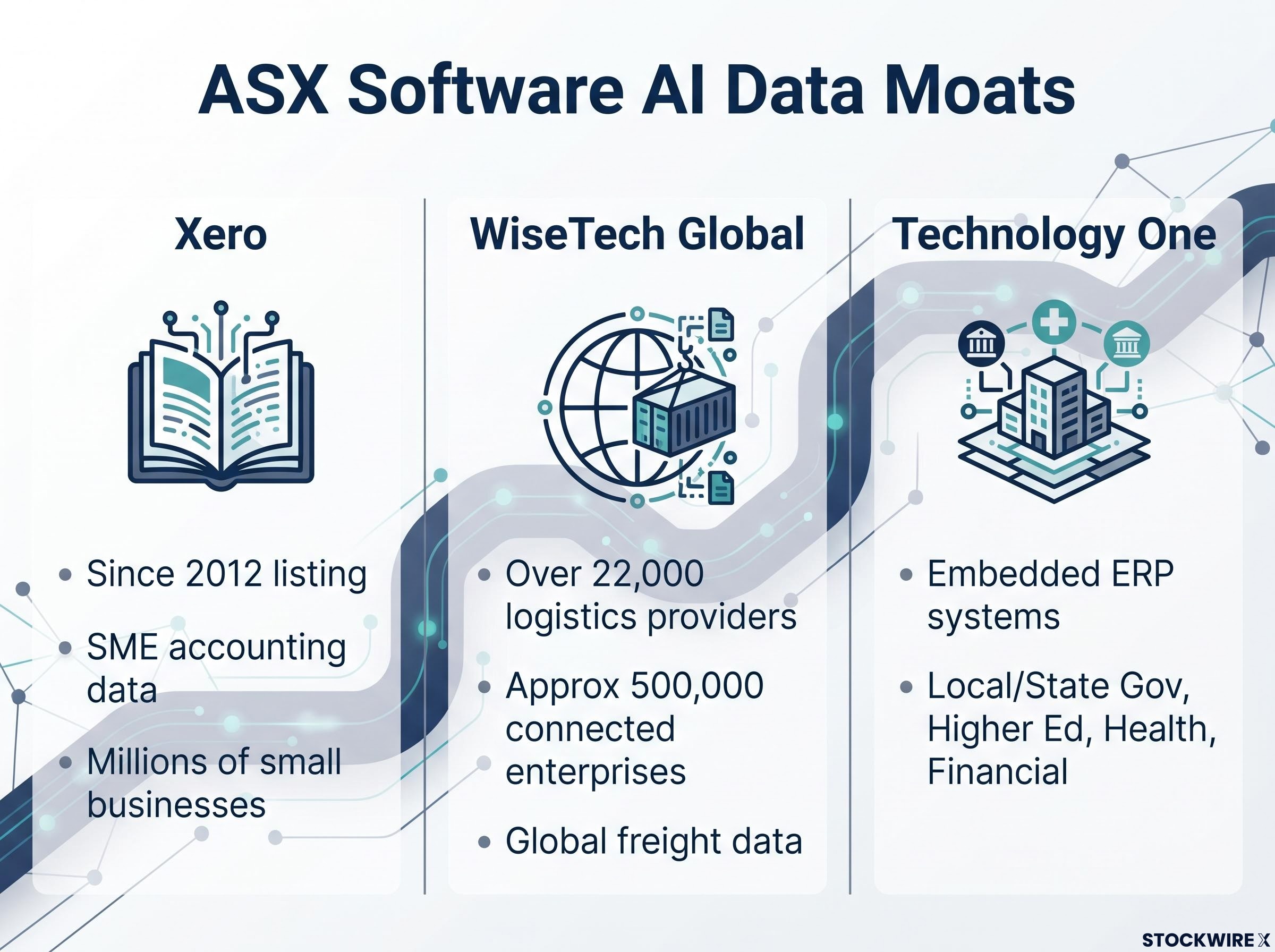
The US software sector recovery preceded the reassessment of ASX software names, and Wealth Within analysts flagged it as a leading indicator. The same structural logic now applies here. The three companies at the centre of that logic each control a different data moat:
The ASX tech valuation reset that followed the SaaSpocalypse was a sentiment event rather than a fundamentals collapse, with revenue growth explaining just 0.1% of the February 2026 price decline across approximately 180 ASX tech companies, according to MopokeCloud analysis.
- Xero: Over a decade of transaction-level SME accounting data, accumulated since its 2012 listing, covering invoicing, reconciliation, payroll and cash flow patterns across millions of small businesses.
- WiseTech Global: A network of more than 22,000 logistics providers and approximately 500,000 connected enterprises, generating real-time global freight, customs and compliance data.
- Technology One: Deeply embedded ERP systems running sector-specific workflows across local and state government, higher education, health and financial services, where relationships are often multi-decade.
The edge is not access to AI tools. Anyone can access those. The edge is the proprietary data pipelines that make AI outputs meaningfully more accurate and harder for a competitor to replicate.
When big ASX news breaks, our subscribers know first
Technology One: AI already showing up where it counts
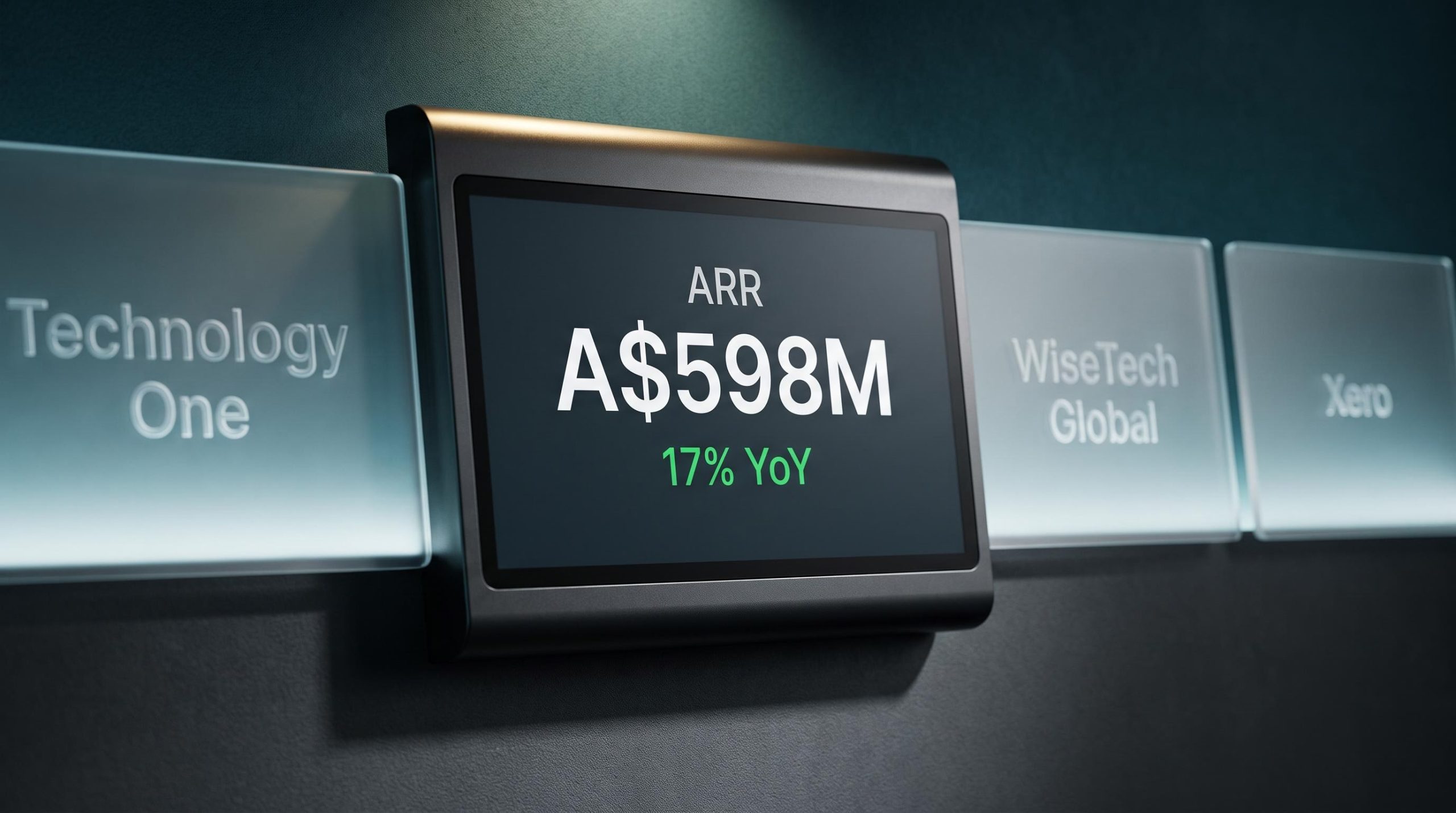
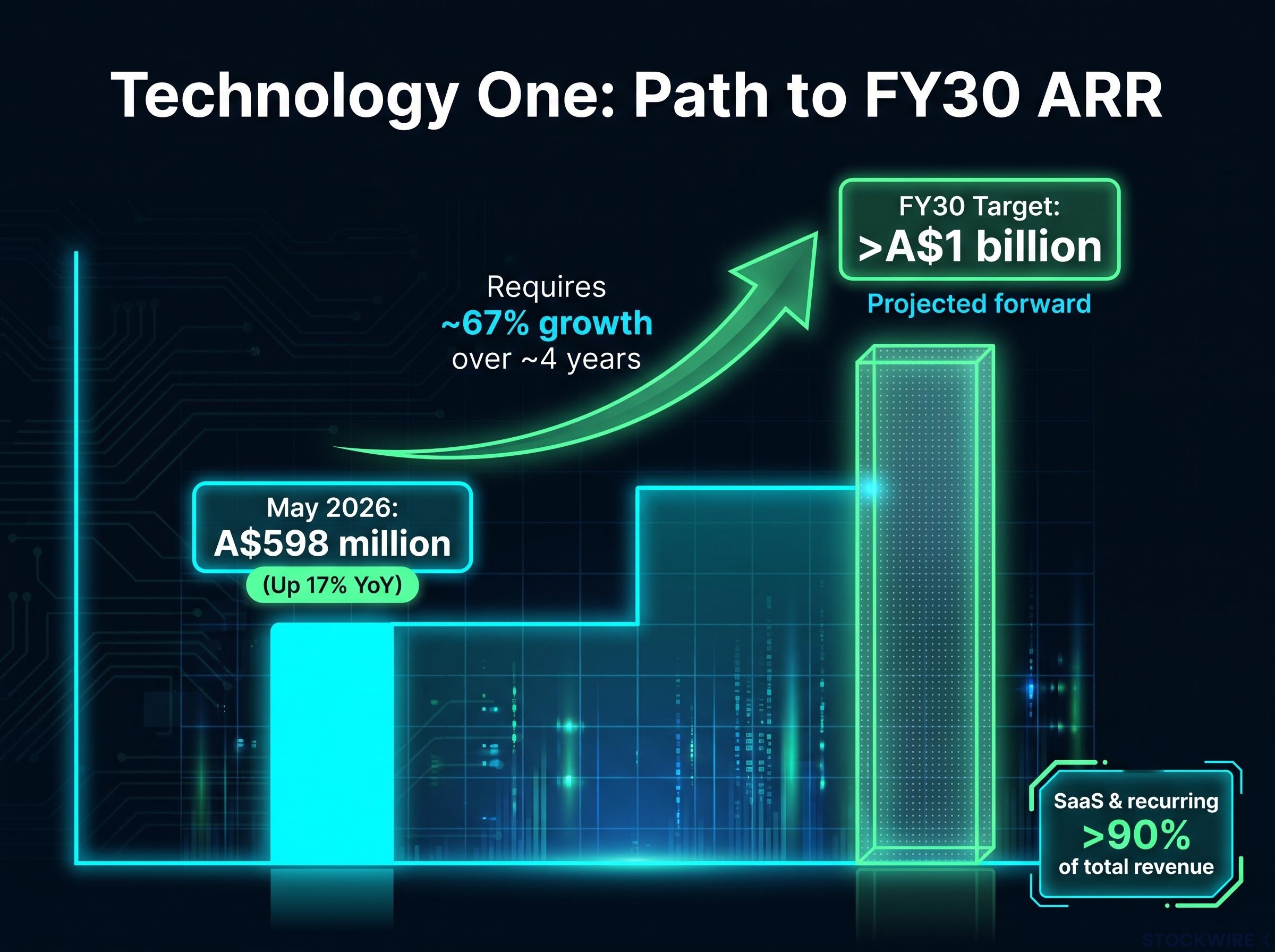
The financial evidence arrives before the narrative. Technology One reported annual recurring revenue (ARR), the value of contracted recurring subscriptions measured on an annualised basis, of approximately A$598 million in its May 2026 half-year result. That figure was up 17% year on year. SaaS and recurring revenue comprised more than 90% of total revenue.
Those numbers matter, but the guidance trajectory matters more. Management raised FY26 profit growth guidance twice in a single financial year, and both times, CEO Ed Chung explicitly attributed the upgrades to AI adoption rather than macroeconomic tailwinds.
The SaaS Plus model now covers 100% of new Technology One agreements and lifts ARR by approximately 40% compared to prior delivery structures, with AI products Plus and Guide positioned as additive revenue streams rather than a headcount displacement risk for customers.
Ed Chung, CEO, Technology One: attributed the February 2026 guidance upgrade to positive customer response to the SaaS Plus offering and new AI-related products, with management later reporting that AI adoption and customer feedback were exceeding expectations.
| Metric | Prior guidance | Upgraded guidance | Result |
|---|---|---|---|
| FY26 profit growth | 13-17% | 18-20% | Reaffirmed at half-year |
| ARR growth | N/A (new disclosure) | 16-18% | 17% YoY (A$598M) |
Two management guidance upgrades in one financial year, both explicitly tied to AI product adoption rather than broader market strength, represent stronger evidence of AI commercialisation than most ASX software companies have produced to date. The company is now targeting more than A$1 billion in ARR by FY30, a marker that gives you a concrete basis for tracking whether the thesis is on schedule.
The sector context reinforces the durability. Technology One operates in local and state government, higher education, health and financial services, segments where switching costs are extremely high and procurement cycles are measured in years. Since its 2012 listing, when the stock traded around A$1, it has appreciated to approximately A$32 per share, a gain of roughly 3,500% across approximately 14 years of continuous compounding.
WiseTech and Xero: execution in progress, different timelines
Neither WiseTech nor Xero has yet produced guidance upgrades explicitly attributed to AI revenue at the auditable level Technology One has established. Both have credible strategies. Both are earlier in the commercialisation cycle. The difference is in the angle.
WiseTech’s AI thesis is anchored in compliance. The company announced the acquisition of FRDM.ai in July 2026, an AI-driven supply chain risk and compliance intelligence platform. FRDM.ai’s risk intelligence is being combined with existing WiseTech products, including BorderWise and Denied Party Screening, to create VerifyWise, a data-driven, AI-enabled solution designed to verify identity, validate trade data and build responsible sourcing models across the supply chain.
FRDM.ai’s supply chain compliance intelligence platform maps supplier networks across multiple tiers using more than 6 billion trade records, covering obligations including UFLPA, CSDDD, CBAM, and the EU Deforestation Regulation, which positions VerifyWise to address regulation-driven demand well beyond traditional freight screening.
The commercial logic is direct. Regulatory and ESG-driven compliance complexity is rising. WiseTech already sits inside the daily operations of more than 22,000 logistics providers and approximately 500,000 connected enterprises. FRDM.ai creates a natural cross-sell into that existing base. The proprietary datasets on both sides, WiseTech’s freight flows and FRDM.ai’s risk intelligence, make the AI harder to replicate and improve model performance over time. What investors should be watching is whether WiseTech’s FY26 results and forward guidance connect the FRDM.ai acquisition to near-term revenue contribution.
WiseTech does carry governance complexity. When the ACCC conducted a regulatory visit, the share price fell only briefly before rebounding, a pattern that points to the market absorbing negative headlines with diminishing sensitivity. That diminishing sensitivity is itself a risk worth monitoring as the company’s compliance footprint expands.
Xero’s AI strategy operates on a different axis: retention. JAX (Just Ask Xero), described as an “AI financial superagent,” is embedded within existing plans rather than sold as a bolt-on. It is built with an internal JAX Assure control system designed to reduce hallucinations and maintain data integrity, and includes a partnership with OpenAI for web research integration. Core capabilities include:
- Automating reconciliations, data entry, invoicing and bill processing
- Surfacing tailored, real-time insights by combining a business’s Xero data with connected app data and curated public information
- Functioning as a natural language interface that learns individual business workflows
- Delivering proactive cash flow, tax and performance prompts
Because JAX is tightly tied to a customer’s historical data and daily operations, it raises switching costs in a way that a competing product cannot replicate without equivalent data depth. Forward guidance for FY27 points toward a better financial year, though management has framed that improvement against a subdued broader environment. What investors should track is whether JAX adoption begins appearing as a metric in financial reporting or pricing commentary.
| Company | AI product / initiative | Commercial stage | Key signal to watch |
|---|---|---|---|
| Technology One | SaaS Plus, AI-driven vertical products | Revenue-contributing, guidance-linked | ARR trajectory toward A$1B FY30 target |
| WiseTech Global | VerifyWise (FRDM.ai + BorderWise) | Product integration, pre-revenue attribution | FY26 results connecting FRDM.ai to revenue |
| Xero | JAX (AI financial superagent) | Deployed, retention-focused, pre-monetisation | JAX metrics in reporting or pricing changes |
For investors comparing the three, WiseTech offers the more differentiated product angle and Xero the stronger retention mechanics, but neither has yet closed the gap in auditable financial proof that Technology One has opened.
What the data moat thesis means for valuation and risk
Premium multiples for these three companies are partly justified by the thesis that proprietary data makes their AI implementations defensible. That thesis only holds if AI features continue delivering tangible, measurable value to customers. Rollout announcements are not evidence. Guidance upgrades are.
AI premium multiples require ongoing evidence of tangible customer value, not just product rollout announcements. Investors should be tracking observable commercial outcomes: guidance upgrades, ARR acceleration, or new product revenue contribution.
Each company carries a different primary risk:
- Technology One: Execution risk on the path from A$598 million to A$1 billion ARR by FY30, requiring approximately 67% growth over roughly four years. The company is priced for delivery.
- WiseTech Global: Regulatory and governance risk from its ACCC history, with scrutiny likely to increase as its compliance footprint grows. The stock’s rapid recovery following the ACCC visit suggests the market may be underpricing this tail risk.
- Xero: SME cyclicality. The improvement in FY27 guidance occurred within what management described as a “slower overall environment,” a qualifier that matters for subscriber growth assumptions even if JAX adoption is strong.
The comparative risk-reward positioning is clearer than the market often acknowledges. Technology One has the strongest current financial proof but is priced for execution. WiseTech has the most differentiated AI angle but carries more governance complexity. Xero has the largest addressable market but the longest path to AI-attributable revenue.
The data moat thesis is not self-validating. What matters is whether you can track observable commercial outcomes, guidance upgrades, ARR acceleration, new product revenue, rather than accepting management commentary as a substitute for evidence.
This article is for informational purposes only and should not be considered financial advice. Investors should conduct their own research and consult with financial professionals before making investment decisions. Past performance does not guarantee future results. Financial projections are subject to market conditions and various risk factors.
Where the proof points are strongest and what to watch next
Across the three companies, the current evidence of AI commercialisation is not evenly distributed. Technology One is the clearest proof. WiseTech is the most differentiated bet. Xero is the longest runway with the highest optionality.
The next twelve months will separate the ASX software companies whose AI narrative is backed by financial evidence from those still in the announcement phase. Here is what to monitor in each case:
- Technology One: Whether ARR continues to track toward the A$1 billion FY30 target. The A$598 million half-year figure establishes the baseline. Each subsequent result either confirms the trajectory or reveals a deceleration.
- WiseTech Global: Whether FY26 results, released 26 August 2026, and forward guidance connect the FRDM.ai acquisition to near-term revenue or margin contribution. The acquisition thesis is credible; the financial evidence is still pending.
- Xero: Whether JAX adoption begins surfacing as a reportable metric in financial results or pricing commentary. Sustained buying activity across four consecutive weeks as of August 2025 suggested technical accumulation at support, but the revenue attribution question remains open.
| Company | Current AI evidence strength | Key metric to watch | Next catalyst |
|---|---|---|---|
| Technology One | Strongest (guidance-linked, auditable) | ARR growth rate vs A$1B FY30 path | FY26 full-year result |
| WiseTech Global | Differentiated but pre-attribution | FRDM.ai revenue contribution | FY26 results (26 August 2026) |
| Xero | Retention-stage, pre-monetisation | JAX adoption in financials or pricing | FY27 half-year or pricing update |
The broader read is this: the AI efficiency narrative is the dominant market theme in mid-2026, and ASX software incumbents with proprietary data and embedded workflows are structurally better placed than greenfield AI entrants. But the market will increasingly demand proof in financial results rather than roadmap announcements. Businesses that deliver that proof earliest will maintain their premium ratings, while those that cannot will discover that a compelling narrative is not a substitute for demonstrated financial outcomes.
For investors wanting to extend this framework beyond ASX software names, our full explainer on AI moat investing examines how network-effect businesses and data incumbents compare to frontier AI labs on margin durability and winner-identification risk.
—