
The July retail sales reading delivered a sharper-than-expected blow to the dollar, with the monthly figure coming in at -0.6% against a market forecast of +0.1%, marking the steepest single-month decline seen in over a year. EUR/USD responded by pushing toward 1.1575 in early Asian trading on Monday, reflecting a greenback that had shed yet another source of underlying support.
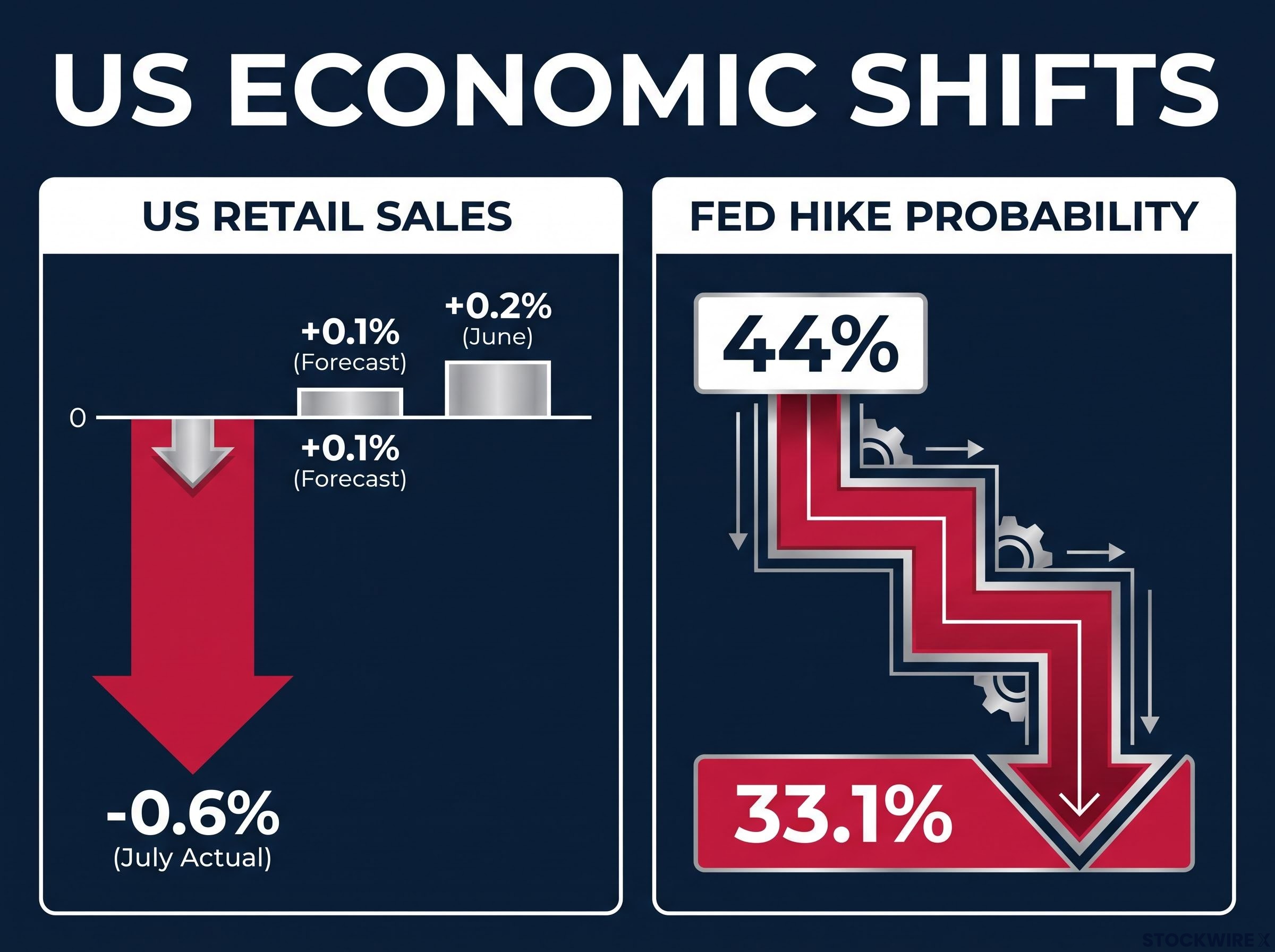
The miss did not arrive in isolation. A set of softer CPI and PPI prints had already landed in the same reporting window, and the combined weight of all three releases drove the probability of a near-term Fed hike down from 44% to 33.1% according to the CME FedWatch tool. No single release would have moved rate-market pricing by nearly 11 percentage points. The accumulation did.
Here is how to read whether this move has durable legs or fades on the first hawkish Fed comment, what specific price levels and events will resolve that question before the week is out, and what conditions need to hold for the bullish bias to survive.
Why the US retail sales miss hit the dollar so hard
The headline number was bad. According to the US Census Bureau, the monthly retail sales reading for July came in at -0.6%, well short of the +0.1% consensus, and a sharp turn from the +0.2% recorded in June. That reversal was not an extension of pre-existing weakness; it represented a change of direction.
Beneath the headline miss, retail sales distortions from Amazon Prime Day’s calendar shift into June and falling gasoline prices depressing nominal fuel receipts account for a meaningful portion of the apparent weakness, both effects expected to mechanically reverse in the August and September data.
July’s monthly retail sales figure fell short at -0.6%, against expectations of +0.1%, the steepest monthly decline recorded in over a year.
The year-over-year figure confirmed the momentum change. The annual rate for July came in at +5.0%, a pronounced step down from the preceding month’s upwardly revised figure of +6.8%, a gap wide enough to indicate that the US consumer is genuinely losing steam rather than simply taking a temporary pause.
That deceleration mattered more than it might have in isolation because it arrived alongside two other soft readings in the same window:
- CPI: Below expectations, easing the urgency for near-term rate action
- PPI: Softer than forecast, reinforcing the disinflationary signal from the consumer side
- Retail sales: The -0.6% miss that completed the trifecta
Any one of these individually would have been manageable. Together, they told traders that the US consumer story is cooling in the same quarter where Fed optionality on hikes was already uncertain, and that timing matters as much as the magnitude of any single print. The dollar’s response was proportional to the accumulation, not to any single release.
When big ASX news breaks, our subscribers know first
What the Fed probability shift actually tells you
The CME FedWatch tool showed the probability of a Fed hike in the following month falling from 44% to 33.1% week-over-week. That number is not just a sentiment gauge. It is the mechanical engine behind the dollar’s recent weakness, and understanding why requires working backwards through the logic.
Fed hike probability mechanics follow a non-linear pattern: odds can move from 10% to 36% within two weeks on a single geopolitical catalyst, which is precisely why the drop from 44% to 33.1% after the July retail miss carries as much signal about the data’s perceived severity as it does about any change in the underlying rate path.
| Metric | Before data releases | EUR/USD implication |
|---|---|---|
| Fed hike probability (next month) | 44% | Dollar supported by rate differential |
| Fed hike probability (after data) | 33.1% | Dollar yield advantage narrows, EUR/USD benefits |
| Longer-term hike expectations | Intact | Deferral, not reversal; limits EUR/USD upside ceiling |
Why the yield differential matters here
The dollar’s core support comes from its interest rate advantage. When near-term hike probability drops, the rate differential that underpins dollar demand narrows, and capital flows respond. That is the transmission mechanism: softer data feeds into lower hike odds, which feeds into a narrower yield gap, which feeds into EUR/USD strength.
Rate markets continue to price in Fed tightening at some stage before the end of 2026, given that US inflation has been running above the 2% target for more than five years. The implication is that tightening is being pushed back, not abandoned entirely. What this tells you is that EUR/USD can continue to benefit even without a new euro-positive catalyst, as long as that repricing holds. The pair is rising on what the dollar is losing, not on what the euro is gaining.
The euro’s own case: what Eurozone data contribute
The Eurozone side of the equation is doing something useful but modest: removing downside risk rather than adding upside momentum.
The Q2 GDP second estimate for the Eurozone came in at +0.4% quarter-over-quarter and +1.0% year-over-year, squarely meeting market expectations. No surprise, no catalyst, but no disappointment either. Scotiabank strategists also noted that the region’s external position had improved, with the June trade account swinging back into surplus after running a deficit across March, April, and May, a development the bank viewed as adding a degree of support to the euro’s standing.
- Q2 GDP: +0.4% QoQ, +1.0% YoY (second release, matched expectations), providing a stable growth floor
- Trade balance: Returned to surplus in June after three months of deficit, removing an external drag on the currency
Scotiabank analysts viewed the GDP result and the improvement in the trade position as together providing a measure of backing for the euro, characterising the combined effect as stabilising rather than a fresh source of upside.
The distinction matters for how you size your exposure. This advance is dollar-weakness-driven, not euro-strength-driven. The Eurozone data provide a floor under the pair, meaning the euro is unlikely to give back ground on its own fundamentals. But the engine is the dollar’s repricing, not a European growth acceleration. If you are trading EUR/USD long, your thesis depends on continued dollar softness more than on any Eurozone data beat.
The structural headwinds on the euro, particularly European natural gas prices above EUR 60 per megawatt-hour and Gulf geopolitical tensions sustaining safe-haven dollar demand, explain why positive Eurozone data surprises repeatedly failed to generate meaningful appreciation in the weeks leading up to this advance.
Understanding EUR/USD levels: where the pair stands and why 1.1575 matters
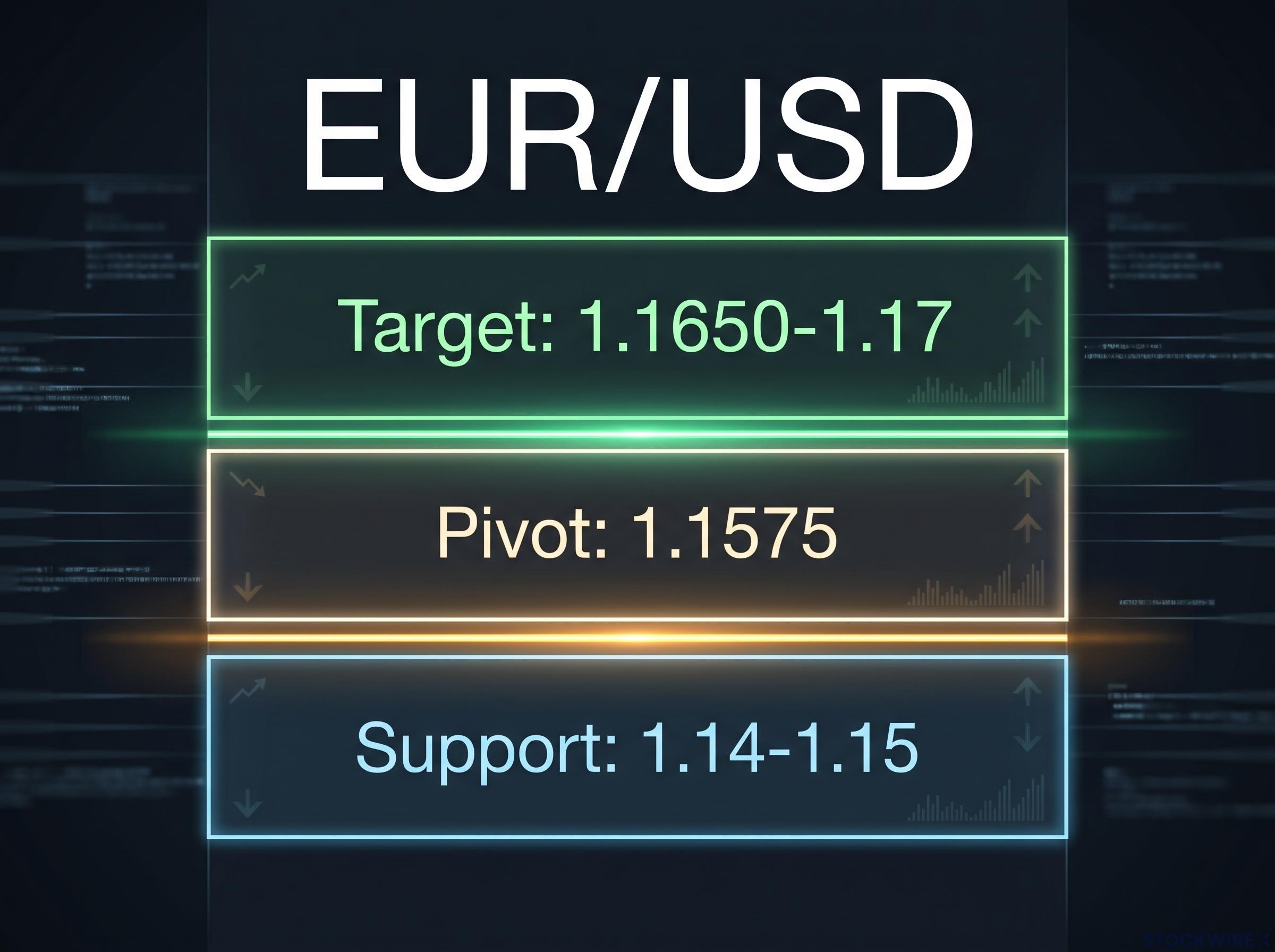
Before assessing event risk, the level map tells you where the trade opportunity sits. Three zones define the pair’s near-term structure, and each carries a different directional signal.
| Level | Description | Directional implication |
|---|---|---|
| 1.14-1.15 | Structural support zone on a closing basis | A sustained break below invalidates the bullish bias |
| 1.1575 | Near-term pivot, current area of trade | Bullish above; neutral-to-cautious on repeated failure |
| 1.1650-1.17 | Upside target on sustained daily closes above pivot | Opens on confirmed hold above 1.1575 |
The 1.1575 pivot is not just a price level to watch. It is a decision boundary. If you are above it, the macro narrative and rate pricing support your position. Repeated intraday rejections at that level, by contrast, are early warnings that the rally is stalling before the fundamental picture shifts.
Institutional EUR/USD targets ranging from 1.160-1.165 on a short-term fair-value basis to 1.20-1.22 on a 6-12 month horizon reflect ING’s view that a hawkish premium is embedded in the dollar that current rate differentials do not justify, a framing that contextualises the current advance as repricing toward fair value rather than speculative overshoot.
The directional strategy follows from the level map:
- Bias favours buying dips while the macro narrative (weakening US data, suppressed hike odds, stable Eurozone) remains intact
- Dip-buying is conditional on EUR/USD holding the 1.14-1.15 support zone on a closing basis
- Chasing spikes near the pivot carries asymmetric risk, since a dollar-weakness-driven rally is inherently more vulnerable to reversal than one backed by euro-specific strength
Three catalysts that can move EUR/USD before the week is out
The data have set the stage. Three events can resolve the directional question that remains open, and each one has a specific outcome split.
Lagarde on Wednesday: the euro-specific swing factor
ECB President Christine Lagarde’s Wednesday address is the highest-profile near-term catalyst. A hawkish tone, one emphasising sustained high rates or further tightening consideration, would add euro-specific support and improve the probability of the pair holding and extending above 1.1575. A dovish or growth-concerned tone reduces euro appeal and risks converting the current advance into a temporary spike rather than a sustained trend.
The remaining two catalysts carry directional weight of their own:
- Fed communication: This is the single highest-impact threat to the bullish thesis. The current advance rests on a repricing of hike expectations to 33.1%. Any hawkish pushback from Fed officials that stresses inflation persistence could rebuild that probability and drive EUR/USD back below 1.1575. Because the move is dollar-weakness-driven, this is the fastest path to reversal.
- Follow-up US data: Additional softness in spending or inflation prints reinforces the current narrative and keeps the dollar on the back foot. Upside surprises, however, could trigger dollar buying and pull the pair toward the 1.14-1.15 support zone.
Each catalyst has asymmetric potential impact this week: Lagarde and Fed communication can resolve the directional question that the data have left open. If you do not have a pre-formed view on each scenario before the headlines land, you are exposed to reactive positioning at the worst possible moment.
What it takes for this EUR/USD move to hold through the week
The bullish bias rests on three conditions. All three must remain intact:
- Fed hike probability stays suppressed: The 33.1% reading needs to hold or drift lower. Any hawkish commentary that rebuilds near-term hike expectations removes the mechanical driver of the dollar’s weakness.
- Lagarde avoids dovish signalling: A growth-worried tone on Wednesday would erode the euro’s floor and expose the rally as a single-driver trade with no support on the other side.
- No upside US data surprise: Follow-up releases that confirm a cooling consumer reinforce the thesis. A spending or inflation beat rebuilds dollar support and puts the 1.1575 pivot under pressure.
Buying dips above the 1.14-1.15 support zone is the approach the research supports, not chasing the pair toward resistance. The advance is dollar-weakness-driven and therefore more fragile than it appears on a spot chart alone.
If any of those three conditions breaks, the bullish bias weakens materially. Central-bank event weeks carry headline risk that can gap price through pre-set levels, and position sizing should reflect that reality. Having a conditional framework before the events land means you respond to each scenario rather than reacting to it, which is where most retail-level positioning errors occur.
This article is for informational purposes only and should not be considered financial advice. Investors should conduct their own research and consult with financial professionals before making investment decisions. Past performance does not guarantee future results. These forward-looking statements are speculative and subject to change based on market developments and central-bank communication.