Every member of the European Central Bank’s Governing Council saw inflation risks tilted the same way in September. Not one of them was willing to say where interest rates go next. The account of the 9-10 September 2026 meeting, published today (8 October 2026), puts that tension at the centre of any read on the ECB rate hike implications for investors.
The decision lifted the deposit facility rate from 2.25% to 2.50%. The account describes a council fully united on the direction of risk but deliberately silent on the route ahead.
That gap matters for anyone holding euro assets, European bonds or currency exposure. Positioning built on the wrong reading of it could prove costly.
Here is a clear way to judge whether September was a one-off adjustment or the opening of a longer restrictive period, and what each outcome could mean for the euro and euro-area markets.
What the account reveals: unanimity on risk, silence on direction
The consensus was as strong as central banking gets. Chief Economist Philip Lane proposed raising all three key ECB rates by 25 basis points (a basis point is one-hundredth of a percentage point), and the Governing Council backed him unanimously. The new rates are:
- Deposit facility rate: 2.50% (up from 2.25%)
- Main refinancing operations rate: 2.65%
- Marginal lending facility rate: 2.90%
- Effective date: 16 September 2026
The deposit facility rate anchors the ECB’s three-rate corridor, which is why the 25 basis point move lifts the main refinancing and marginal lending rates in lockstep and reprices overnight bank funding immediately.
The shared view behind the vote was equally firm. Every policymaker judged inflation risks as skewed to the upside, citing the Middle East conflict and Russia’s war against Ukraine as the main drivers. Members also flagged some downside risks to growth, while describing the transmission of monetary policy into the economy as working smoothly.
The account frames the move this way:
From the account: The decision was judged “robust across a wide range of scenarios” under the updated staff projections, alongside a commitment to stabilise inflation at the 2% medium-term target.
Yet the same document stresses that uncertainty remains very high. Policymakers considered it especially important not to offer forward guidance, meaning no public signal about the future path of rates.
Why no forward guidance matters
Without guidance, the ECB is showing its reaction function instead: the way it responds to data, decided meeting by meeting. Each inflation print, wage figure and growth release now carries more weight than it would under a pre-announced path.
The 2.50% deposit rate also sits within the range of estimated neutral rates, the level at which policy neither stimulates nor restrains the economy. Policy is restrictive, but not clearly beyond neutral.
Expectations have split. Markets had fully priced the September hike and were pricing about 84bp of cumulative hikes by end-2027, up from 64bp at the July meeting, while survey-based forecasts pointed to a plateau at 2.50%.
What this tells you is that the ECB has kept both further hikes and a pause open. Any investment view resting on a fixed rate path is standing on fragile ground.
When big ASX news breaks, our subscribers know first
What do the staff projections say about inflation and growth?
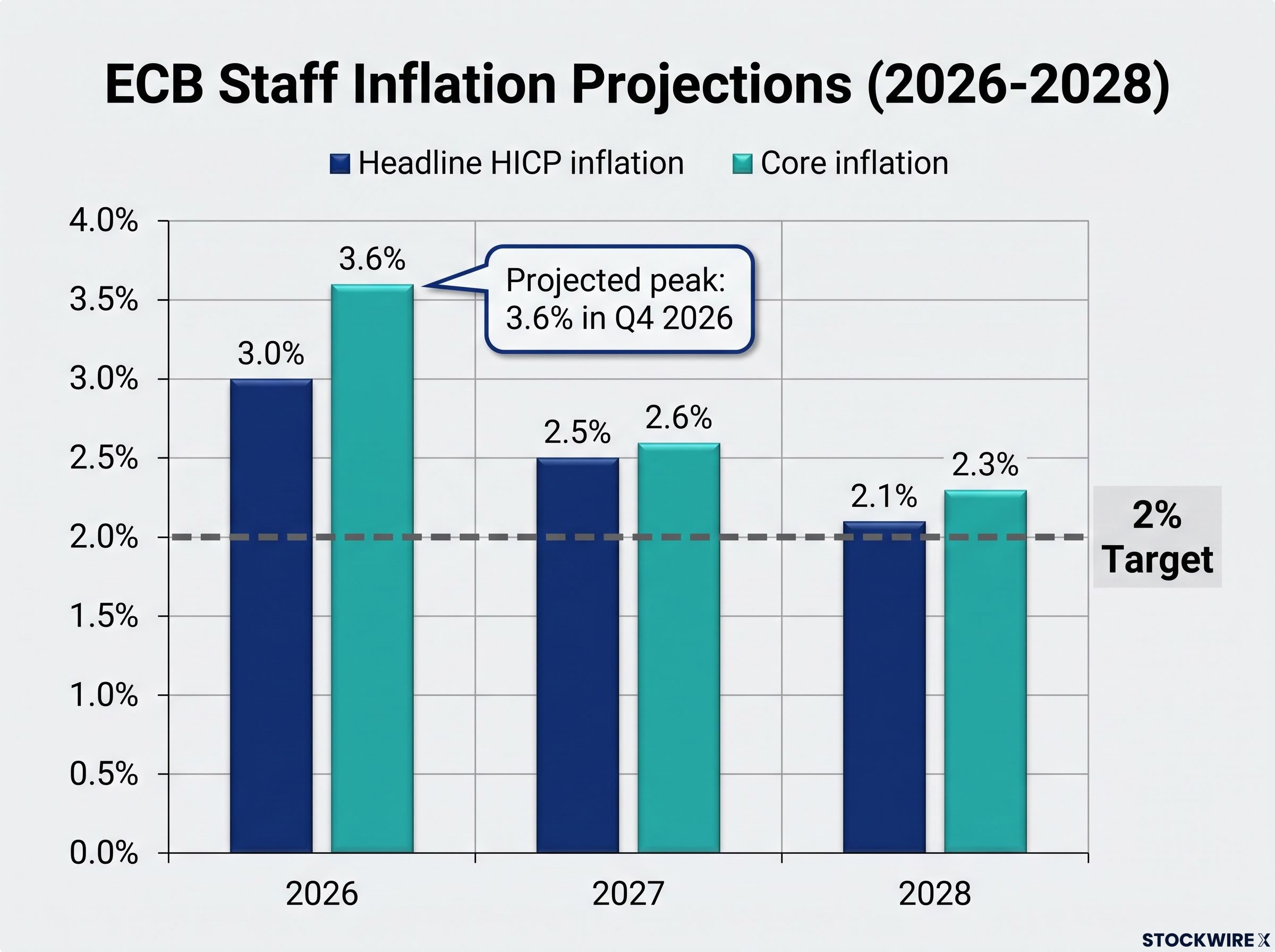
If the account explains the mood, the September staff projections supply the numbers that will judge every future decision. Read them line by line and a pattern emerges.
| Measure | 2026 | 2027 | 2028 |
|---|---|---|---|
| Headline HICP inflation | 3.0% | 2.5% | 2.1% |
| Core inflation (excl. energy and food) | 2.5% | 2.6% | 2.3% |
| Real GDP growth | 0.9% | 1.4% | Not available |
Headline inflation, measured by the Harmonised Index of Consumer Prices (HICP), jumps to 3.0% in 2026 from 2.1% in 2025, driven mainly by energy. It then falls steadily toward target.
Projected peak: Staff expect headline inflation to peak at 3.6% in Q4 2026. This is a forecast, not a realised figure.
Core inflation tells a different story. It rises from 2.5% to 2.6% in 2027 before easing to 2.3%, staying above target throughout even as the energy contribution fades.
Growth offers modest comfort. Real GDP projections of 0.9% for 2026 and 1.4% for 2027 were both revised up from June, though no 2028 figure is available.
President Christine Lagarde restated this baseline at her 28 September 2026 hearing before the European Parliament’s ECON Committee. Policy, she said, must stay sufficiently restrictive until inflation is clearly converging to 2%.
The upward forecast revisions for 2027 and 2028 matter because they push back the date on which the ECB can claim inflation is clearly converging, and a second round in December would strain the temporary-shock thesis.
The divergence is the point. With core running above 2% through 2027, the ECB sees little room to ease quickly, so if your positioning assumes near-term rate cuts, it is betting against the central bank’s own projections.
How do energy shocks become second-round inflation?
Most investors treat an oil spike as temporary. Prices jump, then fall back, and inflation follows them down. The ECB’s concern is what happens in between.
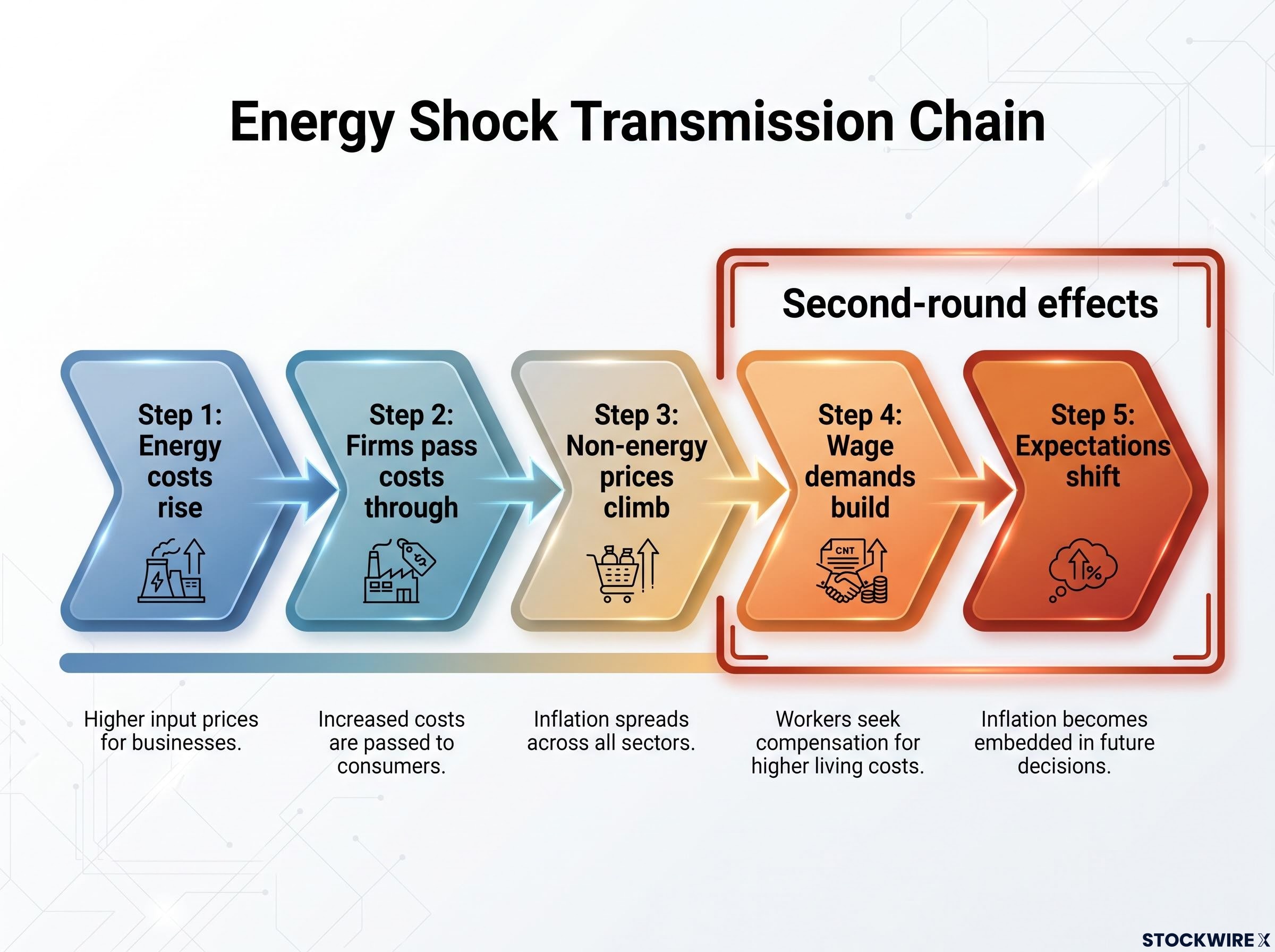
The research links rising oil, gas and electricity prices to the Middle East conflict, though no specific price levels are available. The transmission chain the ECB is watching runs like this:
- Energy costs rise, lifting the price of fuel, power and heating.
- Firms pass costs through, as higher production and transport expenses feed into what they charge.
- Non-energy prices climb, pushing up manufactured goods and services components of HICP.
- Wage demands build, as workers seek to restore real incomes eroded by earlier inflation shocks.
- Expectations shift, as households and firms start assuming higher inflation is normal.
Once the chain reaches steps four and five, inflation can outlive the shock that started it. These are second-round effects: price rises caused not by energy itself but by the reactions to it.
Members stressed continued watchfulness for these indirect effects on broader inflation and wages. The Council judged the risk of above-target inflation becoming entrenched as outweighing the downside risks from tighter financial conditions.
Why this episode differs from 2022-23
According to the ECB’s Economic Bulletin and projections, the 2022-23 energy shock was fading when this one arrived. That timing is what raises concern.
ECB staff describe the current shock as largely cyclical, driven by geopolitics. They warn, however, that repeated shocks can have more structural consequences by shaping inflation expectations and wage-setting norms, which risks requiring a longer restrictive period than earlier projections implied.
For you, the signal is clear. Wage settlements and core inflation matter more than oil headlines in judging whether the ECB hikes again.
Not every forecaster shares the ECB’s baseline, and the inflation forecast gap with Rabobank’s energy-revised models, which see inflation peaking near 4.4% in early 2027, suggests the hold-versus-hike debate may outlast 2026.
How do rates, QE and QT shape the euro and markets?
To connect the September hike to your portfolio, it helps to know how the ECB’s toolkit works. Its goal is price stability, defined as a symmetric 2% inflation target over the medium term, meaning it treats undershoots and overshoots as equally unwelcome.
Decisions sit with the Governing Council: six Executive Board members, including Lagarde, plus the governors of the 20 national central banks, meeting eight times a year. Its main signalling tool is the deposit facility rate, the interest banks earn on money parked with the ECB, which steers short-term borrowing costs.
Two balance-sheet tools work alongside rates. Quantitative easing (QE) is when the central bank creates money to buy government or corporate bonds, while quantitative tightening (QT) is when it stops buying and lets maturing bonds run off without reinvesting.
The ECB used QE during the 2009-11 financial crisis, through the Asset Purchase Programme (APP) in 2015, and via the Pandemic Emergency Purchase Programme (PEPP) during COVID-19. As inflation surged in 2021-23, it ended net purchases and let APP holdings run off.
| Tool | What it does | Typical euro effect | Typical yield effect |
|---|---|---|---|
| Policy rate hikes | Raise borrowing costs and tighten financial conditions | Supportive when they surprise or signal a tighter stance than peers | Push short-term rates higher |
| QE | Creates money to buy bonds | Tends to weaken the euro | Compresses yields and spreads |
| QT | Stops purchases and reinvestment, shrinking holdings | Can support the euro by signalling anti-inflation resolve | Lifts term premia and long-term yields |
These effects reflect established ECB practice; the research did not confirm specific 2025-26 balance-sheet details. No post-hike data on EUR/USD or bond yields is available either.
The key read for you: the September hike was fully priced, so the euro’s direction depends less on it than on whether later data forces the ECB to surprise markets or move differently from other central banks.
Three scenarios for the path from here
- Further hikes: Triggered by an upside inflation surprise, especially in core or wages. This could support the euro and lift yields, though tighter conditions could aggravate fragmentation risks (widening borrowing cost gaps) in more indebted member states.
- Plateau at 2.50%: Triggered by data broadly in line with projections. This matches survey expectations and could see markets trim some of the priced hikes.
- Easing if growth weakens: Triggered by a growth disappointment. This could weigh on the euro and compress yields.
These are conditional outcomes, not forecasts. These statements are speculative and subject to change based on market developments and policy decisions.
For readers wanting to trade these effects, our full explainer on ECB policy tools and the euro shows how futures curve pricing determines when a move surprises markets.
Reading the ECB’s next move without a map
The pieces fit together. A unanimous upside risk view, no forward guidance, a 2.50% rate inside the neutral range and core inflation above 2% through 2027 all point to a central bank that values flexibility over commitment.
The variables that will decide the next moves are core HICP and wage trends, energy prices tied to the Middle East conflict, growth data, and any sign of widening sovereign spreads. The coming Governing Council meetings will each turn on that evidence, not on a path set in advance.
Uncertainty, not direction, is the ECB’s real message. Your edge lies in watching the data it watches.
This article is for informational purposes only and should not be considered financial advice. Investors should conduct their own research and consult with financial professionals before making investment decisions. Past performance does not guarantee future results. Financial projections are subject to market conditions and various risk factors.