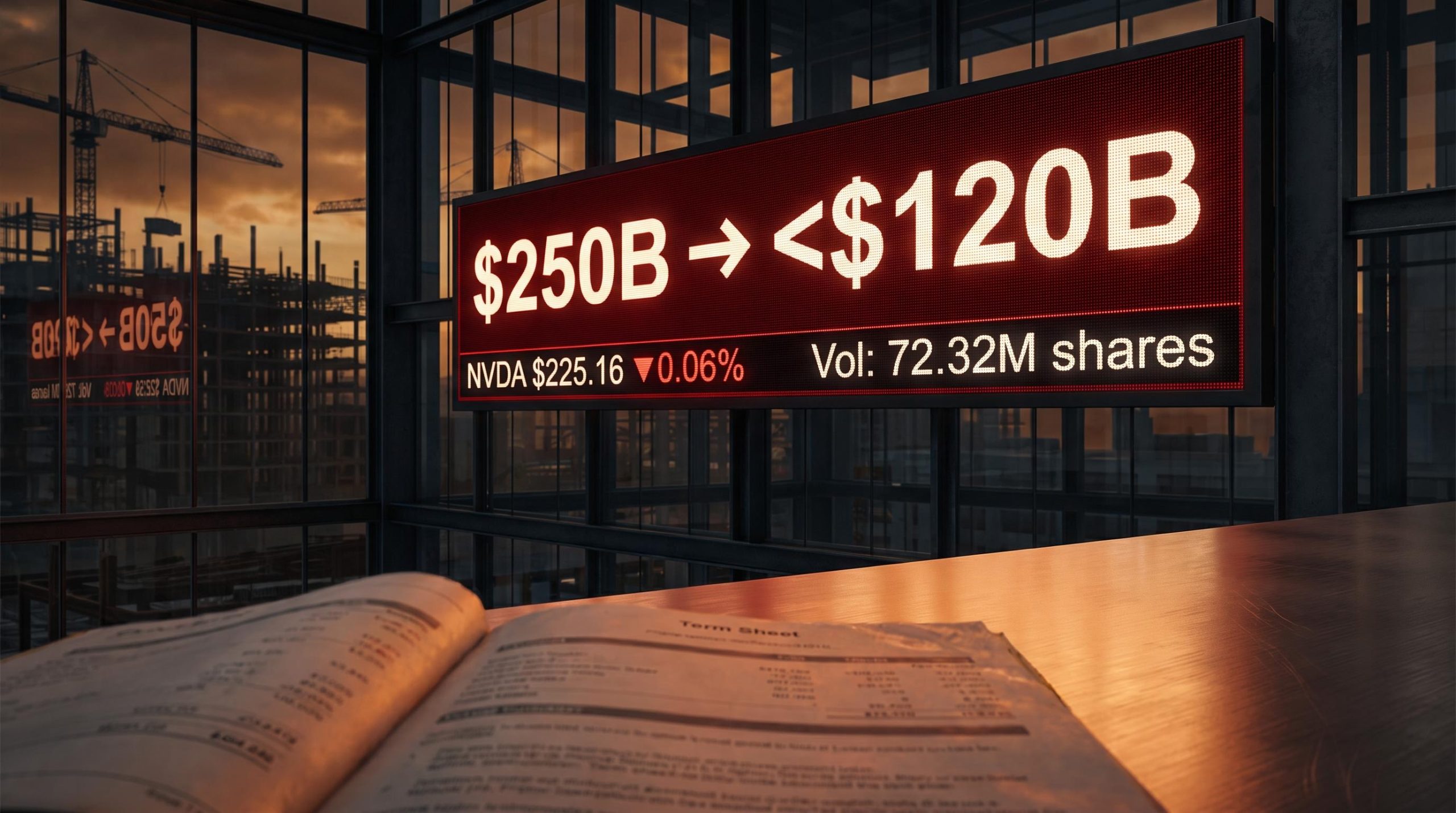
Nvidia has reportedly cut its financial guarantee for a massive OpenAI-linked data centre project from roughly $250 billion to less than $120 billion, a reduction of more than half. The stock barely moved.
The tension in this story is specific. Nvidia is not just a chipmaker here; it was being asked to function as a de facto project financier for one of the largest AI infrastructure builds ever proposed, a 10-gigawatt campus in Pike County, Ohio, valued at potentially more than $500 billion in total. The pullback is a response to investor unease about that role. The Wall Street Journal broke the story on 14 August 2026, citing individuals with knowledge of the matter. Negotiations remain ongoing, and Reuters could not independently confirm the arrangement.
The question for NVDA investors is whether this is a signal worth acting on, or a deal-structure adjustment that leaves the core investment thesis untouched. Here is what the numbers, the market reaction, and the pattern of Nvidia’s recent OpenAI commitments actually tell you.
What Nvidia actually agreed to change, and what stays the same
The original structure was enormous. Nvidia had reportedly agreed to backstop roughly $250 billion in financing tied to a massive AI computing campus being developed with SoftBank’s SB Energy unit. That guarantee covered lease obligations and construction-related debt for the Ohio project. It did not cover the cost of Nvidia’s own chips.
Under the revised terms, Nvidia now backstops only the first phase of the project, reducing total exposure to less than $120 billion. That first phase covers approximately 800 megawatts of capacity, expected to come online around 2028.
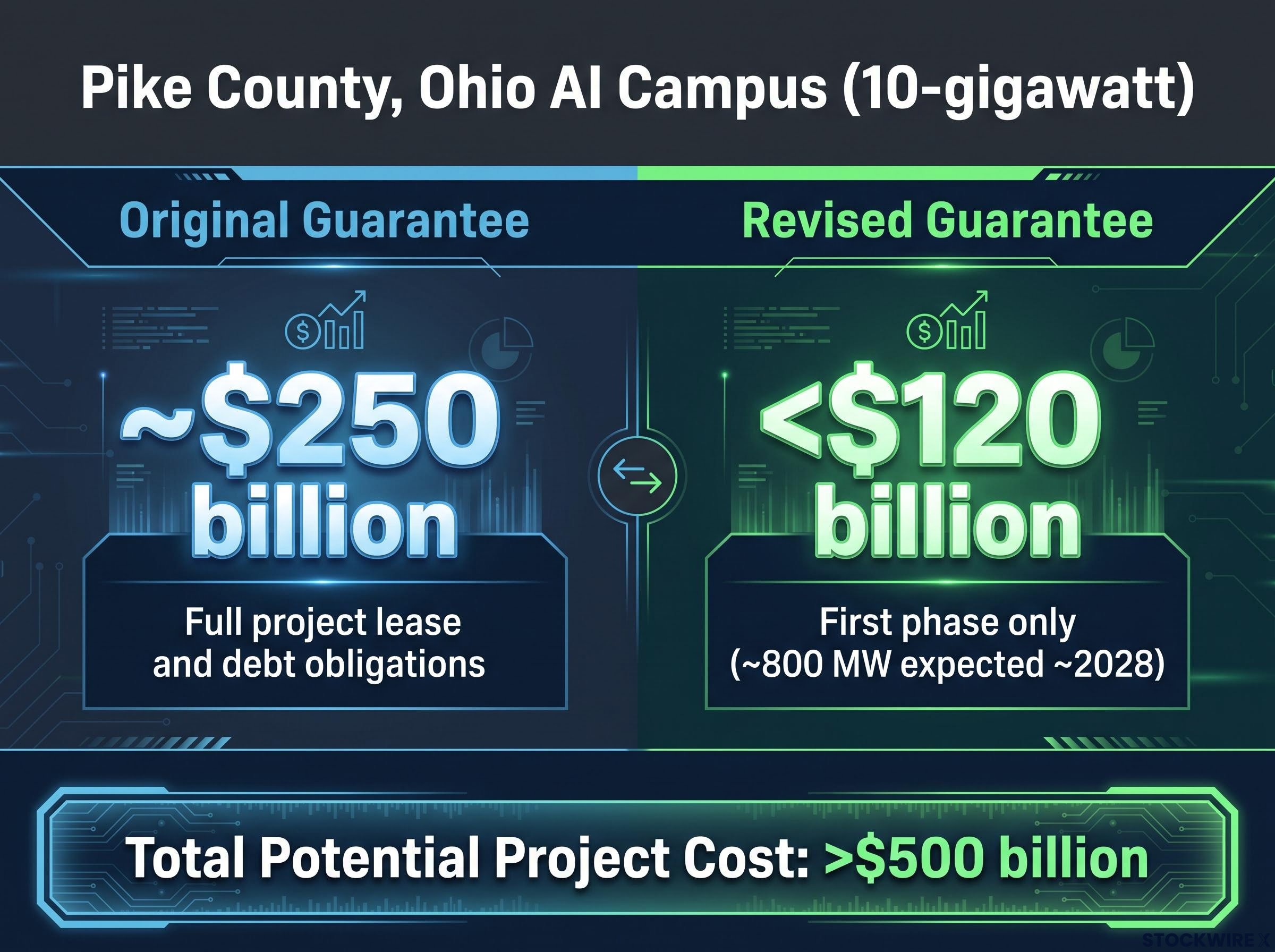
| Detail | Original structure | Revised structure |
|---|---|---|
| Guarantee amount | ~$250 billion | <$120 billion |
| Scope of coverage | Full project lease and debt obligations | First phase only |
| Phase coverage | All phases | ~800 MW first phase (expected ~2028) |
| Total project cost (incl. chips) | Potentially exceeds $500 billion | |
What stays the same
Nvidia remains a key enabler of the project. The broader relationship with OpenAI and SoftBank’s SB Energy unit is intact. The difference between $120 billion and $500 billion tells you that Nvidia is no longer trying to underwrite this build-out alone, and understanding that distinction is what separates a reasonable read of this news from a reflexive one.
When big ASX news breaks, our subscribers know first
Why Nvidia pulled back: reading the investor pressure signal
This is not a one-off moment of deal renegotiation. It is the second time in under a year that Nvidia has walked back an outsized financial commitment tied to OpenAI.
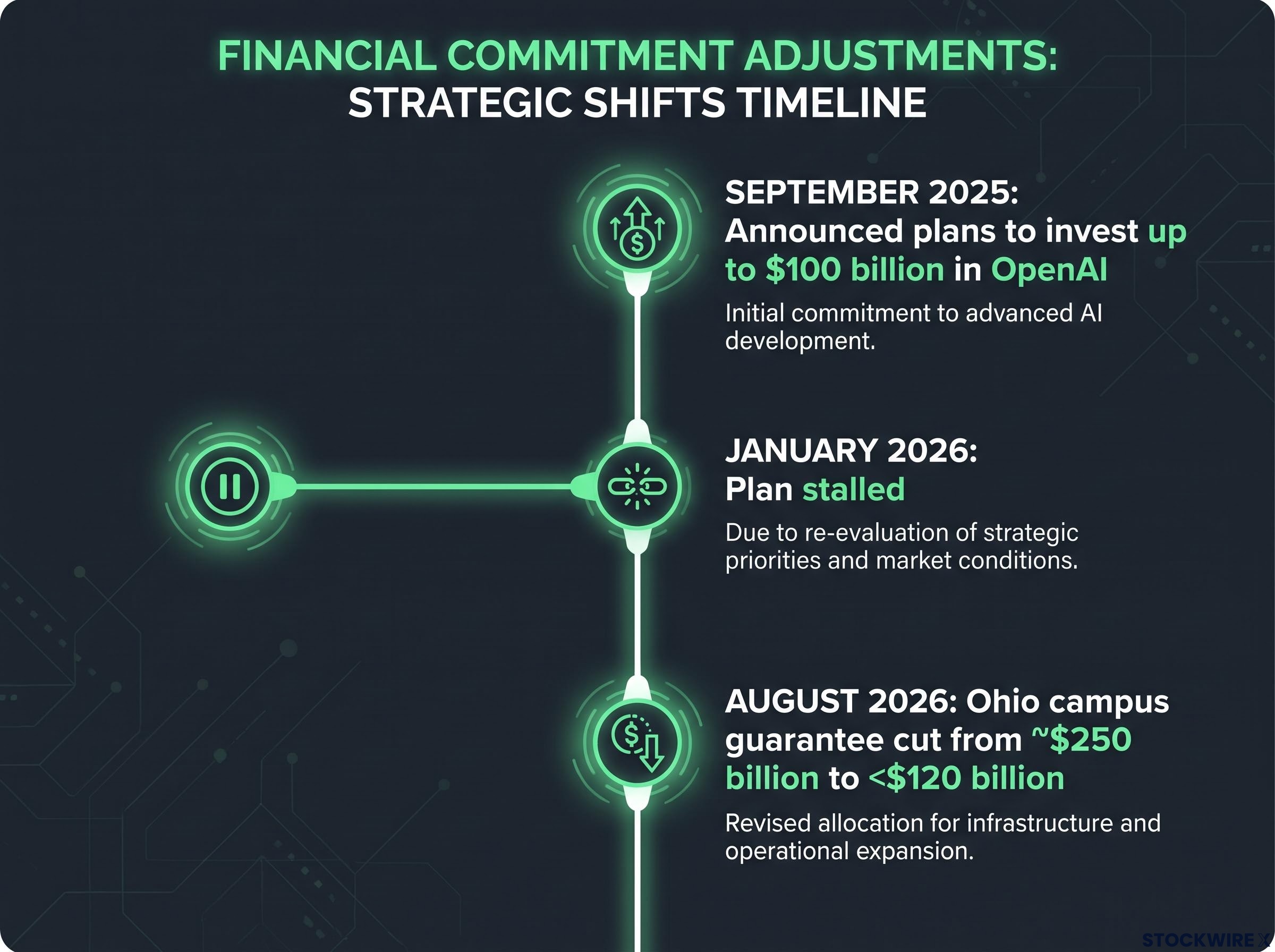
- September 2025: Nvidia announced plans to invest up to $100 billion in OpenAI for data centre expansion. By late January 2026, the plan had reportedly stalled after internal doubts about the scale and structure of the commitment.
- August 2026: Nvidia cut its guarantee for the Ohio campus from approximately $250 billion to less than $120 billion, limiting exposure to the first phase only.
The Wall Street Journal characterised the adjustment as driven by risk-management concerns, not a breakdown in the OpenAI or SoftBank relationship.
The pattern is clear. Nvidia is willing to support strategic customers, but with defined limits on credit, duration, and counterparty exposure. Large guarantees introduce risks that are fundamentally different from traditional chip sales: credit risk if the project underperforms, duration risk across a build-out spanning years, and counterparty risk tied to entities outside Nvidia’s control.
AI capital spending among major hyperscalers has been approaching or exceeding 90% of operating cash flow according to Vital Knowledge research, with Barclays models pointing to more than $200 billion in debt issuance required to close the structural funding gap between 2026 and 2028, a backdrop that makes Nvidia’s decision to reduce its guarantee exposure look less like retreat and more like prudent positioning.
Two large OpenAI commitments walked back in under a year is not coincidence. It is management signalling a preference to remain a supplier rather than a financier, and that posture matters for how you read future mega-deal announcements from this company.
How Nvidia’s balance sheet actually works in a deal like this
A financial guarantee, in this context, means Nvidia is not building the campus or lending money directly. It is backstopping lease and debt obligations so the project can secure third-party financing more easily. If the project’s operators cannot meet their obligations, Nvidia is on the hook.
That is a categorically different risk from Nvidia’s standard business model of selling GPUs and networking gear under purchase agreements. The deal works in three parts:
- Nvidia provides the guarantee backstop, giving lenders confidence that lease and construction-related debt will be repaid.
- Third-party financing is secured against that backstop, allowing the campus to be built without Nvidia funding construction directly.
- Nvidia sells chips separately as the campus is built out, generating hardware revenue that runs in parallel to (and is not dependent on) the guarantee structure.
The chip revenue and the guarantee are structurally separate. Once you understand that distinction, you can stop conflating a reduction in guarantee exposure with a reduction in Nvidia’s AI revenue opportunity. The Ohio campus still needs Nvidia hardware. The demand thesis runs alongside the balance-sheet risk, not through it.
What the market’s non-reaction actually tells investors
NVDA closed at $225.16 on 14 August 2026, down approximately $0.14, or 0.06%. In after-hours trading, shares dipped an additional $0.44 (roughly 0.19%) to $224.72.
NVDA on 14 August 2026: Closed at $225.16 (down 0.06%). After-hours: $224.72 (down a further 0.19%). Trading volume: approximately 72.32 million shares.
That volume figure matters. NVDA was among the most actively traded equities on the day. When you see high volume paired with near-flat price action, the signal is specific:
- The news was widely absorbed and actively traded, not ignored.
- Sellers and buyers reached near-equilibrium, meaning the market judged the development as neutral to mildly positive.
- Earlier expectations of some moderation in Nvidia’s OpenAI terms had already been circulating, partly explaining why the announcement did not produce a sharper move.
When a stock with Nvidia’s profile trades 72 million shares and barely moves on news this large, the market is telling you the guarantee cut was expected, welcomed, or both. That signal deserves more weight than the headline number.
High-volume, near-flat price action has become a recurring pattern in how markets process Nvidia news: when Nvidia reported record Q1 FY2027 revenue of $81.6 billion and issued a $91 billion Q2 guide that cleared consensus by more than $4 billion, shares also slipped after hours, illustrating how elevated expectations consistently compress the incremental move even exceptional results can generate.
What to watch before drawing conclusions on AI infrastructure risk
Several things remain genuinely uncertain. The guarantee terms have not been formally signed as of mid-August 2026. Reuters could not independently confirm the arrangement. And it is unclear how the remaining risk above Nvidia’s approximately $120 billion backstop will be distributed among SoftBank, other lenders, or equity investors.
The broader implication matters too. If Nvidia, the company most directly positioned to benefit from AI infrastructure, is now defining clear limits on how much project-finance risk it will absorb, other infrastructure players may face pressure to do the same. That would affect how future AI campuses are structured and financed across the sector.
Specific watch items worth tracking:
- Final signed terms of the Ohio data centre financing and how the remaining risk is allocated.
- New mega-deal announcements from Nvidia or competitors and whether their risk allocation structures follow the same pattern.
- Commentary from credit-rating agencies or regulators on the scale of AI sector guarantees.
- Whether other major AI infrastructure players begin tightening their own financing commitments.
The most important question this story leaves open is not what Nvidia did, but whether the broader AI infrastructure financing model can sustain its current pace if major suppliers continue pulling back from de facto financing roles. That is the question worth carrying into future earnings calls and deal announcements.
“This article is for informational purposes only and should not be considered financial advice. Investors should conduct their own research and consult with financial professionals before making investment decisions. These statements are speculative and subject to change based on market developments and company performance.”
Nvidia as supplier versus Nvidia as financier: where the investment thesis stands
The guarantee reduction does not impair Nvidia’s role as the dominant supplier of AI accelerators and networking for hyperscale and frontier AI workloads. The Ohio campus still moves forward, still requires Nvidia chips, and still represents a long runway of hardware demand.
Hyperscaler capex commitments totalling approximately $725 billion in 2026 alone provide the demand baseline that makes the Ohio campus commercially viable regardless of how its financing is structured, with Amazon, Microsoft, Alphabet, and Meta all operating under board-approved spending plans that represent confirmed order pipelines for Nvidia hardware.
What this episode shows is management acting in shareholders’ interests: responsive to investor concerns about balance-sheet exposure, willing to renegotiate terms, and focused on keeping Nvidia in its highest-value role.
Key takeaways for NVDA investors:
- The guarantee reduction is a balance-sheet risk reduction, not an earnings or demand signal.
- High-volume, near-flat price action on 14 August 2026 reinforces a neutral-to-positive market read.
- Two pullbacks from large OpenAI commitments in under a year signal management discipline, not deteriorating demand.
- The longer-term risk to monitor is whether AI infrastructure growth can sustain its capital-expenditure trajectory without overleveraging balance sheets across the ecosystem.
For NVDA investors, the honest takeaway is that management just proved it will protect the balance sheet when pushed. That is a quality worth tracking, not a reason for alarm.
For investors wanting to understand how the broader financing risk reshapes relative positioning across the AI ecosystem, our full explainer on Goldman’s AI infrastructure thesis examines why the bank shifted its preference toward neocloud operators and utilities, where 15-20-year lease contracts provide contract-backed revenue that chip suppliers cannot match.