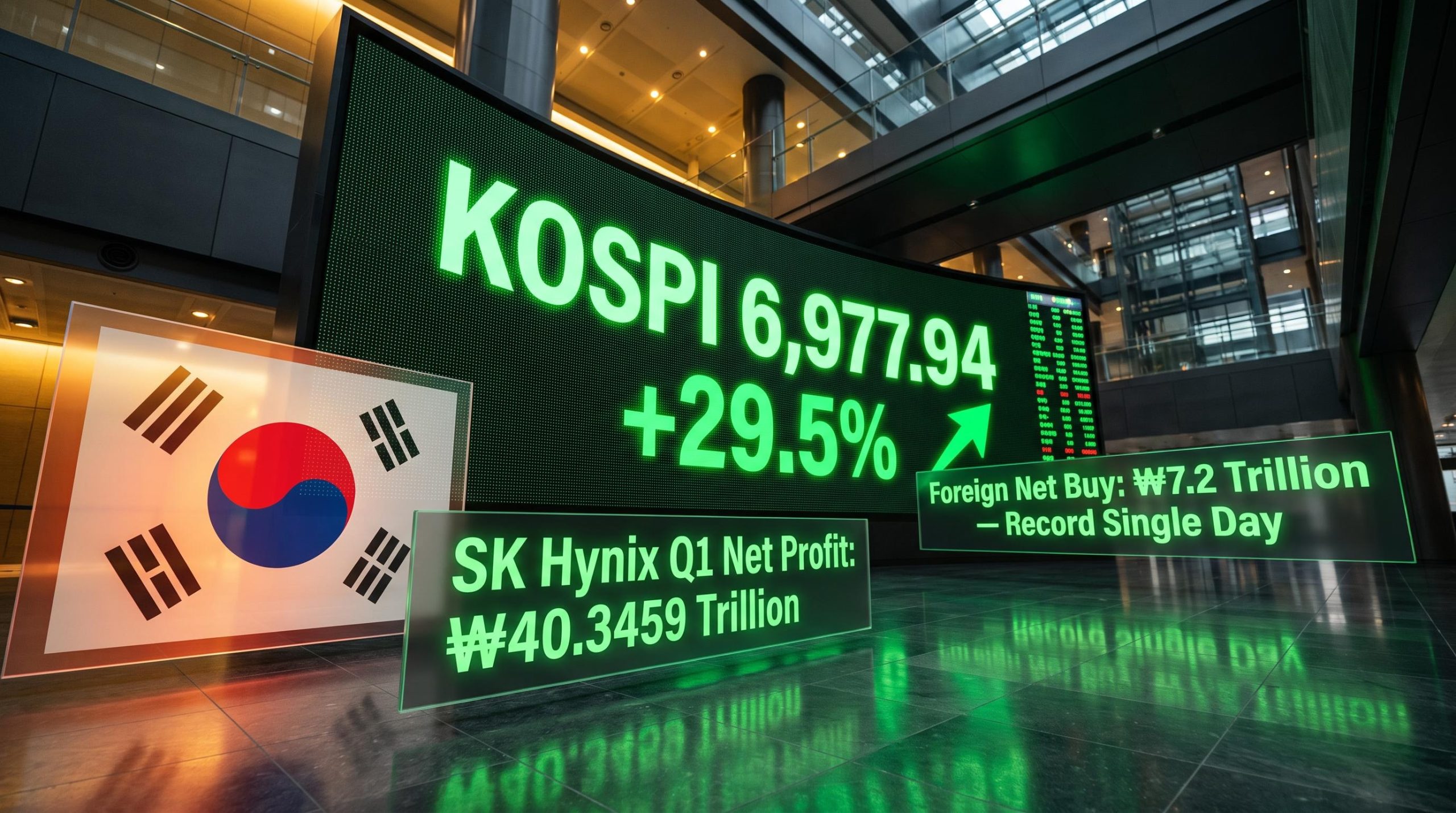
South Korea’s Kospi has risen 29.5% from its late-July trough, crossed the conventional bull market threshold in under two weeks, and recorded the largest single-day foreign equity purchase in the market’s history. All of it was driven by a single sector.
That matters beyond Seoul. Samsung Electronics and SK hynix sit at the heart of global AI infrastructure spending, and their earnings function as a real-time read on memory chip pricing, data-centre capital expenditure, and the durability of the AI demand cycle. Whether you hold Korean equities directly or simply have exposure to global technology, the signal from this rebound carries weight.
Here is what the numbers behind this rally actually tell you, and which variables will determine whether it holds.
From freefall to bull market in a fortnight: how far and how fast the Kospi moved
The Kospi fell from 8,476 to 7,247 in just over a week during early-to-mid July, a decline of approximately 14.5%, as foreign investors sold aggressively. What followed was one of the sharpest reversals in the index’s history.
On 31 July, the Kospi surged 17.9% in a single session. After pulling back more than 5% in early August, the index resumed its advance with consecutive daily gains of 3.68%, 3.56%, and 2.42% on 12-14 August. By 13 August, the cumulative recovery had reached approximately 22%, crossing the conventional 20% threshold for a bull market. Measured against the 30 July trough, the closing level of 6,977.94 on 14 August represented a cumulative gain of 29.5%.
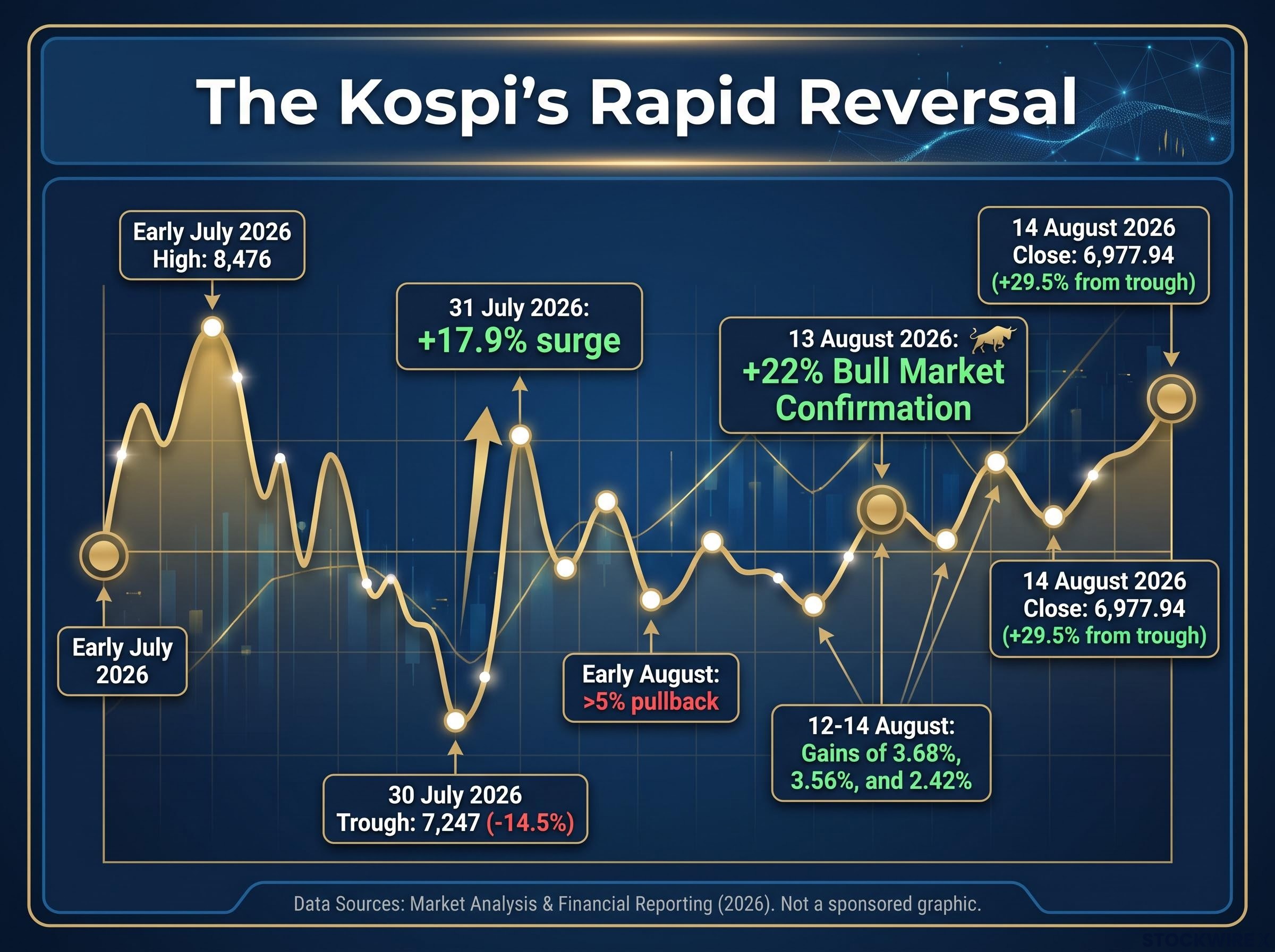
This was not a single-session spike that faded. The pattern of consolidation followed by resumed advance tells you the move was driven by a specific catalyst arriving at a moment of extreme oversold positioning, not a random mean-reversion bounce.
| Milestone | Date | Kospi level | Change |
|---|---|---|---|
| Pre-decline high | Early July 2026 | 8,476 | — |
| Trough | 30 July 2026 | 7,247 | -14.5% |
| Bull market confirmation | 13 August 2026 | ~22% above trough | +22% |
| Latest close | 14 August 2026 | 6,977.94 | +29.5% from trough |
When big ASX news breaks, our subscribers know first
Why semiconductor earnings hold the Kospi’s fate in their hands
The Kospi’s composition explains why a single sector can pull the entire index in either direction. Samsung Electronics and SK hynix command an outsized share of the benchmark’s total market capitalisation, and their combined weight means that when memory chip sentiment shifts, the headline index shifts with it.
That structural fact is what made SK hynix’s Q1 2026 results so consequential. The company reported record quarterly revenue of 52.5763 trillion won and record net profit of 40.3459 trillion won, both driven by AI-related chip demand.
SK hynix Q1 2026 net profit: 40.3459 trillion won, a record quarter fuelled by sustained AI chip demand.
The results did not merely beat expectations. They confirmed that the demand cycle underpinning memory chip pricing is durable rather than speculative, and that confirmation changed the investment calculus for institutional allocators who had been waiting for hard evidence before re-entering.
SK hynix’s market position has strengthened considerably in 2026: the company displaced Samsung as South Korea’s most valuable listed company on 22 June 2026, holding an estimated 70% of the global HBM market and serving as NVIDIA’s primary HBM3E supplier, which gives it a binding-constraint role in the AI accelerator supply chain.
Three structural reasons explain why the chip sector dominates Kospi performance:
- Market-cap weighting: Samsung and SK hynix together account for a disproportionate share of index weight, so their share prices mechanically drive headline moves.
- Export revenue concentration: South Korea’s economy is heavily leveraged to semiconductor exports, linking national economic data to chip pricing cycles.
- Global technology demand linkage: Memory chips feed data centres, smartphones, and AI training infrastructure worldwide, making Korean chipmakers a proxy for global tech spending.
For anyone holding Korean equity exposure, this concentration is both the engine and the vulnerability. A single chipmaker earnings beat can lift the entire index; a single disappointment can do the opposite just as quickly.
The record foreign buying event that confirmed the turn
31 July: foreign investors recorded net purchases of approximately 7.2 trillion won in Kospi stocks, the largest single-day net buying on record.
That figure matters because of what preceded it. Foreign investors were net sellers throughout early-to-mid July and were the primary force behind the index’s 14.5% decline. The reversal from aggressive selling to record buying in a matter of days was not a gradual shift in sentiment; it was a decisive institutional re-engagement.
In the weeks following 30 July, foreign investors built cumulative net positions of roughly $1.9 billion across South Korean equities. Monthly net selling in July narrowed significantly compared with May and June, underscoring the speed at which the flow picture changed.
- Before 31 July: foreigners were net sellers, driving the Kospi’s steepest weekly decline and pushing the index to its trough.
- From 31 July onward: record single-day buying followed by cumulative net purchases of approximately $1.9 billion, with associated currency conversions providing a secondary tailwind to the Korean Won.
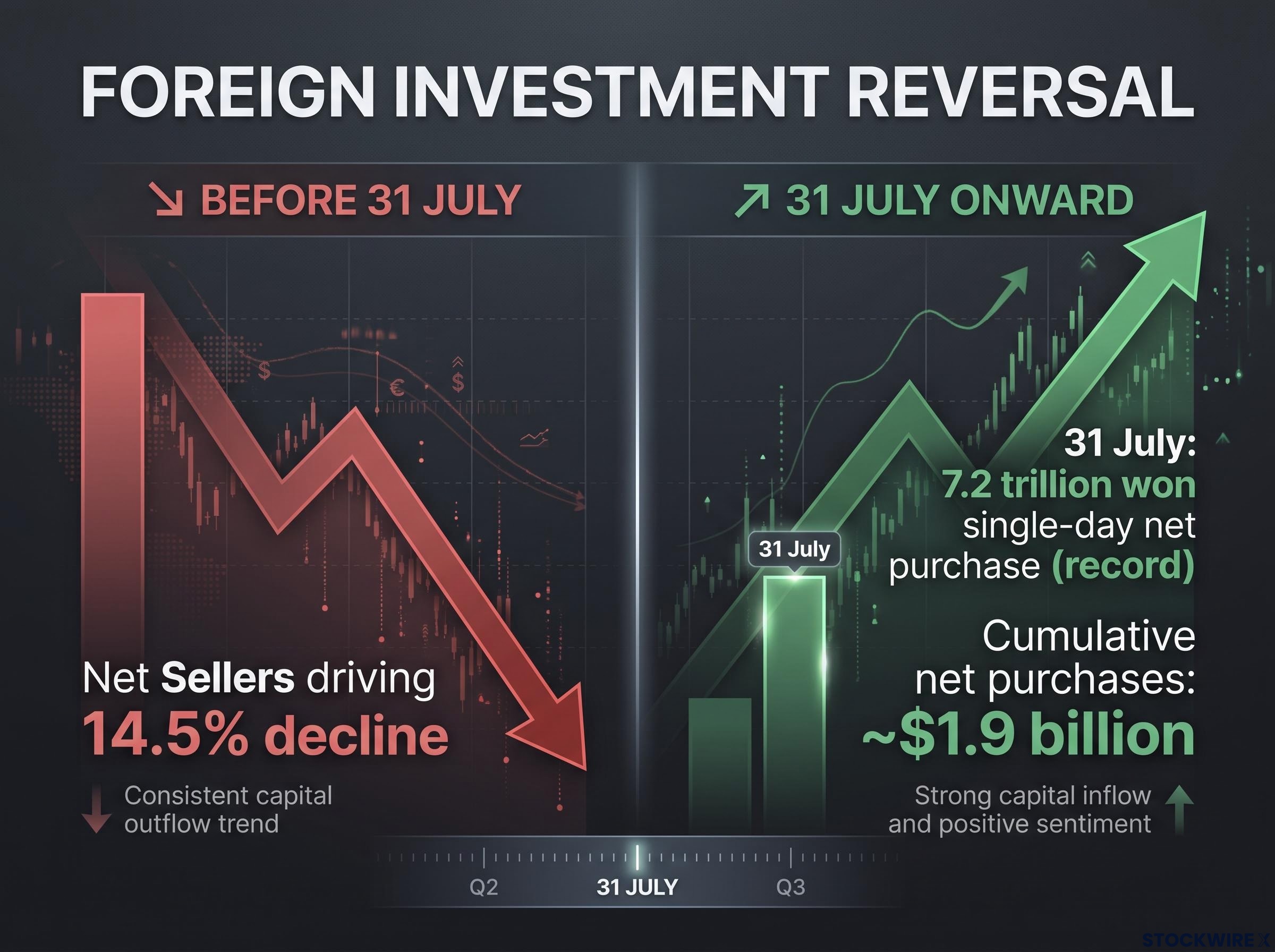
A record single-day foreign purchase tells you the turn was not driven by local retail sentiment. It was institutional portfolio managers making an active, size-able allocation decision, and historically that type of flow carries more signal value about trend durability than retail-driven moves.
Global capital flows in 2026 have sorted dramatically around AI supply chain positioning, with South Korea and Taiwan identified as the primary emerging market beneficiaries while European equity segments face structural headwinds, a pattern that explains why institutional allocators moved decisively into Korean equities rather than redistributing the capital across other markets.
What the global AI and memory demand cycle is signalling
What SK hynix results say about AI chip demand
SK hynix’s record quarter is not just a company-specific story. It is a data point about where the AI infrastructure spending cycle sits right now. The revenue and profit figures reflect sustained demand for high-bandwidth memory chips used in AI model training and inference, which means data-centre operators are continuing to invest at scale rather than pulling back.
That read-through matters for equity investors, bond markets, and supply chain participants well beyond Korea. If memory pricing and order books remain firm, it confirms that the AI capital expenditure cycle has not peaked, a signal with direct implications for how you position across global technology equities.
Regional supply chain implications
When Korean memory demand is strong, the benefits ripple outward across Asia’s technology supply chain. The categories of participants with the most direct exposure include:
Hyperscaler capital expenditure data reinforces this read-through: the AI processor segment’s year-over-year growth rate has accelerated for three consecutive quarters, reaching a guided 67% in Q2 2026, with Nvidia posting 85% revenue growth and combined hyperscaler spending on AI infrastructure running at a pace that shows no sign of plateauing.
- Logic chip manufacturers that supply processors paired with high-bandwidth memory in AI server configurations.
- Advanced packaging specialists whose capacity utilisation rises alongside memory production volumes.
- Semiconductor equipment suppliers that benefit from sustained capital expenditure commitments by Samsung and SK hynix.
- Component and substrate producers across Japan, Taiwan, and Southeast Asia whose order books correlate with Korean chipmaker output.
The Kospi’s recovery, if sustained, supports a constructive read-through to these adjacent supply chains and to broader Asian technology equities. For anyone with emerging market or global tech allocations, Korean semiconductor earnings have become a leading indicator worth monitoring each quarter.
Volatility as the gating factor for continued foreign participation
The 17.9% single-day surge on 31 July was spectacular, but it also illustrated a problem.
A 17.9% move in a single session puts a market outside the risk parameters of most institutional mandates.
Many systematic funds, risk-parity allocators, and sovereign wealth mandates operate under volatility constraints that would have prevented participation during the Kospi’s most extreme swings. The initial buyers who returned on 31 July were high-risk-tolerance participants, not the broader institutional base that sustains a rally over months.
As daily moves compressed from the 17.9% extreme through the early-August pullback and into the 2-4% range by mid-August, the index’s risk-adjusted profile improved materially. That compression is what widened the participation base beyond fast-money buyers.
Three conditions need to hold for continued foreign accumulation:
- Volatility remains contained. Daily swings staying in a normalised range keeps the index accessible to risk-constrained mandates.
- Chipmaker earnings stay above consensus. The sector concentration means a single miss can reverse sentiment sharply.
- The macro environment does not introduce fresh trade or geopolitical headwinds that would trigger another round of foreign selling.
The widening participation base is structurally positive for sustainability, but it also means the fastest-moving phase of the recovery is likely behind. Investors assessing entry now are weighing a more stable environment against a narrower return window.
Investors assessing whether SK hynix’s record quarter marks a cyclical peak or the middle of a structural repricing will find our full explainer on the memory chip price forecast through 2028, which covers the S&P Global Ratings confirmation of durable pricing, the HBM capacity constraints, and how the repricing is flowing through to consumer hardware OEM margins.
What this rally changes, and what it does not
Three things are genuinely different after this fortnight. The Kospi has confirmed a bull market entry with a 29.5% recovery from its trough. Foreign investors have recorded the largest single-day net purchase in the market’s history and have collectively deployed roughly $1.9 billion into South Korean equities in the period since 30 July. And SK hynix’s record Q1 2026 results have validated the AI memory demand thesis with hard earnings data rather than forward guidance alone.
What has not changed is the structural concentration that made all of this possible. The same sector weighting that powered the rebound creates asymmetric downside if semiconductors disappoint or foreign flows reverse. A single negative earnings surprise from Samsung or SK hynix could undo weeks of gains in a matter of sessions.
| Variable | Bullish signal | Risk signal |
|---|---|---|
| Chipmaker earnings | Continued beats on AI memory demand | Any miss or margin compression |
| Foreign flows | Sustained net buying above trend | Renewed net selling or flow reversal |
| Volatility | Daily moves stay in 1-3% range | Return to extreme single-session swings |
The case for the Kospi is real but narrow. It is a bet on AI chip demand staying firm, foreign allocators staying constructive, and volatility staying contained. Any one of those pillars weakening would change the picture materially, and that framework is what separates informed positioning from headline-chasing.
This article is for informational purposes only and should not be considered financial advice. Investors should conduct their own research and consult with financial professionals before making investment decisions. Past performance does not guarantee future results.
—