
Most investors assume exchange rates are set by markets. For the Chinese yuan, the most consequential number each day is published before a single trade clears. At approximately 9:15 a.m. Beijing time, a figure appears on the China Foreign Exchange Trade System (CFETS) screen that determines where the onshore yuan can move for the rest of the session. It is not produced by a trading floor. It is produced by a process the People’s Bank of China (PBOC) controls.
That number is carrying more weight than usual right now. China’s Q2 2026 GDP disappointed, property investment remains deeply negative, and markets are pricing monetary easing. In this environment, the PBOC’s daily fix is not background infrastructure; it is a live policy signal that currency desks across Asia are reading for clues about Beijing’s priorities.
Here is what the fixing mechanism actually is, how the PBOC uses it to steer the yuan, what the current economic data mean for that steering, and how you can interpret the fix yourself as a real-time readout of policy intent.
What the PBOC publishes every morning and why it matters
Every business day, CFETS publishes a central parity rate for USD/CNY before onshore trading opens. That rate is not decorative. Once it appears, the onshore spot rate for USD/CNY can only move within a band of plus or minus 2% around it for the rest of the session. The fix defines the corridor before a single trade clears.
The key structural facts:
- Publication time: approximately 9:15 a.m. Beijing time each business day
- Trading band: ±2%, in place since 2015 when it was widened from ±1%
- Basket references: the formula incorporates the yuan’s performance against three currency baskets: the CFETS basket, the Bank for International Settlements (BIS) basket, and the Special Drawing Rights (SDR) basket
- Current levels: recent fixings near 6.79; onshore spot trading in the 6.74-6.79 range
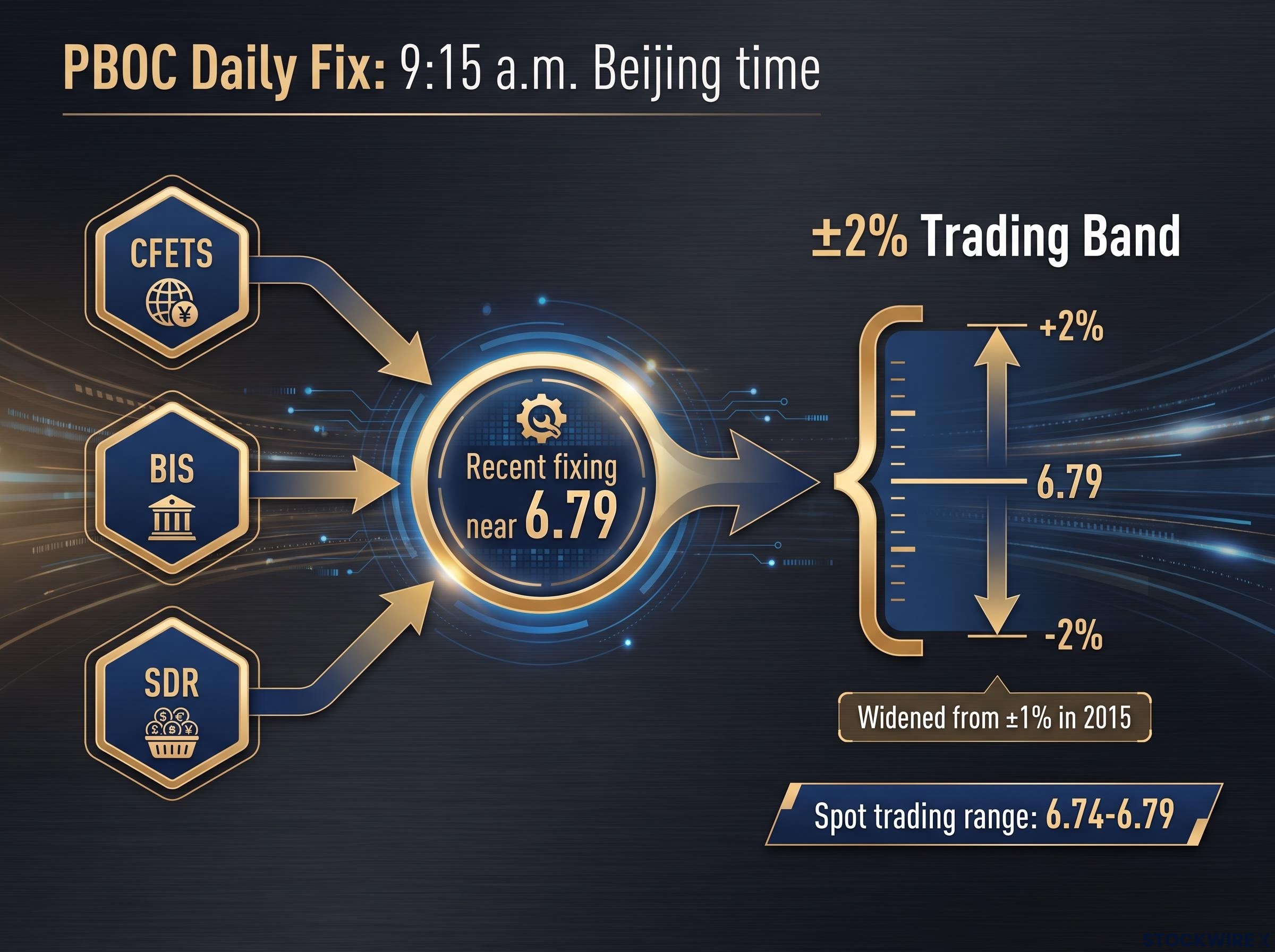
No matter how strong the market pressure to push the yuan in either direction, the PBOC’s morning number sets a hard ceiling on how far that pressure can travel in a single session. That is why traders treat the fix as a daily policy statement rather than a background reference.
How the central parity rate is actually calculated
CFETS collects USD/CNY price quotes from designated market-making banks before each session. Those banks base their submissions on three inputs: the prior day’s onshore close, current supply and demand conditions, and moves in major global currencies.
After collecting the quotes, CFETS trims the extremes, excluding the highest and lowest submissions. A weighted average of the remaining prices produces that day’s central parity rate. The formula explicitly incorporates the yuan’s performance against the CFETS, BIS, and SDR currency baskets, giving the trade-weighted level a formal role in the calculation rather than relying solely on bilateral USD/CNY dynamics.
The CFETS central parity rate formation mechanism, published directly by the authorised trading system under PBOC oversight, confirms that market-maker price enquiries are trimmed of extremes before a weighted average produces each day’s official rate, giving the process a formal procedural structure even as the countercyclical layer remains opaque.
When big ASX news breaks, our subscribers know first
The countercyclical factor: the PBOC’s hidden hand in the formula
There is a layer of the fix that you cannot observe directly. The PBOC can apply what is known as a countercyclical adjustment factor, an embedded modification to the formula that allows the central bank to publish a fix that is stronger or weaker than the market inputs alone would produce.
The adjustment is not separately disclosed. There is no daily announcement saying the PBOC has applied the factor, or by how much. Instead, market participants infer its presence by comparing the published fix to what their own basket-based models calculate the fix should be. When the published number consistently comes in stronger than the model implies, the inference is that the PBOC is actively supporting a firmer yuan. When it consistently comes in weaker, the inference runs in the opposite direction.
The gap between what the formula should produce and what the PBOC actually publishes is the closest available real-time readout of how Beijing is balancing currency stability against other policy priorities, without any official announcement required.
That gap transforms the fix from a mechanical calculation into an active policy instrument. It is the layer that professional FX desks monitor every morning for directional signals, and it has remained an active tool in the fixing formula as of mid-2026.
Why the fix is a policy lever, not just a reference rate
The mechanics established in the prior sections lead to a straightforward conclusion: the PBOC uses the fix directionally, which makes this a managed currency tool rather than a market-reflective one.
The renminbi reserve share remains under 2% of global official holdings despite years of internationalisation effort, a structural ceiling that limits how much the PBOC can rely on capital-account liberalisation to support the yuan and explains why the daily fixing mechanism remains the primary tool for managing the currency’s direction.
The directional logic works like this. A lower USD/CNY fix (meaning a stronger yuan) shifts the entire trading band toward appreciation and signals comfort with a firmer currency. A higher fix (meaning a weaker yuan) does the opposite.
| Fixing direction | Policy signal |
|---|---|
| Stronger than model (lower USD/CNY) | Active support for a firm yuan; priority on stability, capital attraction, and currency credibility |
| Weaker than model (higher USD/CNY) | Tolerance for depreciation; shift toward growth support and export competitiveness |
In recent months, the PBOC has consistently published USD/CNY fixings at levels that push the pair lower, producing a yuan that trades firmer than spot market dynamics alone would imply. Recent fixings near 6.79 with spot trading in the 6.74-6.79 range confirm active management of that spread.
But this tool has limits. Maintaining a significantly stronger yuan when growth is weak compresses exporter margins, tightens financial conditions relative to peers, and risks the fix’s credibility if market pressure consistently runs against it. That constraint is the key insight: July economic data are not just growth figures for you to interpret. They are inputs into the PBOC’s own calculation about how long it can sustain its current fixing stance, which means they have direct implications for where the yuan goes next.
China’s economic backdrop in mid-2026 and the pressure it creates
The data tell a consistent story across multiple reporting periods. This is not a single disappointing print; it is a structural pattern.
China’s structural divergence in 2026 runs deeper than any single data series captures: semiconductor exports surging over 70% year-on-year coexist with property investment in sustained contraction and consumer spending turning negative for the first time since pandemic restrictions ended, a K-shaped split that has persisted for six consecutive years.
- H1 2026: fixed-asset investment minus 5.7% year-on-year; property investment minus 18% year-on-year
- June 2026: fixed-asset investment minus 0.37% month-on-month, following minus 1.25% in May
- Early 2026: real estate development investment minus 11.1% year-on-year
- Markets pricing probability of near-term Loan Prime Rate (LPR) and required reserve ratio (RRR) cuts as July data reinforce growth concerns
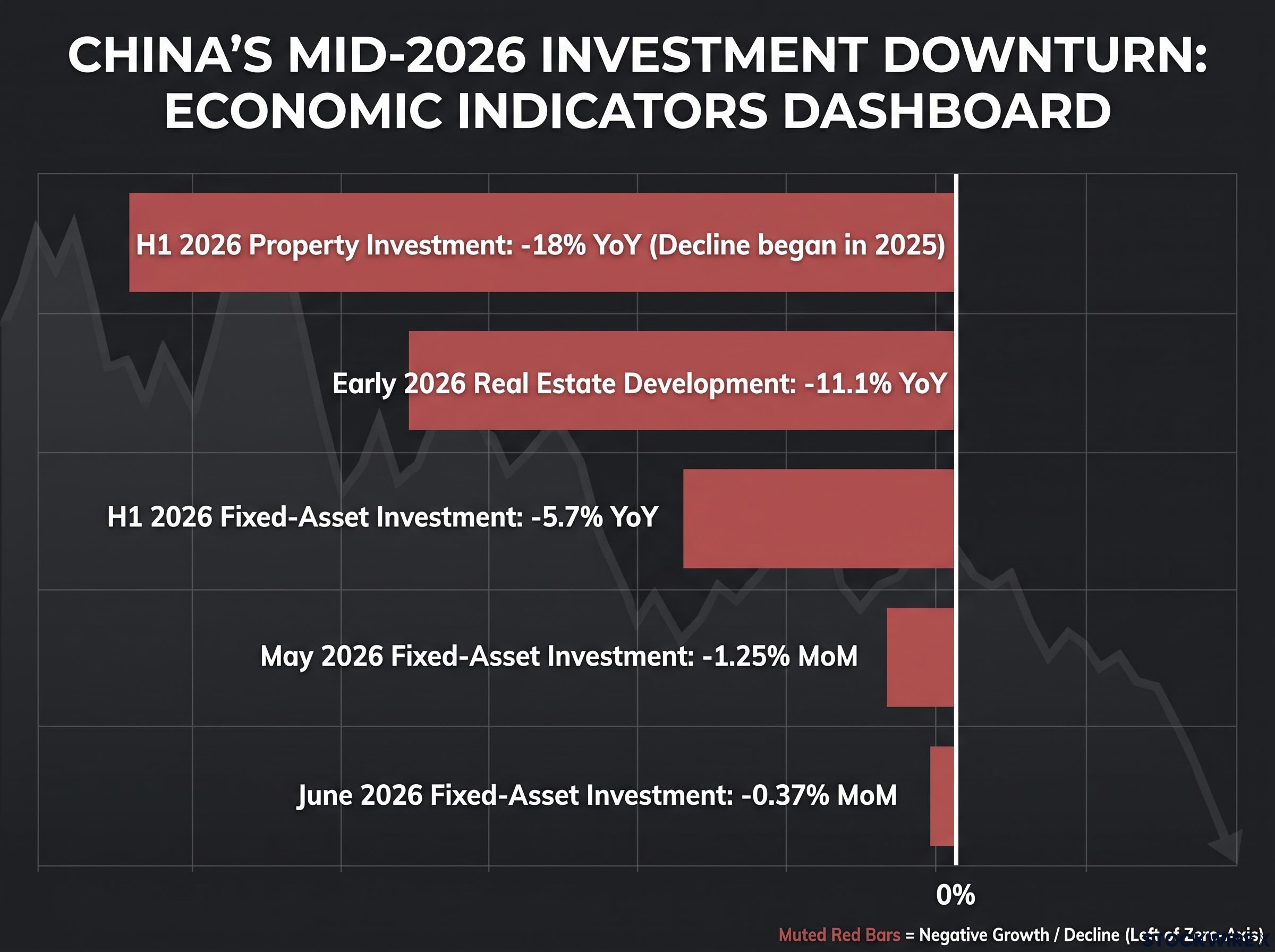
Property investment fell 18% year-on-year in the first half of 2026, deepening a decline that began in 2025 and confirming the real estate sector remains a structural headwind to China’s broader recovery.
Each figure adds pressure in the same direction. Suppressed land revenues weaken local government balance sheets. Property drag limits domestic consumption recovery. Together, they increase pressure for monetary easing, and rising easing expectations widen the yield differential versus the United States and other major economies. That creates depreciation pressure on the yuan that the PBOC must then manage through the fix.
The US-China yield differential is the bilateral expression of a broader structural reality: the dollar sits on one side of 89.2% of all global FX trades, which means any widening of that differential as China eases and the Fed holds draws capital toward dollar assets at a scale that the PBOC must account for when setting each morning’s fix.
The fundamental case for sustained yuan appreciation is weakening. The PBOC is increasingly caught between using the fix to signal stability and accepting that growth realities are working against that signal. For you, these are not abstract macro statistics. They are the inputs that determine whether the PBOC can credibly maintain a stronger-yuan fixing stance, and therefore whether the yuan direction of the past several months can continue.
How July data ripples into Asian FX markets beyond the yuan
The PBOC’s daily fix does not operate in isolation. Chinese economic data and the yuan’s direction affect regional currencies through three transmission channels:
- Trade linkages: economies with heavy export exposure to China see their currencies adjust when Chinese demand signals weaken
- Commodity demand signals: weaker Chinese activity compresses demand expectations for industrial and energy commodities, hitting commodity-exporting currencies
- Risk sentiment: softer Chinese activity data tends to pull capital away from regional currencies that are tightly linked to China’s growth trajectory, reducing broader appetite for regional risk assets
A firmly supported yuan can temporarily stabilise regional FX. A sustained shift toward weaker-than-expected fixings would likely trigger position adjustments well beyond the USD/CNY pair.
Carry trade liquidation is one of the channels through which yuan-driven risk sentiment transmits into the broader region: a sustained shift toward weaker PBOC fixings would compress yield-seeking flows across Asia, with the Australian dollar and higher-beta regional currencies facing the same transmission dynamic that yen strength forces on AUD/JPY positions.
Which currencies move most when the fix surprises
FX desks across Asia treat the daily fix as a barometer for broader regional sentiment, not just a China-specific indicator. Three currencies stand out as high-beta proxies for China-linked risk:
- KRW (South Korean won): South Korea’s heavy manufacturing export exposure to China makes the won one of the most sensitive currencies to shifts in Chinese demand signals
- AUD (Australian dollar): Australia’s commodity export linkage to Chinese industrial activity means the Australian dollar amplifies moves in China-linked growth expectations
- THB (Thai baht): Thailand’s regional position and tourism-linked China exposure give the baht elevated sensitivity to shifts in Chinese risk appetite
USD/CNY and offshore USD/CNH both moved toward 6.76 on the back of PMI weakness earlier in 2026, illustrating how data translates rapidly into cross-market positioning. If you hold positions in or watch any of these currencies, the PBOC fix is a daily input that influences your own exposure, making it worth monitoring even if your focus is not explicitly on the yuan.
What to watch now: reading the fix as a live policy signal
The mechanism, the policy layer, and the economic backdrop all come together in a repeatable monitoring process you can apply starting from the next trading day:
- Check the fix: look for the PBOC’s published central parity rate at approximately 9:15 a.m. Beijing time
- Compare to the prior close: measure the gap between the new fix and where onshore USD/CNY spot closed the previous session
- Compare to model estimates: basket-based model estimates (available from major bank research desks and data platforms) tell you what the formula alone should have produced
- Interpret persistent deviation: a sustained run of stronger-than-model fixes signals continued priority on stability and capital attraction; a sustained run of weaker-than-model fixes signals a shift toward growth support and reduced tolerance for further appreciation
A persistent deviation of the fix from model-implied values is the closest available real-time readout of PBOC policy stance, without waiting for press conferences or official statements.
Key releases to monitor alongside the fix include monthly fixed-asset investment and property data, Caixin and official PMI prints, and LPR and RRR announcements. Current reference levels sit at fixings near 6.79 with spot in the 6.74-6.79 range.
The ability to read the fix-versus-model gap gives you a way to track PBOC policy intent in real time. In a system where central bank communication is deliberately indirect, that is a material information advantage.
Where the yuan goes from here depends on Beijing’s next move
The fixing mechanism gives the PBOC discretion to manage the yuan’s direction every business day, but that discretion is constrained. Growth data, easing expectations, and exporter competitiveness are all under pressure in mid-2026, and each one narrows the space in which the PBOC can keep guiding the currency stronger without policy cost.
Whether July data confirm broad-based weakness, and whether the PBOC responds by shifting its fixing stance over the following sessions, will be the most direct signal of how Beijing is prioritising currency stability against growth support in the second half of the year.
The fix is published every morning. The deviation from the model is the number that tells you which way that balance is tipping.
This article is for informational purposes only and should not be considered financial advice. Investors should conduct their own research and consult with financial professionals before making investment decisions. These statements are speculative and subject to change based on market developments and central bank policy decisions.