When the Fed shifted its stance, the dollar retreated and commodity currency traders anticipated a durable rally across the Australian dollar, the Norwegian krone, the South African rand, the Brazilian real, and the Chilean peso. Those gains never materialised. BNY flow data showed that within a week of the decision, the net positioning across all five currencies had turned back toward selling.
The failure is not a timing problem. The “debasement trade,” which had seen investors pile into commodity currencies through the early months of the year, showed no signs of revival following the Fed’s more recent shift. The dollar move and the commodity FX move are governed by different mechanisms, and conflating the two is the error most investors are making right now.
Here is the framework for separating those mechanisms, screening the flow data that professional capital actually follows, and identifying the specific conditions that need to be in place before any commodity currency position is worth scaling into.
Why the dollar’s retreat did not deliver what commodity FX traders expected
Not all dollar weakness is created equal. Two distinct mechanisms can drive the greenback lower, and they produce very different outcomes for commodity currencies:
- U.S. fundamentals deteriorate and global growth expectations improve. This lifts commodity demand, supports commodity prices broadly, and transmits into appreciation across AUD, NOK, ZAR, BRL and CLP.
- Crowded long-USD positioning unwinds through mean reversion. This reprices the dollar without changing underlying commodity demand or global growth conditions. Commodity FX gets a brief sympathy bid, then stalls.
The current episode is the second type. According to BNY iFlow data, dollar hedging flows had already begun climbing prior to the payroll release that came before the Fed’s policy shift, suggesting the move was building independently of the central bank’s decision.
iFlow data from BNY recorded rising dollar hedge activity before the payrolls report, indicating that the dollar selloff that followed was a positioning unwind already under way rather than a fresh reaction to Fed guidance.
Geoff Yu at BNY described the dollar’s decline as a mean-reversion from an overcrowded long-USD positioning rather than evidence of any fundamental reassessment of the U.S. economic outlook. If the dollar is weakening because speculators are unwinding an overcrowded position rather than because global growth expectations have genuinely improved, then any commodity currency trade built on that move is resting on borrowed time from the moment it opens.
The distinction between a positioning unwind and a fundamental repricing maps directly onto the voting machine dynamics that Ken Fisher applied to currency markets: narrative shifts and crowded position exits move exchange rates over days and weeks, while the underlying macro variables that actually support commodity demand operate on a different, slower timescale.
When big ASX news breaks, our subscribers know first
What the flow data actually showed in the two weeks after the Fed decision
The timeline tells the story more precisely than any summary can. In the sessions immediately following the Fed’s dovish pivot, commodity currencies caught a bid. Traders positioned for the narrative: easier Fed, weaker dollar, commodity FX rally.
Then the flows reversed. BNY iFlow data revealed that flows into the NOK, AUD, CLP, ZAR and BRL basket had rotated back to net selling in the period roughly one week after the Fed decision. The standout detail from that period: not one trading session in the full week following the pivot saw all five currencies simultaneously recording net purchases across the basket.
| Currency | Classification | Post-pivot flow direction (within one week) |
|---|---|---|
| AUD | G10 | Net selling |
| NOK | G10 | Net selling |
| ZAR | EM | Net selling |
| BRL | EM | Net selling |
| CLP | EM | Net selling |
By two weeks after the pivot, post-decision enthusiasm had faded entirely.
How this episode differs from January-February’s debasement trade
The January-February debasement trade looked different on both dimensions that matter. Commodity participation was broader, with industrial metals and energy joining gold. And basket-wide institutional buying was sustained across multiple sessions, not isolated to a single currency on a single day.
This time, gold has performed, but gold alone does not constitute the commodity breadth needed to sustain a broad commodity FX rally. Zero sessions of basket-wide net buying in the week following the pivot tells you that institutional capital did not arrive to validate the rate-expectations narrative. That is the clearest early-warning signal that a positioning-driven move has no trend behind it.
The commodity breadth problem: why gold’s rally is not enough
A sustained commodity currency rally requires more than one commodity performing well. It requires simultaneous participation across the categories that collectively represent global industrial and agricultural demand. Those categories, and their current status, look like this:
- Gold: Performing. Lower real rates and elevated geopolitical risk are supporting prices.
- Copper: No synchronous rally alongside gold.
- Iron ore: No synchronous rally alongside gold.
- Oil: No synchronous rally alongside gold.
- Agricultural commodities: No synchronous rally alongside gold.
This distinction matters because the transmission channel from commodity prices to commodity currencies runs through broad demand conditions, not through any single metal. When copper, iron ore, oil and agricultural commodities are all moving higher, it signals genuine global demand recovery. That recovery creates export revenue, current account support, and capital inflows for commodity-exporting economies. Gold, with its unique sensitivity to real rates and geopolitical hedging, does not carry that signal.
The copper and gold divergence visible in the August 2026 session, where gold surged on rate and geopolitical drivers while copper’s record high reflected a separate structural supply deficit, illustrates precisely why conflating gold performance with broad commodity demand produces a misleading read on commodity FX conditions.
IMF research found that a 10 basis point increase in the U.S. policy rate reduces aggregate commodity prices by approximately 0.5-2.5% over 18-24 business days. The corollary: rate cuts provide a proportionate but similarly modest and delayed boost, far smaller than many investors assume.
Research from Jeffrey Frankel at Harvard confirms that real commodity prices are negatively correlated with real short-term U.S. interest rates, but the relationship is conditional, not automatic. A Fed pivot does not mechanically lift commodity prices.
For investors, the absence of industrial commodity participation means commodity FX is still priced off essentially unchanged demand conditions. Any dollar-weakness tailwind is too thin to sustain a position through normal market noise.
G10 carry constraints: how stagflation dynamics are capping AUD and NOK
On paper, AUD and NOK look attractive. They carry the highest nominal policy rates among G10 commodity currencies, and a softer dollar should widen the yield differential further.
Professional carry traders apply a different filter. They ask three questions before sizing a position:
- How durable is the high yield?
- How likely is the central bank to cut before the trade pays off?
- How exposed is the economy to commodity and external demand shocks?
Both currencies currently score unfavourably on all three.
| Dimension | AUD | NOK |
|---|---|---|
| Nominal policy rate | Among highest in G10 | Among highest in G10 |
| Primary domestic vulnerability | Highly leveraged households | European energy demand dependence |
| Stagflation dynamic | Yes | Yes |
| Carry framework score | Unfavourable on all three questions | Unfavourable on all three questions |
Australia faces stagflation-like constraints: inflation remains elevated enough to limit Reserve Bank flexibility, while growth and productivity challenges cap real returns. The country’s highly leveraged household sector amplifies external demand sensitivity and creates rate-path uncertainty that carry traders cannot hedge cheaply.
Norway faces a parallel set of constraints. Stagflation dynamics, productivity challenges, and heavy dependence on European energy demand mean that once domestic risks are factored in, risk-adjusted carry looks far less compelling than the nominal differential suggests.
When a carry trade fails all three screening questions simultaneously, the appropriate response is not to seek a better entry point. It is to ask whether the position should be sized at all.
Bank of America’s finding that thin liquidity concentrates rather than reduces carry risk sits directly alongside the screening logic described here: carry trade risk frameworks that rely on implied volatility as a signal of genuine calm are capturing compressed risk premia, not reduced underlying vulnerability, the same dynamic that explains why AUD and NOK carry positions face hidden structural headwinds beyond the nominal yield differential.
Why EM carry is losing ground: the easing cycle squeeze on ZAR, BRL and CLP
The constraint mechanism in emerging markets is different from the G10 story, but the conclusion is the same. For ZAR, BRL and CLP, the problem is not stagflation; it is the easing cycle itself.
Fed pivots that reduce global risk aversion simultaneously reduce EM central banks’ need to maintain unusually high rates as a buffer against external shocks. As those banks resume or signal rate-cutting cycles, the carry advantage over USD narrows, even if the Fed is also easing. If EM central banks cut more aggressively than the Fed, relative carry compresses further.
The stabilisation of geopolitical tensions, including reduced Iran-related risk pricing, has removed a key constraint on EM central bank easing. Growth is now the priority, not carry maintenance.
In July, the South African Reserve Bank (SARB) opted to keep rates on hold while signalling an inclination toward future loosening, with softening inflation providing cover for an eventual pivot. This makes it the most visible current illustration of how global growth priorities are setting a ceiling on EM carry performance.
The SARB’s July 2026 MPC statement shows the Quarterly Projection Model forecasting rate cuts later in the projection horizon as inflation falls toward 3% and rates adjust toward neutral, giving investors a concrete documentary basis for treating SARB guidance as a carry-compression input rather than background commentary.
An investor long ZAR carry after that statement is structurally positioned against the central bank’s own guidance. The trade only works if commodity prices deliver tailwinds strong enough to overcome the carry compression the SARB itself is signalling.
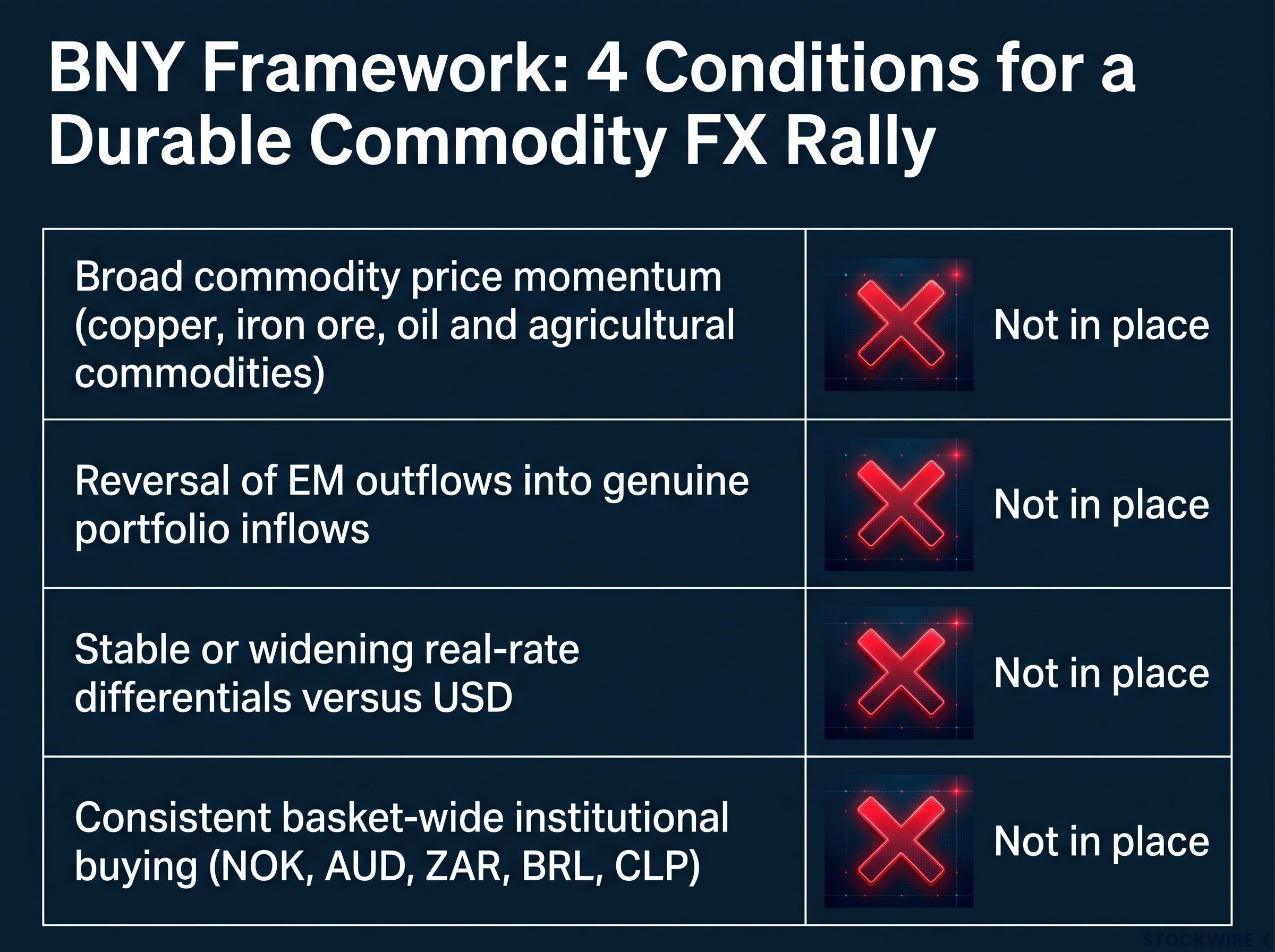
BNY‘s framework identifies four conditions required for a durable commodity FX rally. None is currently in place:
- Broad commodity price momentum across copper, iron ore, oil and agricultural commodities: not in place.
- Reversal of EM outflows into genuine portfolio inflows: not in place.
- Stable or widening real-rate differentials versus USD: not in place.
- Consistent basket-wide institutional buying across multiple sessions: not in place.
Reading EM central bank communications as a carry-compression signal, rather than as background macro commentary, reframes rate decisions as direct inputs into your FX position sizing.
What flow confirmation actually looks like, and how to use it before entering a position
The diagnostic sections above identify why commodity FX is stalling. The practical question is: what would it take for the trade to work, and how would you know before committing capital?
BNY‘s framework requires four conditions to confirm a durable commodity FX rally. As of BNY iFlow data from the research period, none is fully satisfied:
- Broad commodity price momentum (copper, iron ore, oil and agricultural commodities participating alongside gold): not in place.
- Reversal of EM outflows into genuine portfolio inflows (sustained buying of EM equity and local-currency debt): not in place.
- Stable or widening real-rate differentials versus USD (either the Fed remains relatively restrictive or commodity-linked central banks slow their easing): not in place.
- Consistent basket-wide institutional buying (NOK, AUD, ZAR, BRL and CLP collectively net bought across multiple sessions): not in place.
Price moves confirmed by sustained basket-wide buying are structurally more durable than those driven by positioning mean reversion. The distinction between the two is the difference between a thesis and a position.
Practical positioning guidance until conditions align
Until flow confirmation arrives, the framework points to four specific behaviours:
- Size down. Modest, asymmetric exposure rather than large thematic longs. The current backdrop does not support scaling based on Fed rhetoric or DXY direction alone.
- Screen by real rates, not nominal yields. Adjust for inflation, growth risk, and central bank reaction functions when assessing AUD, NOK or EM carry positions.
- Monitor EM central bank guidance as a carry-compression signal. Each incremental signal toward easing in South Africa, Brazil or Chile mechanically trims the carry premium underpinning long positions.
- Treat basket-wide multi-session buying as the minimum threshold for scaling. Isolated single-currency flows do not qualify.
Having a checklist of four specific, observable conditions moves you from “I think commodity currencies look cheap” to “here is the evidence I need before I put capital at risk.”
When the debasement trade could return, and what needs to change first
The Fed pivot is a genuine structural precondition for a commodity FX revival. That is worth acknowledging clearly. The issue is not that the pivot does not matter; it is that the pivot alone is not enough.
Three specific, observable triggers would shift the conditions from “not in place” to “in place”:
- Broadening of commodity price momentum beyond gold. Copper, iron ore, oil and agricultural commodities joining the rally would signal a genuine global demand recovery rather than a gold-specific real-rate trade.
- A clear and sustained Fed rate-cutting trajectory that widens real-rate differentials before EM central banks accelerate their own cuts, preserving carry for ZAR, BRL and CLP rather than compressing it.
- A genuine reversal in EM portfolio flows, with sustained institutional buying of EM equity and local-currency debt creating mechanical FX demand across the basket.
The January-February debasement trade remains the model for what a confirmed commodity FX rally looks like: basket-wide buying, commodity breadth, and real carry support all present simultaneously. The current environment has none of those.
Investors wanting to see what broad commodity momentum collapse looks like in practice will find our deep-dive into the June 2026 commodity selloff instructive; it documents how a stronger dollar transmitted across energy, metals, and agricultural markets simultaneously, the reverse of the breadth confirmation the current framework requires.
Geoff Yu at BNY frames it directly: a Fed pivot is a necessary condition for debasement trades, not a sufficient one.
The investor who waits for iFlow-type flow confirmation will miss the first 10% of the move. But they will avoid most of the false starts. The current setup is not a signal to short commodity currencies. It is a signal to stay selective, size small, and treat the first multi-session basket-wide buying signal as the entry trigger for scaling into a position.
This article is for informational purposes only and should not be considered financial advice. Investors should conduct their own research and consult with financial professionals before making investment decisions. Forward-looking statements regarding commodity prices, central bank decisions, and currency movements are speculative and subject to change based on market developments.