
A company director sells shares, a filing hits the ASX, and the stock drops 12% before lunchtime. Most retail investors look at that sequence and draw one conclusion. That conclusion is often wrong.
ASX rules require directors to disclose share transactions within five business days, making insider activity some of the most transparent data available to you as a retail investor. The problem is not access. It is interpretation.
A director sale can mean a dozen different things, and most of them have nothing to do with the company’s prospects. Understanding the difference between a signal and noise is the skill the market does not hand out for free.
Here is how to apply a structured checklist to any director share sale you encounter on the ASX, and how to stop making the single most common interpretive mistake investors make with these disclosures.
How ASX director disclosure rules actually work
Under the Corporations Act 2001 (Cth) s205G, directors must notify their company of any changes in their interests. The company then lodges the relevant notice with the ASX under Listing Rule 3.19A.2. This is not optional reporting. It sits within the continuous disclosure regime, meaning it carries the same legal weight as any other material announcement.
The continuous disclosure regime carries real legal weight: the Federal Court penalised Electro Optic Systems $4 million in April 2026 after a 14-week gap between an internal revenue downgrade and the company’s public correction, establishing a concrete benchmark for what a breach actually costs.
Three forms cover a director’s lifecycle at a listed company. An Appendix 3X is lodged on appointment, an Appendix 3Z on departure, and an Appendix 3Y whenever a director’s interests change between those two events. The Appendix 3Y is the document you will encounter most often as an investor. It is filed whenever a director buys, sells, exercises options, or transfers securities.
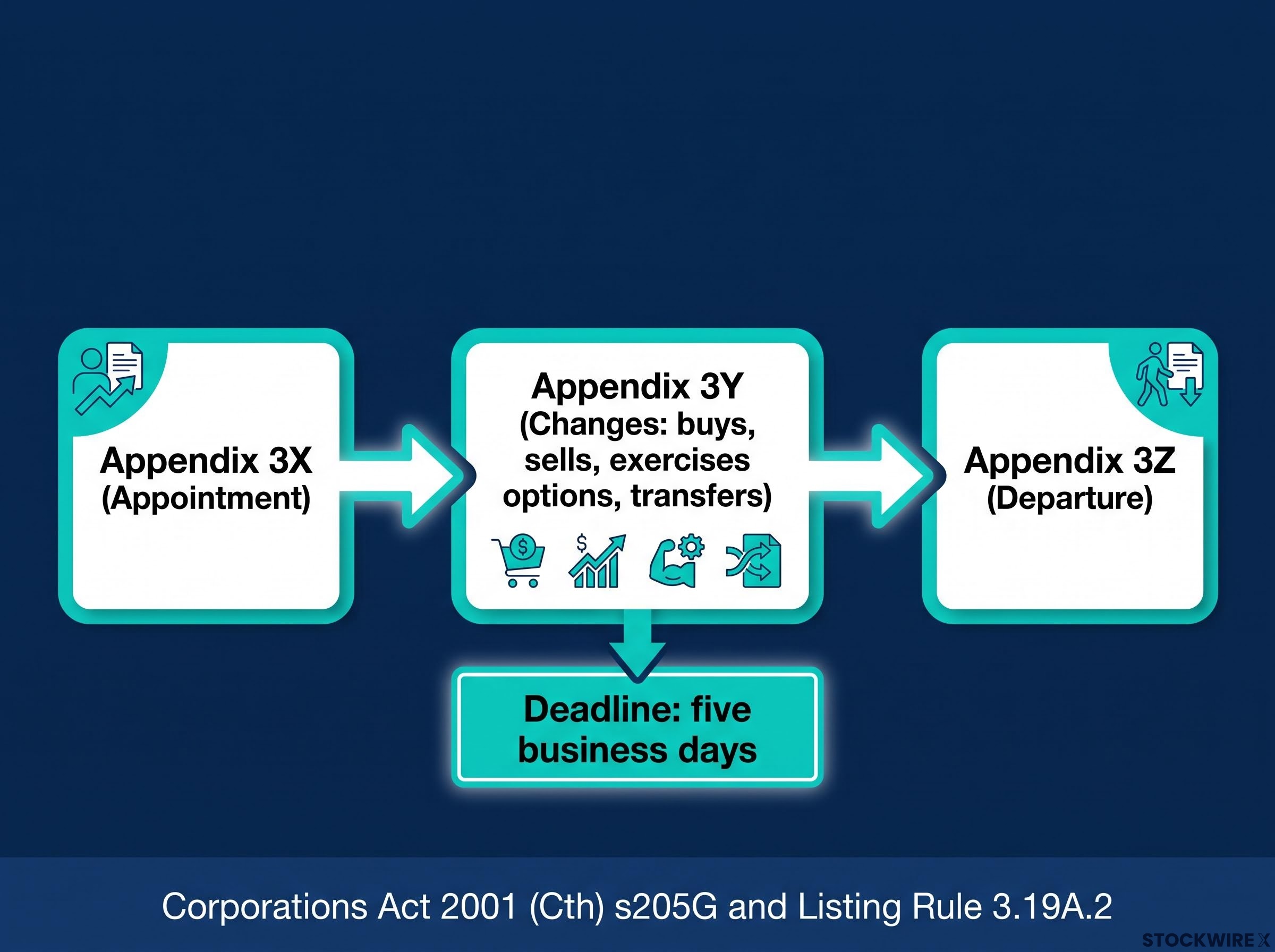
The lodgement deadline is five business days from the transaction. A standard Appendix 3Y contains specific fields that each carry distinct meaning:
- Director name
- Nature of change (purchase, sale, options exercise, transfer)
- Class of security (ordinary shares, options, performance rights)
- Number of securities involved
- Holdings before and after the transaction (both direct and indirect)
The ASX has explicitly determined that investors have a “legitimate interest” in director transactions, which is why these notices form part of the continuous disclosure regime.
That five-day window and those granular fields mean that when a disclosure lands, you are not reading a vague rumour. You are reading a structured legal record with enough detail to ask intelligent follow-up questions about what actually happened and why.
When big ASX news breaks, our subscribers know first
Why a director sale is not the same as a director vote of no confidence
Here is where the most common interpretive mistake lives. Director purchases and director sales are not symmetrical in what they tell you.
When a director buys ordinary shares on-market, they are using personal cash to increase exposure to a company they already know from the inside. There is no forced event driving the transaction. No options expiring. No structural obligation. It is a deliberate vote of confidence.
Board alignment, specifically the distinction between equity granted as compensation and equity purchased with personal capital, is what makes a director purchase a meaningfully stronger signal than any options exercise or performance rights vesting event.
Sales are different. The range of competing explanations is wide, and most of them are benign:
- Personal expenditure: Property purchases, tax bills, school fees. When shares are a director’s most liquid asset, selling is often just cash management.
- Portfolio diversification: After a large share price appreciation, reducing a concentrated position is standard risk management, not pessimism.
- Options mechanics: Some sales are tied to exercising expiring options, leaving the director with little genuine choice about transacting. Selling to fund the exercise price or cover the resulting tax liability is structurally required.
- Estate planning: Changes routed through trusts, family companies, or spousal holdings can reflect succession planning rather than any view on the business.
Wilson Asset Management acknowledges that while insider sales can carry weight, they also often have legitimate non-negative motives, including rebalancing after strong valuation gains.
What “class of security” tells you about the trade’s meaning
The Appendix 3Y specifies the class of security traded, and this distinction matters. An on-market sale of ordinary shares is the most informative trade type because it represents a director choosing to reduce their direct economic exposure. An exercise-and-immediate-sale of options is the least informative; it often reflects an expiry deadline rather than a sentiment shift.
If the class listed is options or performance rights rather than ordinary shares, adjust your interpretation accordingly. The trade may be mechanically driven, not conviction-driven.
The DroneShield case: what a 12% drop can teach you about market psychology
DroneShield director Oleg Vornik filed an Appendix 3Y disclosing a substantial share sale commencing around 6 November 2025. The stock fell approximately 12% that day. Trading volume surged as retail investors saw “insider selling” and reached for the sell button.
That was the headline reaction. Here is what the announcement actually contained.
Rask Media’s November 2025 DroneShield coverage reported that CEO Oleg Vornik sold his entire holding, with Chairman Peter James and Director Jethro Marks also selling substantial stakes, a boardroom-wide pattern that helps explain why the stock fell approximately 48% across the full month rather than just the 12% recorded on the initial disclosure day.
The market sees “insider selling”, assumes bad news, and sells first, asks questions later.
| What the market appeared to infer | What the Appendix 3Y actually showed |
|---|---|
| Director losing confidence in the company | Director sold a substantial block but retained significant remaining holdings |
| Imminent negative news | No accompanying material announcement or downgrade |
| Insider heading for the exit | Skin in the game remained; the director maintained meaningful exposure |
The gap between inference and fact is the lesson here. A 12% price drop in response to a director sale that left significant retained holdings is a case study in the market pricing fear rather than information. The heuristic, “insider selling equals bad news”, overwhelmed the actual content of the disclosure.
For you, the practical takeaway is that price dislocations after director sales can be driven by psychology rather than substance. Those moments deserve research, not reflexive selling.
A six-point checklist for reading any director transaction intelligently
The next time an Appendix 3Y lands for a company you hold, work through these six questions in sequence. Each builds on the last, moving you from raw data to an informed assessment.
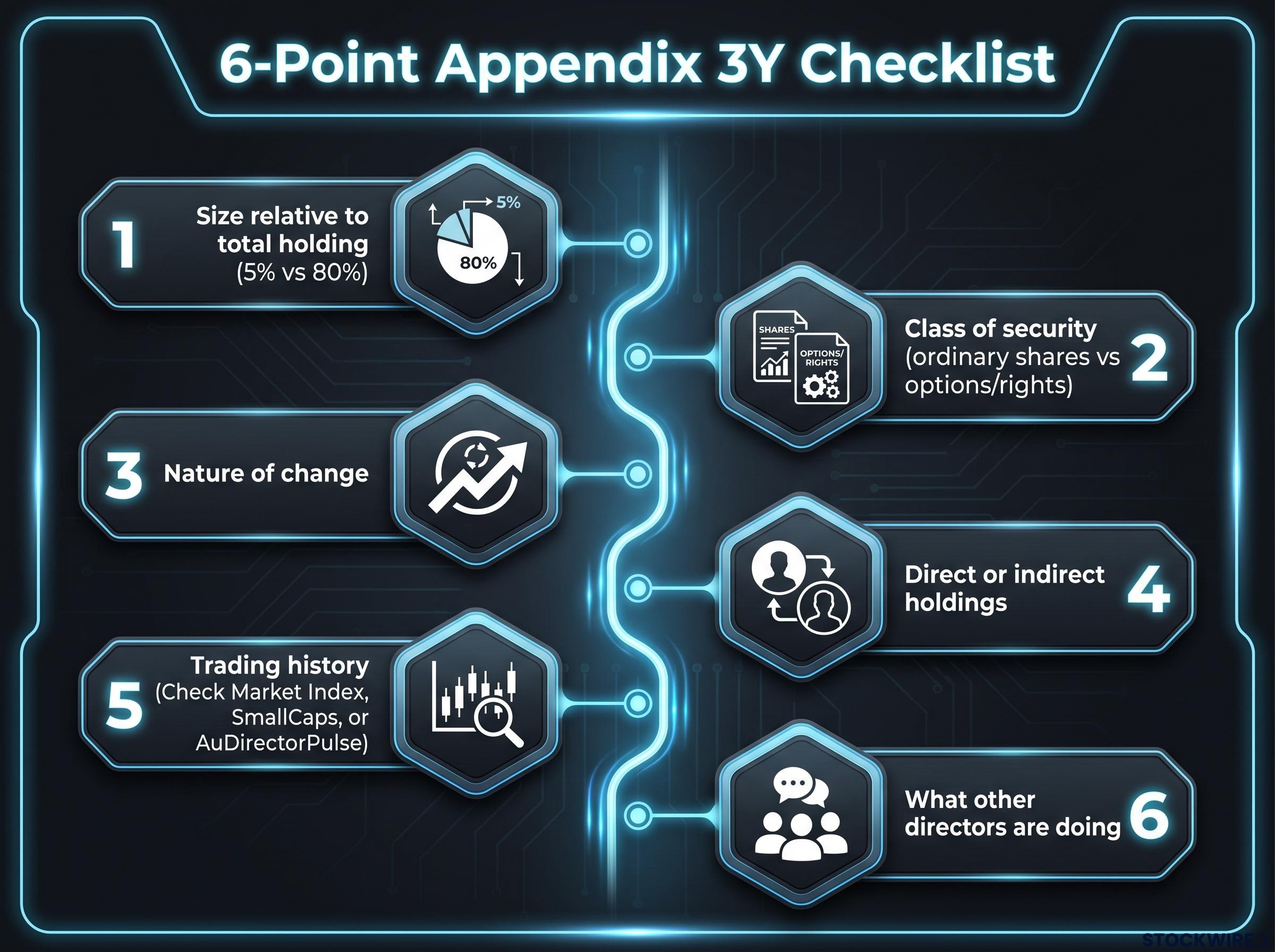
- How large is the sale relative to the director’s total holding? A director selling 5% of their stake is categorically different from one selling 80%. Scale is the first and most important filter.
- What class of security was traded? Ordinary shares carry more weight than options or performance rights. Check whether the trade reflects a genuine reduction in exposure or an options mechanic.
- What was the nature of the change? An on-market sale is more informative than an off-market transfer or an exercise-and-sell tied to option expiry. The Appendix 3Y specifies this.
- Was the change in direct or indirect holdings? Movements through trusts, family companies, or spousal entities can reflect estate planning or tax structuring rather than a view on the business.
- What is the director’s trading history? Check past patterns using aggregators such as Market Index, SmallCaps, or AuDirectorPulse. Is this a first-time large sale, or part of a pattern of regular, modest rebalancing? Context changes everything.
- What are other directors doing at the same time? This is where the signal can sharpen or dissolve entirely.
The comparative dimension: what happens when you zoom out to the boardroom
According to Wilson Asset Management, when several directors sell substantial stakes in quick succession, that pattern warrants far greater concern than any single sale in isolation. Selling that converges across the boardroom is the configuration most worth scrutinising, because personal circumstances become an implausible shared explanation.
Conversely, if one director is selling while another is buying, the net signal is ambiguous. That does not mean you ignore it; it means you need deeper research before acting.
Working through this checklist converts a raw Appendix 3Y filing into a structured assessment of whether the sale is plausibly personal or structural versus a potential signal that your investment thesis deserves fresh scrutiny.
When a director sale genuinely deserves closer attention
Most director sales are benign. But some configurations shift the probability enough that they warrant a harder look at your thesis. Five specific patterns stand out:
- The director materially reduces or exits their position entirely, eliminating or near-eliminating their skin in the game.
- Multiple directors sell substantial stakes in close succession, making a coordinated personal-circumstances explanation implausible.
- Large sales follow a rapid share price appreciation with no obvious personal or structural explanation.
- The director has historically been a consistent net buyer or long-term holder, and this sale represents a marked behavioural change.
- Sales coincide with or precede negative news flow or deteriorating fundamentals.
Use a director sale as a prompt to revisit your investment thesis with fresh eyes, not as an instruction to exit your position.
Even in these cases, the correct response is not to sell automatically. Director trades are a prompt to re-examine your investment thesis and risk assessment. They should be combined with fundamentals, valuation, balance sheet strength, and competitive position. Director transaction data rarely outweighs a well-researched fundamental analysis, and sophisticated institutional participants, including quantitative and algorithmic funds, are also processing these signals. Reactive signal-chasing without a disciplined process is unlikely to generate an edge.
Recognising which configurations actually matter means you can calibrate your attention rather than treating every Appendix 3Y as equally significant. That is both more accurate and less emotionally draining.
This article is for informational purposes only and should not be considered financial advice. Investors should conduct their own research and consult with financial professionals before making investment decisions.
Fitting director transactions into a disciplined investment process
Appendix 3Y monitoring works best when you treat it as a tool for generating questions rather than a rule that dictates trades. A substantial sale should prompt you to ask whether something fundamental has shifted and whether your valuation or risk assessment needs updating. It should not trigger an automatic move in your portfolio.
Three practical habits turn occasional Appendix 3Y readings into a genuine improvement in your investment process:
Position changes versus static holdings carry fundamentally different information content, a principle that applies equally to fund manager analysis and to director transactions: what a director currently owns tells you where their conviction was, while what they are actively buying or selling tells you where it is now.
- Frame every sale as a hypothesis. Write down what you think the sale means and what it would take to change your thesis. If the fundamental case remains intact and the sale appears explained by personal or structural factors, price weakness after a disclosure may represent an opportunity rather than a warning.
- Maintain a decision log. Record why you bought, what assumptions you made, how you interpreted director trades at the time, and what you expected to happen. This is the only way to build a feedback loop that separates skill from noise.
- Benchmark your results. Periodically compare your risk-adjusted returns against a simple benchmark such as the ASX 200.
Measuring whether your use of director signals is actually working
Your decision log should capture three things for every director trade that influenced your thinking: what the disclosure said, what action you took (including no action), and what the outcome was over a defined period. Review it quarterly.
The benchmarking question is straightforward. If your risk-adjusted returns do not beat the ASX 200 over a meaningful period, the additional effort of director transaction monitoring may not be generating value worth the complexity. A single high-performing stock can mask underperformance across the rest of your portfolio, which is why detailed tracking matters. The feedback loop is what turns this from a heuristic into a skill that compounds over time.
What the evidence actually tells you about director sales
The picture that emerges is one of meaningful asymmetry: purchases send a relatively clean message about internal conviction, given that a director is committing personal funds to a business they already understand from the inside. Sales, by contrast, are noisy and context-dependent, and they typically need corroborating evidence before they justify any portfolio action.
Insider selling patterns become more analytically useful when viewed at market scale: US corporate insiders were selling approximately $11 for every $1 they bought in H1 2026, a near-record ratio that illustrates how aggregated director transaction data can surface valuation signals invisible in any single Appendix 3Y filing.
Your practical tool is the checklist. Read the full Appendix 3Y. Assess scale and class. Check the director’s history. Look at what the rest of the board is doing. That process converts a headline into an informed data point rather than an emotional trigger.
Director transaction monitoring is worth doing. It sharpens your research and stress-tests your assumptions. But it is subordinate to fundamental analysis and will not generate a reliable edge when used reactively or in isolation.
The next time an Appendix 3Y crosses your screen for a company you hold, pull up the filing and work through the checklist. That is how the skill compounds: one disclosure at a time, read properly.
—