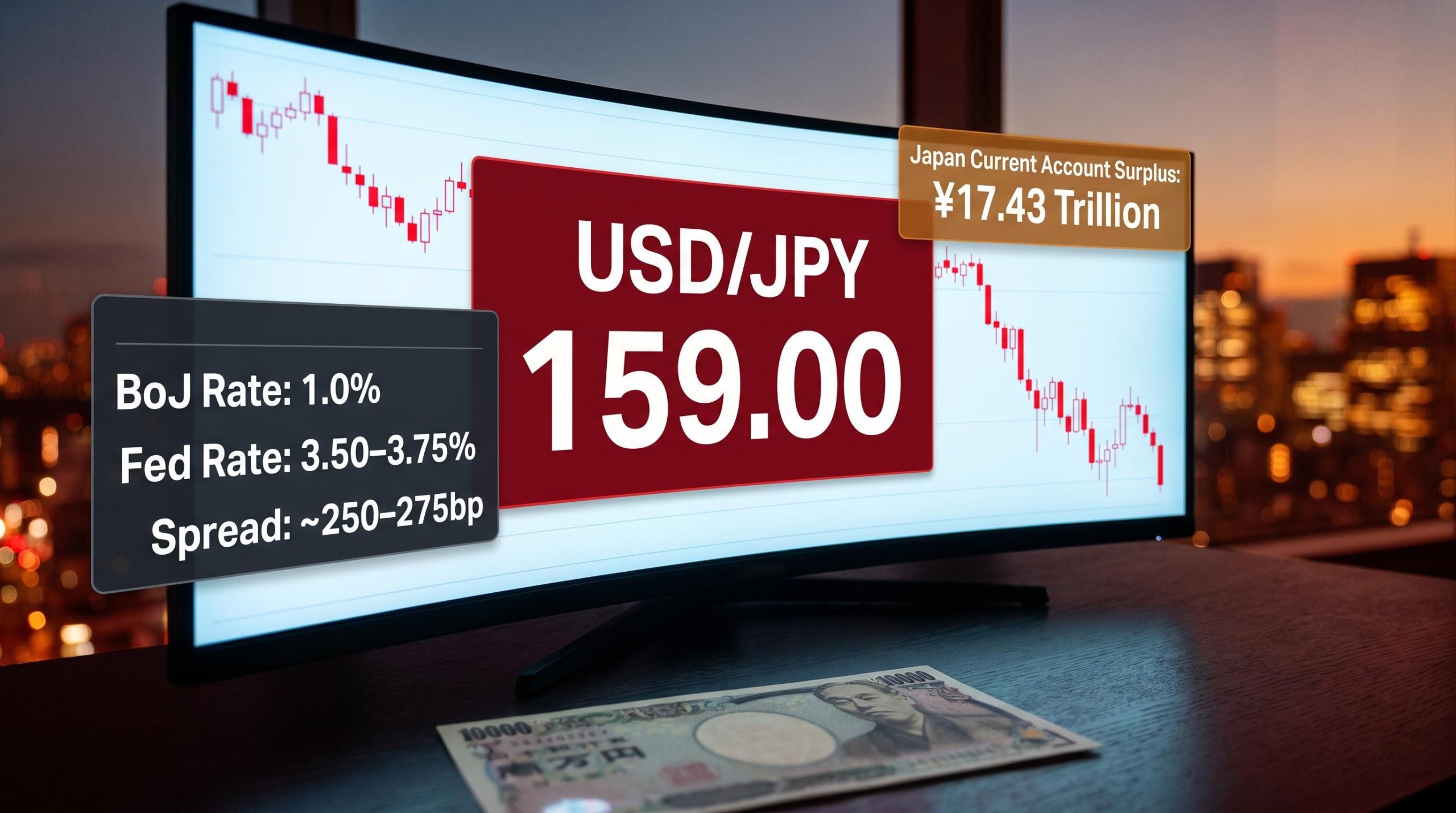
Japan’s current account hit a record 17.43 trillion yen surplus in the first half of 2026. The Bank of Japan raised its policy rate to 1.0%, the highest level since 1995. And yet, the yen just crossed 159 per US dollar again, weaker than it was before either of those things happened.
That is not supposed to work that way. A country earning record surpluses from abroad, with a central bank actively raising rates for the first time in decades, should see its currency strengthen. The fact that the yen keeps doing the opposite tells you something important: the forces working against it are not one-dimensional, and they are not going away on their own.
Here is a framework for understanding five distinct mechanisms that are pushing the yen down simultaneously, why interventions and rate hikes have failed to produce lasting strength, and what conditions you would need to watch for before a genuine reversal becomes plausible.
The rate gap that keeps the yen cheap
Every other force acting on the yen traces back to one underlying fact: Japanese interest rates remain far below those of every other major developed economy.
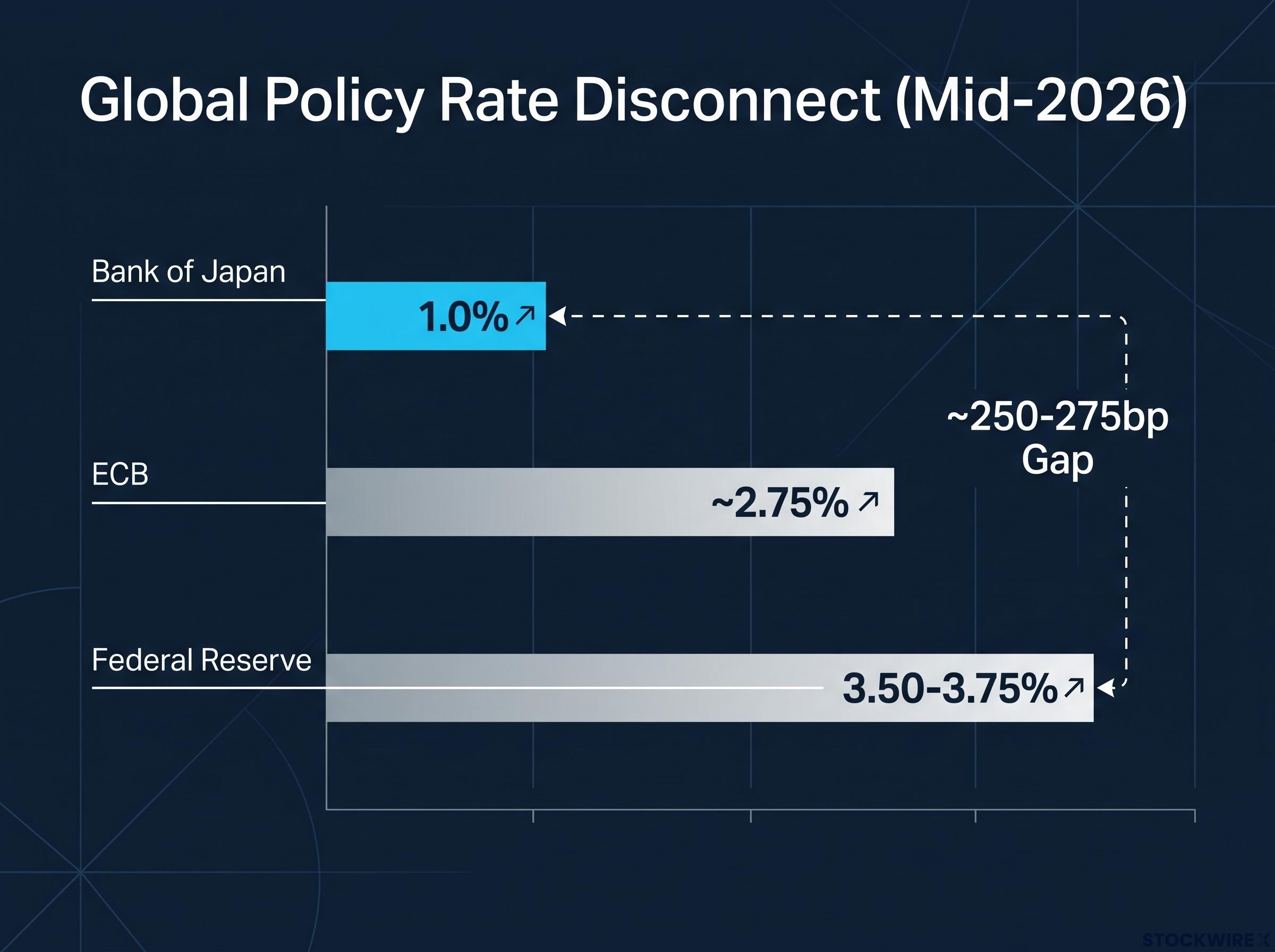
The BoJ’s policy rate sits at 1.0% after its June 2026 hike from 0.75%. The Federal Reserve’s target range, meanwhile, sits at 3.50-3.75%. That is a spread of roughly 250-275 basis points, which means every dollar parked in short-term US assets earns roughly three times more than an equivalent yen investment.
| Central Bank | Policy Rate (mid-2026) | Gap vs. BoJ |
|---|---|---|
| Bank of Japan | 1.0% | Baseline |
| Federal Reserve | 3.50-3.75% | ~250-275bp |
| ECB | ~2.75% | ~175bp |
Currency markets do not just price today’s rate; they price where rates are expected to converge over a multi-year horizon. Japan is still debating where its neutral rate even lies, while the Fed is already discussing cuts. That forward-looking gap is what keeps the yen cheap, not just the headline number.
Even after a historically significant hike, Japan’s 1.0% rate remains “very far” from other developed economies’ levels, according to Commerzbank research.
The most recent BoJ decisions were widely anticipated and accompanied by cautious guidance. Markets judged them as priced in rather than hawkishly surprising, and the yen weakened after the announcements rather than strengthening. Until that spread narrows meaningfully, every other dynamic described below has the same gravitational pull: toward a weaker yen.
The June 2026 rate decision delivered a 7-1 vote alongside a structured bond tapering schedule reducing monthly JGB purchases by approximately 200 billion yen per quarter through March 2027, a combination that markets judged as measured rather than hawkishly decisive, which is precisely why the yen weakened in the aftermath rather than strengthening.
When big ASX news breaks, our subscribers know first
How the yen became the world’s favourite borrowing currency
The rate gap does not just sit passively in the background. It powers a specific trading strategy that creates constant, structural selling pressure on the yen.
That strategy is the carry trade: borrowing money in a currency with low interest rates, converting it into a currency with higher rates, and investing the proceeds to pocket the spread. The difference between what you pay on the yen loan and what you earn on the dollar investment is your profit, and it accrues every single day the trade is open.
How the trade works in practice
The mechanics are straightforward:
- Borrow yen at 1.0% (the BoJ’s policy rate).
- Convert those yen into US dollars, creating selling pressure on the yen in the process.
- Invest the dollars in US assets yielding 3.50-3.75%, earning the 250-275 basis point spread.
Analysts explicitly describe the yen as “one of the main funding currencies for carry trades” even at current policy settings. Holding yen is characterised as “extremely unattractive” given the yield spread versus US and other developed-market rates.
This means the yen faces structural selling pressure that is not tied to any specific news event or policy announcement. It is the daily, mechanical consequence of investors around the world choosing to fund their positions in the cheapest available currency.
Why rate hikes have not unwound it
Each BoJ hike narrows the spread only marginally. A 25 basis point increase from 0.75% to 1.0% reduced the gap with the Fed from roughly 275-300 basis points to 250-275. The trade is slightly less profitable, but still very much worth running.
More importantly, markets price future expected rates, not just today’s level. If traders believe the BoJ will stop hiking well before the gap closes, the carry trade remains attractive on a forward-looking basis. Risk-on sentiment, reinforced by the Nikkei’s strong 2026 performance, actively encourages carry-trade expansion because equities rising means risk appetite is healthy and short-yen positions feel safe.
Carry-trade dynamics are expected to remain active until real-yield convergence occurs, and no major forecaster sees that happening soon.
Why traders do not fully believe the BoJ will follow through
If rate hikes are the obvious answer to yen weakness, why hasn’t the BoJ simply hiked faster? The answer sits in a contradiction at the centre of its own policy framework, one that currency traders have noticed.
The BoJ is raising its policy rate while simultaneously continuing large-scale purchases of government bonds, approximately 2.3-2.5 trillion yen per month as of mid-2026. Those purchases keep Japanese Government Bond (JGB) yields low, which blunts the very tightening the rate hikes are meant to deliver. The tapering plan runs through fiscal 2026-2027, with potential pause considerations from April 2027, and the guidance emphasises “stabilisation” of purchases rather than aggressive reduction.
Volkmar Baur, Commerzbank, has assessed that the BoJ must do more to convince markets, specifically by signalling a readiness to bring forward its rate-hiking timetable rather than maintaining the current measured pace.
BoJ Governor Ueda provided only tentative indications at his press conference that the pace of rate increases could quicken. The bank’s published summary of opinions similarly contained language pointing to earlier hikes, but traders concluded that neither communication went far enough, and the yen sold off in response.
For you, this credibility gap means each BoJ meeting carries a higher bar than the headline rate decision. Three specific signals matter:
BoJ credibility signals gained new specificity at the July 2026 meeting, where a named board dissenter pressed for an immediate hike to 1.25% and the US Treasury conducted a formal rate check on the yen, adding a bilateral diplomatic dimension that can shift the currency independent of any scheduled policy decision.
- The rate decision itself (the number)
- The press conference language (how hawkish the framing sounds)
- The bond purchase trajectory (whether quantitative tightening is accelerating)
If traders believe the BoJ will stop or reverse before closing the rate gap, they stay short yen regardless of the current policy rate. That is exactly what is happening.
The structural forces that good data cannot overcome
Here is where the puzzle deepens. Japan’s macroeconomic data looks genuinely strong: a record current account surplus, an improving trade balance, solid credit growth. On paper, these are the conditions that support a currency. In practice, they are being overridden.
What the current account surplus is not telling you
Japan’s current account surplus reached a record 17.43 trillion yen in the first half of 2026, with monthly surpluses approaching 4 trillion yen. The goods trade surplus hit 742 billion yen for January-June 2026, compared to a deficit in the prior year. Commerzbank argues that the yen’s current weakness stands at odds with these robust readings, which in its view support the case that the currency is trading below fair value on a fundamental basis.
But currency markets price the marginal flow and the forward expectation, not the backward-looking stock of surplus. Energy price movements can shift the trade balance faster than the headline surplus figure updates, creating timing disconnects between data releases and market pricing.
Four structural headwinds are actively offsetting the positive fundamentals:
- Energy import dependence: Japan remains highly reliant on imported oil and gas. Higher energy prices raise the import bill, worsen terms of trade, and weigh directly on the currency.
- Terms-of-trade exposure: Even a strong goods balance can deteriorate quickly when commodity prices move against you, and Japan sits on the wrong side of that exposure.
- Fiscal risk premium: Concerns about fiscal sustainability, large deficits, and Japan’s massive public debt are now explicitly cited by analysts as part of the yen’s weakness. This is a relatively new factor gaining weight in currency pricing.
- Reduced safe-haven demand: In risk-on environments when global equities are strong, demand for the yen as a safe haven falls and can flip into active selling. A positive tone in equities is directly associated with yen weakness.
The record current account surplus tells you Japan is earning more from abroad than it is spending. Understanding why markets are discounting this is where the real learning sits: currency pricing is not a report card on one metric but a composite judgment across yields, flows, fiscal trajectory, and risk sentiment simultaneously.
Speculation, intervention, and the momentum that overrides everything
When a currency trend becomes established, a separate force takes over: momentum. Traders add to short positions simply because the trend is down, pushing the currency further than rates or fundamentals alone would justify.
The yen has entered this phase. Futures positioning and options markets show significant bearish wagers against the currency, reinforcing moves beyond what traditional models would predict from rates and trade flows alone.
What the intervention record actually shows
Japan has responded with force. The government has demonstrated both the willingness and the financial capacity to defend the yen:
- Record monthly intervention spending of approximately 11.7 trillion yen was confirmed in one 2026 period.
- Coordinated US-Japan yen-buying operations took place in July 2026.
- Even combined interventions and rate hikes did not produce lasting appreciation; the yen weakened again once the immediate shock faded.
The pattern is consistent. Each intervention produces immediate yen strengthening, followed by gradual re-weakening as short positions are rebuilt. Experienced traders now treat post-intervention dips as re-entry opportunities for short-yen positions rather than signals of a trend change.
The intervention record from Japan’s 2026 campaign reveals a pattern that experienced traders have learned to exploit: each operation produces immediate yen strengthening, followed by gradual re-weakening as the structural incentives that generated short positions remain fully intact.
For you, this means that any individual intervention announcement is unlikely to mark a lasting turning point. The speculative positioning at scale can temporarily disconnect a currency from both its fundamentals and its authorities’ intentions. Short-term flows and positioning easily dominate slow-moving fundamentals such as current account surpluses, and until the underlying incentive structure changes, the momentum reasserts itself.
The equity-hedge mechanism most analysts overlook
This is the least intuitive layer of the story, and the one most market commentary misses entirely.
A Japan Exchange Group survey cited by Volkmar Baur at Commerzbank shows that foreign investors have built up holdings representing roughly 35% of Japanese equities. Many of these institutional investors hedge the currency risk of their Japanese holdings using forward contracts. That means they hold short-yen positions sized to offset the yen exposure of their equity portfolios.
Here is where it gets interesting. When Japanese stock prices rise, the yen value of those foreign-held portfolios increases. To maintain a constant hedge ratio, investors must mechanically increase their short-yen positions, selling more yen in the forward market.
The sequence works like this:
- The Nikkei rises (approximately 35% year-to-date in 2026).
- The yen value of foreign-held equity portfolios increases proportionally.
- Foreign investors must sell additional yen to increase their currency hedges, creating downward pressure on the yen.

Commerzbank’s Volkmar Baur notes that with foreign ownership of Japanese equities sitting near 35% and the Nikkei having advanced roughly 35% year-to-date, institutional investors holding currency-hedged positions have been compelled to rebalance those hedges in ways that add selling pressure on the yen.
This selling pressure is not a deliberate bearish call on the yen. It is automatic, mechanical, and a direct consequence of rising equity prices. This rebalancing dynamic is likely to continue weighing on the yen in the near term, with the scale of that pressure only receding once the BoJ delivers the kind of unambiguous rate-hike commitment that alters the economics of holding those hedges.
If you own Japanese equity ETFs or funds without currency hedging, this mechanism means strong Nikkei performance can paradoxically contribute to the very currency weakness that erodes your unhedged returns. Equity strength and yen weakness are not just correlated; they are partially causally linked through market-structure mechanics.
Note: This analysis originates from Commerzbank research. The directional dynamic is well-supported, though the precise magnitude of the hedge-rebalancing effect is not separately verified in the broader research literature.
What would actually need to change for the yen to recover
Everything described above, the rate gap, carry trades, BoJ credibility, structural headwinds, speculative momentum, and equity-hedge mechanics, is currently aligned in the same direction. That is why the yen at 159 per dollar feels persistent rather than temporary.
A durable recovery would likely require several of these forces to shift simultaneously. Four conditions to monitor:
- More forceful BoJ commitment to normalisation: Faster or larger hikes, more hawkish forward guidance, and a meaningful reduction in bond purchases that allows JGB yields and real rates to rise substantially.
- Narrowing global rate differentials: Fed and other central bank cuts that bring policy rates closer to Japan’s, reducing the profitability of carry trades.
- A shift in Japan’s terms-of-trade or fiscal narrative: Lower energy prices, a durably improved trade balance, and credible fiscal consolidation could improve the structural story markets are currently pricing negatively.
- A speculative positioning shake-out: A sharp, policy-driven or risk-off rally that forces short covering and resets positioning closer to neutral.
Treat these not as predictions but as a monitoring framework. When two or three of these conditions begin shifting simultaneously, the mechanics of yen appreciation can accelerate faster than gradual rate convergence alone would suggest, because speculative positioning unwinds quickly once the incentive structure flips.
For investors wanting to translate these reversal conditions into a concrete monitoring framework, our full explainer on yen carry trade warning signals identifies which of the three historically reliable precursors to forced deleveraging are already active in 2026 and what the remaining trigger looks like in practice.
This article is for informational purposes only and should not be considered financial advice. Investors should conduct their own research and consult with financial professionals before making investment decisions. Past performance does not guarantee future results. Financial projections are subject to market conditions and various risk factors.
Reading the yen’s weakness as a system, not a symptom
The yen is not weak because Japan’s economy is struggling. It is weak because a specific set of market-structure, policy-credibility, and speculative forces are simultaneously working in the same direction: wide rate differentials powering carry trades, a central bank whose tightening is only partially believed, structural headwinds overriding strong macro data, speculative momentum feeding on itself, and an equity-hedge mechanism quietly adding to the pressure.
Strong fundamentals can coexist with currency weakness for extended periods when these forces are this well-aligned. The same framework that explains today’s weakness is the one you should apply to detect early signals of a reversal. When the rate gap narrows, the BoJ’s credibility strengthens, and speculative positioning reaches an extreme, the conditions for a sharp move in the opposite direction will be in place.