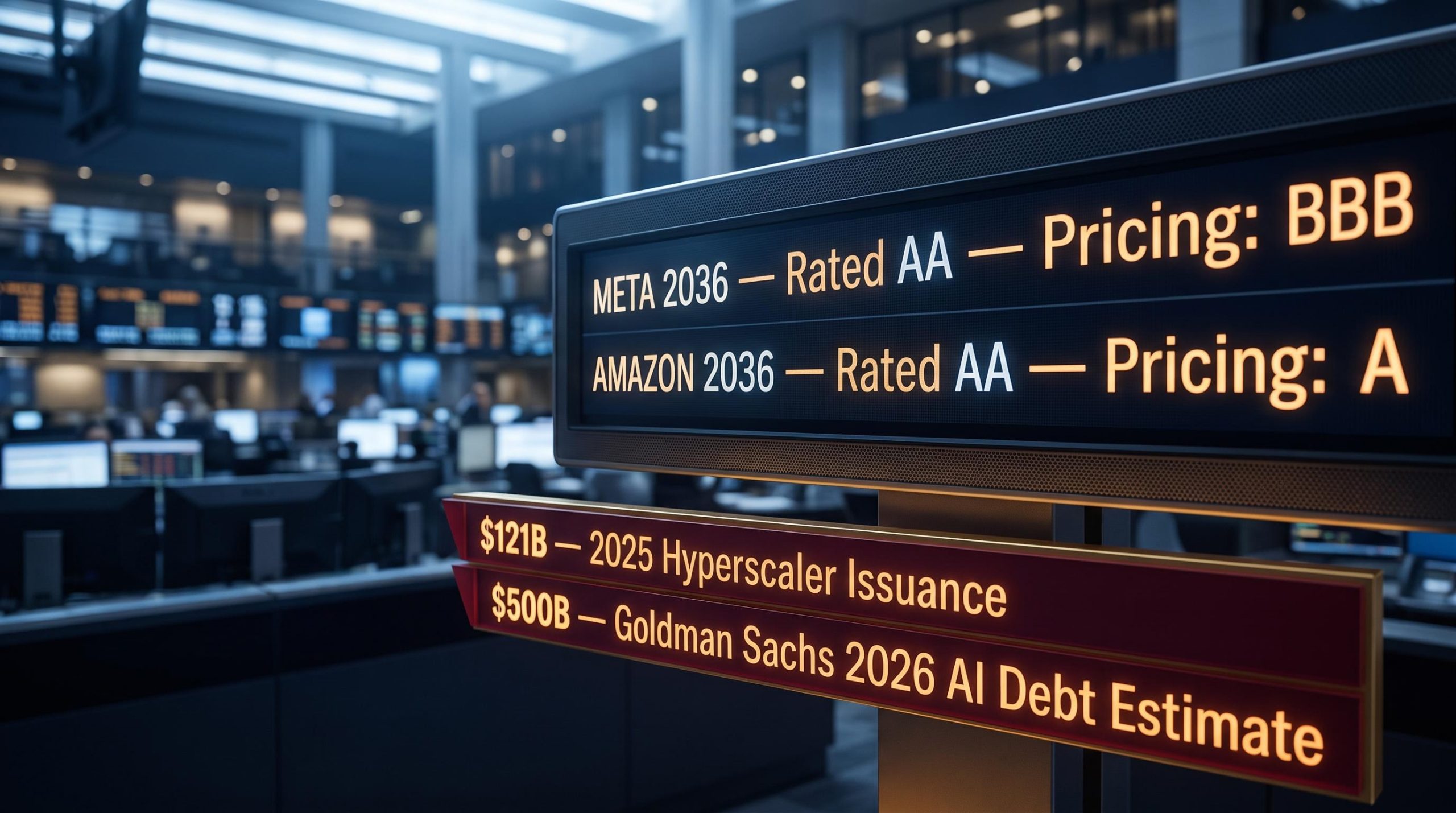
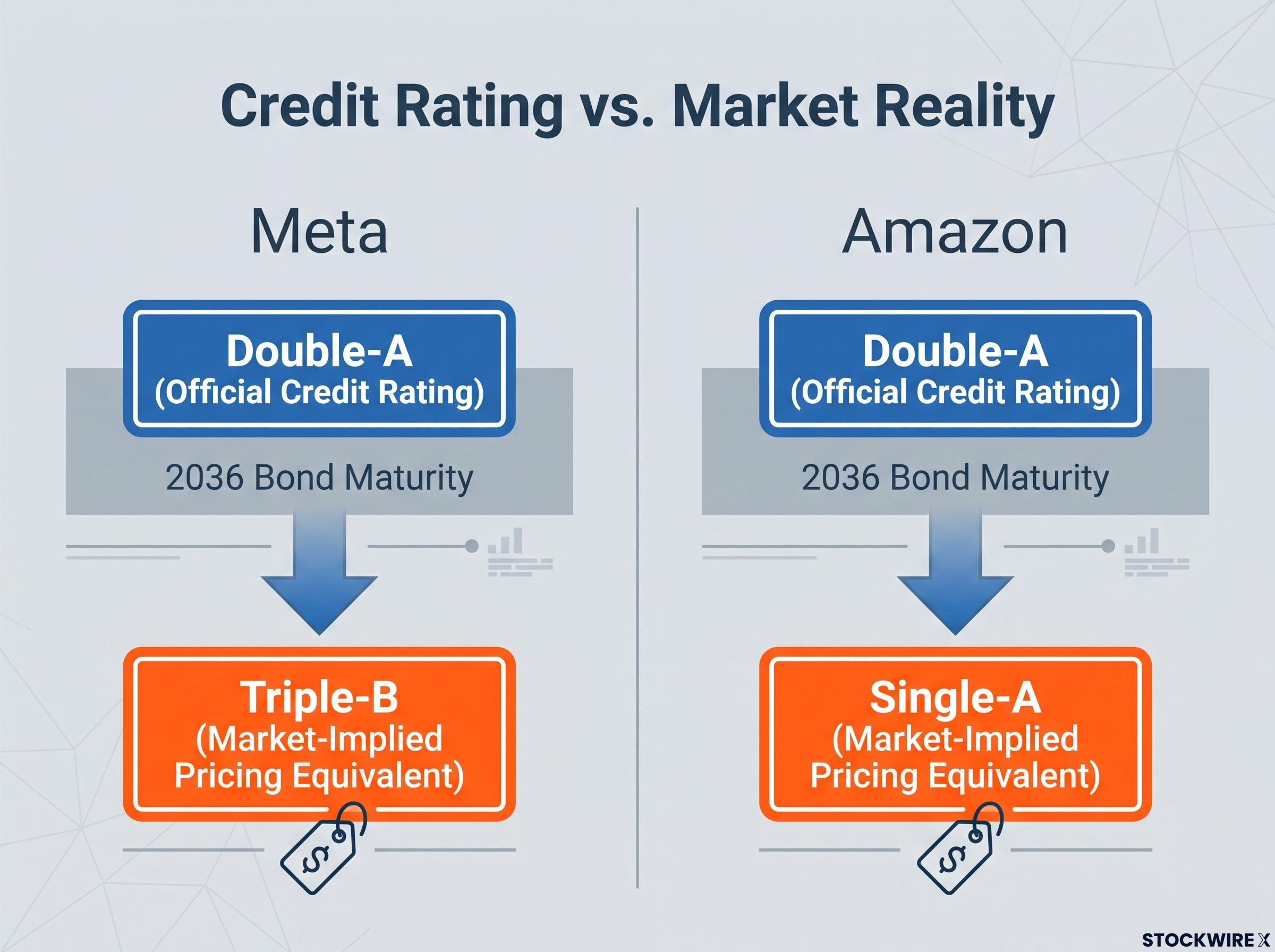
Meta holds an official double-A credit rating. Its 2036-maturity bonds trade at spreads you would expect from a triple-B borrower. Amazon, also rated double-A, prices its long-dated debt as if it were a single-A credit.
That gap between what the rating agencies say and what the bond market charges is not a temporary blip. It is the bond market telling you something the equity market has not fully absorbed: the AI infrastructure buildout has turned the biggest technology companies on earth into systematic, large-scale borrowers, and the supply of their debt is repricing credit in real time.
Goldman Sachs estimates close to $500 billion in AI-related debt issuance in 2026 alone. By 9 July 2026, hyperscaler bond issuance had already surpassed twice the full-year 2025 total, with roughly half the calendar year still remaining. Most investors who hold a bond fund or investment-grade ETF already carry meaningful exposure to this shift without having chosen it. Here is the analytical framework for understanding what you own, what the market is actually pricing, and what to watch as this cycle deepens.
How AI turned investment-grade bonds into a funding machine
Amazon, Alphabet, Meta, Microsoft, and Oracle used to tap bond markets occasionally, mostly for balance-sheet optimisation. Free cash flow funded the actual buildout. The AI capex cycle has broken that model.
The speed and scale of spending on data centres, chips, and training infrastructure have outpaced what even the largest internal cash engines can generate. Debt issuance is no longer a choice; it is a structural necessity. The numbers make the break-point visible:
- $28 billion per year: average annual bond issuance by the Big Five hyperscalers between 2020 and 2024.
- $121 billion: total issuance from those same five names in 2025.
- Approximately $240 billion: cumulative issuance to 9 July 2026, a figure that had already cleared twice the whole of 2025 with months left to run.
- Close to $500 billion: Goldman Sachs’s estimate for total AI-related debt issuance across 2026.
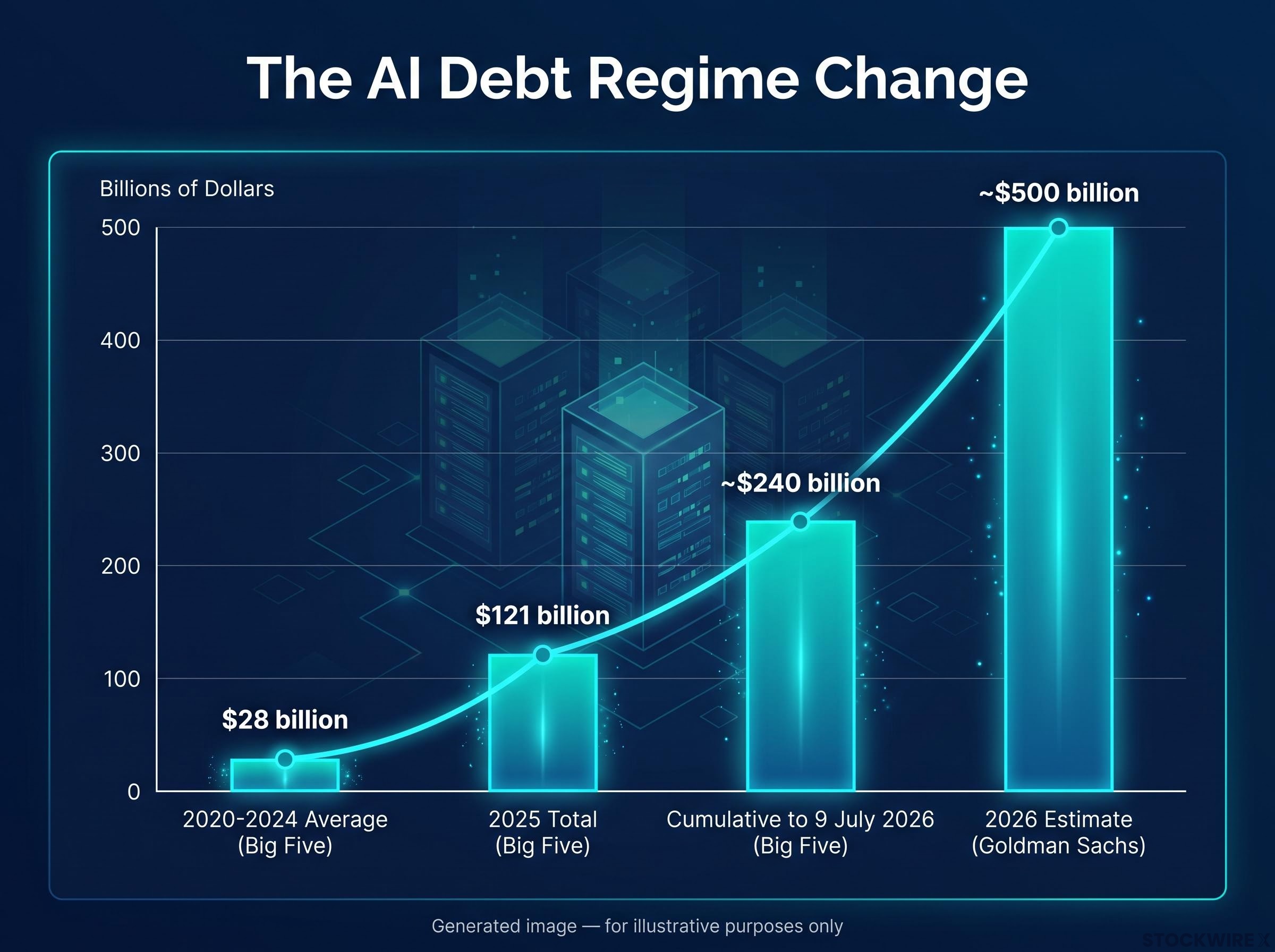
The Big Five hyperscalers issued $121 billion in bonds in 2025, up from an annual average of just $28 billion between 2020 and 2024. That is not a spike. That is a regime change.
Among the major hyperscalers, annual capital expenditure is on a trajectory toward roughly $900 billion by 2028. Once broader AI ecosystem participants such as OpenAI, Oracle, SpaceX, and Anthropic are factored in, total annual AI-related capital spending is set to comfortably clear $1 trillion.
The hyperscaler capex trajectory accelerated further into 2026, with Amazon, Microsoft, Alphabet, and Meta collectively spending $130 billion in Q1 2026 alone and full-year combined guidance reaching approximately $725 billion, a scale that gives concrete dimension to why bond supply forecasts keep revising upward.
These companies are no longer occasional borrowers managing their balance sheets. They are structural, recurring presences in the bond market, and the supply dynamic is not going away when any single project finishes.
When big ASX news breaks, our subscribers know first
When bond spreads stop reflecting what credit ratings say
Bond spreads, the extra yield investors earn over government bonds, compensate for credit risk. They are shaped by both fundamental quality (how likely the borrower is to repay) and market technicals (how much supply investors need to absorb). In principle, a double-A rated issuer should trade at tighter spreads than a single-A or triple-B name. The AI debt cycle has disrupted that relationship.
| Issuer | Official Credit Rating | Bond Maturity | Market-Implied Pricing Equivalent |
|---|---|---|---|
| Meta | Double-A | 2036 | Triple-B |
| Amazon | Double-A | 2036 | Single-A |
Both companies carry double-A ratings. Neither is pricing like one. The gap is not small, and it is not hidden in obscure corners of the curve. These are major benchmark maturities from two of the most widely held issuers in global credit.
Supply pressure as the primary driver
The explanation is not, primarily, a deterioration in fundamentals. It is volume. Barclays explicitly warned that hyperscaler issuance exceeded $200 billion in 2026 and is testing the absorption capacity of the high-grade market. Coverage ratios on new deals have declined in some periods, meaning fewer investors are showing up relative to the amount of debt on offer.
AI-tagged bonds already represent approximately 15% of the US investment-grade market. M&G calculates that AI-linked debt surpassed $1.2 trillion by October 2025, making it the single largest segment in the US high-grade market. The Big Five alone could exceed 5% of the main investment-grade index by end-2026.
The pricing gap between official rating and market spread is the bond market’s way of flagging that supply volume, not default risk, is the governing variable right now. If you hold these names through a fund, you are absorbing that repricing whether or not you are aware of it.
Oracle’s credit downgrade to BBB-minus in July 2026, the lowest investment-grade notch in the company’s history, provides the clearest live case study of the fundamental spread-widening scenario: S&P cited $55.66 billion in fiscal 2026 capex, negative free cash flow, and leverage heading toward the mid-4x range as the specific triggers that forced rating action ahead of market pricing.
How a prior infrastructure debt cycle offers a warning for AI borrowers
This is not the first time investment-grade companies have binged on debt to fund an infrastructure buildout that markets initially treated as a temporary financing need.
European telecommunications companies in the early 2000s followed a strikingly similar arc. They were rated high investment-grade. They borrowed heavily to build out 3G networks. The debt was dismissed as temporary. Over time, sector average credit ratings migrated from double-A territory toward triple-B and lower.
Yarra Capital Management has drawn this parallel explicitly, pointing to its conviction that the current AI investment cycle will follow a comparable path, with average hyperscaler credit ratings drifting lower from double-A toward triple-B over the years ahead.
Yarra Capital Management draws a direct line between today’s hyperscaler borrowing surge and the European telecom debt cycle of the early 2000s, concluding that average hyperscaler credit ratings are likely to drift from double-A down toward triple-B over a multi-year period.
The similarities and differences matter equally:
Similarities:
- High investment-grade ratings at the outset of a capex supercycle
- Debt initially framed as temporary, then becoming structural
- Leverage rising faster than revenue growth can absorb
Differences:
- Hyperscalers currently generate substantially larger recurring revenue and free cash flow than telecoms did
- The AI assets being built may generate returns that 3G network assets ultimately did not
As of mid-2026, credit ratings for major hyperscalers remain high investment-grade with no broad imminent downgrade cycle forecast. But weaker or more aggressive borrowers within the broader AI ecosystem carry higher transition risk. The telecom analogy is not a prediction of collapse. It is a warning that the conditions which precede gradual rating migration are already assembling, and your bond fund may be accumulating exposure to that multi-year drift now.
Why bond investors outside the US cannot treat this as someone else’s problem
The AI debt boom originated in US dollar markets. It has not stayed there.
Alphabet is already one of the largest outstanding corporate borrowers in euro, sterling, Swiss franc, and yen markets. AI-related concentration is already embedded in non-US indices before any deliberate allocation decision by local investors.
How the transmission mechanism works in practice
Global credit pricing for large multinational issuers follows a benchmarking chain. A corporate issuer prices in US dollars first. That spread becomes the reference. When the same issuer brings a euro or Australian dollar deal, investors benchmark off the USD deal’s pricing, not off local credit conditions in isolation.
This means if a hyperscaler prices at triple-B-equivalent spreads in the US, that pricing reference travels directly to its EUR and AUD deals. The credit risk premium embedded in non-US AI-linked bonds is set partly by decisions made in New York, not by conditions in local markets.
The five non-US markets most exposed:
- EUR: Alphabet is already a major outstanding borrower; additional hyperscaler supply expected as US demand softens.
- GBP: Sterling credit indices carry hyperscaler exposure benchmarked against USD pricing.
- CHF: Swiss franc corporate market faces outsized concentration given its smaller overall size.
- JPY: Yen-denominated hyperscaler bonds absorb USD spread dynamics through global benchmarking.
- AUD: Australian investment-grade investors face imported spread pressure on any locally issued hyperscaler debt.
J.P. Morgan estimates the high-grade market could absorb approximately $300 billion in AI and data-centre bonds over the next year, with total funding needs reaching approximately $1.5 trillion over five years.
An Australian or European investor holding what looks like a domestically diversified investment-grade fund is, in practice, holding a portfolio whose credit dynamics are increasingly determined by US AI capex decisions and dollar-market supply conditions.
What the investment-grade label is no longer telling you
Investment-grade credit ratings, from triple-A through triple-B-minus, have historically served as stable anchors in a portfolio. The criteria for maintaining them constrained how much leverage a company could take on and how aggressively it could spend. For decades, the label worked as a reasonable shorthand for low volatility and predictable credit behaviour.
The AI debt wave is quietly eroding that signal’s reliability.
The distinction to understand is between two types of spread widening:
| Type | Driver | Cause | Duration | Investor Implication |
|---|---|---|---|---|
| Technical | Supply and demand imbalance | Too much issuance for the market to absorb at existing spread levels | Potentially temporary if supply moderates | May create buying opportunities if fundamentals remain intact |
| Fundamental | Leverage and cash flow deterioration | Borrower’s financial position weakening relative to its debt load | Longer-lasting; may precede rating downgrades | Signals genuine credit risk increase; requires reassessment |
The AI situation contains elements of both. Today, the dominant driver is technical: supply pressure from record issuance. But the structural capex trajectory means leverage is rising, and the fundamental layer could follow if AI investments do not generate adequate returns.
IESE estimates that AI-related debt accounts for approximately 30% of net new investment-grade supply in the US dollar market. Index-level spread metrics still look historically tight. Individual-issuer spread behaviour, as the Meta and Amazon examples demonstrate, tells a different story.
The exposure channel varies by investor type:
- Active fund holders: Your manager can underweight hyperscalers when spreads do not compensate. The question is whether they are doing so.
- ETF and index fund holders: You automatically absorb rising AI-linked concentration via index methodology. New issuance enters the benchmark, and your allocation follows without any active decision on your part.
- Direct bond buyers: You choose your exposure, but the spread you accept today may not reflect the credit you hold in five years if rating migration materialises.
If you rely on a fund’s investment-grade label as a proxy for low volatility and stable credit quality, that label now coexists with embedded concentration in a capital-intensive, leverage-rising theme that looks nothing like the stable corporate debt exposure it historically implied.
This article is for informational purposes only and should not be considered financial advice. Investors should conduct their own research and consult with financial professionals before making investment decisions.
What the AI debt cycle demands from bond investors now
The supply is not going away. AI-tagged bonds sit at approximately 15% of the US investment-grade market and are rising. The Big Five alone could exceed 5% of major indices by end-2026. Various forecasts place annual AI-related issuance in the $300-$600 billion range in coming years, with some broader estimates exceeding $900 billion.
Three variables deserve active monitoring:
- Issuer-level spread behaviour relative to official ratings. When a double-A credit consistently prices like a triple-B, the market is telling you something the rating agencies have not acted on yet. Track the gap, not the label.
- AI-linked sector weight in your bond fund or ETF. Passive strategies absorb this concentration by construction. Knowing your actual exposure is the first step toward managing it.
- Forward capex trajectory of the major hyperscalers. Each new capex guidance revision upward signals future supply. The issuance has not peaked because the spending has not peaked.
Goldman Sachs notes that the largest tech companies have already issued more than $170 billion in corporate debt year-to-date 2026, exceeding all of 2025 and quadrupling pre-AI annual averages, yet credit spreads remain very low.
For investors wanting to understand how the broader credit market is absorbing the AI debt wave alongside a $15 trillion corporate refinancing wall, our full explainer on AI debt market dynamics examines how institutional capital is migrating toward AI-linked debt structures and the hidden leverage mechanisms amplifying downturn risk.
Those low headline spreads give investors false comfort. The individual-issuer pricing already tells you the market is absorbing this supply at visible cost, and the structural drivers of future supply have not peaked. The analytical discipline this situation demands is not temporary. AI debt is now a permanent feature of global investment-grade markets.
Past performance does not guarantee future results. Financial projections are subject to market conditions and various risk factors.
The AI equity story and the credit reality are now running on different tracks
Equity markets price AI on growth and optionality. Bond markets are bearing the leverage and supply consequences that make that growth possible. Those two markets are telling different stories about risk, and for bond investors, the credit story is the one that determines what you actually own.
The AI debt problem became visible to equity markets in June 2026 when Oracle fell more than 9% after hours despite beating earnings expectations, as a $40 billion financing announcement forced investors to reprice the balance sheet rather than reward the income statement, a dynamic that mirrors exactly the divergence between bond and equity market signals described here.
What remains genuinely uncertain is whether AI capex returns will justify the debt load, whether rating migration will materialise on the telecom-parallel timeline or stay contained, and whether absorption capacity in global investment-grade markets will prove deeper than declining coverage ratios currently suggest.
What is not uncertain is the structural shift itself. AI-linked credit exposure now requires active monitoring, not passive confidence that an investment-grade label still means what it meant five years ago. Whether you hold it through an active fund, an ETF, or direct bonds, the question is the same: do you know what you own, and are you being adequately compensated for holding it?
—