Most income-focused Australian investors have one lever: dividends. They watch the payout dates, chase the franking credits, and build portfolios around names that reliably hand cash back twice a year.
Yet the shares already sitting in those portfolios can generate a second income stream most holders never touch: option premium. It is cash paid upfront, in exchange for an agreement about the price at which you would sell shares you own, or buy shares you want.
This matters more now than it did a year ago. With the Reserve Bank cash rate at 4.60% and options-based income strategies drawing fresh interest on the ASX, the regulator has taken notice. In August 2026, the Australian Securities and Investments Commission (ASIC) issued a formal warning about exchange-traded options, which makes it worth explaining the fully backed versions of these strategies carefully and honestly.
Because here is the thing these strategies live on a spectrum. At one end sits speculative, leveraged options trading. At the other sit the fully covered versions, which carry a very different risk profile.
This explainer covers exactly how premium collection works on ASX stocks, what you surrender to receive it, and whether the structure fits the way you actually invest.
What you actually own when you sell an option
Before any terminology, start with what you physically hold. Covered calls and cash-covered puts are not abstract instruments. Each one begins with an asset you already control, and the option is simply a contract you write against it.
The mechanics of call and put options are worth establishing before going further, because the vocabulary of strikes, premiums, and expiry dates underpins every calculation in this article, and the structural difference between buying and selling an option is the reason the risk profiles diverge so sharply.
Covered call: selling the upside on shares you already hold
Say you own shares in a large ASX company. A covered call is a two-asset position: the shares you hold, plus a call option you sell against them.
When you sell that call, you give someone else the right to buy your shares at a fixed price (the strike) before a set date. In return, they pay you cash upfront: the premium. That premium is yours to keep no matter what happens next.
If the share price stays below the strike at expiry, the call expires worthless. You keep the shares, you keep the premium, and you keep any dividend paid along the way. The call only bites if the shares rally past the strike, at which point they may be called away.
The key point is that the shares back the call from day one. You are never obligated to deliver stock you do not own, which means no leverage enters the structure.
Cash-covered put: getting paid to commit to a purchase
A cash-covered put flips the position around. Here you hold cash, and you want to buy a particular stock at a price you consider fair.
Instead of simply placing a limit order, you sell a put option. That gives someone else the right to force you to buy the shares at the strike price, and again you collect a premium immediately for making that commitment formal.
Fairway Capital Management uses a clean illustration: sell a put at $19.50 on a $20 stock and collect $0.50 in premium. If you are exercised, your effective acquisition cost works out to roughly $19, the strike minus the premium you already banked.
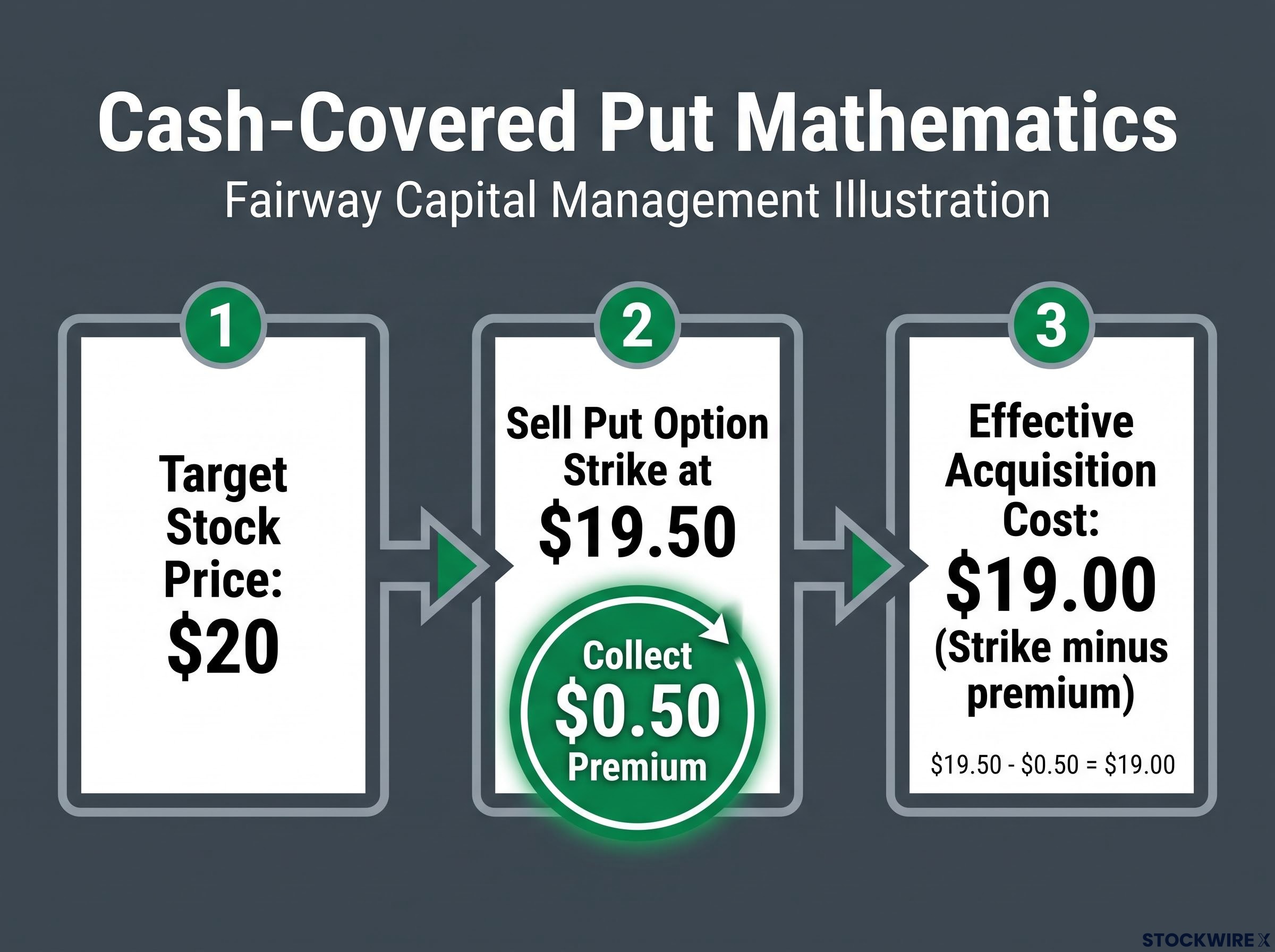
For this to be genuinely unleveraged, the full exercise value must sit in cash, set aside and ready, not just the smaller margin the exchange requires. The cash backs the put the way shares back the call.
That backing requirement is the whole game. It is the mechanism that separates these strategies from the speculative, leveraged options trading ASIC warned about in August 2026. One is an income overlay on assets you already hold; the other is a directional bet funded with borrowed exposure.
| Element | Covered call | Cash-covered put |
|---|---|---|
| What you hold | Shares you already own | Cash set aside for the purchase |
| What you sell | A call option over those shares | A put option on the stock you want |
| What you receive | Premium, paid upfront | Premium, paid upfront |
| Obligation you accept | Sell shares at the strike if called | Buy shares at the strike if exercised |
One more structural point worth knowing: this is not a strategy you can run across the whole market. Exchange-traded options exist on roughly the top 50-60 ASX-listed names, concentrating activity in large-cap stocks such as the major banks, the big miners, and the major telcos.
When big ASX news breaks, our subscribers know first
Where the income actually comes from
Most people hear “option income” and picture a single premium cheque. The reality is that a fully executed strategy draws on four distinct income streams, and understanding them as an integrated whole changes how you evaluate the approach.
Here they are, in the order they conceptually arrive:
- Put premiums: cash collected when you sell put options.
- Call premiums: cash collected when you sell call options over shares you hold.
- Interest on cash: income earned on the cash held to back put obligations.
- Dividends: payouts (and franking credits, subject to tax rules) on the shares underlying covered calls.
Compare that to pure dividend investing, which leans on one thing: the company’s decision to pay, timed around ASX reporting seasons. Dividend income is cyclical and outside your control. The option premium legs, by contrast, are generated by your own decisions about strikes and expiries.
The third stream is the one investors most often overlook. When you hold cash to back a put, that cash is not sitting idle. It earns interest while it serves as collateral, which means the “cost” of staying unleveraged is actually paying you.
Cash as a working asset Fairway Capital Management held approximately 85% of fund assets in cash as at 30 June 2026, earning interest on that balance while it backed written put obligations. Cash backing is a productive element of the strategy, not dead collateral.
At a cash rate of 4.60%, that interest leg is not a rounding error. For an Australian investor, it is a meaningful income contribution that makes the collateral work for its keep rather than drag on returns. Actual yields on cash accounts and term deposits track the cash rate without matching it exactly, varying by product type, term, and provider margins.
The practical takeaway: if you are weighing whether an options overlay complements or cannibalises your current income, you need to account for all four streams, not just the headline premium.
What you give up, and when that matters most
The capped-upside trade-off is not a theoretical footnote. It is a real cost that Australian covered-call writers have already paid, and the clearest way to see it is to look at a stock many readers own.
Consider Commonwealth Bank of Australia (CBA). Fairway Capital Management cites it as an illustrative example, with the share price rising from around $120 to well above $160 across 2024 and 2025. A covered-call writer who sold calls at a conservative strike during that climb would have had their shares called away early, pocketing the premium but surrendering the bulk of a very large capital gain.
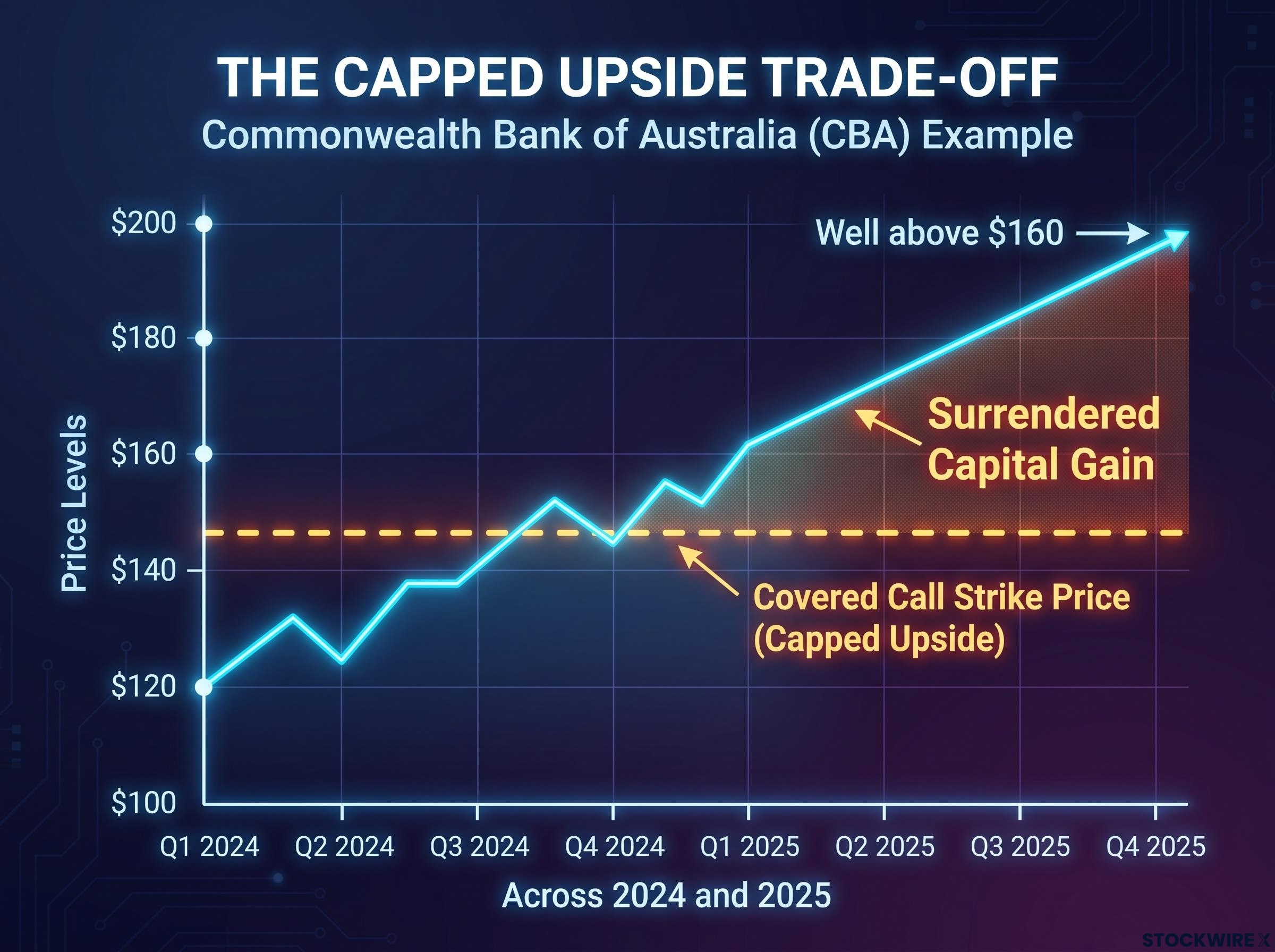
That is the mechanism in plain terms. Sell a call, and you cap your participation above the strike. If the shares are called away, you miss every dollar of appreciation beyond strike plus premium.
CBA is not an isolated case. Post-pandemic rebounds in the major banks and commodity booms involving BHP and Rio Tinto produced exactly the kind of sharp rallies that leave covered-call returns well short of simple buy-and-hold.
The long-run performance of option-selling strategies across nearly two decades of Cboe data confirms the same pattern the CBA example illustrates at the single-stock level: lower volatility and smaller drawdowns come at the cost of a meaningful compounding gap versus simple equity exposure in sustained bull markets.
The CBA example carries a specific lesson. If the shares in your own portfolio have just had a strong run, writing calls now could lock in exits at prices that look conservative in hindsight, and you need to decide how much of that risk you are prepared to wear.
When capped upside is a reasonable price to pay
The trade-off is not always costly. The practitioners at Fairway Capital Management acknowledge their approach underperforms in sharply rising markets, but argue those conditions are less frequent than volatile or flat ones.
Capped upside is a reasonable price to pay when the environment suits it:
- Flat or range-bound markets, where premium income meaningfully boosts returns and the foregone upside is small.
- Large, stable ASX-20 names trading at stretched valuations, where further near-term appreciation looks limited.
- Income-priority investors who are genuinely indifferent to having shares called away at a pre-set price.
When forced purchase risk bites in cash-covered puts
The cash-covered put carries a mirror-image risk, and it is different in character. Here the danger is not missing an upswing but being dragged into a falling market.
If the stock drops below your strike, you can be forced to buy it at the strike price even as the shares keep sliding. You acquire the stock at a level that is no longer attractive, and you sit on unrealised losses comparable to direct equity ownership, only from a worse entry point. The premium softens the blow, but it does not remove it.
What Australian tax rules and ASIC guidance mean for these strategies
For Australian investors, the regulatory and tax layer is not background noise. It directly shapes the after-tax return and determines whether these strategies suit the way you are structured.
Start with the tax distinction that matters most here. Option premiums received are generally treated as assessable income, but they carry no franking credits. For investors accustomed to the tax shelter of franked dividends, that is a meaningful gap.
Franking credits sit at the centre of this trade-off for Australian investors, because a fully franked dividend can be worth materially more than its headline cash amount when the grossed-up value and potential ATO refund are counted, and replacing that income with unfranked option premium requires a careful like-for-like comparison before the switch makes sense.
What the ASIC warning actually targets ASIC Media Release 26-193MR (13 August 2026) warned retail investors about short-dated exchange-traded options, stating they “use leverage” and are “highly susceptible to time decay.” The warning is aimed at short-dated, leveraged ETO use. It does not describe fully covered, longer-dated positions, which occupy a different risk category.
The regulator has been building this posture for a while. ASIC Regulatory Guide RG 282, issued 7 November 2025, sets design and distribution obligations for exchange-traded products, reinforcing the expectation that complex products reach appropriately defined target markets.
The franking question lands hardest for specific investors. For a self-managed super fund (SMSF) in pension phase, franking credits on dividends can be highly valuable, so replacing franked dividend income with unfranked option premium could reduce the fund’s effective after-tax yield even if the gross income rises. That trade-off deserves to be modelled by a tax adviser before anything is implemented.
Record-keeping is the other practical trap. Common errors include misclassifying premium as dividend income and failing to track cost bases when shares are called away or put to you, both of which create problems at tax time.
Drawing on ASIC and ASX education materials, these strategies are framed as appropriate only for investors who can tick the following boxes:
- You understand how ETOs work, including assignment and exercise.
- You can afford a genuine capital loss on the underlying shares.
- You have clear investment objectives, not a vague hunt for yield.
- You can tolerate capped upside on calls and forced purchases on puts.
- You are not treating the position as set-and-forget income.
If several of those statements do not describe you, the regulator’s view is that the strategy probably does not fit.
Deciding whether a premium income overlay fits your portfolio
So where does this leave you? Covered calls and cash-covered puts are overlay strategies, layered on top of share or cash positions you already hold. They are not replacements for dividend investing, and treating them as one is the first mistake to avoid.
Before implementing either, work through these questions honestly:
- Do you own, or want to own, the ASX-20 or top 50-60 names with established ETO series? If not, the strategy is simply unavailable to you.
- Are you genuinely indifferent to having shares called away, or committed to buying more at a fixed price? If either outcome would unsettle you, reconsider.
- Have you modelled the after-tax result against your current franked dividend income? Gross premium can look attractive while net income goes backwards.
- Is the expected premium after costs meaningfully higher than your current income? Complexity, monitoring, and tax reporting are real costs that erode net returns.
The profile matters. An investor who already owns CBA, BHP, and Westpac and is comfortable selling at a target price is a natural candidate to evaluate these strategies now. An investor holding those same names primarily for franked income and long-term growth should run the after-tax numbers carefully first.
Timing plays a role too. At a cash rate of 4.60%, the interest-on-cash leg of a cash-covered put strategy is meaningfully income-productive at this point in the cycle, which strengthens the case for put-writing relative to a lower-rate environment.
Investors exploring how covered calls and cash-covered puts combine into a continuous income cycle will find our full explainer on the options wheel strategy covers how elevated interest rates change the return equation for the cash collateral leg.
As a reference point on positioning, Fairway Capital Management’s stance as at August 2026 showed an active focus on financials ahead of major bank reporting season, with three of the four major banks reporting in November 2026, and a cautious view on resources following a strong run.
This article is for informational purposes only and should not be considered financial advice. Investors should conduct their own research and consult with financial professionals before making investment decisions.
Past performance does not guarantee future results. The examples cited are illustrative and subject to market conditions and various risk factors.