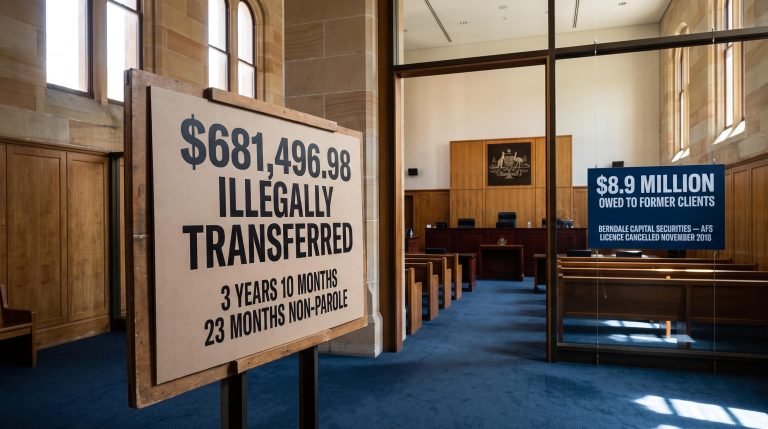
On 6 August 2026, a NSW District Court judge sentenced Usman Siddiqui, the sole director of Equitable Financial Solutions Pty Ltd (EFSOL), to six years and six months’ imprisonment for siphoning $1.75 million from a company that already owed its clients more than $20 million.
The victims were members of Australia’s Muslim community who trusted a Sharia-compliant finance provider with their savings. The company was almost certainly insolvent for more than three years before Siddiqui made the transfers, and ASIC pursued the case over four years, from passport seizure to conviction. That combination of community harm, deliberate fiduciary betrayal, and sustained regulatory effort makes this one of the most significant white-collar criminal outcomes in Australia this year.
Here is what Siddiqui actually did, who was hurt and by how much, what the law says about this kind of conduct, and what the outcome signals for Australian directors and investors watching from the outside. No legal training required.
A $1.75 million diversion while creditors waited for $20 million
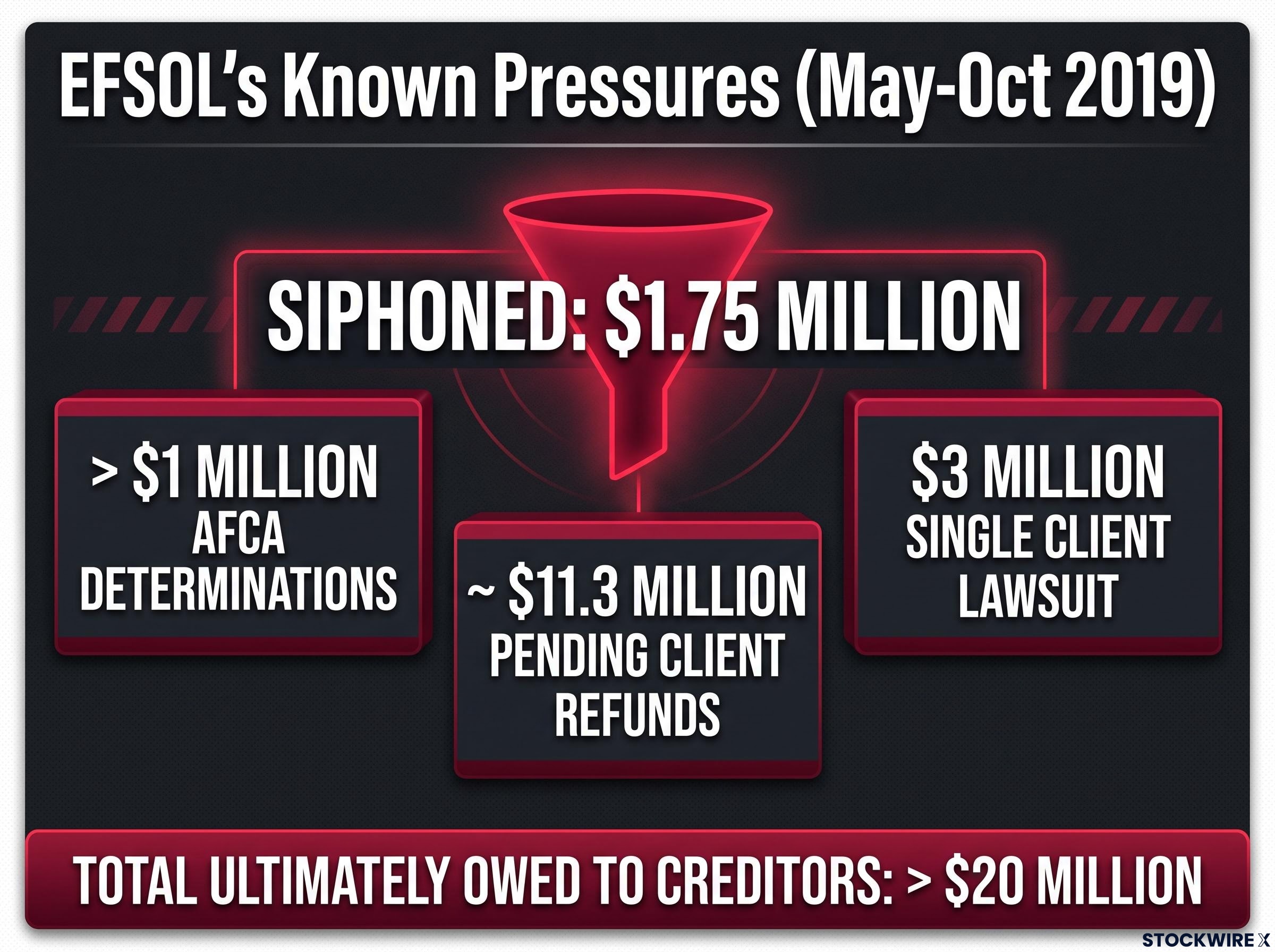
During the period from May to October 2019, Siddiqui moved approximately $1.75 million out of EFSOL’s accounts, routing the funds first into accounts held in his own name and then into accounts he controlled offshore. His guilty plea covered two counts under section 184(2)(a) of the Corporations Act 2001 (Cth), and a third related offence was brought before the court and factored into the sentencing outcome.
The transfers were not impulsive. When Siddiqui moved the money, he already knew about all three of the financial pressures bearing down on the company:
- AFCA determinations exceeding $1 million: the Australian Financial Complaints Authority had by mid-2019 issued multiple adverse rulings against EFSOL adding up to more than that figure
- Pending client refund obligations: clients were owed approximately $11.3 million in investment refunds that the company had not yet returned
- A single client had filed proceedings in court to recover an investment of $3 million from the company
That timing is what separates this case from financial desperation or poor judgement. Siddiqui moved money out while being fully aware of the obligations piling up, and both the court and ASIC treated that awareness as central to the seriousness of the offending. The court heard evidence of four separate instances captured in the original charges, a pattern of conduct rather than a single lapse.
When big ASX news breaks, our subscribers know first
The clients who lost most: a community built on trust in Sharia-compliant finance
EFSOL’s client base consisted largely of Australian Muslims who sought financial products structured around Islamic finance principles. These were clients who chose EFSOL specifically because it offered Sharia-compliant credit and investment services, a niche with limited alternatives in the Australian market.
Liquidation proceedings began on 26 November 2019, with Grant Thornton appointed as liquidator, and by February 2020 the total amount owed to creditors had been assessed at more than $20 million.
The disproportion matters: Siddiqui personally diverted $1.75 million. The total debt owed to creditors stood at more than $20 million.
The liquidators’ assessment concluded that EFSOL had in all likelihood crossed into insolvency on or around 1 July 2016, a date sitting more than three years before Siddiqui executed the fund transfers. That finding tells you clients were not just defrauded at the end; they may have been placing money into an already-failing business for years, which compounds the harm well beyond the amount Siddiqui personally took. When victims are drawn together by shared religious identity and have limited alternative providers, misconduct like this causes outsized community damage.
What section 184 of the Corporations Act actually means for directors
The Corporations Act imposes a layered framework of duties on company directors. Sections 180 to 183 establish the civil tier: duties of care and diligence, good faith, proper use of position, and proper use of information. Breach these, and you face civil penalties, compensation orders, or disqualification from managing corporations.
Section 184 sits above that. It is the criminal tier, reserved for conduct involving proven dishonesty. Section 184(2)(a) specifically targets directors who dishonestly use their position to gain an advantage for themselves or to cause detriment to the corporation. The maximum penalty is 15 years’ imprisonment.
| Provision | Type | Standard | Maximum consequence |
|---|---|---|---|
| Sections 180-183 | Civil | Care, diligence, good faith, proper use of position/information | Pecuniary penalties, compensation, disqualification |
| Section 184 | Criminal | Dishonesty proven beyond reasonable doubt | Up to 15 years’ imprisonment |
Criminal prosecutions under section 184 are comparatively rare. ASIC more commonly pursues civil remedies under sections 180 to 183, so when ASIC refers a matter to the Commonwealth Director of Public Prosecutions (CDPP) for prosecution under section 184, the alleged conduct sits at the most serious end of the spectrum the law contemplates for corporate misconduct. For investors and business operators, that distinction matters: a section 184 conviction is qualitatively different from a civil penalty or disqualification order.
Director liability in Australia operates on two simultaneous tracks: criminal proceedings under section 184 run independently of any civil penalty the company itself faces, meaning a custodial sentence against Siddiqui does not close the door on separate civil recovery actions against him personally.
Four years from passport seizure to prison: how ASIC built the case
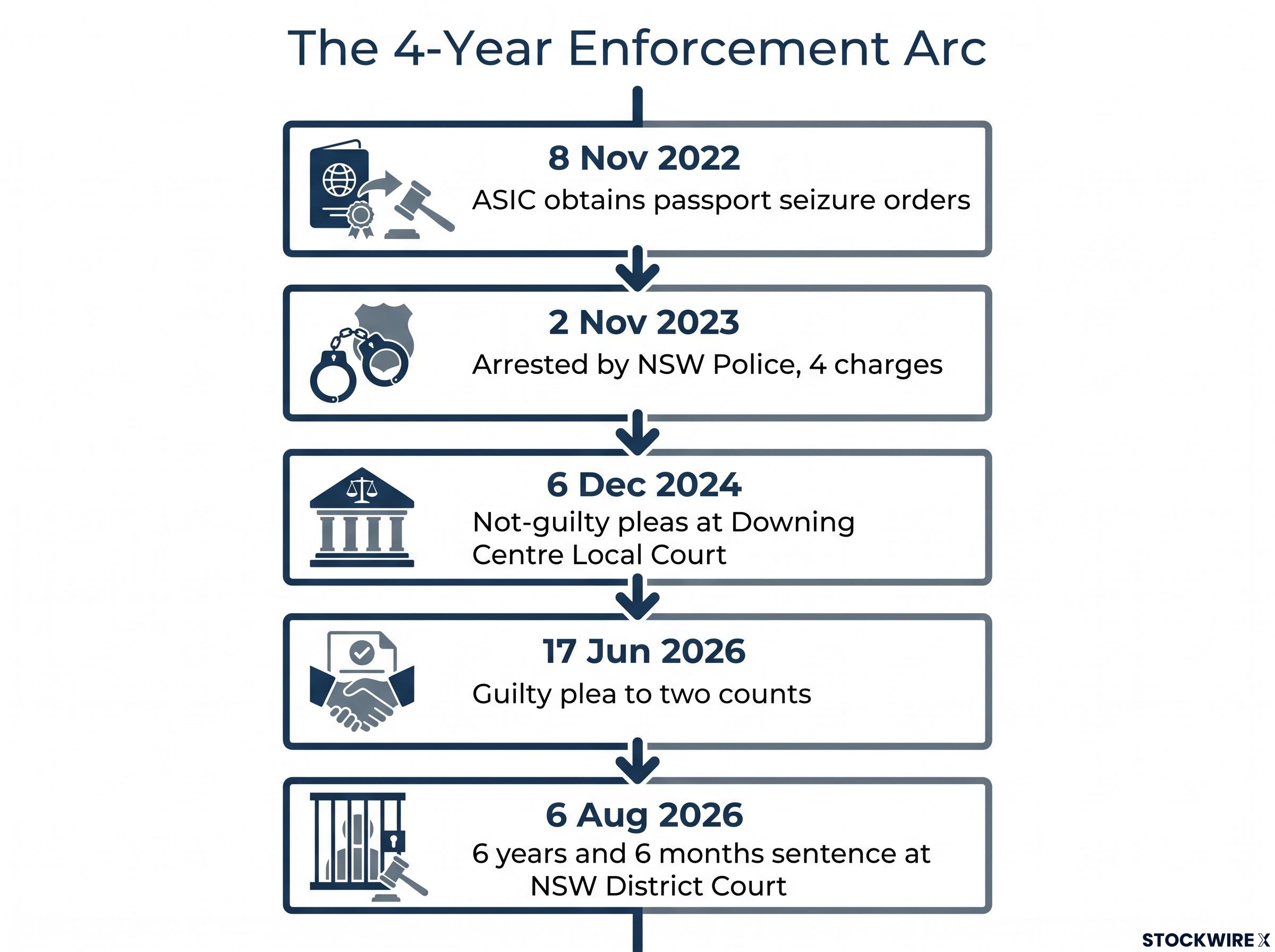
The enforcement arc stretched across nearly four years, with each step representing an escalation in pressure:
- 8 November 2022: ASIC obtained Federal Court orders restraining Siddiqui from leaving Australia and requiring surrender of his passport, the first public signal of a serious investigation
- 2 November 2023: NSW Police arrested Siddiqui; ASIC charged him with four counts of contravening section 184(2)(a)
- 6 December 2024: Siddiqui entered not-guilty pleas to all four counts at the Downing Centre Local Court and was committed to stand trial
- 17 June 2026: Siddiqui pleaded guilty to two counts ahead of a trial date relisted for 27 July 2026; the trial did not proceed
- 6 August 2026: Judge Anderson SC handed down a sentence of six years and six months’ imprisonment in the NSW District Court, with a non-parole period of three years and three months
ASIC Chair Sarah Court framed the outcome as a deterrence signal to directors, stating that those who misuse their position for personal advantage will face regulatory action.
That four-year timeline tells you something about how ASIC approaches serious white-collar crime. The process is methodical, not dependent on a quick resolution. Anyone who assumes complex financial fraud is too difficult to prosecute should note the persistence of the enforcement machinery behind cases like this one.
ASIC enforcement priorities for 2026 explicitly name financial services alongside gaming and superannuation as sectors where large, complex governance proceedings are a standing commitment, providing the broader regulatory backdrop against which the Siddiqui prosecution sits.
What the sentence signals about deterrence and director accountability in Australia
Judge Anderson SC emphasised three factors in sentencing:
- The misconduct was deliberate and calculated, not an inadvertent lapse in judgement
- The dishonest conduct occurred across multiple separate occasions, rather than being confined to a single act
- General deterrence is assigned particular prominence when sentencing white-collar offenders whose conduct is conscious and causes substantial harm
The sentence of six years and six months, with a non-parole period of three years and three months, sits at roughly 43% of the 15-year statutory maximum under section 184. For a first-time offender, that proportion is a clear signal from the courts. Serious fiduciary betrayal, especially against a vulnerable client base, will not attract a token penalty.
The case adds to a pattern of ASIC pursuing criminal referrals under section 184 for the most serious director misconduct, reinforcing that civil penalties and disqualification are not the ceiling. For investors, the deterrence framing matters because it signals that the regulatory and judicial system is prepared to treat complex financial fraud as a serious criminal matter rather than a civil compliance issue. That should inform how you assess governance risk in the companies you hold.
The Siddiqui sentence is one of two significant custodial outcomes handed down in Australia within weeks: the Federal Court sentenced the former Berndale Capital Securities director to nearly four years for misappropriating retail client funds and filing false statements with ASIC, reinforcing that courts across jurisdictions are treating director-level financial misconduct against clients as warranting real imprisonment.
What this case tells Australian investors about governance risk in niche financial providers
EFSOL’s collapse illustrates a structural vulnerability: a sole director with unchecked control over accounts, targeting a community with high trust and limited alternatives, operating in a specialist product niche with lower mainstream visibility.
The multiple AFCA determinations against EFSOL before its collapse were a live signal that something was wrong. More than $1 million in adverse determinations had been issued before the fund transfers took place. Complaint escalation is a governance signal, not just a consumer remedy mechanism, and multiple adverse determinations at a single provider warrant scrutiny before committing further funds.
If you interact with smaller or community-focused financial providers, four verifiable markers reduce governance risk:
- ASIC licence status: confirm the provider holds an active Australian financial services licence
- AFCA membership and complaints history: check for patterns of adverse determinations
- Independent director or oversight structure: a sole-director model concentrates control and removes internal checks
- Audited financial statements: independent audits provide a baseline assurance of financial health
This article is for informational purposes only and should not be considered financial advice. Investors should conduct their own research and consult with financial professionals before making investment decisions.
A custodial sentence, a $20 million shortfall, and the limits of after-the-fact enforcement
The sentence is a meaningful enforcement outcome. ASIC’s multi-year pursuit demonstrates that complex financial fraud cases can reach criminal conviction in Australia. The CDPP secured a custodial term that sits well above a token penalty, and Sarah Court’s public statement framed it as a deterrence message aimed at every serving director.
But imprisonment does not restore the $20 million owed to creditors. The community of Australian Muslim investors who trusted EFSOL face losses that the criminal justice system cannot reverse.
More than $20 million in creditor claims remained outstanding as at February 2020. The $1.75 million Siddiqui diverted was the final act in a much longer story of corporate failure.
That gap between the criminal conduct and the total harm is the honest reality of after-the-fact enforcement. The sentence changes the calculus for future directors. It does not change the outcome for these creditors. Proactive governance scrutiny, the kind that catches the warning signs before the money moves, matters more than any post-collapse prosecution. ASIC’s deterrence message is most valuable if it changes director behaviour before the harm occurs.
Investors wanting to understand how courts have applied the dishonesty counts across recent cases will find our full explainer on dishonest director convictions under the Corporations Act, which examines the Pellew jury verdict and the automatic disqualification consequences that attach the moment certain legal events occur.