Most Australian retail investors spend hours comparing ETF expense ratios, scanning fund performance charts, and reading product reviews. The decision that actually shapes the outcome of their portfolio, the split across asset classes, sits largely unexamined. They are optimising the wrong variable entirely.
The growth of retail ETF investing in Australia has made this imbalance worse, not better. Fund comparison tools, low-cost brokerage platforms, and an expanding universe of ASX-listed ETFs have made it easier than ever to get absorbed in product-level decisions. Asset allocation, the division of your capital across equities, bonds, property, cash, and other asset classes, gets treated as a background assumption rather than the active decision it should be.
Here is what the academic evidence shows actually drives your long-term portfolio results, and here is how to apply that sequencing to an Australian portfolio. If you have recently compared ETFs without first setting a deliberate allocation, this is the framework that puts the more consequential decision back in front.
The research case for allocation over selection
You probably suspect that choosing between two similar ETFs matters less than the financial product industry implies. The academic evidence confirms that suspicion, and the numbers are more lopsided than most investors expect.
The foundational research is the Brinson, Hood and Beebower study (commonly referred to as BHB), whose central finding was that the variation in portfolio returns across time is attributable to asset allocation by a margin exceeding 90%. That finding has been tested, replicated, and cited across the global investment industry for decades. The specific figures from Australian sources reinforce it:
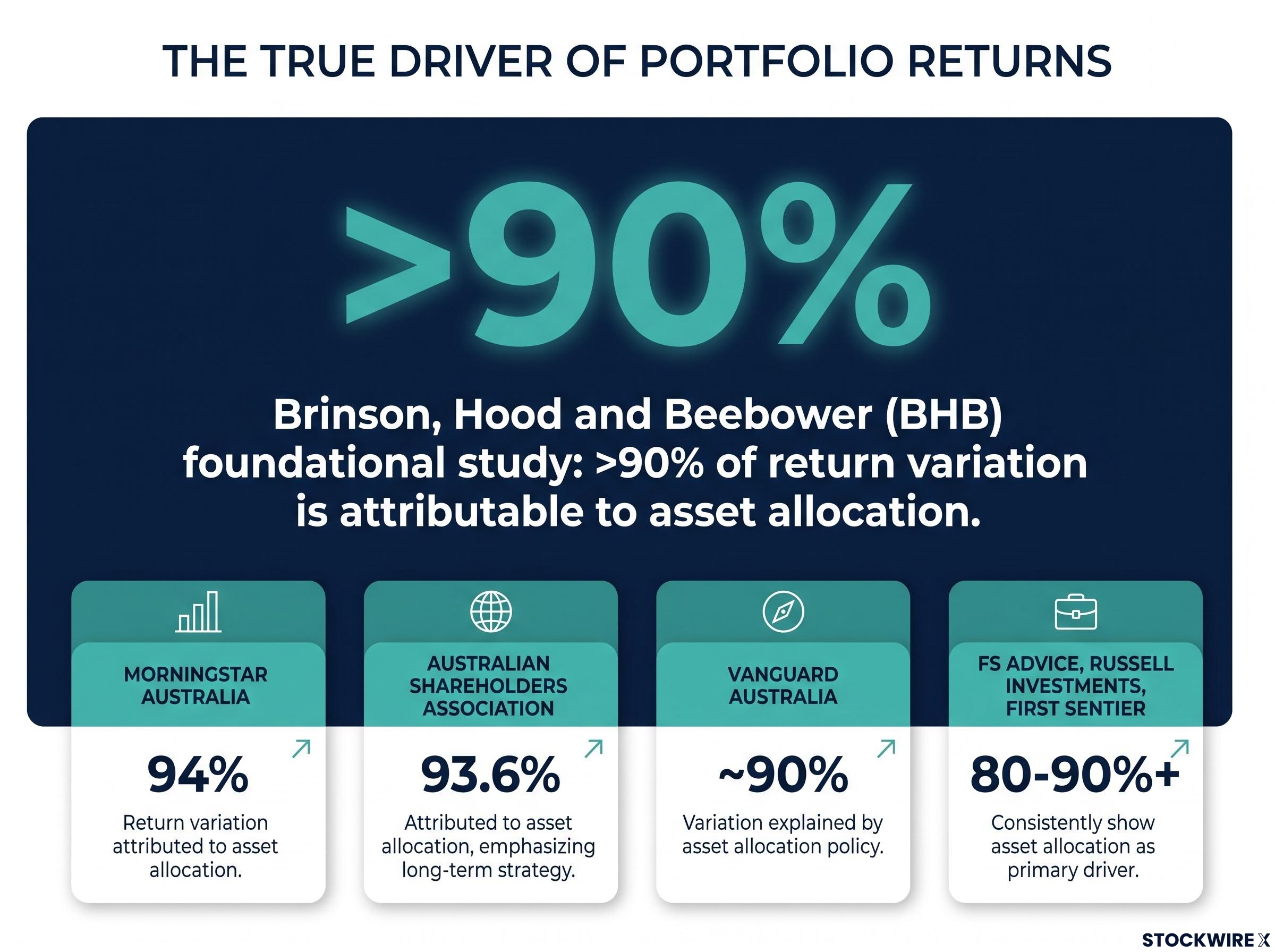
- Morningstar Australia cites BHB at 94% of return variability explained by allocation decisions
- The Australian Shareholders Association cites 93.6% of investment returns attributable to asset allocation
- Vanguard Australia, analysing local balanced funds specifically, puts the figure at approximately 90%
This is not only US data applied to Australian conditions. The Vanguard finding draws directly on Australian balanced fund performance, making it immediately relevant to your portfolio. Broader Australian industry analysis from FS Advice, Russell Investments, and First Sentier consistently places the figure at 80-90% or higher.
The compounding implication for you is direct: the hours spent comparing ETF performance records and management fees are being applied to a variable that explains, at most, a single-digit percentage of your long-term outcome. The allocation decision you may not have formally made is driving the rest.
Compounding over long horizons amplifies the allocation effect substantially: the second decade of an investment generates nearly double the dollar gains of the first decade on the same initial capital, which is why a misallocated portfolio costs more in absolute terms the longer it runs uncorrected.
Jess Leung, portfolio manager at Global X ETFs, highlights that the biggest driver of your investment journey is not which ETF or stock you select, but the broader portfolio decisions around how assets are divided. In her view, your allocation should reflect your own financial objectives and the goals you are genuinely working toward.
When big ASX news breaks, our subscribers know first
What asset allocation actually means (and what it does not)
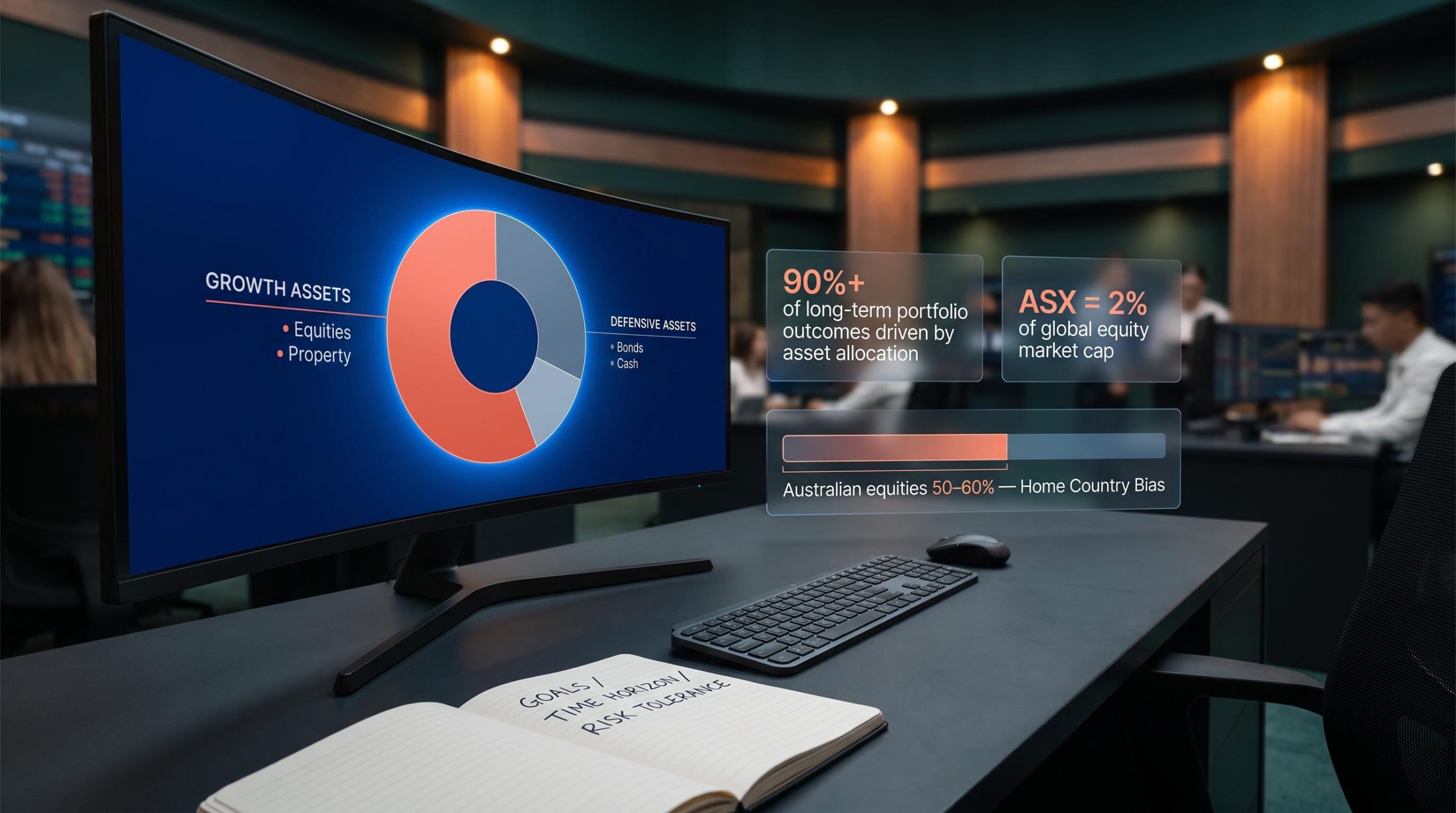
Asset allocation is the decision about how your capital is divided across asset classes. The primary axis is growth versus defensive: growth assets (equities and property) carry higher expected returns and higher volatility, while defensive assets (bonds and cash) offer lower expected returns with greater stability.
Morningstar defines it as the mix of growth and defensive assets and calls it “the single biggest driver of long-term returns.” IG and PIMCO describe it as the process of balancing risk and return by investing across equities, fixed income, and cash.
Within each category, further allocation decisions determine how your money is distributed. These are allocation-level choices, not fund-selection choices.
| Asset class | Category | Common Australian vehicle |
|---|---|---|
| Australian equities | Growth | ASX-listed ETF, superannuation option |
| International equities | Growth | ASX-listed international ETF |
| Property | Growth | A-REIT ETF, direct property |
| Government bonds | Defensive | Bond ETF, superannuation option |
| Corporate bonds | Defensive | Bond ETF, direct bond |
| Cash | Defensive | High-interest savings, cash ETF |
What allocation is not
Asset allocation is not the comparison of individual funds, ETFs, or securities within an asset class. It is not about picking sectors or timing markets. The decision of whether to hold 60% or 80% in equities is categorically more consequential than whether those equities are accessed through fund A or fund B.
Vanguard Australia makes the sequencing explicit: identify the appropriate asset mix first, then select products to gain exposure to that mix.
The three questions that should drive every allocation decision
Before you compare a single fund, your allocation needs to be anchored to your personal circumstances. These are not abstract planning exercises. They are the inputs that produce an allocation you will actually hold through volatile markets.
- What are you trying to achieve? Saving a deposit in three years, funding retirement two decades away, and building a university fund for a child in twelve years require entirely different portfolio structures. Your objective determines the return you need and the level of volatility you can absorb along the way.
- How long is your investment horizon? Longer timeframes give a portfolio more opportunity to recover from sharp falls, which generally supports a larger weighting to growth assets. As the horizon shortens, the case for defensive assets strengthens because recovery time becomes more constrained.
- What is your genuine capacity for risk? This is where most investors are least accurate with themselves, and the consequences of underestimating it are more severe than underestimating either of the other two.
IG structures its recommended process in this exact order: define goals, assess risk tolerance, choose asset classes, select investments, then monitor and rebalance. LGT Wealth Management links allocation directly to goals, risk tolerance, and investment horizon. The sequence is not optional. It is the mechanism that connects your personal circumstances to a portfolio structure.
Why your risk tolerance on paper is not your real risk tolerance
There is a gap between what you mark on a risk questionnaire and what you do during a 30-40% drawdown. Financial capacity for risk (your ability to absorb losses based on your time horizon and income) is one thing. Emotional capacity for risk (whether you will panic-sell when your portfolio drops by a third) is something else entirely.
An allocation that maximises expected return in a spreadsheet but causes you to liquidate during a market crisis is not a functional allocation. The tolerable allocation is the one you will actually hold through volatility, not the one that looks best in a projection.
Emotional risk tolerance is consistently the most underestimated variable in portfolio construction: research shows that around 30.9% of investors who sold during a major market downturn never re-entered equities, permanently forfeiting the recovery gains that a held allocation would have captured.
If you have chosen your current ETFs without first formally answering these three questions, your allocation is the product of defaults and convenience rather than a deliberate decision. This framework shows you how to reverse that.
Home country bias and the four layers of Australian overexposure
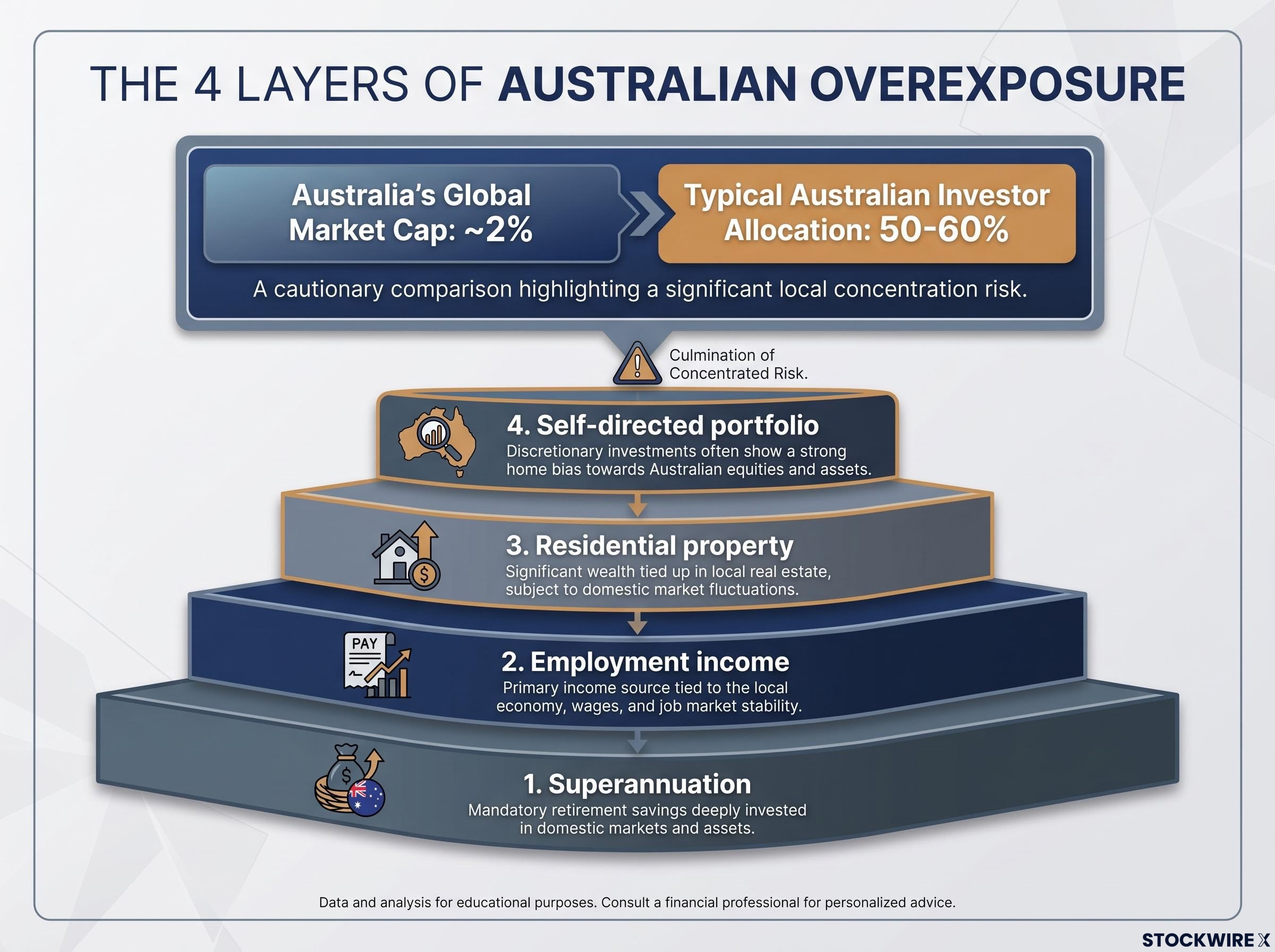
While Australia accounts for roughly 2% of total global equity market capitalisation, a significant number of Australian investors carry 50-60% of their overall portfolios in domestic assets.
That gap is the signature of home country bias, and for most Australians it has not been arrived at through deliberate portfolio construction. It is the cumulative result of unconsidered defaults rather than an active choice.
The home bias return cost is quantifiable rather than theoretical: over the decade to June 2025, the ASX 200/300 delivered annualised returns of 11.1% including franking credits, trailing the MSCI World at 12.5% and the S&P 500 at 15.5%, with Morningstar confirming the franking credit offset does not close the gap for growth-oriented investors.
The concentration runs deeper than most investors realise, because domestic exposure accumulates across four separate channels simultaneously. Each one, on its own, may seem reasonable. Together, they create a level of concentration most investors have never consciously accepted.
| Channel | How it creates domestic concentration |
|---|---|
| Superannuation | Default options commonly hold significant Australian equity allocations, giving you domestic exposure before you make a single investment decision |
| Employment income | Your salary is tied to the performance of the Australian economy; a domestic downturn can reduce your income at the same time it reduces your portfolio |
| Residential property | For most Australians, the largest single asset they own, entirely anchored to local economic and property market conditions |
| Self-directed portfolio | Often also tilted toward ASX-listed securities, compounding the domestic concentration already present in the other three channels |
When you account for all four channels together, a domestic economic contraction does not damage a single corner of your financial life in isolation. Your superannuation falls, your employment income comes under pressure, your property value declines, and your investment portfolio contracts, each of these driven by the same underlying Australian conditions. Holding exposure across four separate vehicles that all respond to the same economic forces is not diversification. It is a concentrated position in one country’s fortunes, arrived at by accumulation rather than intention.
Vanguard Australia emphasises that international diversification is not a preference; it is a structural requirement to mitigate domestic sector and country risk.
Why the ASX alone cannot do the job
Even if you set aside the home country bias argument entirely, the structural composition of the ASX limits what a domestic-only portfolio can access.
The ASX 200 is heavily weighted toward two sectors:
- Financials (major banks and insurers)
- Resources (mining and energy companies)
These sectors carry significant weight in the index, leaving limited representation of:
Vanguard Australia on home country bias confirms that Australian-listed companies represent only around 2% of global equity market capitalisation by value, while the ASX itself is dominated by the top 10 companies accounting for more than 46% of the market’s total value, concentrated overwhelmingly in banks and miners.
- Technology (the index has negligible exposure to the major global software and hardware businesses that dominate world markets)
- Global healthcare (limited compared to US and European markets)
- Global consumer companies (the large consumer-facing multinationals that operate at scale internationally are largely absent)
Investors who hold only domestic equities have substantial exposure to cycles in banking and commodities, and almost no exposure to entire segments of global economic growth. The missing sectors are not niche. They represent some of the largest and most consequential businesses in the world.
Reframing international exposure as portfolio correction, not speculation
The conventional framing of international investing as a speculative add-on inverts the logic. A domestic-only portfolio is the concentrated position. It is a bet on two sectors within a market that represents 2% of global equity capitalisation.
Adding international equities does not add risk in the way many investors assume. It moves your portfolio toward a more neutral, market-weighted baseline that reflects the actual breadth of the global economy. Vanguard Australia and other major Australian managers are explicit on this point: a diversified mix including international exposure is not an optional enhancement. It is a structural requirement for a well-constructed portfolio.
For investors ready to act on that reframe, our comprehensive walkthrough of investing in international shares from Australia covers the specific ETF combinations, tax handling, and portfolio sizing decisions that translate an allocation target into a working international sleeve.
For you, the reframe is consequential. Choosing not to hold international equities is not a neutral default. It is an active decision to concentrate in a narrow, sector-heavy index, and most Australian investors have made this decision without framing it that way.
The allocation-first sequence that changes how you build a portfolio
The entire argument of this article collapses into a single practical shift: the order in which you make decisions.
- Define what you want your portfolio to achieve, over what period, and what volatility you can genuinely live with. Record these answers in writing. Be rigorous about the emotional dimension of risk tolerance, not just the financial arithmetic.
- Determine your target allocation across growth and defensive assets, and across domestic and international markets. This is the variable that accounts for 90%+ of your long-term outcome. Derive it from the answers you recorded in step one.
- Identify the specific ETFs or funds that will deliver exposure to each allocation bucket. This is the point at which fund comparison becomes a meaningful exercise, and it is considerably more straightforward because you are selecting the most cost-effective vehicle for a clearly defined exposure rather than assembling a portfolio from products upward.
Vanguard Australia makes the sequencing explicit: identify the appropriate asset mix first, then select products to gain exposure to those assets.
Fine-tuning ETF expense ratios within a well-constructed allocation is a legitimate second-order optimisation. Doing it before the allocation is set is solving for a variable that explains a fraction of your outcomes while leaving the dominant variable unaddressed.
Your next concrete action is not to find a better ETF. It is to write down your goal, your time horizon, and your honest risk tolerance, and then derive your target allocation from those answers before you look at a single fund.
The question worth asking before you compare another ETF
The sequencing error is the root cause of most allocation problems for Australian retail investors. Correcting it does not require sophisticated financial knowledge. It requires a deliberate shift in the order of decisions: allocation first, product selection second.
The Australian-specific stakes sharpen the urgency. Home country bias, the structural limits of the ASX, and the four channels of domestic overexposure are not inevitable features of your portfolio. They are the product of decisions made by default, and they are reversible through deliberate allocation review.
You now have the evidence base, the framework, and the specific Australian context to audit your own allocation before you return to fund comparison. That audit is the more impactful use of your time.
This article is for informational purposes only and should not be considered financial advice. Investors should conduct their own research and consult with financial professionals before making investment decisions.