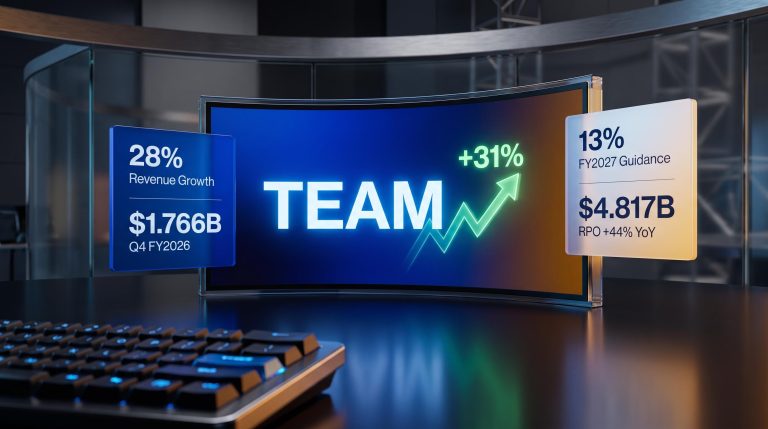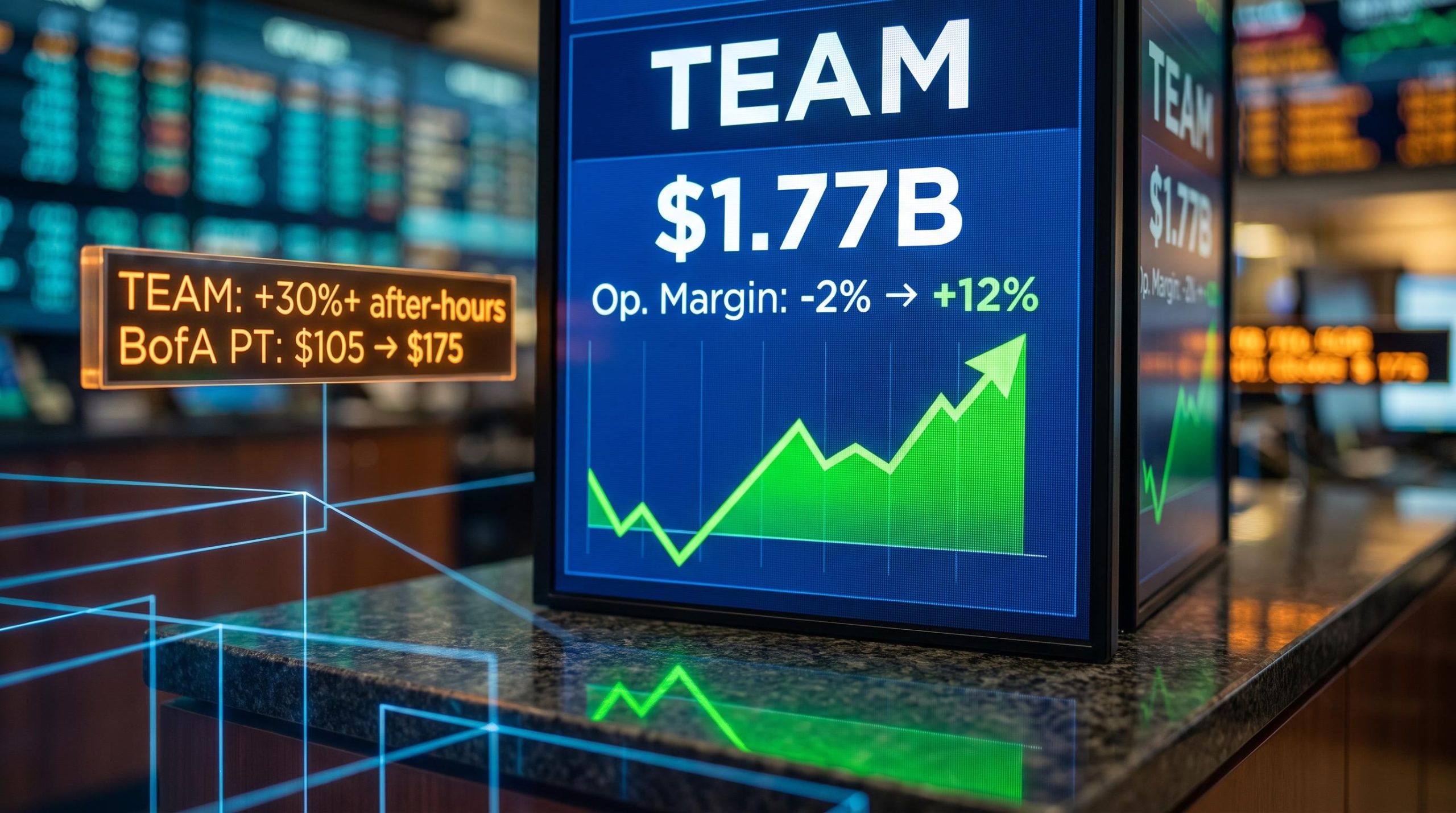
For most of 2026, enterprise software stocks were priced as AI casualties. Atlassian had shed around 32% year-to-date through the close on 6 August, with the market treating its collaboration tools as the kind of niche functionality that AI copilots would absorb into broader suites. Then the company reported fiscal Q4 results after the bell, and the stock jumped more than 30% in a single after-hours session.
The narrative had been durable for a reason. Earlier earnings from ServiceNow and IBM had reinforced the bear case, and the logic was structurally sound: if large language models could handle project management prompts and customer workflows natively, why would enterprises keep paying for standalone SaaS products? That question held the sector down for months.
Two earnings reports in two days broke the consensus. Shopify posted 34% revenue growth on 5 August, and Atlassian followed with a beat so large it prompted Bank of America to shift its rating to Buy and lift its price target by 67% in a single note. Here is the framework for understanding which software names AI is actually strengthening, which remain exposed, and which specific stocks analysts are flagging as the next re-rating candidates.
Two quarters that cracked the AI disruption consensus
The numbers tell the story before any interpretation is required.
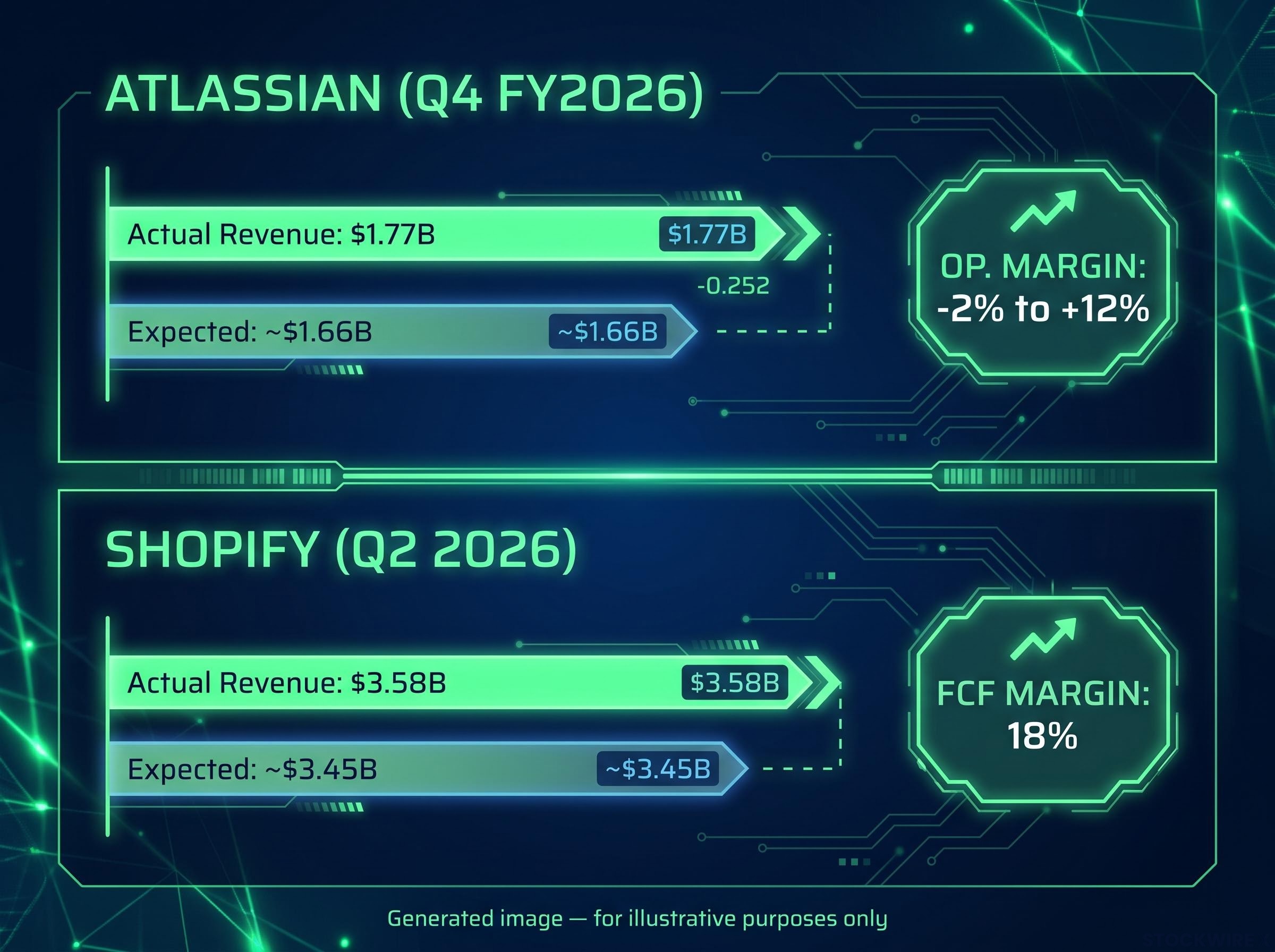
Atlassian delivered fiscal Q4 2026 revenue of $1.77 billion, representing growth of around 28% year over year and comfortably ahead of the analyst consensus sitting near $1.66 billion. Adjusted earnings per share reached $1.87, well above the $1.50 the market had pencilled in, and nearly double the $0.98 reported a year earlier.
The margin signal: Atlassian’s operating margin swung from -2% to +12% year over year, the single data point that most directly undercuts the “AI is compressing software margins” thesis.
Shopify had already started cracking the consensus the day prior. Q2 2026 revenue hit $3.58 billion, a 34% year-over-year increase, with gross merchandise volume (GMV, the total value of goods sold through its platform) reaching $115.6 billion. Free cash flow of approximately $654 million translated to an 18% margin.
| Company (Period) | Revenue (Actual vs. Expected) | YoY Growth | Key Margin Metric | Stock Reaction |
|---|---|---|---|---|
| Atlassian (Q4 FY2026) | $1.77B vs. ~$1.66B | ~28% | Op. margin: -2% → +12% | +30%+ after-hours |
| Shopify (Q2 2026) | $3.58B vs. ~$3.45B | 34% | FCF margin: 18% | +17% (5 Aug); 20-25% premarket |
After closing at $110.17 on 6 August, the stock was showing a pre-market indicated price of $144.61 as of the morning of 7 August. A stock does not move 30%-plus on a modest beat. That magnitude of reversal, from a 32% year-to-date drawdown, tells you the market was not just adjusting estimates. It was repricing a structural thesis.
The software selloff selectivity theme had been visible in the data before Atlassian reported: more than 75% of software application and infrastructure companies in the Morningstar US Technology Index were in negative territory year-to-date, but the spread between the top and bottom deciles had reached a record 133 percentage points, signalling sharp investor discrimination within the sector.
When big ASX news breaks, our subscribers know first
Why AI became the sector’s biggest headwind in the first place
The bear case was coherent, and investors who held it were not being irrational given the information available through the first half of 2026. It rested on three pillars:
- Suite absorption: AI copilots embedded in horizontal platforms like Microsoft 365 and Teams would subsume the functionality of niche tools such as Jira and Confluence, reducing the need for standalone SaaS contracts.
- Build-your-own displacement: AI-native startups would allow enterprises to construct custom workflows, bypassing expensive incumbent software entirely.
- Margin and pricing compression: The combined effect would structurally compress growth rates and pricing power for legacy vendors, making current valuations unsustainable.
Prior earnings had reinforced this view. ServiceNow and IBM results earlier in the cycle had stoked disruption fears and pulled software valuations down across the sector, giving investors additional reasons to stay underweight. HSBC had published a contrarian research note titled “Software Will Eat AI” contending that the sector was undervalued and that enterprise software companies faced less AI risk than the market was pricing in, but those arguments lacked hard earnings corroboration until Atlassian reported.
Platforms that qualify as systems of record carry a structural advantage here: AI agents executing multi-step enterprise tasks depend on authoritative, incumbent data sources to function, making displacement far harder than the bear case assumed.
Understanding the bear case matters because dismissing it as obvious in hindsight misses the point. These results are more significant precisely because the thesis they dismantled was grounded in structural logic, not just sentiment.
The mechanism that flips AI from threat to tailwind
Why context is AI’s real bottleneck
Large language models are powerful general-purpose tools, but they are context-blind. An LLM can draft a project update, but it cannot know which sprint your engineering team is in, which tickets are blocked, or which customer escalation needs to be routed first, unless it has access to the structured, up-to-date data that sits inside operational platforms.
That is the bottleneck. The algorithms are commoditising rapidly. The proprietary workflow and transaction data that makes AI outputs useful in specific enterprise settings is not. Platforms sitting at the centre of project management, HR, customer relationship management, and e-commerce transaction flows become the distribution layer that AI runs on, not the layer it replaces.
Atlassian’s specific proprietary asset in this context is the Teamwork Graph, a structured map of how teams, projects, and knowledge connect across an organisation’s entire Atlassian instance. Bank of America pointed to it as a differentiated asset that rivals would find difficult to replicate quickly, and that assessment underpinned the decision to move TEAM from Neutral to Buy and raise the price target from $105 to $175.
Mizuho’s TMT specialist Jordan Klein put TEAM at the top of his watch list in a note published after the results, singling it out as his standout name of the session. He argued the stock remained attractively priced even after the rally, citing metrics of roughly 5x EV/Sales and 16x EV/Free Cash Flow as cheap given the underlying growth rate.
The same logic applies to Shopify. On the Q2 call, management attributed part of its outperformance and guidance confidence to AI-driven features improving merchant conversion and operating efficiency. AI is augmenting the platform’s transaction data, not routing around it.
The Teamwork Graph and Shopify’s merchant transaction layer are not talking points. They represent structural barriers that prevent generic AI tools from replicating what these platforms deliver, and that barrier is why Bank of America moved its price target 67% in a single note.
Which names could be next to re-rate
The mechanism established above, platforms that own structured workflow data becoming AI distribution layers rather than AI casualties, provides the evaluative lens for identifying the next re-rating candidates. Two names have already been flagged specifically.
Named by analysts as near-term re-rating candidates:
- Datadog (DDOG): Provides unified observability across infrastructure, applications, and security. AI workloads generate more complex, higher-volume infrastructure signals, which deepens monitoring needs and platform usage rather than reducing it. The mechanism parallels Atlassian’s: AI workloads depend on Datadog’s observability layer.
- Snowflake (SNOW): Its Data Cloud functions as a staging ground for enterprise AI. Customers centralise data there to train, fine-tune, or power retrieval-augmented generation (RAG) applications, a technique where AI models pull from a company’s own data to generate more accurate, context-specific answers. The more serious enterprises get about AI, the more they need governed, centralised data infrastructure.
| Company | Key Data Asset | AI Mechanism |
|---|---|---|
| Datadog (DDOG) | Infrastructure and application telemetry | AI workloads increase monitoring volume and complexity |
| Snowflake (SNOW) | Centralised enterprise data cloud | AI training and RAG applications require governed data infrastructure |
Broader cohort to watch:
- Workday: Deeply embedded in HR workflows; re-rating depends on productising AI on top of people and payroll data.
- Salesforce: CRM data layer gives it AI distribution potential, but bundling competition from Microsoft is a direct headwind.
- ServiceNow: Its upcoming earnings are a specific near-term test, given prior results had moved sector sentiment negatively.
- Veeva: Life sciences workflow depth could make it a beneficiary, but the vertical is narrower.
Datadog and Snowflake are not the same bet as Atlassian. They need their own earnings validation. Treat Mizuho’s identification of them as a hypothesis to test against upcoming results, not a confirmed thesis.
Atlassian’s own forward guidance supports the broader narrative beyond a single quarter: management projected FY2027 cloud revenue growth of approximately 25.5% and total revenue growth of approximately 13%, with Q1 2027 guidance above consensus.
What the bull case still has to prove
Two earnings beats weakened the AI disruption thesis. They did not eliminate it. Three specific risks remain, and investors sizing positions need to evaluate each:
- Customer-segment bifurcation: Large enterprises may be ramping AI-driven software spend while SMB and mid-market customers remain cautious on renewals. Companies skewed toward smaller customers could still see pressure even as flagship names re-rate.
- Hyperscaler bundling: Microsoft, Google, and Amazon continue to bundle AI-enhanced productivity tools with cloud suites, encouraging customers to consolidate spend. This is a structural threat that plays out over years, not quarters, and was not resolved by two positive prints.
- Valuation dispersion: Atlassian’s 32% pre-earnings drawdown created room for a violent re-rating when results surprised. Names that did not de-rate as sharply may offer a different risk-reward profile, with less upside from “AI fear relief” and more downside if their own earnings fail to demonstrate the same dynamic.
Post-rally, Atlassian trades at approximately 5x EV/Sales and 16x EV/Free Cash Flow, according to Mizuho’s assessment. Whether significant upside remains depends on the durability of the growth trajectory embedded in the FY2027 guidance.
Investors who re-rate the entire sector based on two data points are making the same category error as those who dismissed it based on two bad prints earlier in 2026. The evidence has shifted, not settled.
Goldman Sachs’ Gabriela Borges had set a 2027 timeline for meaningful software outperformance, arguing that quantified AI revenue evidence, not narrative disclosures, is the only test that separates real fundamental stories from momentum trades; Atlassian’s margin swing and forward guidance now provide exactly the kind of concrete data point Goldman said the sector lacked.
A two-category framework for what comes next
HSBC’s “Software Will Eat AI” note now has concrete earnings results supporting its central argument for the first time. The question facing investors is no longer whether AI will kill enterprise software broadly, but which specific incumbents can prove, through results, that AI is expanding their moats and monetisation.
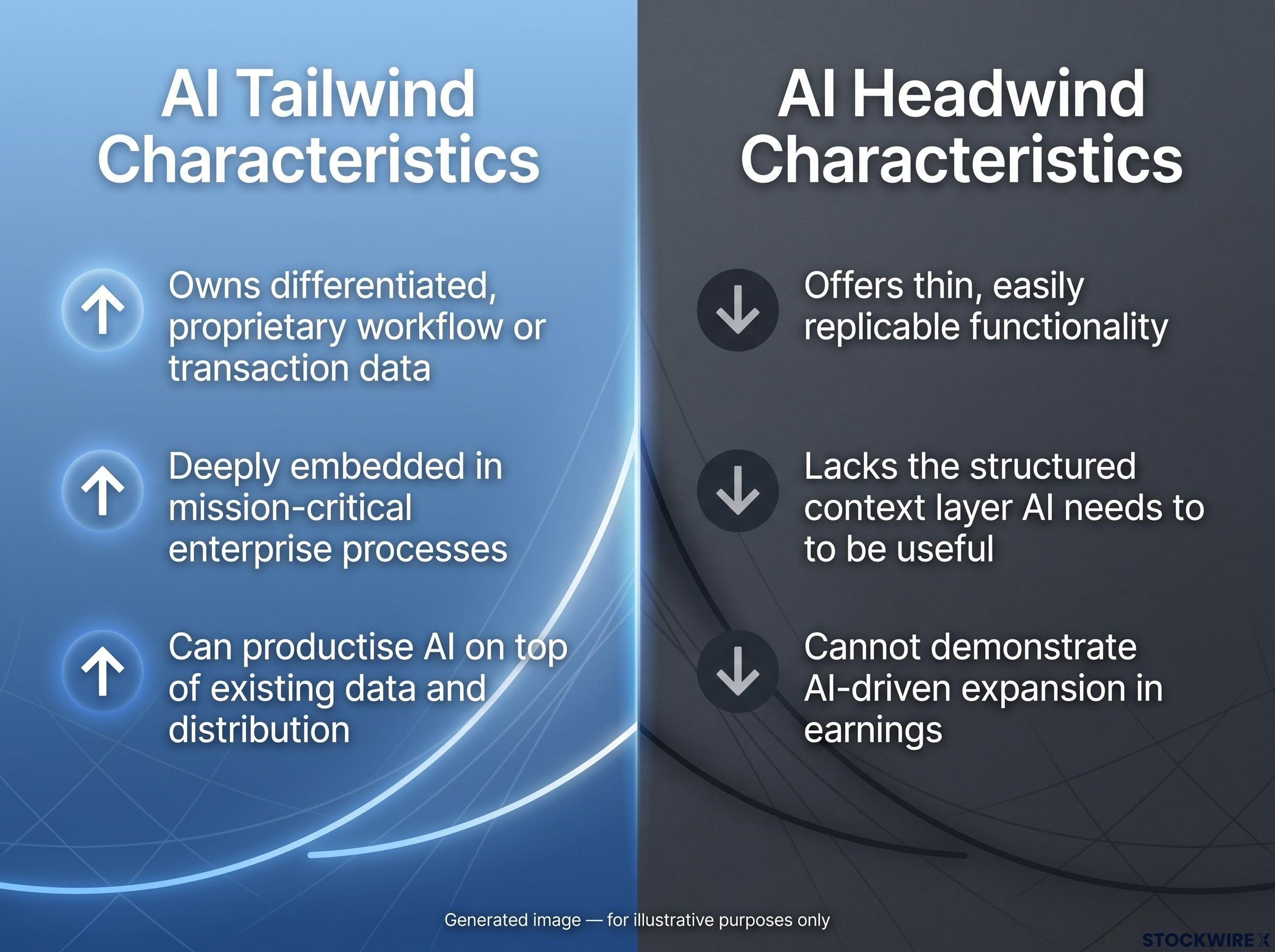
| AI Tailwind Characteristics | AI Headwind Characteristics |
|---|---|
| Owns differentiated, proprietary workflow or transaction data | Offers thin, easily replicable functionality |
| Deeply embedded in mission-critical enterprise processes | Lacks the structured context layer AI needs to be useful |
| Can productise AI on top of existing data and distribution | Cannot demonstrate AI-driven expansion in earnings |
Bank of America and Mizuho have both moved to reprice the sector based on this framework. The sell-side consensus is actively shifting, and the window between now and the next major software earnings cycle is when the market will debate how broadly to apply that shift.
ServiceNow’s upcoming results are the most immediate test. Prior ServiceNow earnings had moved sector sentiment negatively; a positive print using the same data-as-moat logic would widen the re-rating beyond two names.
The re-rating has started, but the earnings cycle will decide who it belongs to
Atlassian and Shopify delivered two concrete data points that upended the prevailing view of AI as a software sector threat. Taken together, the operating margin expansion, the revenue beats, the forward guidance, and the analyst upgrades all point toward the same conclusion: platforms with proprietary, structured workflow data are emerging as AI beneficiaries rather than victims of the technology.
The durability of the sector re-rating depends on what comes next. Datadog, Snowflake, ServiceNow, and others need to demonstrate the same mechanism in their own results. Until they do, this remains a two-company proof of concept, not a confirmed sector rotation.
The framework is now clear. The question investors should carry into the next earnings cycle is not whether AI will hurt software, but which platforms can prove, with numbers, that AI is deepening their moats and expanding their monetisation. Atlassian and Shopify answered that question. The rest of the sector is next.
For investors wanting to understand the infrastructure layer that enterprise AI runs on, our full explainer on Q1 2026 hyperscaler earnings covers Google Cloud’s 63% growth, AWS’s $364 billion backlog surge, and what record combined capex of $130 billion signals about AI demand durability.
This article is for informational purposes only and should not be considered financial advice. Investors should conduct their own research and consult with financial professionals before making investment decisions. Past performance does not guarantee future results, and forward-looking statements are subject to change based on market developments and company performance.