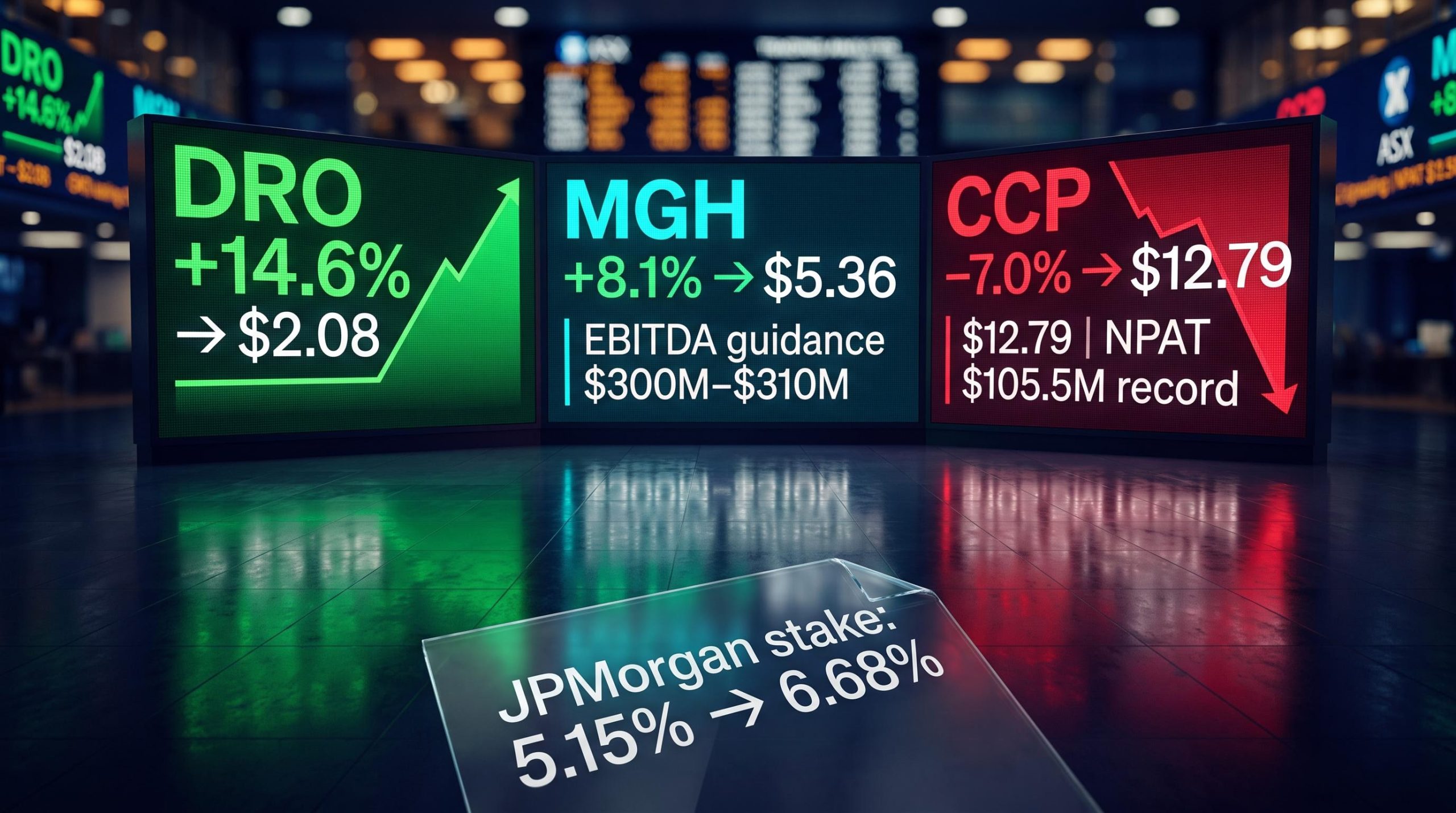
DroneShield jumped 14.6% on Tuesday without a single word of operational news. MAAS Group lifted its full-year earnings forecast by up to $60 million. Credit Corp fell 7% despite posting a record profit.
These three moves tell three different stories about how the ASX actually works during earnings season.
The broader market rally on 4 August 2026 provided a constructive backdrop, but the most instructive action was at the stock level. Institutional shareholding disclosures, data-centre-driven contract wins, and the gap between headline results and forward guidance each drove sharp price moves that reward careful reading over headline-chasing.
After this, you will know how to read a substantial holder notice for what it actually signals, why record profits can still send a stock lower, and which sector tailwinds are currently doing the heaviest lifting across the ASX. Each of today’s three headline movers gives you a concrete, reusable lesson for the rest of the August reporting period.
Why DroneShield surged 14.6% without any operational news
A 14.6% single-session gain to $2.08 made DroneShield (DRO) the largest mover among the ASX Top 300 on 4 August 2026. There was no earnings update, no contract announcement, no operational news of any kind.
The trigger was a substantial shareholder notice. A filing from JPMorgan Chase & Co. revealed that the bank’s ownership of DroneShield shares had moved from 5.15% up to 6.68%, crossing the 1% movement threshold that requires a fresh filing with the ASX.
JPMorgan’s DroneShield stake: increased from 5.15% to 6.68% per substantial shareholder notice dated 4 August 2026.
Here is the detail most investors missed: the bulk of JPMorgan’s DroneShield exposure has been structured through securities lending arrangements rather than straightforward long holdings. That means a meaningful portion of those shares is on loan to other market participants, often for short-selling purposes. When a large securities-on-loan position sits alongside broad institutional interest and defence sector demand, the conditions for squeeze-like price action are fertile.
Short squeeze mechanics help explain why the JPMorgan disclosure produced such a violent single-session move: when a large securities-on-loan position coincides with broad institutional interest, forced covering can amplify price action well beyond what any fundamental revaluation would justify.
DroneShield was not the only defence name to move without company-specific news:
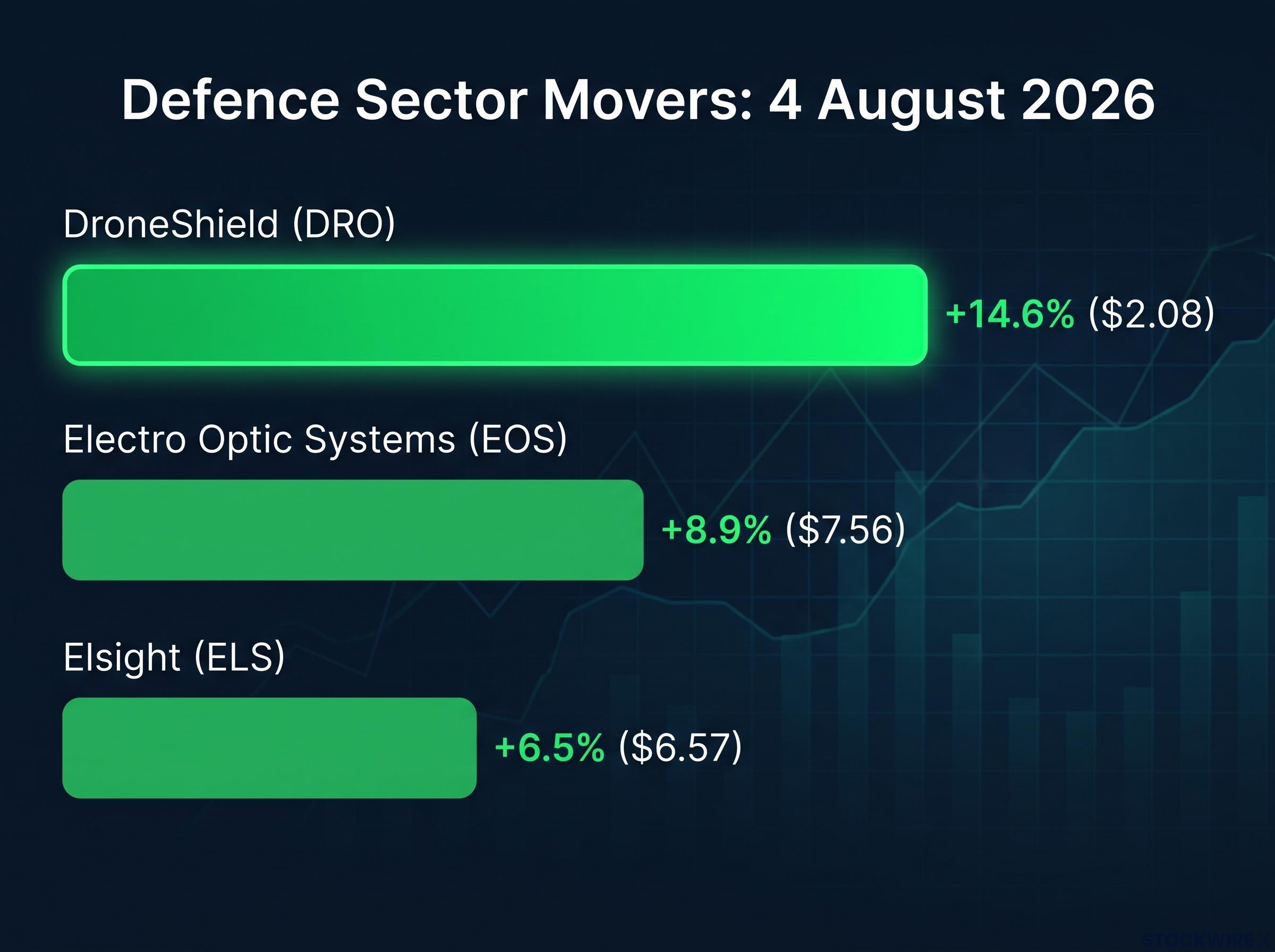
- DroneShield (DRO): +14.6% to $2.08
- Electro Optic Systems (EOS): +8.9% to $7.56
- Elsight (ELS): +6.5% to $6.57
The securities-lending structure in JPMorgan’s notice means you should not interpret this as straightforward institutional conviction buying. It tells you more about trading dynamics and short-side positioning than about a fundamental long-term view on DroneShield’s prospects.
When big ASX news breaks, our subscribers know first
What substantial holder notices actually tell you (and what they do not)
Under Australian law (the Corporations Act 2001), any entity that crosses the 5% ownership threshold in a listed company, or moves by 1% thereafter, must file a substantial holder notice with the ASX. These filings are publicly available and free to read. Most retail investors stop at the headline percentage.
ASX continuous disclosure rules set the legal architecture within which substantial holder notices, trading halts, and broker research all operate, and the gaps in that framework are precisely where retail investors are most exposed to asymmetric information.
That is where the misreading begins.
The difference between a long position and a securities lending arrangement
Securities lending is when the holder of a stock loans shares to a third party, typically a short-seller, in exchange for a fee. The original holder may retain economic exposure in some structures but transfers voting rights for the duration of the loan. A rising headline stake can therefore coexist with shares actively being used to bet against the company.
The practical framework for reading any substantial holder notice comes down to three steps:
- Identify the threshold trigger: Has the holder crossed 5% for the first time, or moved by 1% from a previously disclosed position?
- Check the nature of relevant interest breakdown: The notice must disclose whether shares are held as direct long positions, through derivatives, or via securities lending arrangements.
- Assess securities-on-loan versus direct long position: A notice showing a rising percentage via securities lending tells you something about liquidity and trading dynamics; it does not tell you the institution is accumulating with long-term conviction.
A substantial holder notice showing a rising stake is not automatically a buy signal. The DroneShield-JPMorgan example is a live reminder: check the nature of the interest before drawing any conclusion about institutional sentiment.
MAAS Group’s $60 million guidance lift and the data-centre catalyst behind it
MAAS Group Holdings (MGH) rose 8.1% to close at $5.36 on 4 August 2026, driven by an upward revision to its FY26 underlying EBITDA guidance. The numbers moved materially.
| Metric | Previous guidance | Upgraded guidance | Implied change |
|---|---|---|---|
| FY26 underlying EBITDA | $250M-$280M | $300M-$310M | +$40M-$60M at the midpoint |
Two distinct earnings levers drove the upgrade. One was a fair value uplift on MAAS’s stake in data-centre developer Firmus, where MAAS has committed a further $300 million, which came in ahead of expectations. The other was the award of new electrical infrastructure contracts totalling $855 million, generating a substantial near-term revenue pipeline.
$855 million: the value of a single electrical infrastructure contract win announced by MAAS Group, underscoring the scale of Australia’s data-centre construction pipeline.
This was not an isolated company event. SKS Technologies Group (SKS) also gained 8.1% to $8.64 on the same session, and Morgans retained its accumulate rating on SKS while lifting its price target to $9.40 from $8.95. Both stocks are leveraged to the same thematic: Australian data-centre construction is generating real, near-term earnings for specialist contractors, and the pipeline appears durable given continued AI and cloud infrastructure investment.
AI infrastructure investment is the structural driver behind both the MAAS Group contract pipeline and the parallel SKS Technologies re-rating, with Australia’s data centre capacity expected to more than double from 1,350 MW to 3,100 MW between 2024 and 2030, a build programme generating near-term earnings for specialist contractors across the market.
For you, the MAAS upgrade is less about one good day and more about what it confirms. The data-centre build-out is one of the more visible structural tailwinds running through the Australian market, and MAAS’s numbers give that thematic a concrete, earnings-backed anchor.
How Credit Corp fell 7% on a record profit
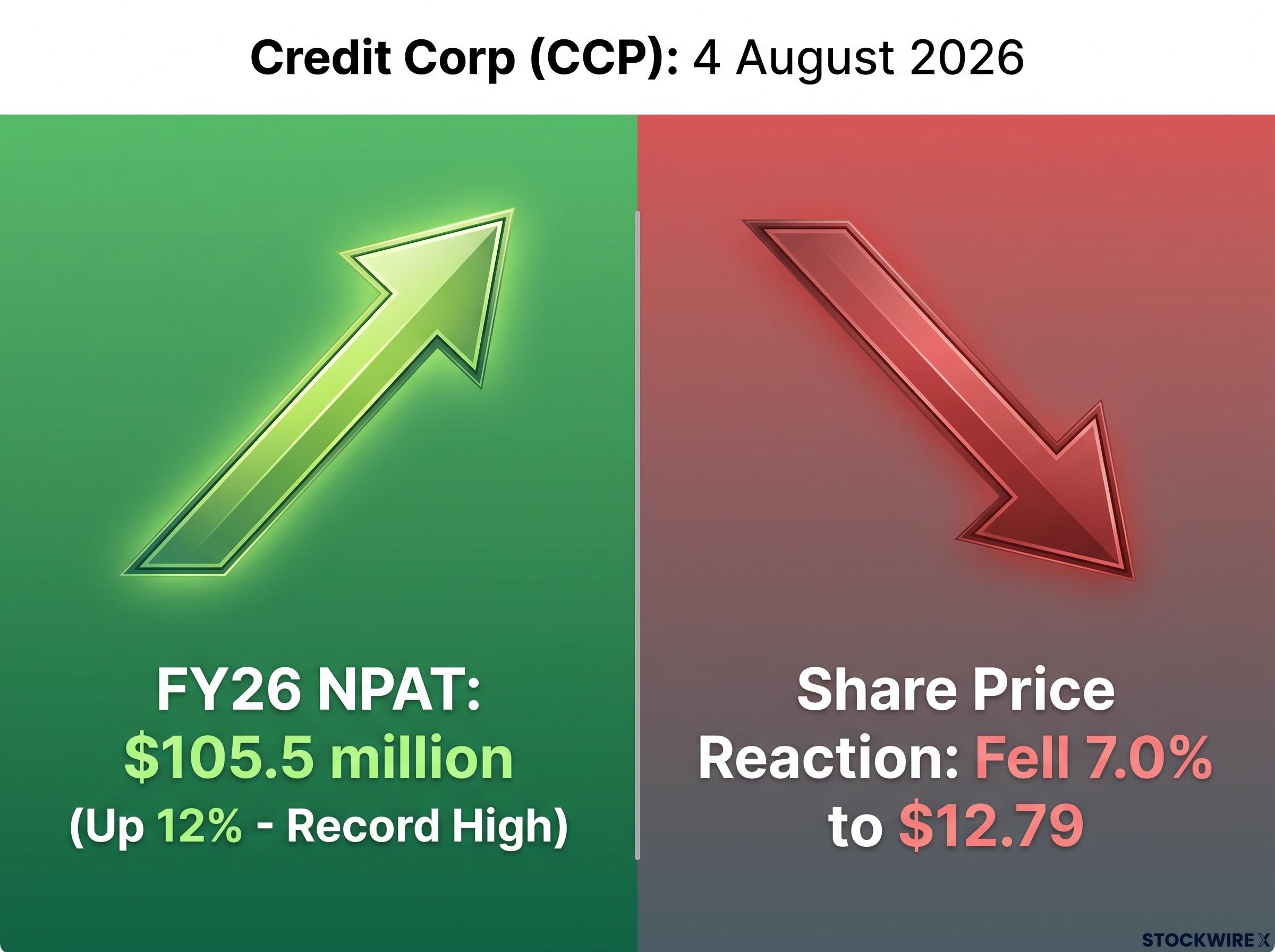
For FY26, Credit Corp Group (CCP) recorded net profit after tax of $105.5 million, representing 12% growth on the prior year and a new high for the company. Despite this, the shares dropped 7.0% to $12.79 on 4 August 2026.
The positive side of the ledger:
- Record NPAT of $105.5 million, up 12% year-on-year
- Continued growth in the Australian consumer lending book
The negative side:
- FY27 growth guidance came in below analyst consensus expectations
- First-half FY27 guidance was below estimates
- US debt-ledger purchasing was guided materially lower than FY26 levels, signalling constrained investment ahead
The market did not punish Credit Corp for the result it delivered. It repriced Credit Corp for the result it projected.
Why forward guidance matters more than the headline number during earnings season
Equity valuations are built on discounted future cash flows, which means analysts and fund managers are always comparing guidance against their prior models and consensus estimates. A result that clears the historical bar but misses the forward bar reprices the stock to reflect the downward revision to future earnings expectations.
This is among the most misunderstood dynamics in Australian equity markets, particularly for newer investors who treat “record profit” as an unambiguously positive signal. The Credit Corp case is a direct reminder: during earnings season, the market rewards or punishes the gap between guidance and consensus expectations, not the absolute size of the profit number.
Broker actions shaping near-term price ceilings and floors
Broker ratings are publicly reported and freely available, but most investors treat them as binary buy-or-sell signals. They are more useful as information about valuation range, analytical disagreement, and near-term price anchors.
| Company | Broker | Action | New target |
|---|---|---|---|
| FireFly Metals (FFM) | Moelis Australia | Downgrade to hold from buy | $1.90 (from $2.30) |
| The Lottery Corporation (TLC) | JPMorgan | Downgrade to neutral from overweight | $5.40 (from $5.70) |
| FDC Consolidated (FDC) | UBS | Initiation at buy | $4.15 |
| Northern Star (NST) | Goldman Sachs | Retained buy | $23.80 |
| Northern Star (NST) | RBC Capital Markets | Retained sector perform | $20.60 |
FireFly Metals (FFM) fell 8.9% to $1.70, compounding a reversal from a conference-driven rally the prior session. The Moelis downgrade added pressure to an already fragile trend. The Lottery Corporation (TLC) shed 3.6% to finish at $5.40 after JPMorgan cut its rating to neutral and set a price target matching the day’s closing price, leaving buyers with no implied upside.
On the initiation side, UBS launched coverage on FDC Consolidated Holdings (FDC) with a buy rating and $4.15 price target, the kind of new-coverage event that can shift the information landscape for a lesser-followed name.
The Northern Star Resources (NST) divergence is worth tracking: Goldman Sachs at buy with a $23.80 target sits more than $3 above RBC Capital Markets at sector perform with $20.60. That gap signals genuine analytical disagreement on one of the ASX’s largest gold producers.
Transurban’s clustered-neutral consensus: Citi neutral at $15.60, CLSA hold at $14.40, Jefferies hold at $13.69, Morgan Stanley equal weight at $14.68, Ord Minnett hold at $14.40, and UBS neutral at $14.50. Six brokers, all within a tight range, all neutral.
When multiple brokers independently converge on a neutral rating at similar price targets, that clustering tells you professional analysts broadly agree the stock is fairly valued at current levels. If you are considering a new position, that consensus defines the near-term ceiling you would be buying into.
Three disciplines for reading days like today
Today’s three headline stories are not isolated curiosities. They are recurring patterns that appear in some form on most active ASX trading days. The August reporting period intensifies all three.
The August reporting period arrives with an unusual backdrop: analysts forecasting 12% aggregate earnings growth, the strongest in four years, while investor sentiment has simultaneously collapsed to its most bearish reading in over a year, a combination that amplifies the price impact of any guidance miss or beat.
- Read substantial holder notices for the nature of the interest, not just the percentage. DroneShield surged 14.6% on an institutional disclosure, but JPMorgan’s securities-lending structure told a very different story from a straightforward long position. The “nature of relevant interest” section of any notice is where the real signal lives.
- Treat forward guidance and its relationship to consensus as the primary lens for interpreting results. Credit Corp posted a record $105.5 million profit and fell 7% because FY27 guidance disappointed. The market prices the future, not the past.
- Track sector thematics, because they lift stocks without specific news. MAAS Group’s $60 million guidance upgrade and SKS Technologies’ parallel move both trace back to the same data-centre infrastructure tailwind. Defence names rallied together for the same reason.
These are not abstract principles. They are specific reading habits applied to the ASX’s own public disclosure infrastructure, and the investor who develops them will interpret the market’s daily news flow more accurately than one who reads only the headline price moves.
This article is for informational purposes only and should not be considered financial advice. Investors should conduct their own research and consult with financial professionals before making investment decisions.