
Credit Corp delivers record NPAT of $106m in FY2026, lifts dividend 14%
In its FY2026 results presentation dated 4 August 2026, Credit Corp Group reported a record full-year net profit after tax (NPAT) of $106m, up 12% on FY2025.
Management outlined earnings per share (EPS) of 155.0¢, also up 12%, alongside a full-year dividend of 77.5¢, an increase of 14%. The company’s US debt buying segment stood out as the primary driver of the result. Looking ahead, management issued FY2027 NPAT guidance of $110–$118m, signalling continued growth.
When big ASX news breaks, our subscribers know first
FY2026 results at a glance
The presentation detailed a group financial scorecard showing revenue growth of 7% to $586.0m and NPAT growth of 12% across the three operating segments.
| Segment | FY2026 Revenue | FY2025 Revenue | FY2026 NPAT | Var % (NPAT) |
|---|---|---|---|---|
| AU/NZ debt buying & collection services | $220.6m | $219.9m | $23.4m | 5% |
| US debt buying | $150.5m | $125.9m | $26.2m | 57%* |
| AU/NZ lending | $214.9m | $199.8m | $55.9m | 3% |
| Total | $586.0m | $545.6m | $105.5m | 12% |
*US debt buying NPAT variance on a constant currency basis.
Headline group metrics reported included:
-
Gross financial assets grew 9% to $1,385m
-
Return on equity (ROE), at pro-forma 40% gearing, rose from 11.1% to 13.1%
-
EPS of 155.0¢ and dividend per share (DPS) of 77.5¢
The US business powered the record result
The presentation positioned US debt buying as the primary growth engine, with segment NPAT up 57% on a constant currency basis to $26.2m. Management attributed the improvement to rising productivity and a narrowing legal-effectiveness gap versus listed US competitors.
Key US segment highlights (in USD) included:
-
Collections up 24% to US$183m
-
Productivity per hour up 37% to US$334
-
Cost to collect improved to 36% (from 38%)
-
Asset turnover improved to 0.52 (from 0.48)
-
Payers book (face value) up 11% to US$338m
-
Acquired debt from 7 major sellers, up from 5
For investors, the segment’s contribution to returns was notable. On the ROE bridge, the US business added +2.3 percentage points to the group ROE uplift. Management flagged that US asset turnover is converging towards listed competitor levels, a signal of improving capital efficiency.
Record lending volume drives loan book to $510m
The AU/NZ consumer lending segment delivered a record lending volume of $424m, up 15%, and a record closing loan book of $510m. Segment NPAT rose 3% to $56m after absorbing increased growth investment.
The presentation detailed the following:
-
P&L investment in growth initiatives rose from $1m in FY2025 to $4.5m in FY2026
-
Realised credit losses of 15.5% and arrears remained within pro-forma
-
The wizit card and Powerup line of credit now account for 17% of new customer loan traffic
On geographic diversification, the presentation detailed the company’s UK market entry. Credit Corp acquired a “licensed shell” in FY2026 and issued its first loans in July 2026, targeting a large, underserviced UK sub-prime lending market with favourable economics.
Understanding Credit Corp’s business model
Credit Corp operates two core earnings engines. The first is debt buying, where the company acquires purchased debt ledgers (PDL), portfolios of credit-impaired consumer debts, at a discount and collects the amounts owed over time. A credit-impaired debt is one where the borrower has fallen behind on repayments.
The second engine is consumer lending to credit-impaired borrowers at annual percentage rates (APRs) below the cap applicable to mainstream credit. The company noted a “Regulatory upside, no ‘payday’ loans” positioning here.
Metrics such as asset turnover, cost to collect, and payment arrangement books matter because they indicate how efficiently the company converts its assets into cash and the durability of future collections. For investors, earnings quality rests on disciplined PDL pricing and consistent collection execution.
AU/NZ debt buying and the role of AI
AU/NZ debt buying NPAT rose 5% to $23.4m, aided by a one-off acquisition of a large performing book in February 2026, which lifted ledger investment 50% to $135.7m. Cost to collect improved to 44%, while asset turnover held steady at 0.78.
On artificial intelligence, management outlined a framework of centralised governance, a commitment to an enterprise toolset, and a mandatory “human-in-the-loop” approach. Wins to date span call summarisation, dialling execution, quality assurance call review, and overhead automation, each contributing to operational efficiency.
FY2027 guidance signals continued growth
The forward outlook management provided pointed to continued growth across the group’s segments.
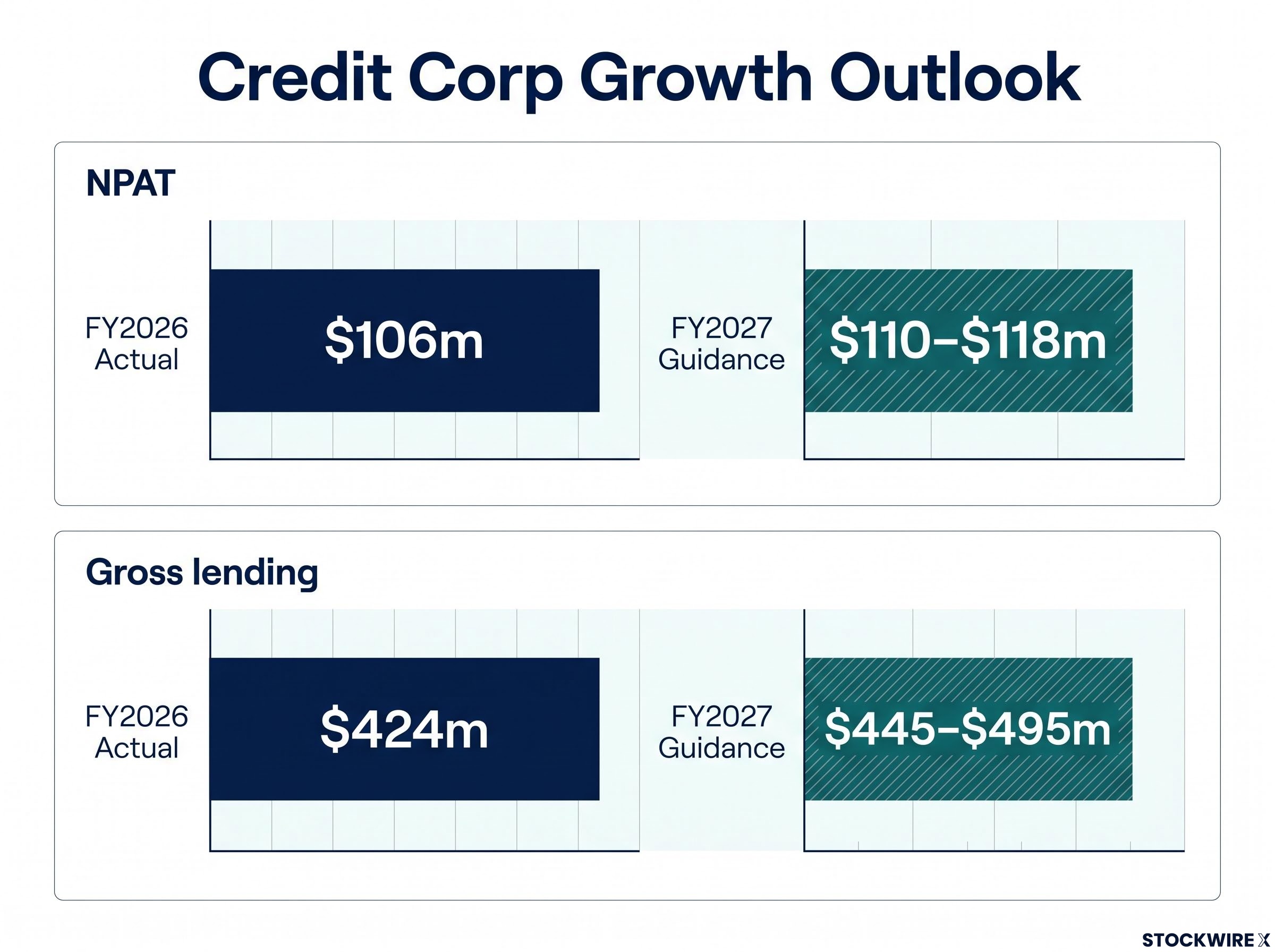
| Metric | FY2027 Guidance | FY2026 Actual |
|---|---|---|
| Ledger investment | $200–$280m | $302m |
| Gross lending | $445–$495m | $424m |
| NPAT | $110–$118m | $106m |
| EPS (basic) | 161–173¢ | 155¢ |
FY2027 ledger investment guidance comprises expected US purchasing of A$100–$130m and AU/NZ purchasing of A$100–$150m. Management flagged the following market context:
-
US supply has started to contract and price increases on larger tenders present headwinds, though collections have remained consistent since mid-2023
-
AU/NZ lending showed evidence of increased consumer demand in H2 FY2026
-
AU/NZ debt buying is seeing increased supply, offset by intensified competition from a new well-capitalised entrant
-
Expanded finance facilities with reduced margin are in place to fund opportunistic investment
Management commentary
Management Commentary
Management noted that Credit Corp’s strategic growth aspirations remain intact despite more challenging conditions in some markets, with purchasing discipline and operational improvement flagged as core responses.
Strategic aspirations intact
The presentation reinforced that long-term growth targets remain in place, including a total AU/NZ consumer loan book aspiration of $1bn, a UK book target of $400m+, and a US annual investment aspiration of US$200m+. Management restated a long-term ROE target of 16% alongside low-gearing discipline.
The Humm deal collapse in June 2026 left Credit Corp’s balance sheet entirely intact, with no acquisition debt, no integration risk, and no shareholder dilution, freeing the company to pursue opportunistic ledger investment within its stated gearing discipline.
The result presented record earnings, a growing dividend, and diversified growth engines spanning the US, AU/NZ, and a newly established UK market.
Stay Ahead on Finance Sector News
Big News Blast delivers FREE breaking ASX finance news directly to your inbox within minutes of release, complete with in-depth analysis already done. Join 20,000+ investors who never miss a market-moving announcement. Click the “Free Alerts” button at Big News Blast to start receiving alerts the moment news breaks.