


Credit Corp walks away from Humm acquisition bid
Credit Corp Group has formally ended discussions to acquire 100% of Humm Group Limited (ASX:HUM) after commercial due diligence raised a number of matters which it was unable to gain comfort on following further discussions with Humm. Credit Corp informed Humm on the evening of Friday 19 June 2026 that its bid was materially reduced relative to its non-binding indicative offer, effectively terminating the transaction.
Humm confirmed over the weekend that a mutually acceptable transaction could not be agreed between the two parties. Credit Corp ceased discussions entirely and announced the outcome on 22 June 2026 following Board authorisation.
The decision demonstrates disciplined capital allocation—Credit Corp chose to walk away rather than proceed on unfavourable terms. By not overpaying or accepting unresolved risks, management has protected shareholder value and preserved the company’s balance sheet flexibility for future opportunities.
When big ASX news breaks, our subscribers know first
What is an indicative proposal in M&A?
A non-binding indicative proposal is an expression of interest in acquiring a company, not a binding commitment to proceed. It signals preliminary intent and typically triggers a due diligence period where the prospective acquirer verifies assumptions before committing capital.
During this phase, the buyer examines the target’s financial performance, asset quality, operational risks, and regulatory compliance. It is common for bids to be revised—either upwards if the business exceeds expectations, or downwards if issues emerge. In some cases, the acquirer withdraws entirely.
When Credit Corp stated its bid was “materially reduced,” it signalled that due diligence uncovered matters significant enough to warrant a substantial downward revision. This language typically indicates the acquirer found financial, operational, or strategic concerns that undermined the original valuation.
Why due diligence matters for shareholders
Due diligence protects shareholders by ensuring acquisitions are based on verified information rather than preliminary assumptions. Key areas examined include:
- Financial performance verification: Validating revenue, earnings, and cash flow claims
- Asset quality and liability exposure: Assessing hidden liabilities or impaired assets
- Operational and integration risks: Identifying execution challenges post-acquisition
- Regulatory or compliance considerations: Uncovering legal or regulatory obstacles
Walking away from a transaction after due diligence is a normal and often prudent outcome. It demonstrates that management is willing to abandon a deal that does not meet internal thresholds, rather than proceeding with a value-destructive acquisition.
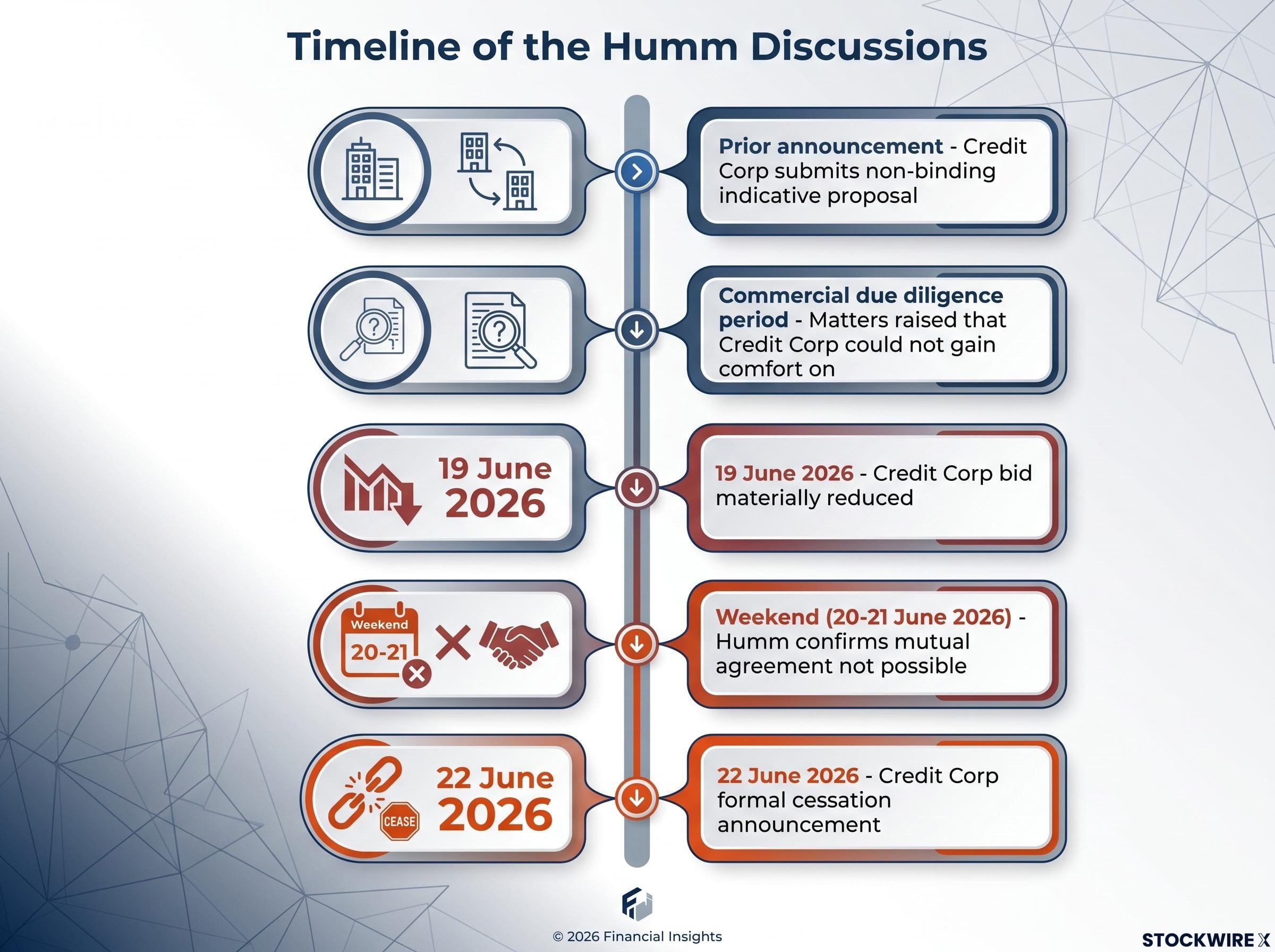
Timeline of the Humm discussions
| Date | Event | Party | Outcome |
|---|---|---|---|
| Prior announcement | Non-binding indicative proposal submitted | Credit Corp | Offer announced publicly |
| Commercial due diligence period | Matters raised that Credit Corp could not gain comfort on | Credit Corp | Concerns identified |
| 19 June 2026 | Bid materially reduced | Credit Corp | Revised offer communicated |
| Weekend (20-21 June 2026) | Confirmation of no deal | Humm | Mutual agreement not possible |
| 22 June 2026 | Formal cessation announcement | Credit Corp | Discussions ended |
What this means for Credit Corp shareholders
Credit Corp retains its capital and balance sheet flexibility following the termination. The company has no acquisition-related debt to service, no integration risk to manage, and no dilution from a transaction that did not meet internal hurdles.
Management can now redirect focus to organic growth and existing operations across its core debt purchasing and consumer lending businesses. The company remains positioned to pursue alternative opportunities if they arise, but without the overhang of an uncertain or dilutive deal.
Not proceeding with a transaction that did not meet strategic or financial thresholds demonstrates capital discipline. Shareholders avoid the risk of value destruction from an acquisition that failed to stack up during due diligence. The announcement was authorised by the Board, indicating formal closure of this chapter.
What happens next
Credit Corp has not signalled alternative acquisition targets or changes to its strategic priorities. The company continues to operate its core businesses without the distraction of an active M&A process.
No further transaction discussions with Humm are anticipated. The disciplined exit preserves optionality for future capital deployment while maintaining the financial strength to pursue organic growth or alternative transactions that meet the company’s investment criteria.
Stay Ahead on ASX Fintech and Financial Services News
Join 20,000+ investors receiving FREE breaking ASX news within minutes of release, complete with in-depth analysis. Click the “Free Alerts” button at StockWire X to get real-time alerts on major M&A developments, regulatory updates, and market-moving announcements the moment they break.