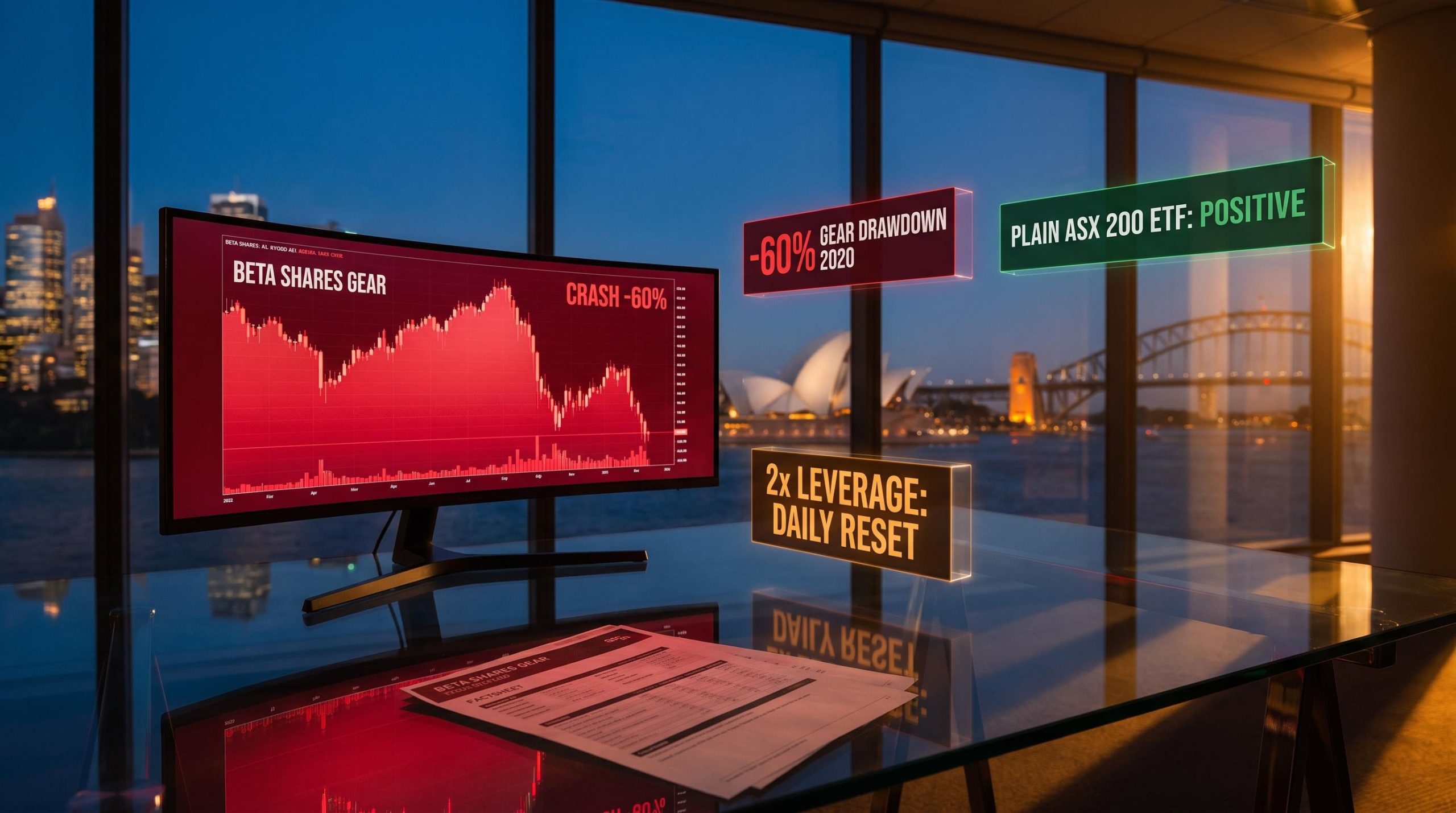
During the COVID-related selloff in early 2020, BetaShares GEAR, a geared fund tracking the S&P/ASX 200, lost more than 60% of its value and took well over a year to claw back those losses. A plain, ungeared ASX 200 ETF finished that same year in positive territory. Same index. Same twelve months. Radically different outcomes.
Interest in leveraged and geared ETFs has grown sharply among Australian retail investors, driven partly by the accessibility of ASX-listed products like GEAR and partly by offshore brokerage platforms that open the door to aggressive US-listed triple-leveraged funds. The mechanics that make these products behave so differently from ordinary index ETFs are not well understood, and the misunderstanding tends to cost people money.
Here is what you will actually understand after reading this: how leveraged ETFs work at a structural level, what the Australian-specific risks and regulatory guardrails look like, and how to think about position sizing if you decide to use them at all. Practical clarity, not a warning lecture.
How leveraged ETFs actually work (and how they differ from regular index funds)
A leveraged ETF targets a multiple of the daily return of an underlying index. The most common multiples are 2x and 3x. The fund achieves this amplified exposure through derivatives (futures and swaps) or, in the case of Australian geared funds like BetaShares GEAR, through borrowed capital that increases the size of the position relative to investor equity.
Knowing how ETFs work at a structural level, including the creation and redemption mechanism, unit trust structure, and ASX trading mechanics, provides the baseline from which the daily reset and leverage overlay of geared products become easier to assess against your actual investment goals.
The critical word in that description is “daily.” The target multiple applies to each individual trading day’s move, not to the cumulative return over weeks, months, or years.
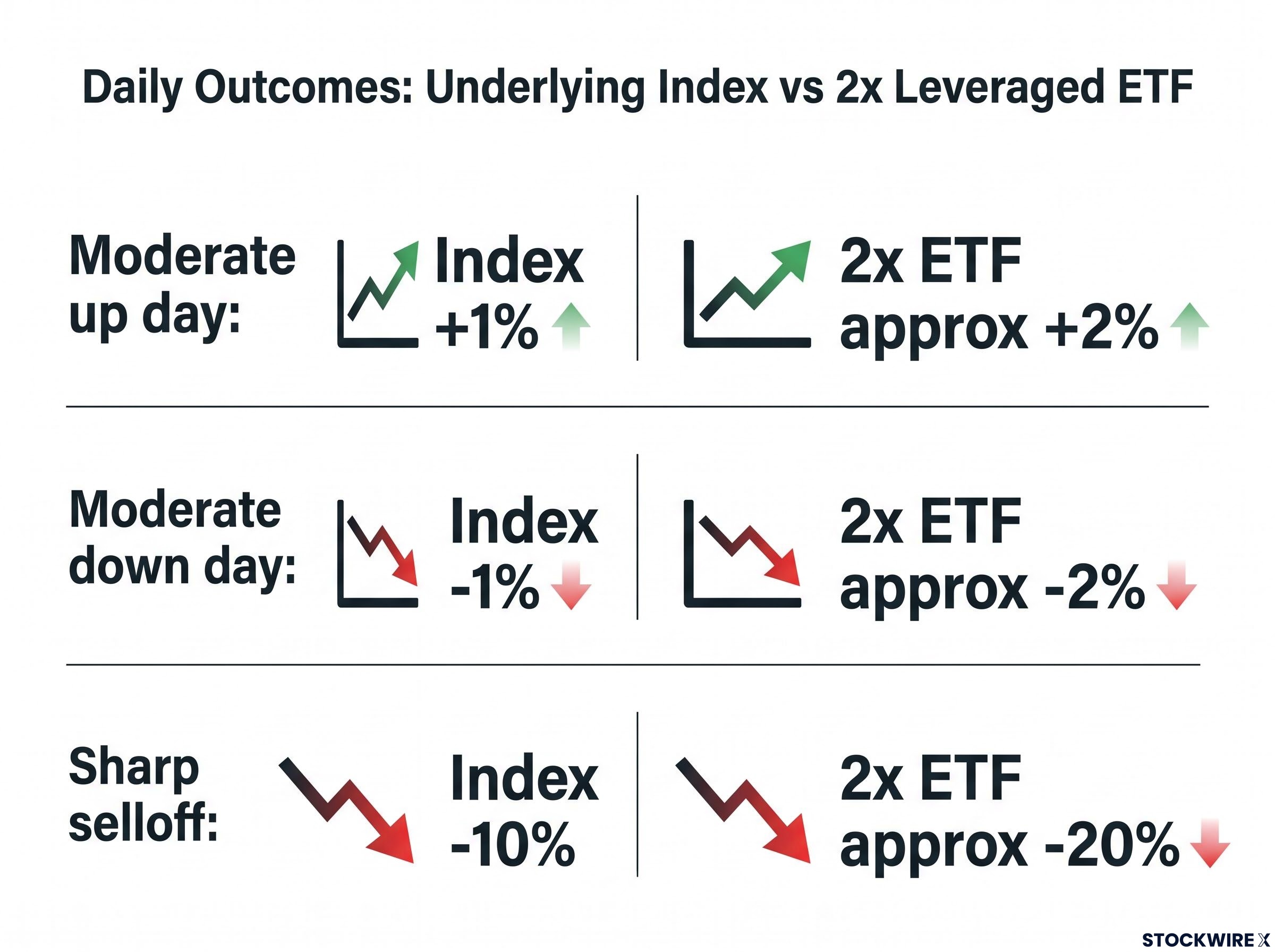
| Scenario | Underlying index daily move | 2x leveraged ETF daily outcome |
|---|---|---|
| Moderate up day | +1% | Approximately +2% |
| Moderate down day | -1% | Approximately -2% |
| Sharp selloff | -10% | Approximately -20% |
The same relationship applies in both directions. A 1% daily gain becomes roughly 2% (or 3% in a triple-leveraged product). A 1% daily loss becomes roughly 2% or 3% in the other direction.
The daily reset: why the clock resets every night
Every trading day, the fund rebalances its derivative or borrowed position to restore the target leverage ratio based on that day’s closing value. If the index rose and the fund is now over-leveraged relative to its target, it buys more exposure. If the index fell, it sells.
This daily mechanical reset is what makes a leveraged ETF a fundamentally different instrument from a leveraged share portfolio held at a broker, where the borrowed amount stays fixed. Understanding this distinction determines whether the product can ever fit your investment goals, because everything that follows in this article, the compounding drag, the concentration risk, the suitability question, flows from this single structural feature.
When big ASX news breaks, our subscribers know first
Volatility decay and why being right about direction is not enough
Volatility decay, also called compounding drag, is the erosion of a leveraged fund’s value that occurs in choppy, sideways, or mean-reverting markets. It happens because the daily reset amplifies both up and down moves asymmetrically over time. Here is how it works in practice.
Consider a simple two-day scenario:
- Day 1: The index falls 10%. Your 2x leveraged ETF falls approximately 20%.
- Day 2: The index rises 11.1%. That is enough to return the index to its starting point (a 10% fall followed by an 11.1% gain gets you back to square one).
- Index outcome: Back to where it started. Flat.
- 2x ETF outcome: The fund gained approximately 22.2% on Day 2, but it gained that from a base that was already 20% lower. It does not get back to its starting value. It finishes below where it began, even though the index finished flat.
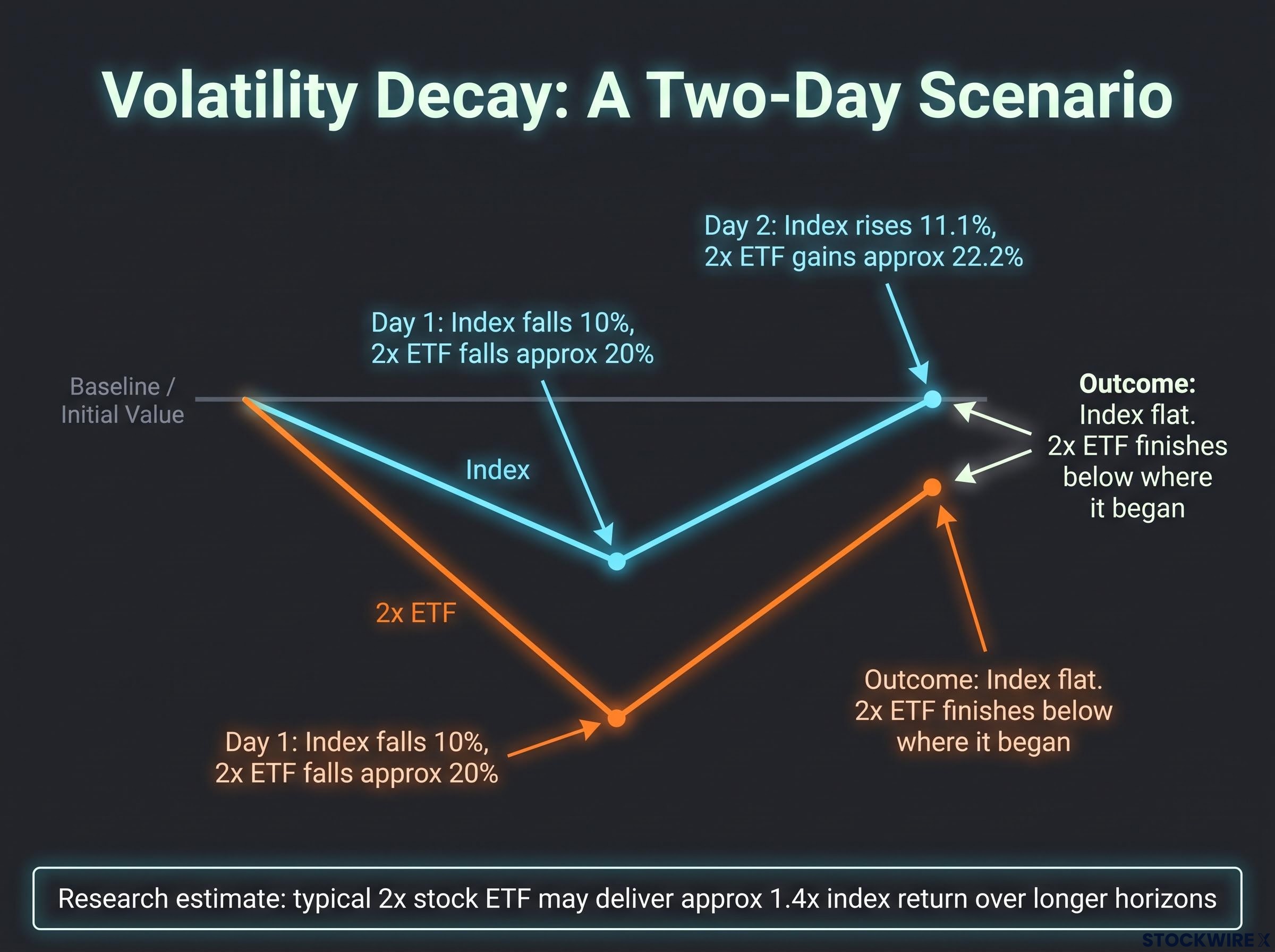
That gap is volatility decay. It widens the more volatile the market is, regardless of what direction the index ultimately moves. In choppy, directionless conditions, the daily resetting mechanism can steadily erode the fund’s value even when your directional view on the market ultimately proves correct.
Volatility drag compounds more severely as leverage increases: a 3x product reaches deeper loss thresholds faster and faces a disproportionately higher recovery burden than a 2x product, which is why the stated multiplier and the delivered return over any multi-day period can diverge so dramatically.
One research estimate (which should be treated as directional rather than precise) suggests a typical 2x stock ETF may only deliver approximately 1.4x the index return over longer horizons, while still roughly doubling the risk. That gap between the stated multiple and the delivered multiple is almost entirely explained by volatility decay.
“These products are generally designed for short-term trading, not buy-and-hold.”
Even if your directional view on the market proves correct over a six-month period, volatility decay means you could earn significantly less than you expected, or even lose money. That changes the calculus of when these products are worth using. They perform closest to their stated multiple in strongly trending markets with low day-to-day volatility. In every other regime, compounding drag works against you.
What the Australian regulatory landscape allows (and restricts)
ASIC (the Australian Securities and Investments Commission) has taken an explicitly cautious approach to the most aggressive forms of leverage. Leveraged ETFs offering 3x or 4x daily moves, which are common in the United States and Europe, are not permitted for local listing on the ASX. ASIC has publicly warned that leveraged and inverse ETFs pose risks to retail investors and “should not be traded by investors who do not have appetite for this risk or understand the complexity.”
ASIC’s RG 282 on exchange traded products sets out the compliance obligations issuers must meet under the Corporations Act 2001, including disclosure standards for complex products that carry elevated risk, the same category into which leveraged and geared ETFs fall.
ASX-listed geared products such as BetaShares GEAR use borrowing rather than high-multiple derivatives, and they do not offer the extreme leverage ratios available offshore. Australian ETF providers have likened these products to a “Formula 1 car”: powerful when used by professionals, dangerous in the hands of typical retail investors.
- ASX-listed geared products: Available to Australian investors, use borrowing to amplify exposure to indices like the ASX 200, generally limited to moderate gearing levels, subject to ASIC oversight and Australian listing requirements.
- US-listed leveraged products accessible to Australians: Include triple-leveraged semiconductor funds, single-stock leveraged ETFs, and other aggressive products that cannot be listed locally. Not subject to Australian listing restrictions when purchased through offshore brokerage platforms.
Accessing offshore leverage: what falls outside Australian protections
US brokerage access opens the door to 3x and single-stock leveraged ETFs that sit well beyond what ASIC permits on the ASX. The listing restrictions do not apply to products purchased on foreign exchanges, so the responsibility for understanding the product falls entirely on you.
As a policy benchmark illustrating the global direction of regulatory thinking, South Korea responded to a market rout by considering rules that would cap the proportion of a retail investor’s portfolio held in single-stock leveraged ETFs, with one proposal placing that ceiling at 20%. That specific rule does not currently apply in Australia, but it reflects how seriously regulators worldwide are taking retail exposure to these instruments.
The fact that a product is accessible through your brokerage platform does not mean it meets the same protective criteria as ASX-listed funds. “Can I buy it?” and “should I?” are entirely separate questions.
The concentration problem: leveraging into already-skewed indices
When you hear “index fund,” you probably think “diversified.” That is partly true for an unleveraged product, but once you apply leverage, the concentration risk embedded in the underlying index gets amplified alongside the market-direction risk.
The ASX 200 carries significant structural concentration in banking and mining. A geared ASX 200 fund is therefore not just a 2x bet on the broad Australian market; it is also a 2x amplified exposure to a handful of large financial and resources companies, whether or not that was your intent.
This is not an Australian-specific problem. SelfWealth’s H2 2026 Outlook notes that the ten largest S&P 500 constituents account for around 36% of the total index, meaning leverage on a “broad market” US fund is substantially a bet on a small number of mega-cap technology companies. In emerging markets, South Korea and Taiwan together represent close to half of the benchmark equity index, with that weight heavily skewed toward chip-related businesses.
| Index | Dominant concentration | What a 2x position implies |
|---|---|---|
| S&P/ASX 200 | Banking and mining | 2x amplified exposure to Australian financials and resources |
| S&P 500 | Top 10 names (~36% of index) | 2x amplified exposure to US mega-cap technology |
| MSCI Emerging Markets | South Korea + Taiwan (~50% of index) | 2x amplified exposure to East Asian semiconductor supply chain |
Before applying leverage to any index product, the question to ask is not just “how much leverage?” but “what am I actually leveraging into?” A 2x geared ASX 200 fund doubles your exposure to Australian banks and miners, whether or not that concentration was your intention. That is a home-bias risk layered on top of a leverage risk.
For readers wanting to understand why the top ten S&P 500 names controlling roughly 36% of the index creates structural risk beyond what the diversification label implies, our full explainer on index concentration examines how cap-weighting feedback loops amplify those exposures with every inflow cycle.
Who leveraged ETFs are actually suited to (and who should stay away)
Based on regulator and provider guidance, leveraged ETFs are generally designed for experienced active traders with short-term directional views, a strong understanding of derivatives and compounding, daily monitoring capacity, and genuine tolerance for rapid, large drawdowns. They may be used for short-term tactical trades or for expressing a specific directional view with limited capital.
They are generally unsuitable for long-term buy-and-hold investors, anyone building toward a specific financial goal such as retirement or a property deposit, and investors who would likely panic-sell after a steep drawdown.
The BetaShares GEAR experience in 2020 makes this concrete. During the COVID selloff, the fund shed more than 60% of its value and needed well over twelve months to recover those losses, while a plain ASX 200 ETF, with no gearing at all, closed that calendar year in the black. That is not a tail-risk scenario that required a financial crisis lasting years; it was a market event measured in weeks.
ASIC and Australian ETF providers describe leveraged ETFs as potential routes to “wealth destruction” if misused by ill-informed investors.
Before considering any leveraged product, work through these five questions honestly:
- Time horizon: Is this a short-term tactical trade, or were you planning to hold for months or years? Providers and regulators repeatedly state these products are not designed for buy-and-hold.
- Drawdown capacity: How would you react to a 50-70% drawdown in this position? Would that loss derail your broader financial plans?
- Position sizing: Is this a small satellite in an otherwise diversified portfolio, or a major holding that could threaten your overall goals?
- Genuine diversification: Are you diversified across geographies, sectors, and asset classes, or concentrated in a narrow theme expressed through multiple funds?
- Product understanding: Do you clearly understand daily reset, compounding drag, fees, and how the ETF behaves in different market conditions? If not, these products may not be appropriate for you.
Your honest answer to the drawdown question is the most reliable suitability test available. The 60% drawdown figure is not an outlier; it is what happened to a mainstream geared ASX 200 fund during a real market event.
Building a portfolio where a leveraged position cannot threaten your long-term goals
If you have worked through the suitability questions and concluded that a leveraged position has a role in your approach, the structural question becomes: how do you size and position it so that it cannot set back your long-term financial goals?
The core-satellite framework provides the practical answer:
The core-satellite framework, as applied to ASX ETF portfolios, defines both the sizing ceiling for any satellite position and the diversified foundation that the satellite must not be allowed to undermine, which is precisely the structural discipline that keeps a leveraged bet from threatening long-term compounding.
- Establish the diversified core. Build a foundation of broad, low-cost ETFs across regions and asset classes. This is the part of your portfolio designed to compound over decades, and it should represent the large majority of your total allocation.
- Define the satellite allocation size. Set a ceiling for higher-risk or higher-conviction positions. The principle is straightforward: no single concentrated or leveraged position should be sized so large that it can materially damage your overall financial trajectory.
- Apply leverage only within the satellite, with active monitoring. Geared or leveraged ETFs, where used at all, sit as small tactical positions within this satellite layer. They require daily monitoring and predefined exit criteria, not passive buy-and-hold.
True diversification in the satellite layer requires spreading your exposure across distinct themes, regions, sectors, and asset classes, not clustering similar bets under different fund names. Holding several leveraged or thematic ETFs all tied to the same sector (technology or semiconductors, for example) is concentration, not diversification.
When dollar-cost averaging into ungeared funds beats timing a leveraged one
Regular automated investing into broad, ungeared ETFs removes the timing requirement that leveraged ETFs demand. You do not need to call both direction and entry point correctly at the same time; instead, you build exposure steadily through volatile periods rather than having to trade around them.
For most Australians focused on long-term wealth building, this approach captures compound growth without the volatility decay and drawdown risk of leveraged products. The goal is not to eliminate all risk from your portfolio but to ensure that a leveraged position going badly wrong removes a satellite, not the whole satellite dish.
What a leveraged ETF can and cannot do for your portfolio
Leveraged ETFs are precision short-term trading instruments, not turbocharged long-term wealth builders. The gap between those two descriptions is where retail investors most commonly get hurt. Daily reset, volatility decay, concentration risk, and amplified drawdowns are not edge cases; they are the product working as designed.
For the right investor, with the right position size and the right market conditions, these products have a legitimate tactical role. The question is whether your situation, your goals, and your honest risk tolerance actually match the profile these instruments require.
You now understand the mechanics, the Australian regulatory framework, the concentration risks hiding inside broad index labels, and the portfolio construction principles that keep a leveraged bet from threatening what matters most. The product itself is neutral. The decision is yours.
This article is for informational purposes only and should not be considered financial advice. Investors should conduct their own research and consult with financial professionals before making investment decisions. Past performance does not guarantee future results.
—