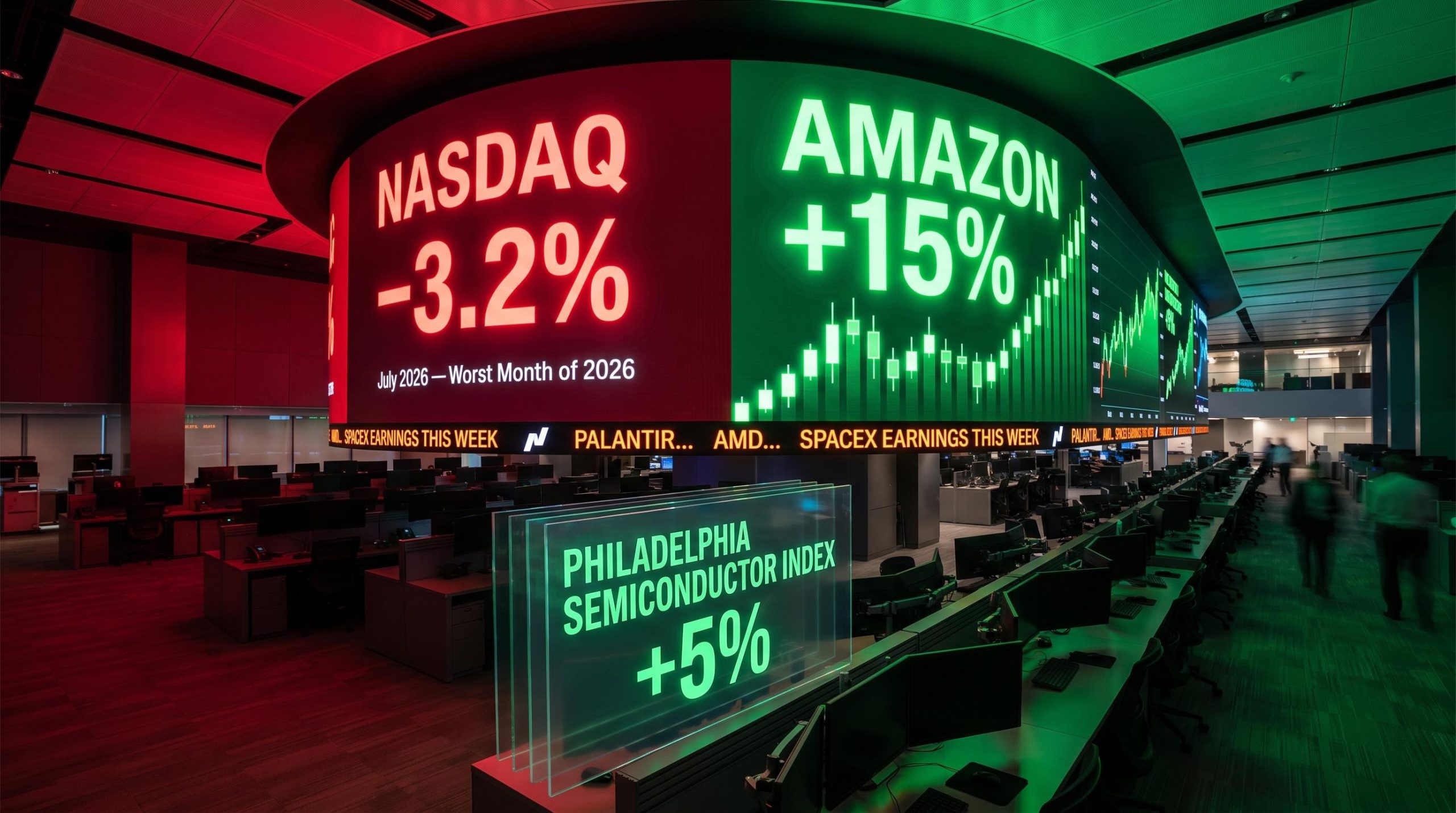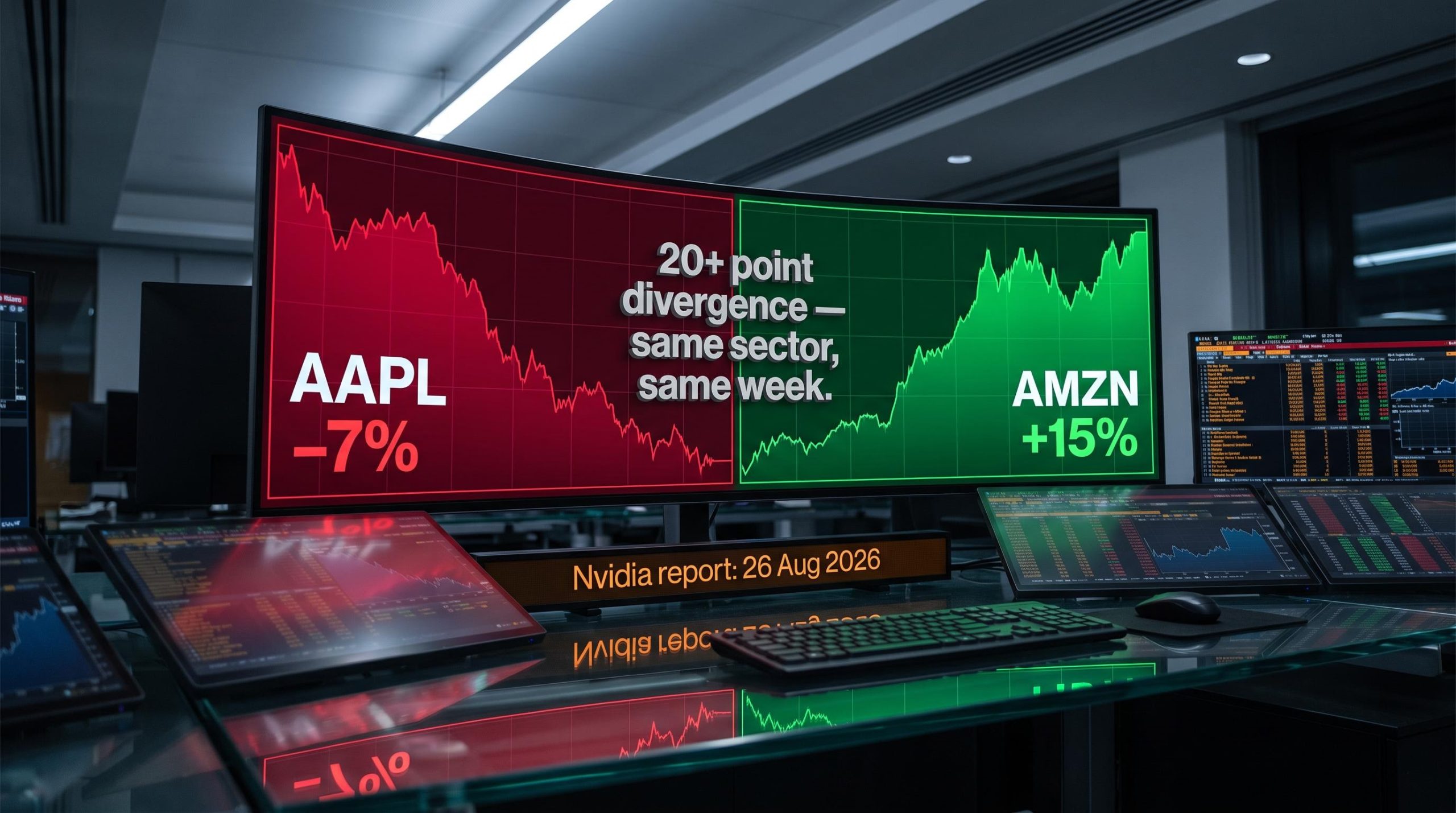
Apple dropped roughly 7% and Amazon surged approximately 15% in the same earnings week. Both are mega-cap tech. Both reported around 3 August 2026. One was punished; the other was rewarded at a scale that would look generous for a mid-cap growth name, let alone the world’s largest online retailer.
That divergence is not a quirk of the calendar. It is the clearest signal of what is actually happening inside technology stocks right now: earnings dispersion is running at extremes, single-stock moves are routinely reaching double digits overnight, and the label “tech” has stopped telling you anything useful about the risk you are carrying.
August compresses a dense sequence of AI-related earnings reports, including Palantir, AMD, and Nvidia, into a window that also happens to coincide with the weakest seasonal liquidity of the year. Here is a framework for interpreting what these earnings reactions actually mean, understanding the leverage mechanics that can amplify them, and acting on the seasonal calendar before it acts on you.
The Apple-Amazon split is not an anomaly, it is the new normal
Watch the numbers side by side and the strangeness becomes difficult to ignore.
| Company | Earnings outcome | Price reaction | Analyst explanation |
|---|---|---|---|
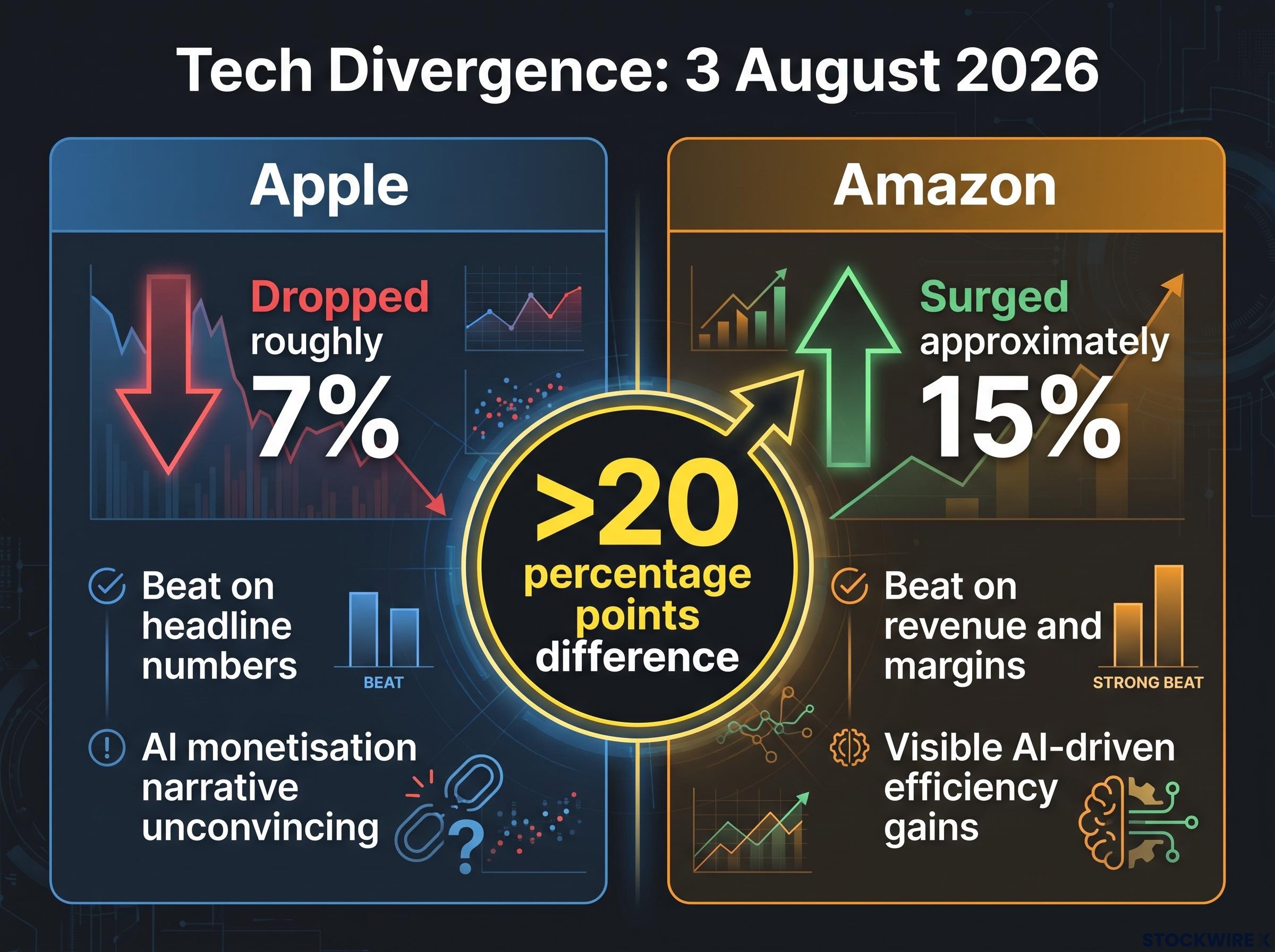
| Apple | Beat on headline numbers | ~7% decline | AI monetisation narrative unconvincing; stretched starting valuation left no room for a “good enough” quarter |
| Amazon | Beat on revenue and margins | ~15% surge | Cloud and advertising margins expanded; visible AI-driven efficiency gains; capex discipline credible |
Same sector classification. Same reporting window. Opposite outcomes, separated by more than 20 percentage points. The market was not reacting to “tech earnings.” It was reacting to two entirely different business stories that happen to share a sector label.
Earnings dispersion across technology names is not a temporary phenomenon; April and May 2026 ranked as the second and third highest monthly return dispersion readings in 30 years of MSCI ACWI data, a structural regime shift rather than a one-quarter anomaly.
IBM reportedly declined over 25% on a miss even as the broader tech sector rose, reinforcing the same pattern: index-level strength can mask severe single-stock pain when dispersion is this high.
Why earnings beats are no longer enough
The market is no longer pricing the current quarter. It is pricing the credibility of forward AI revenue, and the distance between those two things is widening.
An unusually high share of S&P 500 companies have beaten estimates this season, yet price responses have frequently been flat or negative. When starting valuations are already stretched, a “good” quarter earns you nothing; it is the minimum expectation. Any softness in guidance, any ambiguity about when AI spending converts to margin, and the stock gets repriced.
Holding broad tech exposure without understanding each position’s individual AI monetisation story is no longer a neutral act. It is an unexamined bet on which sub-thesis the market decides to reward next.
When big ASX news breaks, our subscribers know first
What the AI capex scrutiny actually means for stock prices
The shift happened quietly, but it is now unmistakable. Investors have moved from rewarding AI ambition to demanding AI proof.
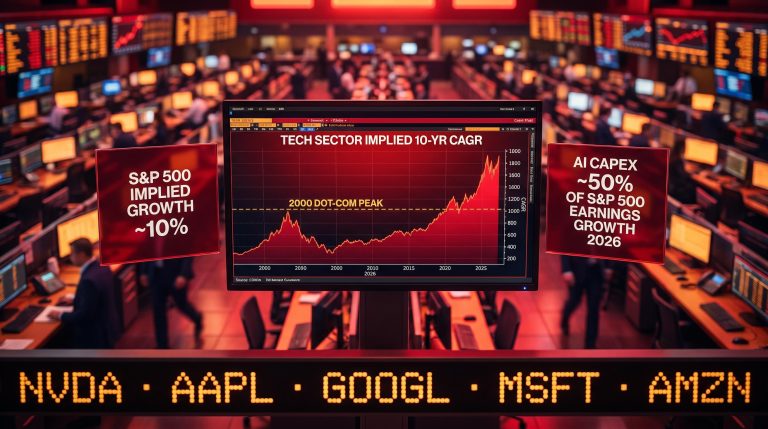
The “market in revolt” framing: Analysts describe a market that is penalising open-ended AI capex commitments unless they are accompanied by visible near-term revenue and margin uplift. The estimated $700 billion-plus in AI capex spending across the largest platforms in 2026 (an unverified but widely cited figure) illustrates the scale of capital at stake, and the scrutiny that follows it.
Deutsche Bank strategists have noted that chipmakers and banks are rallying while software names sell off. The distinction matters: chipmakers and cloud infrastructure names are showing AI capex translating directly into hardware revenue. Software names, by contrast, are still largely selling the promise of AI monetisation rather than proving it.
The distinction the market is now enforcing maps directly onto the AI capex vs returns divide that has quietly widened since 2024: hyperscalers committing 93-94% of operating cash flow to AI infrastructure are not automatically the companies that will capture the revenue that investment enables.
The market is applying a different discount rate to AI hope versus AI revenue, and the spread between those two rates is widening with every earnings print.
Characteristics of tech companies currently being rewarded:
- Visible AI-driven revenue growth with margin expansion
- Disciplined capex with clear payback timelines
- Credible forward guidance with specific AI monetisation milestones
- Lower starting valuations relative to demonstrated earnings power
Characteristics of those being penalised:
- Open-ended AI spending with vague return timelines
- High price-to-sales multiples without corresponding margin improvement
- Guidance that relies on AI adoption narratives rather than booked revenue
- Capex growth outpacing revenue growth quarter after quarter
If you hold AI-adjacent software names trading at elevated price-to-sales multiples, the burden of proof has shifted. A strong revenue number is no longer sufficient if it is not paired with a credible path to margin expansion. The market has made that clear in the price action.
How a 24-year-old’s hedge fund collapse explains your risk exposure
When the Situational Awareness fund, run by a 24-year-old manager, was undone by forced losses, it appeared on the surface to be a story about youth and inexperience. It is that. But the mechanics behind the collapse are not exotic. They are the same mechanics that operate in any margin account, any leveraged exchange-traded fund (a fund that uses borrowed capital to amplify returns), and any concentrated options position.
Here is how a leveraged position unravels:
- The adverse move arrives. A tech stock drops 10% overnight on an earnings miss. At 3:1 leverage, that 10% move translates into approximately a 30% capital loss on the position.
- The margin call hits. The broker demands additional capital to restore the required collateral ratio. If the capital is not available immediately, the broker begins liquidating positions, regardless of the investor’s fundamental thesis.
- Forced selling cascades. The liquidation itself pushes prices lower, potentially triggering further margin calls across other leveraged holders. This is why sharp drops sometimes occur with no visible news catalyst and are followed by partial rebounds once the forced flows clear.
Forced selling cascades are not confined to individual accounts; the same mechanics played out at sector scale in June 2026 when over $1 trillion in semiconductor market value was erased across Asian markets as leveraged retail positions unwound simultaneously.
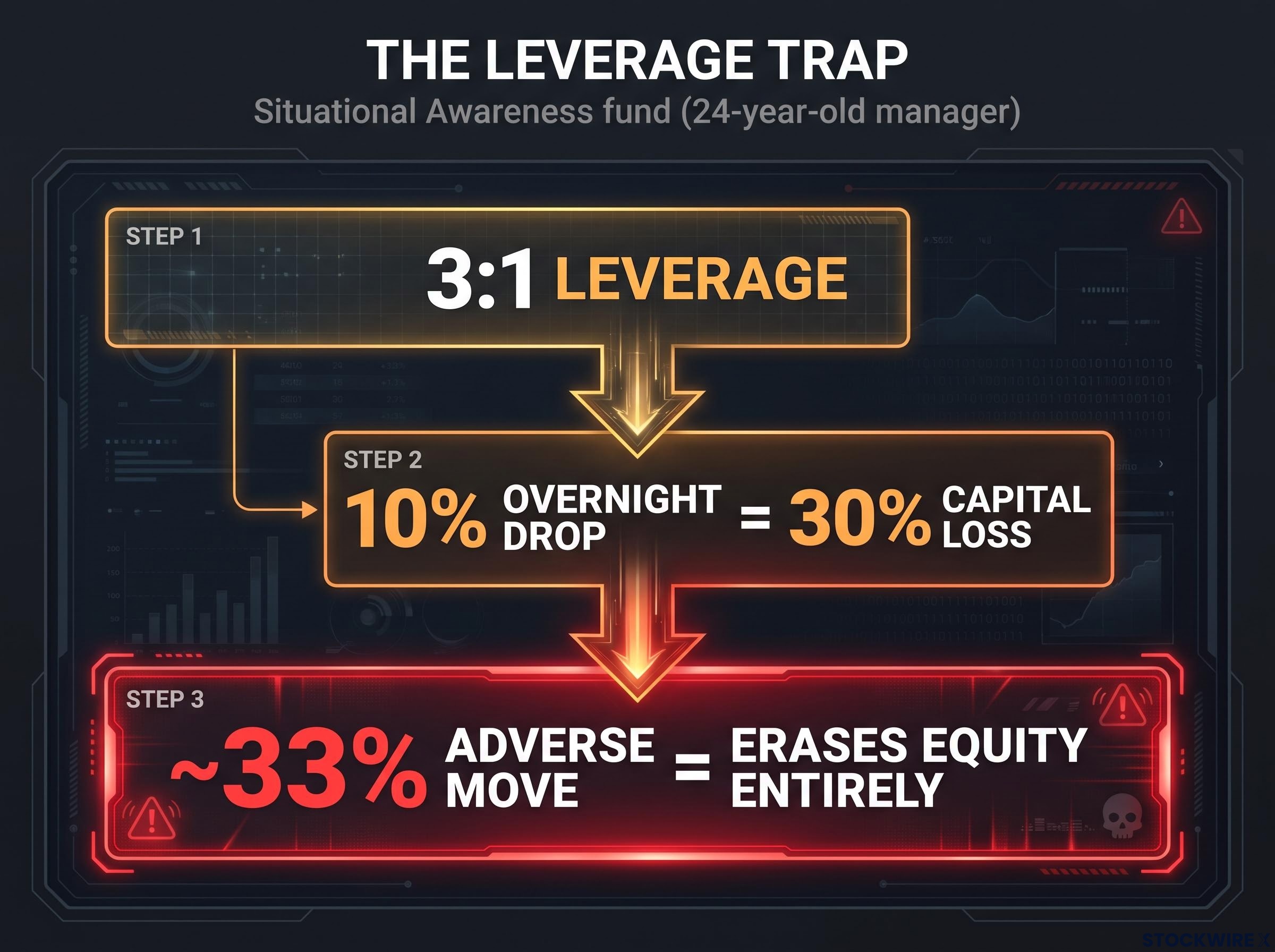
A move of roughly 33% against a 3:1 leveraged position can erase equity entirely. In the current environment, where double-digit overnight moves in tech names are a recurring feature of earnings season, those leverage ratios are operating on thinner ice than historical volatility patterns might suggest.
What this means if you are using margin or options in tech
The forced-selling mechanic is not just a hedge fund problem. Any retail investor using margin in a high-dispersion earnings environment is operating on the same structural logic, just at smaller scale.
Margin accounts, leveraged ETFs, and short-dated options all share the same vulnerability: when the adverse move exceeds your cushion, your broker sells your position for you. Your fundamental thesis becomes irrelevant.
Three concrete guardrails apply here. Position sizing: no single stock should be large enough that a 50-100% loss would meaningfully harm your financial stability. Leverage restraint: avoid margin and options leverage in a regime of elevated single-name volatility unless you have deep experience managing drawdowns. Liquidity buffer: holding cash or short-duration liquid assets gives you the ability to buy when others are forced to sell, rather than becoming the forced seller yourself.
August’s earnings calendar and why the next four weeks are not ordinary
Three reports in August carry the potential to move not just their own share prices but entire sector ETFs and broad benchmarks. Each one answers a different question about the AI trade.
| Company | Report date | Primary market question | Broader sector signal |
|---|---|---|---|
| Palantir | 3 August 2026 | Is enterprise AI software genuinely monetising at scale? | Sets tone for AI software valuations; commercial revenue growth and customer count are the metrics to watch |
| AMD | 4 August 2026 | Is AI server hardware demand holding or softening? | Signals semiconductor demand trajectory; capex commentary from cloud providers will ripple through the chip sector |
| Nvidia | 26 August 2026 | Can AI infrastructure revenue sustain the growth rates the market has priced in? | Carries outsized weight for the entire AI investment narrative; guidance will likely re-price the category in either direction |
Palantir already shows elevated options activity ahead of its print, signalling active market positioning. As a proxy for whether enterprise AI software is genuinely converting hype into recurring commercial revenue, its results carry interpretive weight beyond the company itself.
Nvidia’s report on 26 August is the single most consequential data point in this window. Estimates for AI-infrastructure-related revenue are substantial (one unverified estimate cites $80 billion-plus), and any miss or cautious guidance would likely cascade through semiconductors, cloud names, and AI-adjacent software.
If you hold any semiconductor ETF, cloud infrastructure name, or AI-adjacent software stock, the Nvidia print carries the potential to re-price your entire category. Positioning into that event without awareness of the risk is avoidable.
Why August and September tend to punish investors who are not paying attention
The August-September seasonal weakness in U.S. equities is not a superstition. It is a documented historical pattern rooted in how institutional money behaves during the summer.
Jamie Dutta, Vantage Market Analyst, has specifically identified August-September 2026 as a seasonally challenging period for equity markets. The pattern is structural rather than mystical.
“August and September have historically been the weakest months for U.S. equities, with the period characterised by reduced institutional participation and thinner liquidity conditions that amplify price moves in both directions.” — Jamie Dutta, Vantage Market Analyst
Three practical features of this period matter right now:
- Lower liquidity. Summer schedules and lighter institutional participation mean fewer shares are traded. Moderate order flows produce outsized price moves, amplifying both earnings reactions and forced-selling dynamics.
- Rebalancing flows. As Q3 progresses, large investors trim winners and adjust sector weights, creating selling pressure that has nothing to do with fundamentals but moves prices nonetheless.
- Headline sensitivity. In thin markets, geopolitical developments, macro data releases, and policy commentary produce sharp intraday swings that feel disproportionate to the underlying news.
The practical implication: any tech earnings miss in the next six weeks will likely land harder than it would in a higher-liquidity month. The risk-reward calculation for holding concentrated positions into prints is materially different right now than it was in April.
The counterweight is that Q4 through to year-end has historically delivered positive returns for U.S. equities, with the pattern holding with particular consistency in midterm years.
For readers wanting the historical data behind the August weakness, our full explainer on summer seasonal patterns examines a century of S&P 500 returns across the May-October window, including the specific mechanisms that cause institutional participation to thin and why the pattern has weakened in modern markets.
Four disciplines for equity investors navigating the next six weeks
Each discipline here maps directly to one of the risks identified earlier. This is not generic caution; it is a system built from the specific problems this earnings season is producing.
- Map your earnings dates. For every tech holding, know when the company reports and what the market is focused on. The Palantir-AMD-Nvidia sequence alone covers enterprise AI software, semiconductor demand, and infrastructure capacity. Entering these windows unaware is an avoidable mistake.
- Focus on why stocks move, not just how much. A selloff after a beat typically signals expectations were too high or forward guidance disappointed, not necessarily that the business is broken. A rally after a modest quarter may reflect improving revenue quality or a more credible AI monetisation path than the market had priced. Understanding the reason behind moves helps you distinguish forced-selling opportunities from genuine thesis changes.
Turning volatility into opportunity rather than threat
- Hold dry powder. Given thin seasonal liquidity and elevated single-stock volatility, holding cash or short-term liquid assets prevents you from becoming a forced seller and gives you the capacity to buy quality names if they are hit by technical or forced-flow selling rather than fundamental deterioration.
- Avoid over-concentration and leverage. Concentrated positions in a small number of richly valued tech names, combined with margin, is the most vulnerable portfolio structure in a high-dispersion regime. The Situational Awareness collapse is the reinforcing example. Broad diversified exposure with no leverage is significantly more robust in this phase.
When technically driven selling hits fundamentally sound names, investors with cash can act at prices unavailable in normal conditions. That opportunity only exists for investors who have avoided the leverage and concentration traps described above. Preparation completed before a forced-selling event is the only kind that actually matters; once the margin calls are flying, the window to act thoughtfully has already closed.
What comes after August matters more than surviving it
August 2026 is a convergence of earnings dispersion, leverage-amplified volatility, and seasonal headwinds. That convergence rewards preparation and punishes complacency in ways that are structural, not coincidental.
The October-to-year-end seasonal tailwind is historically real. Investors who navigate August with capital intact and no forced liquidations are better positioned to participate in that recovery than those who arrived concentrated and leveraged.
The Nvidia report on 26 August is the most consequential single data point remaining in this window. Its guidance will likely set the tone for how the AI investment narrative enters Q4. Everything before it is preparation; everything after it is response.
This article is for informational purposes only and should not be considered financial advice. Investors should conduct their own research and consult with financial professionals before making investment decisions. Past performance does not guarantee future results. Financial projections are subject to market conditions and various risk factors.