
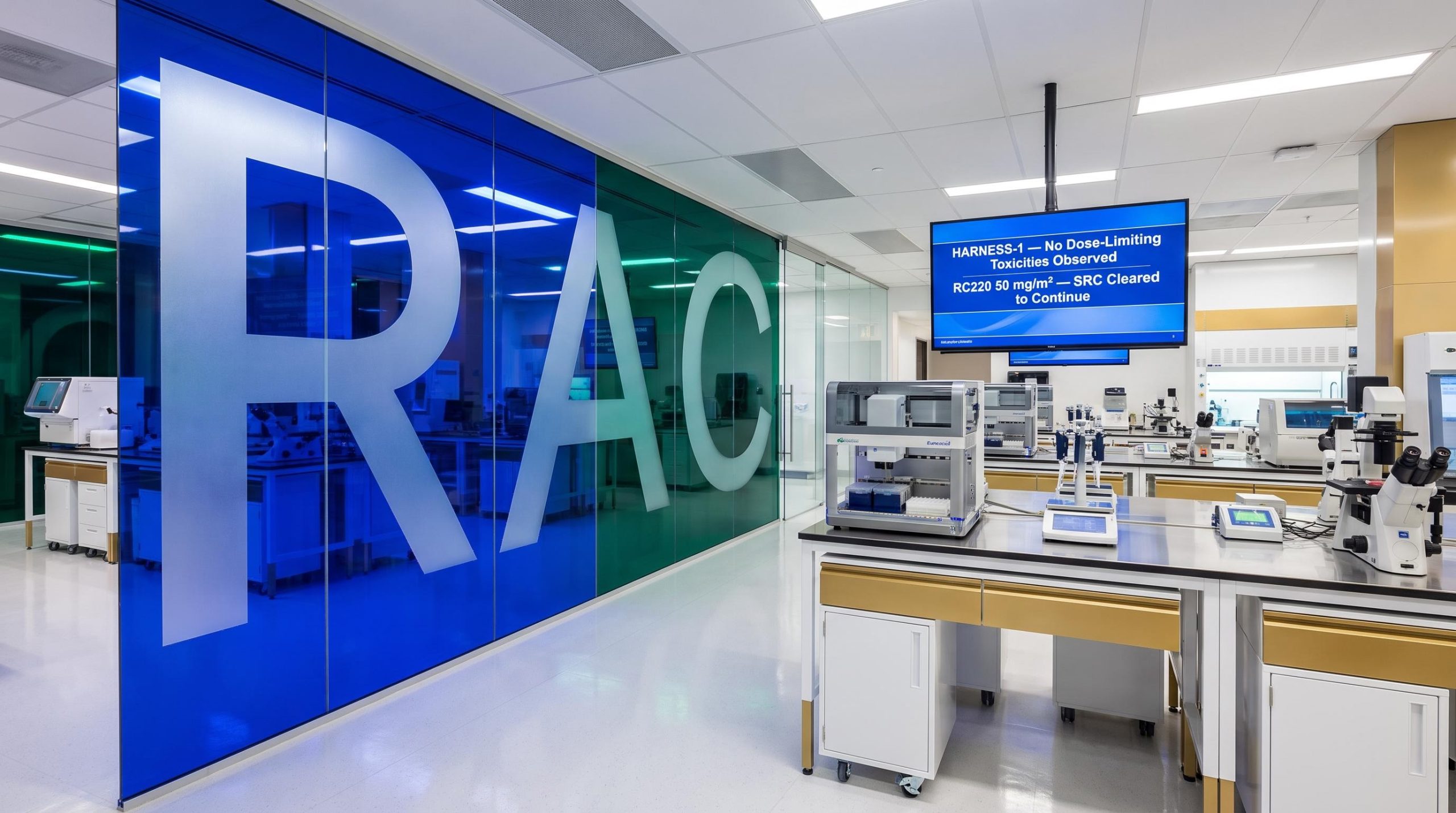
SRC clears HARNESS-1 to continue after first patient safely treated with RC220
Racura Oncology (ASX: RAC) has confirmed that its Safety Review Committee (SRC) has reviewed data from the first patient treated in the HARNESS-1 clinical trial and cleared the study to continue. The first patient received RC220 at 50 mg/m² in combination with osimertinib 80 mg daily, a treatment for EGFR-mutant non-small cell lung cancer.
According to the announcement dated 29 July 2026, no dose-limiting toxicities or treatment-related safety concerns were identified during the safety observation period. As a precaution, the SRC has recommended that one additional patient be treated at the 50 mg/m² dose before escalation to 100 mg/m².
Enrolment is now underway, with two eligible patients awaiting an open slot at Monash Health. The next SRC review is expected in 6–8 weeks.
When big ASX news breaks, our subscribers know first
What the SRC review found
The headline outcome was positive. During the safety observation period, the first patient recorded no dose-limiting toxicities and no treatment-related safety concerns following administration of RC220 alongside osimertinib.
After the observation period ended, the patient reported moderate (Grade 2) colitis symptoms, an inflammation of the large intestine or colon. According to Racura, the cause of these symptoms has not yet been determined, and clinical investigations remain ongoing.
Importantly, the Grade 2 colitis was not classified as a dose-limiting toxicity or a treatment-related adverse event. Because its cause is currently unknown and it occurred in the first patient treated, the SRC recommended the additional 50 mg/m² patient as a prudent precaution before any escalation.
Important context on the colitis finding
The announcement provides scientific context on the finding. According to Racura, no cases of colitis have been reported in the medical literature across the more than 1,500 patients treated with bisantrene.
By contrast, serious colitis has previously been reported in patients receiving osimertinib therapy, sometimes occurring after many months of stable treatment. Racura has not stated or implied that the reported colitis was caused by RC220, noting only that the cause is under investigation.
Dr Daniel Tillett, CEO and Managing Director
“We are encouraged by the SRC’s review and welcome its support for the HARNESS-1 trial to continue. The absence of dose-limiting toxicities or treatment-related safety concerns during the safety observation period is an important early signal, and enrolment of the next patient is underway. We understand and fully support the SRC’s careful approach to patient safety. Treating an extra patient at 50 mg/m2 will allow a new patient needing urgent additional treatment to access the trial as soon as possible.
We thank the first patient and their family for supporting this important study and acknowledge Principal Investigator A/Prof Surein Arulananda and the Monash Health team for their continued contribution to advancing the HARNESS-1 trial.”
Understanding Phase 1 dose escalation and the role of the SRC
For investors less familiar with early-stage clinical trials, understanding the mechanics of Phase 1 oncology studies helps explain why this milestone matters. The primary purpose of a Phase 1 dose-escalation study is to understand patient safety and tolerability as the treatment dose increases.
What a Safety Review Committee does
A Safety Review Committee is a group of clinicians and trial experts who review patient safety data and decide whether a trial should proceed, be modified, or be ended. Its role is focused on patient safety and trial conduct, not on judging whether the experimental treatment works.
The trial protocol sets out the safety rules for the study. The SRC reviews all available safety information before deciding whether HARNESS-1 can move to the next planned dose level. That decision rests with the SRC alone.
How the accelerated titration design works
HARNESS-1 uses an accelerated titration design, where the first three dose levels consist of single-patient cohorts that expand to three patients if a dose-limiting toxicity is observed. Each cohort follows a defined sequence:
-
Screen and enrol an eligible patient
-
Dose RC220 at the set level with osimertinib
-
Complete a 21-day safety observation period
-
SRC review of all collected safety data
Each accelerated cohort is expected to take 6–8 weeks. This step-by-step approach limits each patient’s exposure to higher doses before safety data has been reviewed, a careful design that de-risks the programme. As the company notes, a delay does not necessarily indicate a safety problem, but may simply reflect the time required for recruitment, safety checks, or review meetings.
HARNESS-1 trial roadmap and next steps
The path forward moves through the remaining accelerated cohorts before the trial transitions to its dose-optimisation stage. The table below summarises the planned progression.
| Stage | Dose Level | Cohort Size | Status | Expected Timing |
|---|---|---|---|---|
| Accelerated titration | 50 mg/m² | Single patient (now +1 additional) | First cohort complete, enrolling | Next review 6–8 weeks |
| Accelerated titration | 100 mg/m² | Single patient | Pending SRC clearance | Event-driven |
| Accelerated titration | 150 mg/m² | Single patient | Pending | Event-driven |
| BOIN stage | Multiple levels | 3–6 patients per level | After accelerated cohorts complete | Aim to identify maximum tolerated dose |
If the data supports progression after the 100 mg/m² and 150 mg/m² single-patient cohorts are completed and reviewed, the study will move into the Bayesian Optimal Interval (BOIN) stage. Each cohort at that point includes 3–6 patients per dose level, with the aim of accurately identifying the maximum tolerated dose of RC220 in combination with osimertinib.
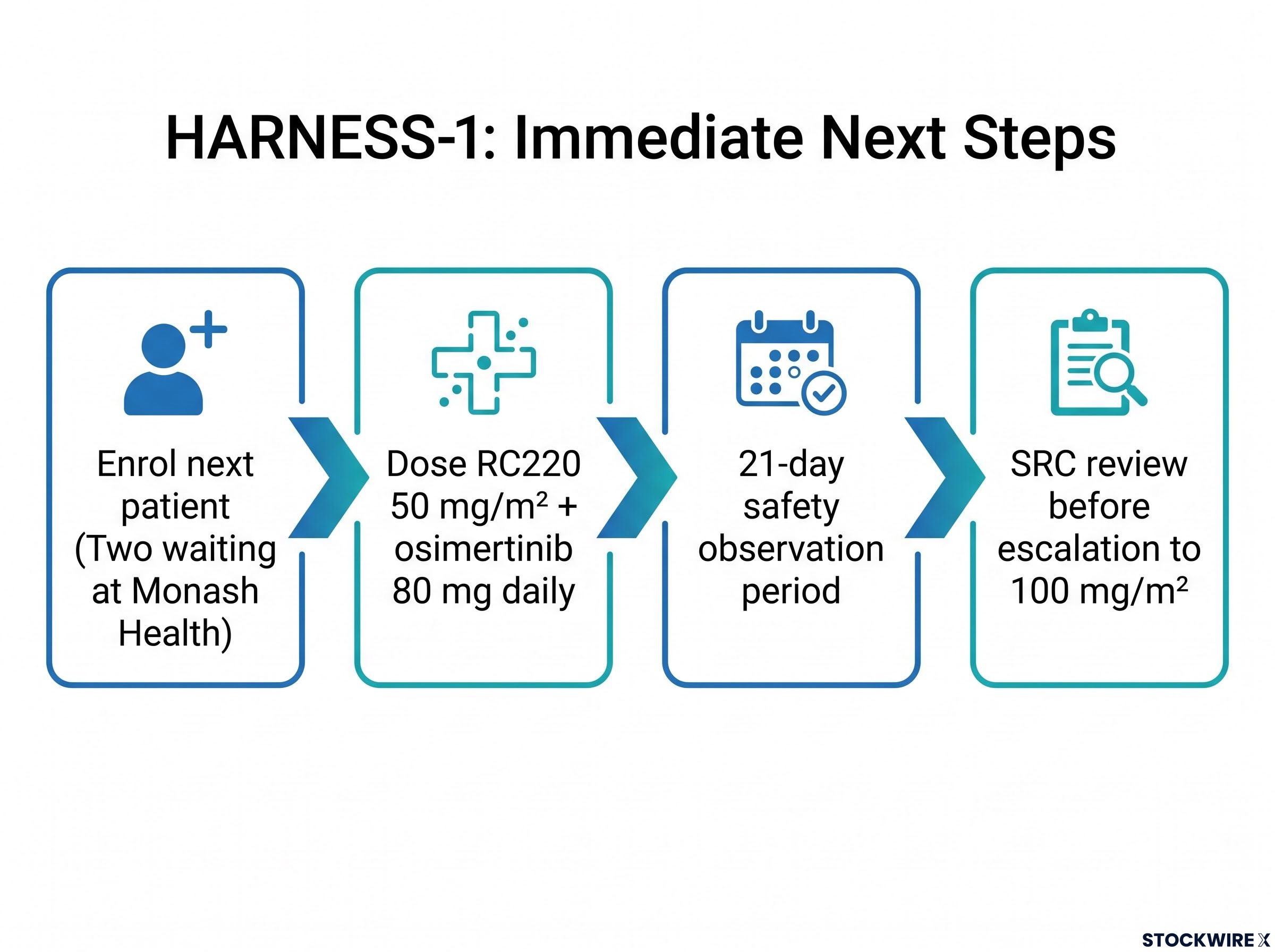
Immediate next steps
The company has outlined the sequence that must occur before any dose escalation:
-
Enrol the next patient (two are waiting at Monash Health)
-
Dose RC220 at 50 mg/m² with osimertinib 80 mg daily
-
Complete the 21-day safety observation period
-
Conduct the SRC review before any escalation to 100 mg/m²
Racura notes that Phase 1 oncology trial timing depends on events, not fixed dates. Screening, enrolment, dosing, safety follow-up and SRC review all need to occur before the trial can advance, meaning timelines can shift if any step takes longer than expected.
Why this matters for the RAC investment case
HARNESS-1 is the Phase 1a/b arm testing RC220 in combination with osimertinib in EGFR-mutant non-small cell lung cancer. RC220 is Racura’s proprietary formulation of (E,E)-bisantrene, which primarily acts by silencing c-MYC, a cancer gene the company reports is dysregulated in up to 70% of all cancers.
RC220 mechanism of action data presented at the 2026 AACR Annual Meeting confirmed that (E,E)-bisantrene silences c-MYC expression in breast and lung cancer cells within two hours, with binding affinity to c-MYC G-quadruplex structures measured at 208 nM, providing independent scientific validation across the three active clinical programmes.
The broader pipeline spans multiple MYC-driven indications, including the Phase 3 EMILI trial in acute myeloid leukaemia, the HARNESS trial in non-small cell lung cancer, and the CPACS trial in combination with doxorubicin, where Racura aims to deliver both anthracycline cardioprotection and enhanced anticancer activity.
The CPACS trial dose escalation to 80 mg/m2 in May 2026 demonstrated the SRC process working as designed across a separate RC220 programme, with zero dose-limiting toxicities recorded across all three Cohort 1 patients and multi-site screening now active across Australia, Hong Kong, and South Korea.
Racura’s discoveries have supported composition-of-matter IP filings that, if granted, could provide up to 20 years of patent protection for (E,E)-bisantrene. The company adds that it is actively exploring partnerships, licence agreements and potential commercial merger and acquisition opportunities to accelerate global patient access to RC220.
Clearing this first SRC gate keeps the lung cancer programme moving without protocol modification or delay, a meaningful early de-risking step for the trial as it works towards higher dose levels.
When to expect the next update
Racura will update the market as required under its ASX continuous disclosure obligations. Future updates may cover enrolment, dosing, safety review, dose escalation, or other material trial developments. With two patients currently awaiting a slot and a 21-day safety evaluation window, the company expects the next update to occur within the next 6–8 weeks.
Don’t Miss the Next ASX Healthcare Breakthrough
Big News Blast delivers FREE breaking ASX healthcare news directly to your inbox within minutes of release, complete with in-depth analysis. Join 20,000+ investors already staying ahead of the market. Click the “Free Alerts” button at Big News Blast to get the next market-moving healthcare announcement the moment it drops.