

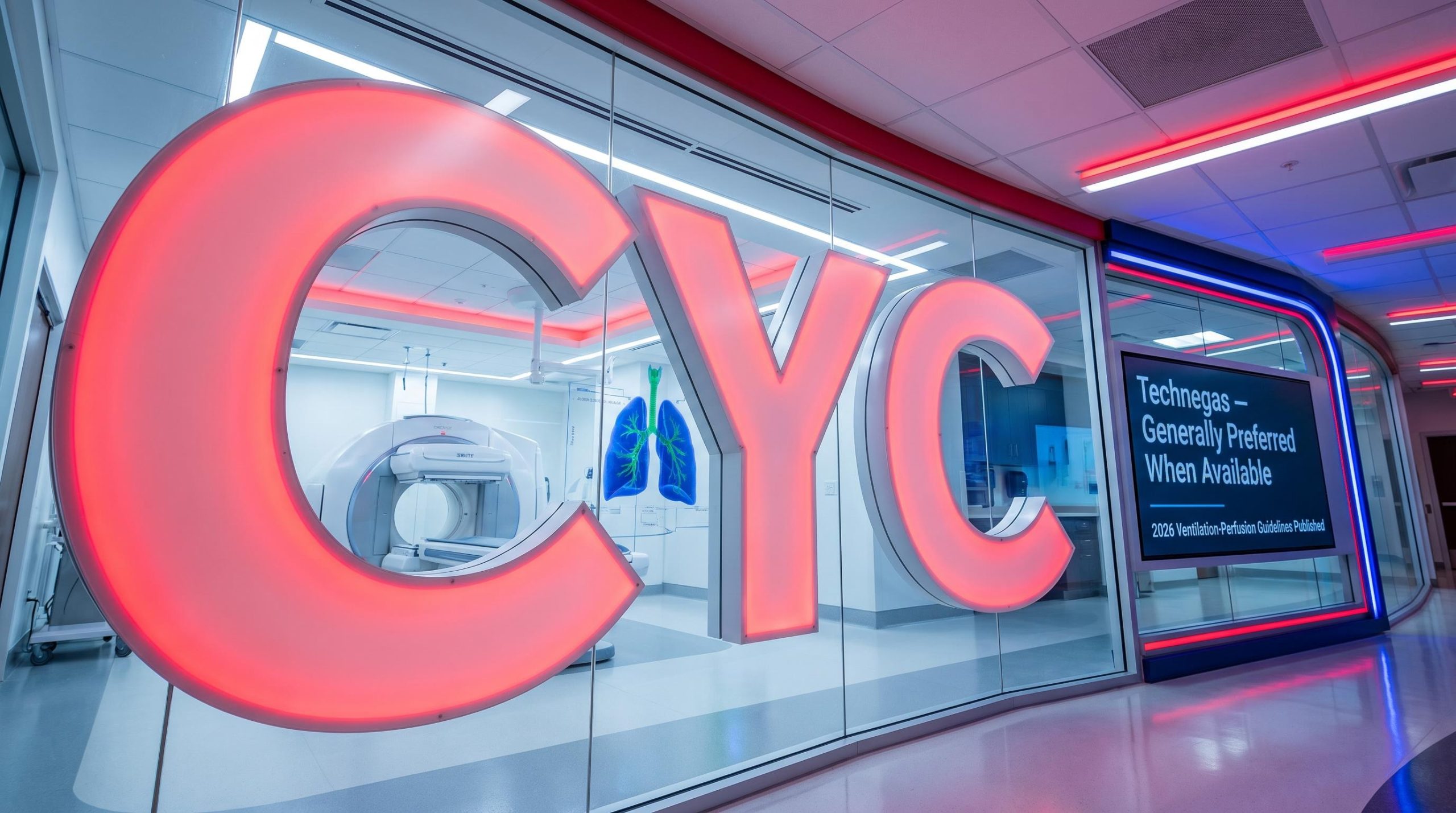
Technegas named preferred ventilation agent in landmark US lung imaging guidelines
Cyclopharm (ASX: CYC) announced on 29 July 2026 the publication of the first update to US lung ventilation guidance in 14 years, with its Technegas product named the preferred ventilation agent under the new international standard.
The document, the Procedure Standard / Procedure Guideline for Ventilation-Perfusion Pulmonary Scintigraphy (2026), describes Technegas as “generally preferred when available”. That single phrase carries weight for investors, because it comes from the medical profession itself rather than from company marketing.
Four leading nuclear medicine societies jointly published the Guidelines: the Society of Nuclear Medicine and Molecular Imaging (SNMMI), the European Association of Nuclear Medicine (EANM), the American College of Nuclear Medicine (ACNM) and the Australian and New Zealand Society of Nuclear Medicine (ANZSNM).
The Guidelines replace the previous US standard issued in 2012, which predated Technegas availability in that market. For a company selling into US hospitals, a favourable mention in the profession’s own standard of care changes the commercial conversation, shifting product selection from a sales pitch to a documented clinical position.
When big ASX news breaks, our subscribers know first
Why naming Technegas by name is unusual, and what it means
Guidelines of this kind are normally written to be brand-neutral. They describe classes of agent or list generic names, leaving the product choice to each hospital committee.
The new Guidelines break that convention. Technegas is defined in the glossary and given its own dedicated section, while competing agents appear under their general headings.
Cyclopharm’s subsidiary Cyclomedica is named in the text as the manufacturer. The equipment section specifies the Technegas system and the single-patient-use consumables supplied with every scan.
James McBrayer, Managing Director and CEO, Cyclopharm
“This is not our marketing claim. It is the profession’s own clinical position, published by four international societies under their own names. Every hospital committee our team sits in front of can now read it for themselves. We expect these Guidelines to drive accelerated clinical demand in the US. Everything we have built there so far, we built without them. We are only getting started.”
How Technegas fits the shift to 3D lung imaging
Measuring how the lung works
A CT scan shows what a lung looks like. Technegas shows how it is working. It is a functional imaging agent designed to measure ventilation, the movement of air through the lungs.
The Guidelines describe particles that spread evenly into the smallest airways and stay there, giving an accurate picture of breathing region by region.
Of commercial significance, the new Guidelines call for a move to three-dimensional scanning in the US. This technique is ideally suited to the functional ventilation attributes of Technegas, and the Guidelines describe the limitations of the main competing ventilation agents for that technique.
A clear opening for AI
The Guidelines also identify artificial intelligence (AI) as a fast-emerging tool in the field, one that depends on clean, stable, clinically validated data.
According to the Guidelines, Technegas data requires no such correction. That is a differentiation point as AI-assisted interpretation moves further into clinical practice.
Both the 3D imaging shift and the emergence of AI represent structural tailwinds that, on the Guidelines’ own reasoning, favour functional agents such as Technegas.
A market bigger than pulmonary embolism
The Guidelines set out a wider set of uses than the diagnosis of blood clots in the lung, each with its own technical guidance. This corroborates the direction of Cyclopharm’s “Beyond PE” strategy.
These uses fall within the scope of the Technegas FDA-approved indication for the “visualization of pulmonary ventilation”. The expanded applications recognised in the Guidelines include:
-
Screening for chronic PE-related pulmonary hypertension
-
Follow-up scans three to six months after a clot has been identified, where residual blockage carries a two- to three-fold higher risk of recurrence
-
Measuring lung function before and after lung surgery or radiotherapy
-
Assessing lung transplants
-
Grading small airways disease such as chronic obstructive pulmonary disease (COPD) and asthma
Radiation dose, a clear competitive advantage
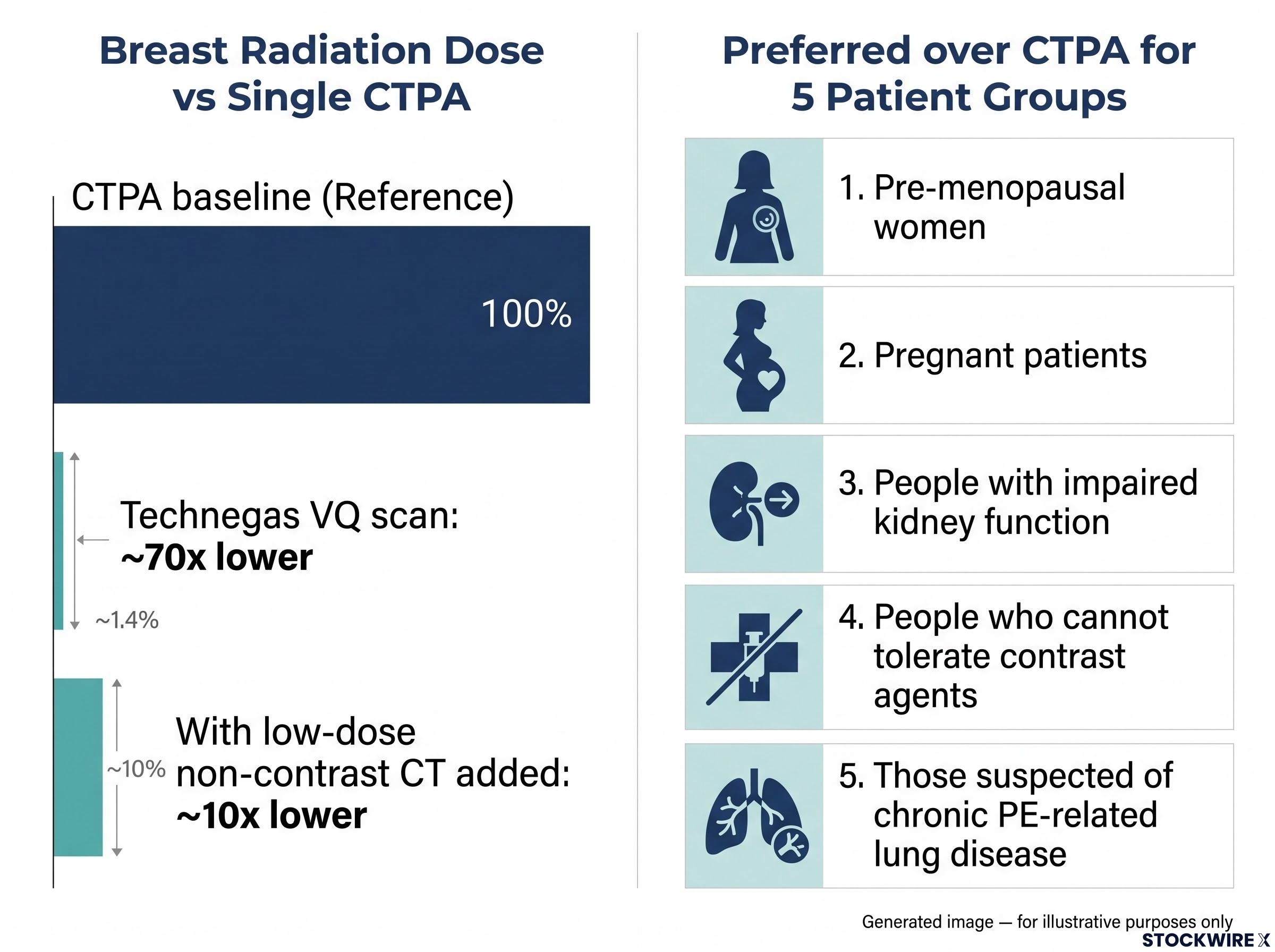
Radiation dose is a key reason doctors choose one scan over another, particularly for younger women. According to the new Guidelines, a Technegas-based lung scan delivers a substantially lower breast radiation dose than a single CT pulmonary angiogram (CTPA).
| Metric | Technegas VQ scan | Comparison |
|---|---|---|
| Breast radiation dose vs single CTPA | ~70x lower | CTPA baseline |
| With low-dose non-contrast CT added | ~10x lower | CTPA baseline |
On that basis, the Guidelines identify five groups of patients for whom a Technegas VQ scan should generally be preferred over CTPA:
-
Pre-menopausal women
-
Pregnant patients
-
People with impaired kidney function
-
People who cannot tolerate contrast agents
-
Those suspected of chronic PE-related lung disease
What it means for Cyclopharm’s US growth story
Clinical practice changes when evidence becomes strong enough that the profession changes its own rules. Technegas has been used in more than 5 million patient procedures worldwide.
That clinical base is supported by a substantial body of research: more than 230 peer-reviewed papers and over 2,400 scholarly citations (Khatib & Young, 2023). The clinical leadership of nuclear medicine across the US, Europe and ANZ has weighed that evidence and written Technegas into its standard of care.
Federal healthcare adoption has added a separate institutional layer to Cyclopharm’s US rollout, with NIH approval giving the company access to VA hospitals and military treatment facilities under a Federal Supply Schedule agreement that peer institutions often monitor for imaging protocol validation.
The commercial insight is straightforward. Every US site Cyclopharm has won so far was secured without guideline support, because the 2012 standard predated the product and could not reference it. That has now changed.
Cyclopharm’s US hospital network expansion has progressed through a land-and-expand playbook, with 50 revenue-generating installations now linked to 331 contracted locations spanning elite academic medical centres including Brigham and Women’s, Emory Health Care, and the VA system.
James McBrayer, Managing Director and CEO, Cyclopharm
“Before today, American hospitals have worked to a lung imaging standard written before Technegas was even available in that market. That standard has now been replaced, and the new Guidelines name Technegas as the preferred agent.”
McBrayer said the company expects the Guidelines to drive “accelerated clinical demand in the US.” For investors, the update removes a structural barrier that has sat between Cyclopharm and broader US hospital adoption.
The Guidelines are expected to support broader institutional adoption and increased utilisation across US hospitals and health systems. Whether that translates into specific revenue outcomes remains to be seen, and no financial projections have been disclosed. What has changed is the starting position: the profession’s own rulebook now names Technegas as the preferred agent.
Don’t Miss the Next Healthcare Breakout on the ASX
Big News Blast delivers FREE breaking ASX healthcare news directly to your inbox within minutes of release, complete with in-depth analysis. Join 20,000+ investors already staying ahead of the market. Click the “Free Alerts” button at Big News Blast to get the next market-moving announcement the moment it drops.