SK Hynix just posted some of the strongest AI-driven earnings in its history. Today, its shares fell 11%.
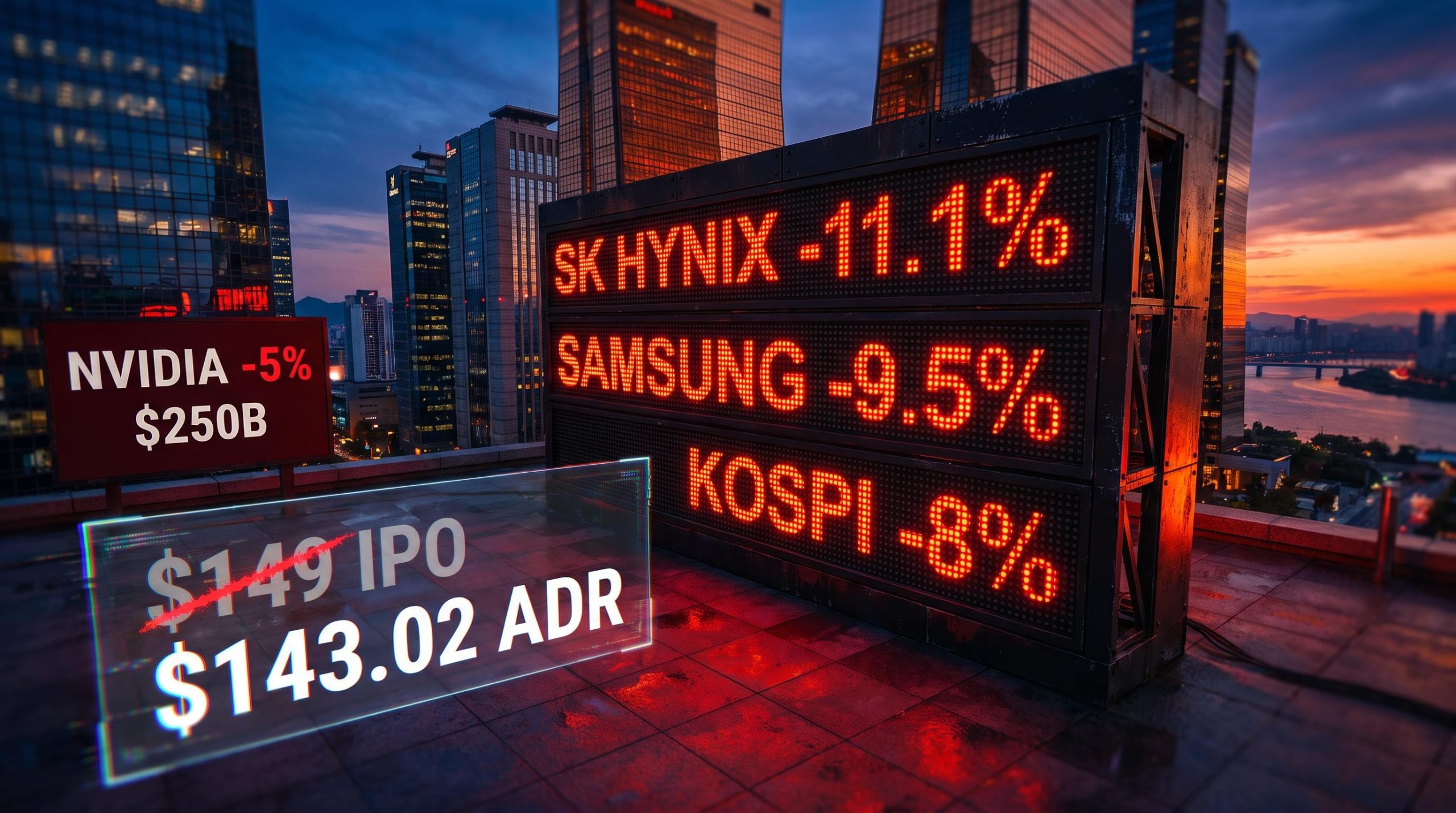
The 28 July 2026 session delivered one of the sharpest single-day corrections Korean chipmakers have seen since the AI semiconductor rally began in earnest. Samsung Electronics fell as much as 9.5%. The KOSPI benchmark dropped roughly 8% by early trading. The trigger was not a profit warning, a product failure, or a geopolitical shock in the conventional sense. A Wall Street Journal report disclosed that Nvidia might need to arrange around $250 billion in financing to support an OpenAI data centre project, prompting serious questions about whether genuine customer demand, rather than supplier capital, is driving the AI chip boom.
Here is what happened, why South Korean chip stocks bore the sharpest impact, and what the structure of this selloff tells you about where the AI semiconductor trade stands right now. The data points to something more specific than a routine correction, and the distinctions matter for anyone watching this space.
What happened on 28 July, and how severe was the damage
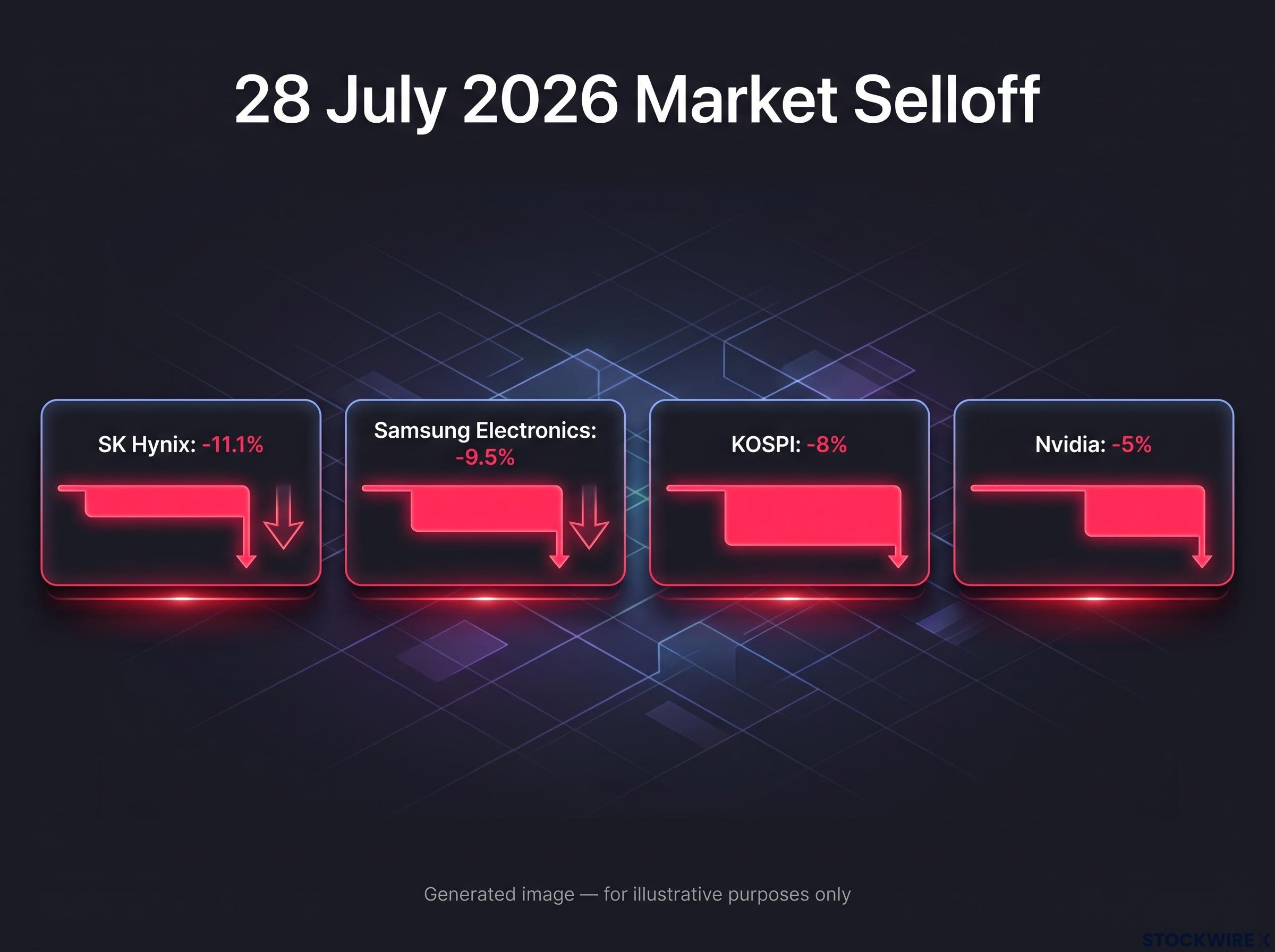
The numbers arrived fast:
- SK Hynix shares fell by as much as 11.1% during the session
- Samsung Electronics shares declined by up to 9.5%
- The KOSPI benchmark index had shed around 8% by 0120 GMT
- SK Hynix U.S.-listed ADRs had already settled at $143.02 in overnight trading, putting them beneath the company’s $149 IPO price
SK Hynix ADRs closed at $143.02 in the prior session, falling below the company’s IPO price of $149, before Korean markets had even opened.
That ADR figure matters. When a market leader is already trading below its IPO price before the home exchange opens, sentiment has shifted meaningfully overnight. The intraday declines in Seoul were confirmation, not initiation.
This was not isolated to one name. The breadth of the selling, spanning both Korean memory leaders and the benchmark index itself, made this a sector-wide event with systemic characteristics.
The KOSPI benchmark‘s 8% intraday decline amplified through passive ETF redemption mechanics: Samsung Electronics and SK Hynix together have represented well over 40% of the index’s total market capitalisation, meaning concentrated selling in either name transmits as a broad market event rather than an isolated stock move.
When big ASX news breaks, our subscribers know first
The Nvidia-OpenAI report and why it rattled suppliers
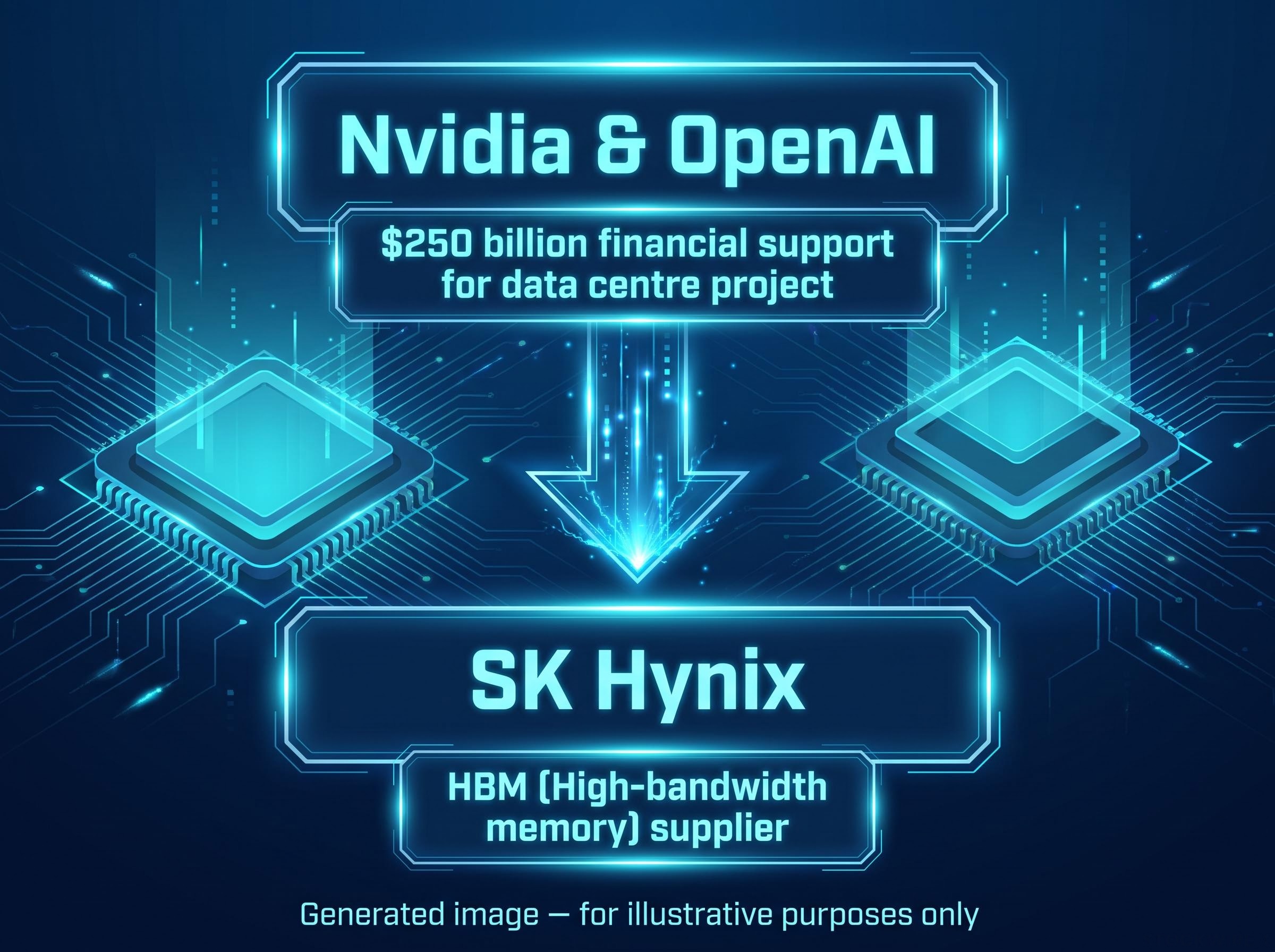
The catalyst was a Wall Street Journal report, cited by Reuters, describing how Nvidia was reportedly set to provide around $250 billion in financial support for an OpenAI data centre project.
$250 billion: the reported scale of Nvidia’s potential financial backstop for an OpenAI data centre project.
The investor logic followed a clear chain. If Nvidia, the dominant seller of AI accelerators, must finance the spending of one of its largest customers at this scale, the natural question becomes whether the demand for those chips is as organically strong as the market assumed.
AI capital spending among major hyperscalers is approaching or exceeding 90% of operating cash flow according to Vital Knowledge research, with Barclays modelling more than $200 billion in debt issuance required to close the structural funding gap between 2026 and 2028, a backdrop that gives the Nvidia-OpenAI financing report a broader systemic context than a single project.
Nvidia shares fell close to 5% on the day. That weakness moved downstream fast. SK Hynix is a primary supplier of high-bandwidth memory (HBM) chips for Nvidia’s AI accelerators, meaning its revenue trajectory is directly coupled to Nvidia’s order book. If the credibility of that order book comes into question, the supplier absorbs the repricing.
For anyone holding positions in AI supply chain names, this distinction is not academic. Demand backstopped by the supplier is structurally different from demand generated independently by customers. The financing report changed the sustainability calculus in a way that a simple earnings miss would not.
How high-bandwidth memory works and why Korean chipmakers sit at the AI supply chain’s centre
High-bandwidth memory (HBM) is a type of advanced memory chip designed to move data at extremely high speeds by stacking multiple memory layers vertically and connecting them with thousands of tiny channels. AI accelerators, particularly Nvidia’s GPUs, depend on HBM to train large language models and run inference workloads because these tasks require far more data throughput than conventional memory can deliver.
SK Hynix is the leading HBM supplier globally, and Samsung holds a significant position across both memory and logic chips. That dominance is why the KOSPI had been among the world’s best-performing indices; AI infrastructure spending flowed disproportionately through Korean producers. Samsung’s preliminary Q2 operating profit, an estimated 19-fold jump year-on-year, showed just how concentrated the AI revenue surge had become in Korean memory names.
The same supply chain centrality that drove those gains is the structural reason Korean equities absorbed the sharpest drawdown when sentiment shifted. That symmetry is not a coincidence. Concentration cuts both ways.
Why even a 19-fold profit jump was not enough to hold the rally
Samsung reported a Q2 operating profit surge of approximately 19-fold year-on-year, driven by AI memory demand. The market’s response was a share price decline of close to 7%.
Samsung’s Q2 2026 earnings guidance, released officially by Samsung Electronics in early July, put preliminary consolidated operating profit at approximately 89.4 trillion Korean won, making the subsequent share price decline on results confirmation one of the more striking sell-the-news episodes of the current AI cycle.
Samsung’s operating profit jumped an estimated 19-fold year-on-year. Its shares fell close to 7%.
That pattern did not appear in isolation. The prior week, chip stocks sold off after Alphabet’s results, despite those results beating expectations. Analysts had already flagged this sequence as a momentum warning sign: when strong beats produce selling rather than buying, the expectations already embedded in the share price have outrun what results can satisfy.
If the market sells a 19-fold profit increase, the issue is not the earnings result. It is the level of expectation already priced in. That makes the risk structural rather than event-specific, because no single quarter’s result, no matter how strong, can satisfy expectations that have been compounding ahead of fundamentals for months.
China’s semiconductor push and what CXMT’s 466% debut means for Korean memory margins
Chinese memory chipmaker CXMT surged 466% on its market debut, a first-day performance that signals how aggressively investors are pricing Chinese memory capacity growth. That appetite for Chinese chip exposure is directly correlated with the re-rating pressure on Korean memory incumbents.
The competitive threat runs deeper than one listing. According to industry analyst reports, Chinese producers are working to build their own domestic deep-ultraviolet (DUV) lithography tools, a segment historically dominated by Western and Japanese-European equipment makers. If Chinese producers can source lithography tools domestically, the technology barriers that have protected Korean producers begin to erode.
The memory pricing risks that were flagged as structural concerns in analyst notes before 28 July are now arriving simultaneously: ChangXin Memory Technologies achieved commercial DDR5 delivery with yields above 80% earlier in 2026, moving China’s competitive threat from a projected future event to a present supply-side reality.
Han Ji-young, analyst at Kiwoom Securities, warned that faster Chinese progress could erode the quasi-duopoly premium enjoyed by Samsung and SK Hynix at the leading edge of memory production.
| Dimension | SK Hynix / Samsung | Emerging Chinese competitors |
|---|---|---|
| Technology position | Leading-edge HBM and advanced DRAM | Scaling conventional DRAM; HBM gap remains |
| Chinese competition exposure | High: margins depend on quasi-duopoly pricing | State-backed capacity expansion accelerating |
| Strategic risk | Margin compression if technology gap narrows | Domestic DUV tools reduce reliance on Western suppliers |
Whether the 28 July selloff marks a turning point or a reset within the AI trade
The bear case rests on a clear set of structural concerns:
- Concentrated AI customer base with limited revenue diversification
- Supplier-financed demand signals from the Nvidia-OpenAI report
- Accelerating Chinese catch-up in both memory chips and lithography tools
- Valuation exhaustion visible in the “sell-the-news” pattern across multiple earnings cycles
The bull case is equally specific:
- Continued structural demand for HBM tied to data centre build-outs that are still expanding
- SK Hynix’s technology leadership in high-end HBM, which has not been matched by competitors
- Samsung’s diversified footprint across memory and logic, providing a partial buffer
The variables that determine which scenario unfolds from here:
- Whether AI infrastructure spending continues to be financed organically by hyperscalers, or whether supplier backstops become structural
- How quickly Chinese DUV and HBM capabilities scale to mass production
- Whether the next earnings cycle produces results that can genuinely surprise above expectations that are already elevated
The 28 July session does not resolve this debate. It does establish that elevated volatility is now the baseline for this trade.
What the data tells you before the next earnings cycle lands
The 28 July selloff was not a single-cause event. It was a sentiment shock exposing fragile foundations: financing concerns, valuation exhaustion, and Chinese competition amplification arrived simultaneously. That multi-causal structure is what makes this session different from a routine pullback.
Earnings beats alone will likely be insufficient to re-rate Korean chip stocks upward unless they also address the sustainability of AI spending and the credibility of the competitive moat against Chinese memory producers. The market is now trading these names on expectation credibility rather than earnings magnitude.
The forward indicators that matter most from here:
- Hyperscaler capex guidance: whether the next round of spending commitments comes from customer balance sheets or requires supplier financing
- Chinese DUV tool production timelines: any acceleration narrows the technology gap faster than current consensus assumes
- Nvidia financing disclosures: further detail on the scale and structure of customer backstops
The reader who understands that distinction, that expectation credibility now drives the trade rather than earnings size, will be better positioned to read the next cycle’s data than one who treats this as a straightforward buy-the-dip moment.
For investors holding Samsung or SK Hynix positions through this drawdown, our dedicated guide to holding chip stocks through volatile markets covers the rules-based frameworks endorsed by Jefferies, Barclays, and five major asset managers for avoiding reactive trading decisions during high-volatility sessions.
This article is for informational purposes only and should not be considered financial advice. Investors should conduct their own research and consult with financial professionals before making investment decisions. These statements are speculative and subject to change based on market developments and company performance.