Financial markets are pricing next week’s Federal Reserve decision as a near-coin-flip that still leans toward a hold. One major Wall Street institution has looked at the same data and reached the opposite conclusion.
Citi Research is forecasting a 25 basis point rate hike at the September 15-16, 2026 Federal Open Market Committee (FOMC) meeting, a call that runs directly against the roughly 70% of economists who expect no move at all. That meeting arrives with the federal funds target range sitting at 3.50%-3.75% and the memory of a fractious 9-3 vote to hold at the July gathering still fresh.
This analysis maps out what the central bank is likely weighing next week, from the contrarian forecast itself to the inflation prints driving it and the internal divisions that could complicate everything. Here is what you need to know to position for the equity volatility and yield curve shifts that would follow if the consensus proves wrong.
The contrarian case for a September rate increase
The market and Citi Research are looking at the same economy and telling two different stories. That gap is where the risk lives for anyone holding a portfolio into next week.
Citi’s forecast is specific: a 25 basis point increase that would lift the federal funds target from 3.50%-3.75% to a new range of 3.75%-4%. The broader economic consensus expects the Fed to sit still. A 9 September Reuters poll found roughly 70% of surveyed economists anticipating no change, and prediction market Polymarket assigned a 72.5% probability to a hold in August.
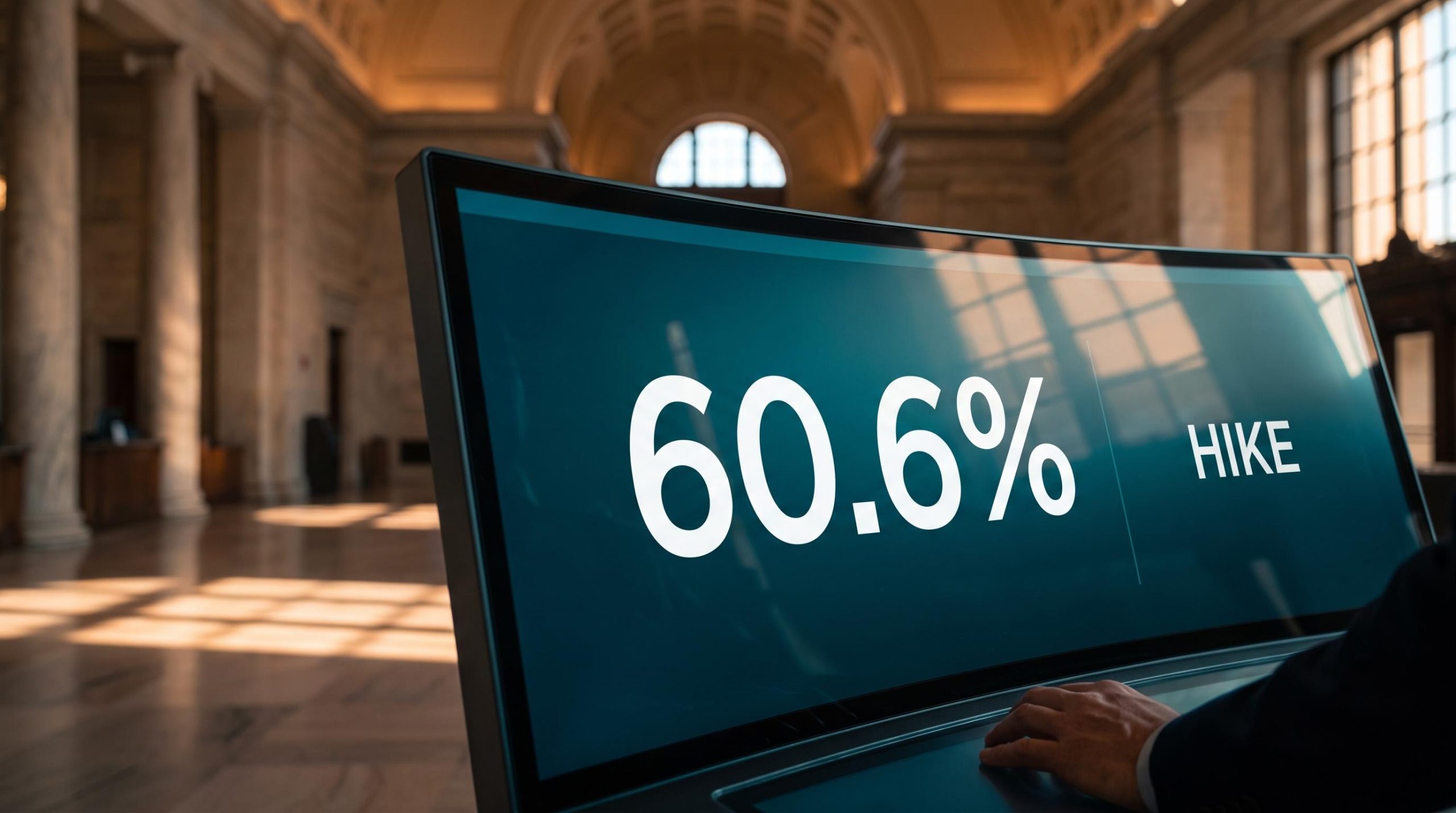
Yet the futures market tells a more uncertain tale. According to CME FedWatch, which reads the odds of a hike from federal funds futures pricing, the probability climbed to 58% on 7 September and reached 60.6% by 10 September. Futures also imply a roughly 85% chance that rates will be higher by December.
Rate hike odds swung from nearly 70% to a coin flip in under 48 hours after the August payrolls print, illustrating how rapidly a single data release can reprice the entire rate path and expose portfolios anchored to stale consensus estimates.
So the pricing is not a clean hold. It is a market that has crept toward pricing a hike while a majority of forecasters still resist it. That tension is the tell.
Wall Street cannot agree on the path from here, either. The divergence across major desks reveals how little consensus actually exists beneath the headline numbers.
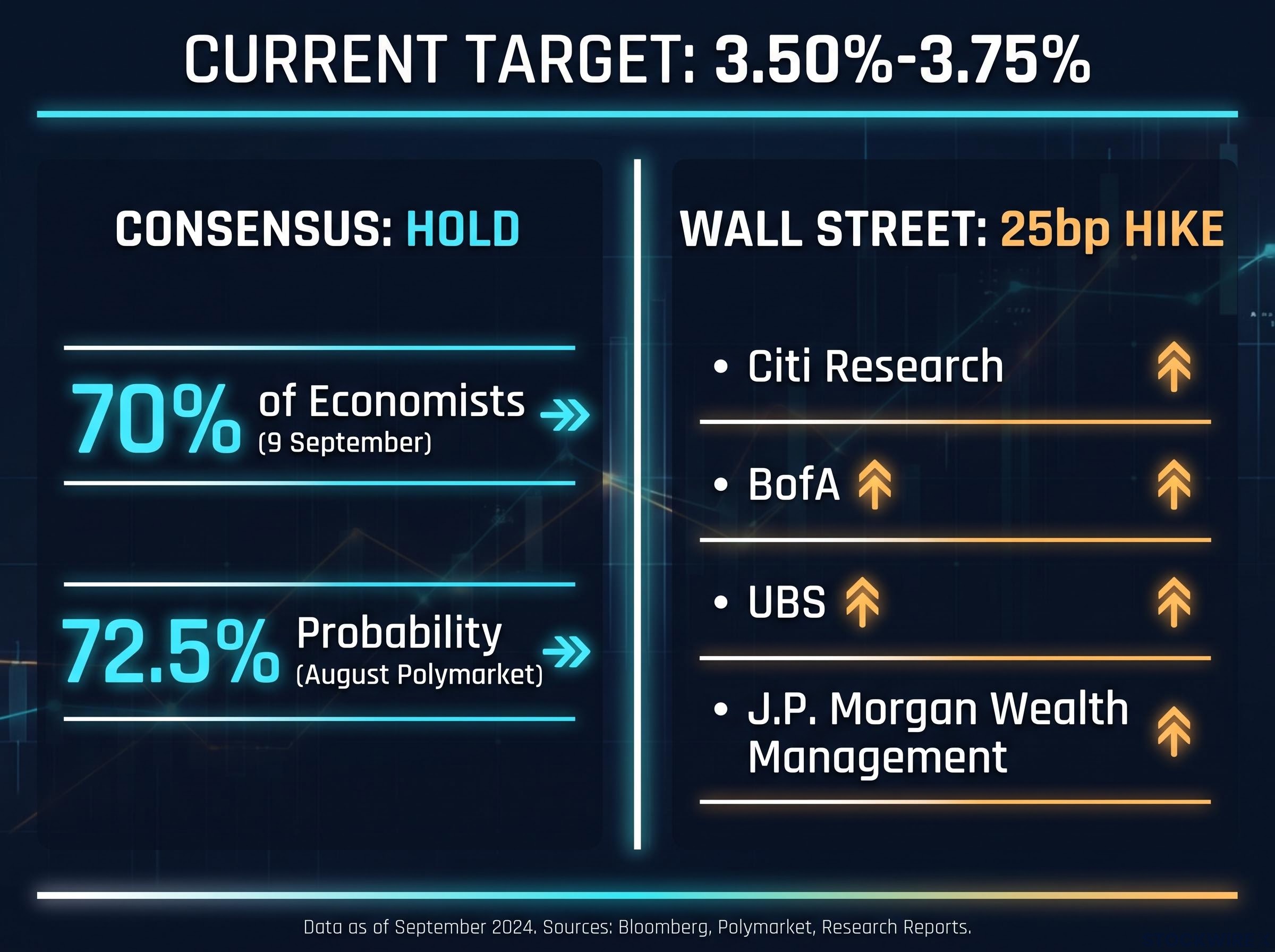
| Institution | September Prediction | Late 2026 Outlook |
|---|---|---|
| Citi Research | 25bp hike | One further hike possible (two total for the year) |
| BofA | 25bp hike | Three hikes: September, October, December |
| UBS | 25bp hike | Two hikes in 2026 |
| J.P. Morgan Wealth Management | 25bp hike | Single adjustment, then on hold |
Here is what this means for you directly. If Citi is right and the broader consensus is wrong, the market is currently mispriced for a hold, and a hike next week would force an immediate repricing across equities and bonds. Retail investors who anchor to consensus headlines are exactly the ones most exposed to that shock.
When big ASX news breaks, our subscribers know first
How a policy calibration differs from a tightening cycle
If the Fed does hike, the single most important thing to watch is not the number. It is the language wrapped around it.
Citi expects the Fed to frame any September increase as a policy “calibration”, a one-off fine-tuning measure meant to address inflation that has proven sticky, rather than the opening move in an aggressive tightening cycle. The distinction matters enormously. A calibration signals adjustment; a tightening cycle signals a sustained campaign to slow the economy.
This framing is also a communication tool. By portraying the hike as a limited adjustment rather than a commitment to a long series of increases, the Fed Chair can preserve flexibility, reinforce credibility on inflation, and, critically, minimise the number of dissenting votes on a divided committee.
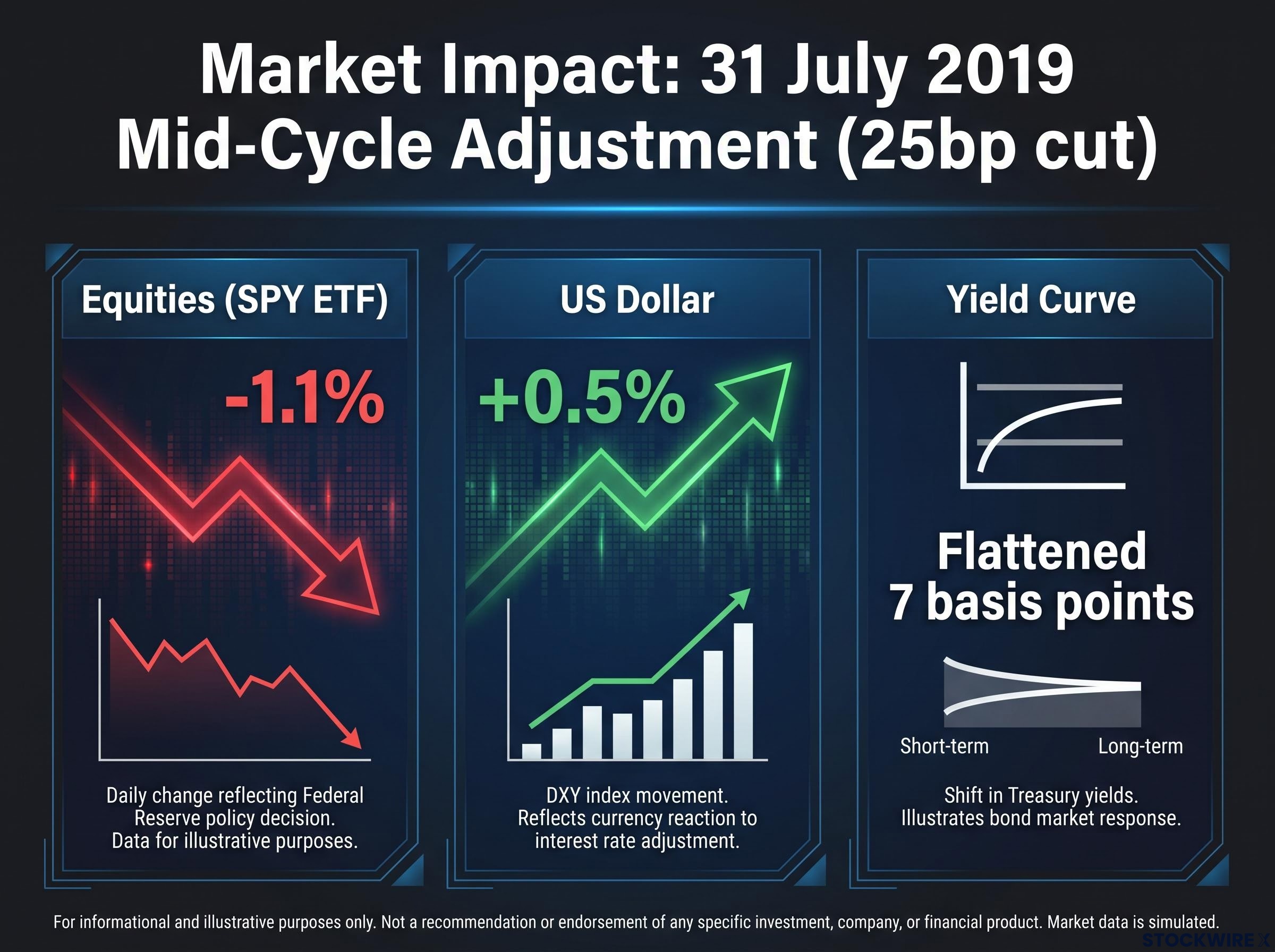
There is a direct precedent for how markets read this kind of language. On 31 July 2019, when the Fed cut rates by 25 basis points, Chair Jerome Powell described the move as a “mid-cycle adjustment”. Because that phrasing did not match what markets had expected, it triggered an immediate repricing across three assets:
- Equities: The SPY ETF fell approximately 1.1% intraday as investors recalibrated their expectations.
- US dollar: The greenback strengthened by roughly 0.5% on the shift in rate expectations.
- Yield curve: The Treasury yield curve flattened by approximately 7 basis points, with front-end yields moving more than long-dated ones.
A 2026 calibration hike could produce similar second-order effects in reverse. Analysts warn that a modest hike aimed at protecting credibility would likely strengthen the dollar and flatten the curve further, as short-dated yields rise on the move while longer-dated yields stay anchored by the expectation that no prolonged tightening follows.
Recognising this language shift helps you avoid overreacting. If the Fed hikes and calls it a calibration, the smart read is a surgical, one-off adjustment, not the start of a sustained assault on asset prices. That difference should shape how you respond to the announcement rather than how the initial headline makes you feel.
The sticky inflation metrics forcing the committee’s hand
Strip away the forecasts and the internal politics, and the case for a hike comes down to a handful of stubborn decimal points.
Recent inflation data landed just hot enough to hand the hawks their justification, even as broader components pointed toward disinflation. The August report is the clearest example of how marginal the trigger really is.
Here are the numbers doing the work:
- Core CPI (August 2026): Rose 0.3% month-over-month and 2.4% year-over-year, according to the Bureau of Labor Statistics. Citi notes the unrounded monthly figure was 0.29%.
- Core PCE (July 2026): Rose 3.3% year-over-year, per the Bureau of Economic Analysis, still well above the Fed’s 2% objective.
That 0.29% unrounded Core CPI figure matters more than it looks. Citi’s reading is that it implies Core PCE, the Fed’s preferred inflation gauge, would advance at a comparable monthly pace. A monthly Core PCE running near a 3.5% annualised rate would not clear the bar the Fed needs to see for inflation moving convincingly toward target.
The core PCE trajectory over the preceding three months matters as much as any single monthly print, because the Fed applies a multi-gauge convergence test before adjusting policy and one favourable reading carries no independent weight in that framework.
The upcoming meeting will also bring revised economic projections. Citi expects the median forecast for 2026 Core PCE to be marked down from the June baseline of 3.3% to roughly 3%, measured on a fourth-quarter-to-fourth-quarter basis, with GDP expectations broadly unchanged and unemployment edging slightly lower.
When you watch these fractional inflation increases persist month after month, you are looking at the precise trigger points that could compress valuations in your growth stock holdings. Rate-sensitive names react most sharply to exactly this kind of data, which is why a 0.29% print deserves your attention rather than a shrug.
Boardroom fractures and near-term economic risks
The economics build a case for a hike. The people inside the room are the reason it is not a done deal.
The July FOMC meeting split 9-3, with three regional Federal Reserve Bank presidents voting to raise rates while the majority held. That documented divide is the clearest evidence of a genuine hawk-dove fault line, and Citi expects those three presidents, joined by several governors, to back a September increase.
Leading the hawkish camp is Fed Chair Kevin Warsh. In his 28 August 2026 Jackson Hole keynote, he described the 2% PCE objective as a “firm, fixed target”, noting the 12-month change in the PCE price index stood at 3.7% and the six-month change at 4.1%.
Warsh’s confirmation into a 3.8% CPI environment in May 2026 established the credibility-first posture he carried into Jackson Hole, where his ‘firm, fixed target’ framing directly mirrored the language he used during Senate testimony to distinguish himself from a more flexible inflation-tolerance approach.
“Inflation remained too high,” Warsh signalled at Jackson Hole, indicating that rate hikes remain the Fed’s predominant tool and that additional policy work will be required if price pressures do not moderate quickly enough.
Governor Christopher Waller sits in a more data-dependent position. Citi characterises him as drawing encouragement from two consecutive months of softer inflation, though a hotter reading would push him toward supporting a hike. On 3 September, Waller reiterated that current inflation levels remain inconsistent with the 2% goal. Both officials agree inflation is too high; they differ on the timing of the response.
Tracking these individual stances gives you an early warning system for future moves. When a data-dependent governor like Waller starts leaning hawkish, that is your cue to consider adjusting fixed income duration before the broader market catches up.
The growing risk of a monetary policy error
Not everyone thinks a hike is wise. Critics argue that with Core CPI and Core PCE both well off their earlier peaks, the Fed should let previous increases continue working through the economy rather than adding new pressure.
The strongest evidence for that caution is the consumer. July retail and food services sales came in at $763.6 billion, down 0.6% from June, a sign that demand may be softening even as the committee contemplates tightening.
Raising rates into weakening consumer spending carries a real policy-error risk. A sharper-than-expected slowdown could eventually force the Fed to reverse course and cut, undermining the very credibility the calibration hike was meant to reinforce.
The August retail sales report is the near-term variable that could settle the argument. Citi projects a rebound, with both the headline and control group measures rising 0.7% month-over-month, alongside firmer readings in industrial production and single-family housing starts. A strong print would validate the hike; a weak one would hand the doves their case.
Navigating the volatility of a divided central bank
The stage is set for a genuinely two-sided decision. Consensus still favours a hold, yet the data, the futures pricing, and Citi’s contrarian call all point to a credible path for a 25 basis point calibration hike that the market is not fully braced for.
The timing sharpens the stakes. The August retail sales report is scheduled for release on 16 September, landing concurrently with the FOMC decision, which sets up a compressed window where a policy surprise and a fresh demand reading could hit simultaneously.
For your portfolio, the practical takeaway for the final quarter of 2026 is to prepare for elevated currency and yield curve movement rather than betting the house on either outcome. A calibration hike would likely lift the dollar and flatten the curve, pressuring rate-sensitive growth names, while a hold would reward those positioned for stability. Watching the language as closely as the number is how you avoid overreacting to whichever way the committee breaks.
For readers wanting a foundational framework before interpreting next week’s statement language, our full explainer on how the FOMC works covers the voting structure, rate toolkit, and how to detect real policy shifts by comparing current language against the Summary of Economic Projections.
This article is for informational purposes only and should not be considered financial advice. Investors should conduct their own research and consult with financial professionals before making investment decisions.
Past performance does not guarantee future results. Financial projections are subject to market conditions and various risk factors. These statements are speculative and subject to change based on market developments and company performance.