

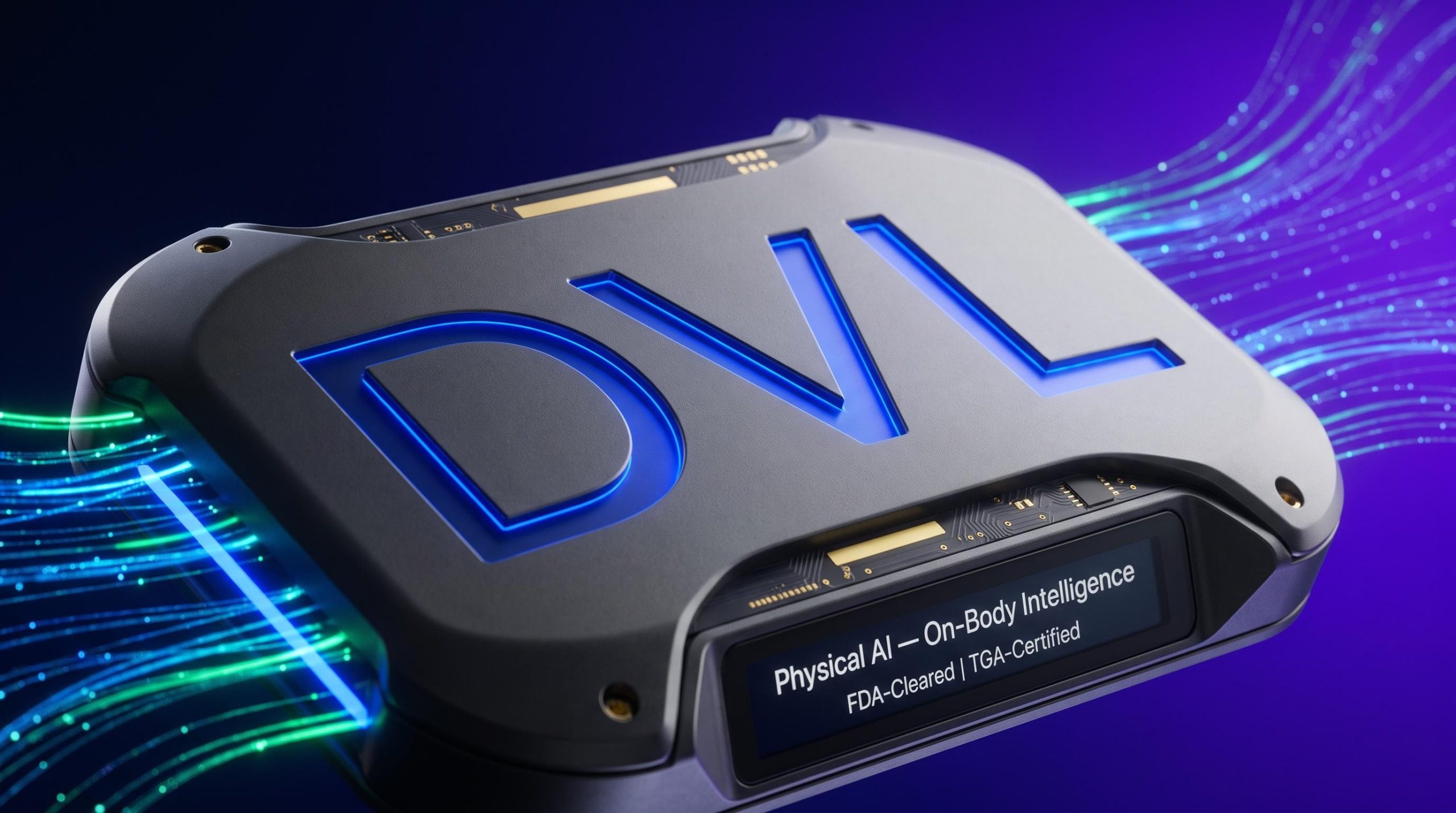
dorsaVi launches Sensor v6.5, its first Physical AI wearable running intelligence on the body
dorsaVi Ltd (ASX: DVL) has commercially launched Sensor v6.5, its first Physical AI product. The intelligent wearable measures, analyses, decides and acts on human movement in real time, directly on the device, with no iPad base device or cloud connection required.
The launch marks dorsaVi’s first commercial expression of Physical AI at what it calls the “Ultra-Edge.” Sensor v6.5 is built on the Company’s existing FDA-cleared, TGA-certified platform, which has more than a decade of deployment across clinical, elite sport, defence and occupational health.
When big ASX news breaks, our subscribers know first
What Sensor v6.5 does — from measurement to intelligent action
For more than a decade, dorsaVi’s technology objectively measured human movement. Sensor v6.5 marks a shift: the device now also decides and acts on that movement, running the full loop directly on the sensor itself.
The Company describes this as a measure, analyse, decide and act loop:
-
Measure – raw movement captured on the body.
-
Analyse – real-time processing and interpretation on the sensor, with no cloud round-trip and no latency penalty.
-
Decide – onboard assessment of movement quality, distinguishing normal movement, elite performance characteristics and patterns associated with injury risk.
-
Act – configurable haptic, audible or visual biofeedback delivered within milliseconds of a movement event.
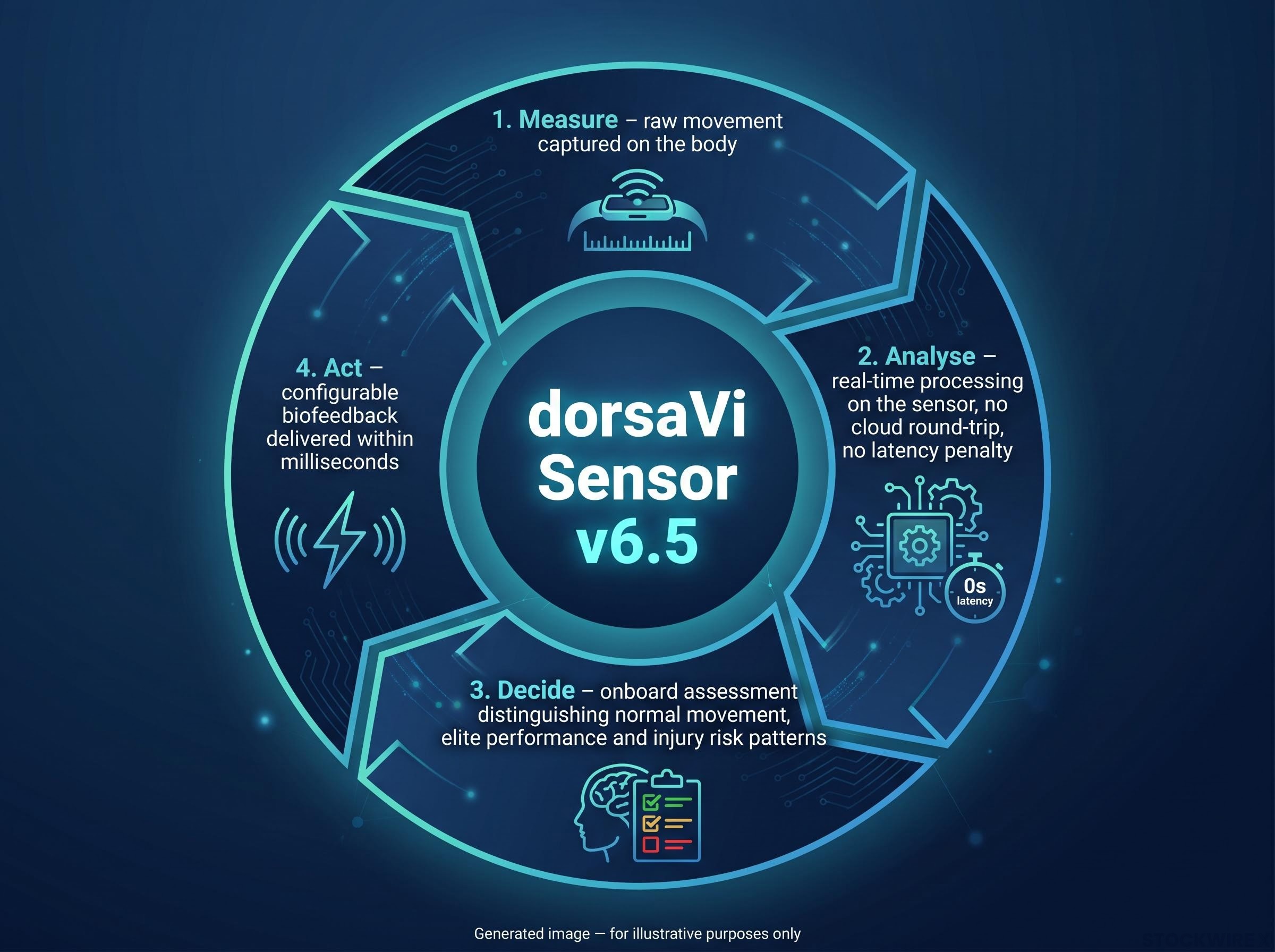
Conventional wearables transmit movement data to a phone or server for later analysis, so any intervention arrives after the event. By moving the full loop onto the sensor, dorsaVi states that feedback lands at the moment it can change the outcome rather than minutes or hours later.
| Attribute | Conventional Wearable | Sensor v6.5 |
|---|---|---|
| Where processing happens | Cloud or remote server | On the device itself |
| Feedback delay | Minutes or hours | Milliseconds |
| Cloud connection required | Yes | No |
What is Physical AI, and why on-body has been the hard problem
Most of the AI investors read about lives in a data centre, where it writes text, generates images and answers questions, remote from where anything physically happens. Physical AI is different. It describes systems that sense the physical world, interpret what is happening, make an automated decision and act on it in real time, at the point where the event occurs.
According to dorsaVi, Physical AI is emerging first in autonomous vehicles, robotics and industrial systems, almost all of which run on power, size and compute budgets that a body-worn device cannot carry. A wearable cannot carry that budget, which is why intelligence on the body has been the harder problem to solve.
The Company frames the distinction in investment terms: a product that already runs the full loop on the body is “the signal that matters, not a projection of what edge AI might one day do.” dorsaVi positions Sensor v6.5 as commercially ready where much of the on-body category remains theoretical.
The underlying principle is clinically grounded. dorsaVi’s Randomised Controlled Trial (P Kent, 2015) in chronic low back pain showed that feedback delivered at the moment of a movement fault, rather than reviewed on a screen later, significantly improved movement outcomes. Sensor v6.5 embeds that validated principle directly into the wearable.
The roadmap — dorsaVi’s memory and compute engine
dorsaVi describes a two-part strategy. Sensor v6.5 runs on conventional silicon today, while the custom hardware roadmap is a deliberately longer-term program under the Ultra-Edge Modular Design and Build program, aimed at pushing future generations toward always-on operation.
Three technologies are in development, each targeting a constraint that currently limits how much intelligence a body-worn device can carry:
-
Resistive Random-Access Memory (RRAM): non-volatile memory that stores information and retains it even when the device is off, using far less power than the memory in today’s devices.
-
Compute-in-Memory (CIM): computing performed inside the memory itself so data does not have to move, with research indicating up to 100x less energy per AI decision.
-
Neuromorphic Processing (the “reflex engine”): the sensor stays quiet during normal movement and wakes only when something meaningful happens, enabling always-on efficiency.
The design targets power levels low enough to run on a coin-cell battery, a threshold dorsaVi states conventional architectures cannot reach. Importantly, this hardware is in development with defined milestones and is not complete.
The program forms part of dorsaVi’s five-stage Execution Plan, with design priorities guided by the Company’s Technical Advisory Board, which includes Roger Peniche, former Vice President of Engineering and Manufacturing at Omron Robotics. Management frames the sensor and the hardware roadmap as “one strategy, not two.”
The Ultra-Edge Modular Design and Build programme, now in its third workstream, separates sensing, compute, and memory into independently licensable modules, with an API integration layer in development to allow robotics manufacturers and medical device companies to embed ultra-edge AI capability without requiring in-house semiconductor expertise.
Where v6.5 can be deployed — from sport to defence to robotics
dorsaVi distinguishes between established markets, where it already holds an FDA-cleared commercial presence, and new target markets that the shared architecture can extend into:
-
Healthcare and rehabilitation (established) – intelligent wearables guide patients through recovery protocols and provide corrective feedback beyond the clinic, supporting adherence and reducing re-injury risk.
-
Elite sport (established) – immediate biofeedback reinforces optimal movement patterns across any sport involving repetitive loading, from running and ball sports to Olympic lifting.
-
Defence and physically demanding occupations (established) – real-time fatigue detection and movement-quality monitoring for soldiers, emergency services and industrial workers.
-
Robotics and exoskeletons (same core, new market) – the same measure, analyse, decide and act core is paired with a machine-control interface in place of human biofeedback, extending the platform without new foundational sensing or decision R&D.
The significance for investors is that one shared core can extend the platform into large adjacent markets without rebuilding the underlying technology.
Ultra-Edge commercial partnerships secured in March 2026, including agreements with ESPN injury expert Dr Chirag Patel and the European SEROMA clinical consortium, demonstrated that institutional and clinical buyers were already selecting the platform’s on-sensor processing capability over passive data collection alternatives.
CEO Mathew Regan on the strategy
Mathew Regan, Group Chief Executive Officer
“The sensor and the custom hardware we are developing are one strategy, not two: on-body Physical AI ready for market now, and the engine to power it more efficiently as it matures… We are starting where we are strongest, on the body, with a clear line of sight into the broader Physical AI opportunity.”
What it means for investors
dorsaVi presents Sensor v6.5 as a commercialisation-ready Physical AI product available now, rather than a projection. It is built on an already FDA-cleared, TGA-certified, revenue-deployed platform that has been used by leading organisations including BHP, Boeing, Toyota, Coles and Woolworths, alongside defence agencies.
The shared measure, analyse, decide and act core offers optionality into robotics and exoskeletons, while the longer-term hardware roadmap advances under staged, milestone-based reporting.
dorsaVi has stated it will report against defined milestones as the Ultra-Edge Modular Design and Build program progresses.
Don’t Miss the Next Healthcare Tech Breakout on the ASX
Big News Blast delivers FREE breaking ASX healthcare and tech news directly to your inbox within minutes of release, with in-depth analysis already done. Join 20,000+ subscribers who stay ahead of the market the moment announcements drop. Click the “Free Alerts” button at StockWire X to start receiving alerts today.