This week’s Federal Reserve gathering carries an unusual dynamic: the rate outcome is the least interesting part. Attention has already shifted to what the committee chooses to communicate rather than what it decides on the rate itself.
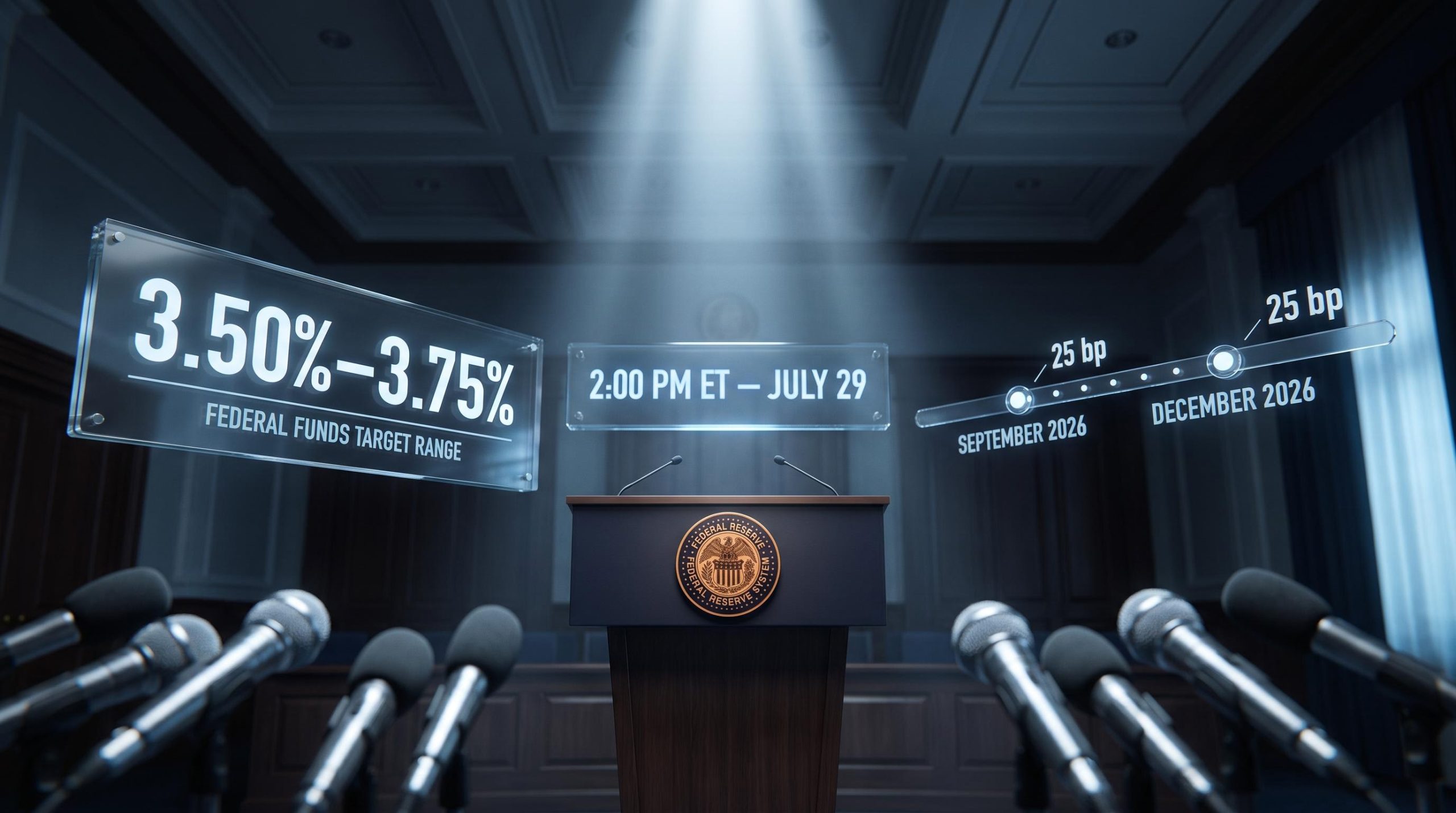
The July 28-29 FOMC meeting lands inside a 48-hour window that includes Q2 GDP, PCE inflation, and earnings from Microsoft, Meta, Apple, and Amazon. The federal funds rate staying at 3.50%-3.75% is consensus. The statement language and press conference are not. That asymmetry is where the real market risk sits this week.
Here is the framework for reading the specific statement language that will move markets before the macro data even arrives, along with a three-scenario decision tree and a step-by-step monitoring sequence for Tuesday and Wednesday.
Why this week’s rate decision is already priced in
Futures markets assign a very high probability to an unchanged rate outcome on Tuesday. The federal funds target range of 3.50%-3.75% has held through multiple meetings, and nobody with serious capital behind the trade is positioned for a surprise move.
That consensus is the point, not a reason to look away. When a decision is fully priced in, markets stop reacting to the current move and start reacting to changes in expectations about the next 6-18 months of policy. The rate holding is not the signal. The rate holding was already the trade weeks ago. All the information content is now concentrated in the language around that hold.
The June 2026 regime shift under Warsh produced exactly this dynamic: rates held, the dot plot revised higher, and markets repriced approximately 50 basis points on a one-year forward horizon without a single concrete tightening step, establishing the template for how July communication will be read.
The June meeting illustrated this mechanism clearly. Rates held, but updated projections signalling a higher year-end 2026 median range (around 3.75%-4.00%) re-priced the forward path. The result was a “hawkish pause” that drove cross-asset volatility despite zero change in the actual rate.
If you expect Tuesday to be quiet because the rate is not moving, the June meeting is your counter-evidence. The same mechanics are in play this week.
When big ASX news breaks, our subscribers know first
What the Fed’s statement will actually tell you
The FOMC statement is released at 2:00 p.m. ET on July 29. It runs a few hundred words. Not all of them matter equally. Two specific paragraphs carry the most market-moving potential, and knowing which ones to watch lets you interpret the release in real time rather than waiting for media summaries that arrive 30-60 minutes later, after the initial moves have already occurred.
Warsh’s 130-word policy statement from June, which eliminated forward guidance entirely and withheld his own dot plot projection, means the July statement and press conference carry even more interpretive weight than they would under the prior communication regime.
The three language signals to watch:
- Inflation confidence phrasing. Whether the committee describes price pressures as persistent or acknowledges clear progress toward target carries significant weight. That choice shifts market pricing between one cut and two for the remainder of 2026, repricing every rate-sensitive asset in the process. Participants scrutinise each adjective and qualifier in this paragraph with considerable care. Treasury yields and rate-sensitive FX pairs typically respond within minutes, reflecting how firmly the committee appears to believe inflation is on a sustainable downward path.
- Labour market characterisation. Recent statements have framed employment conditions as resilient but gradually easing. Any language shift toward explicit weakness or deterioration would bring forward anticipated cut timing, even though the underlying signal would be negative for the growth outlook. The precise descriptors used here carry outsized significance.
- Forward guidance conditionality. This is where the press conference becomes more important than the statement itself.
The forward guidance signal and what it means for September
Current market and Fed projections cluster around one 25 basis point (bp) adjustment for 2026. A basis point is one-hundredth of a percentage point. September and December 2026 are the meetings where economists and derivatives traders pencil in the first potential move.
The question is whether Chair Powell names explicit criteria for the next move. If he does, something along the lines of “if inflation continues to move down and labour conditions remain strong,” markets will treat that as a rate path anchor even without a formal dot plot change. The dot plot (the chart showing each official’s rate projection) is not released at every meeting. July is a non-projection meeting, so the statement and press conference are the only channels for new information about the committee’s forward view.
For investors wanting to replace the toolkit that forward guidance made obsolete, our full explainer on rebuilding rate-expectations frameworks covers the specific data releases, yield-curve signals, and positioning disciplines that now carry the weight the dot plot once provided.
The FOMC meeting calendar published by the Federal Reserve confirms July as a non-projection meeting, which is why the statement and press conference carry the entire burden of communicating any shift in the committee’s forward view this cycle.
Three scenarios for Tuesday’s statement and their cross-asset implications
Pre-mapping conditional outcomes converts a potentially chaotic event into a structured decision environment. That is how professional traders approach high-event-risk days, and it is the framework you should have ready before 2:00 p.m. ET.
These are conditional relationships grounded in recent historical responses, not deterministic predictions.
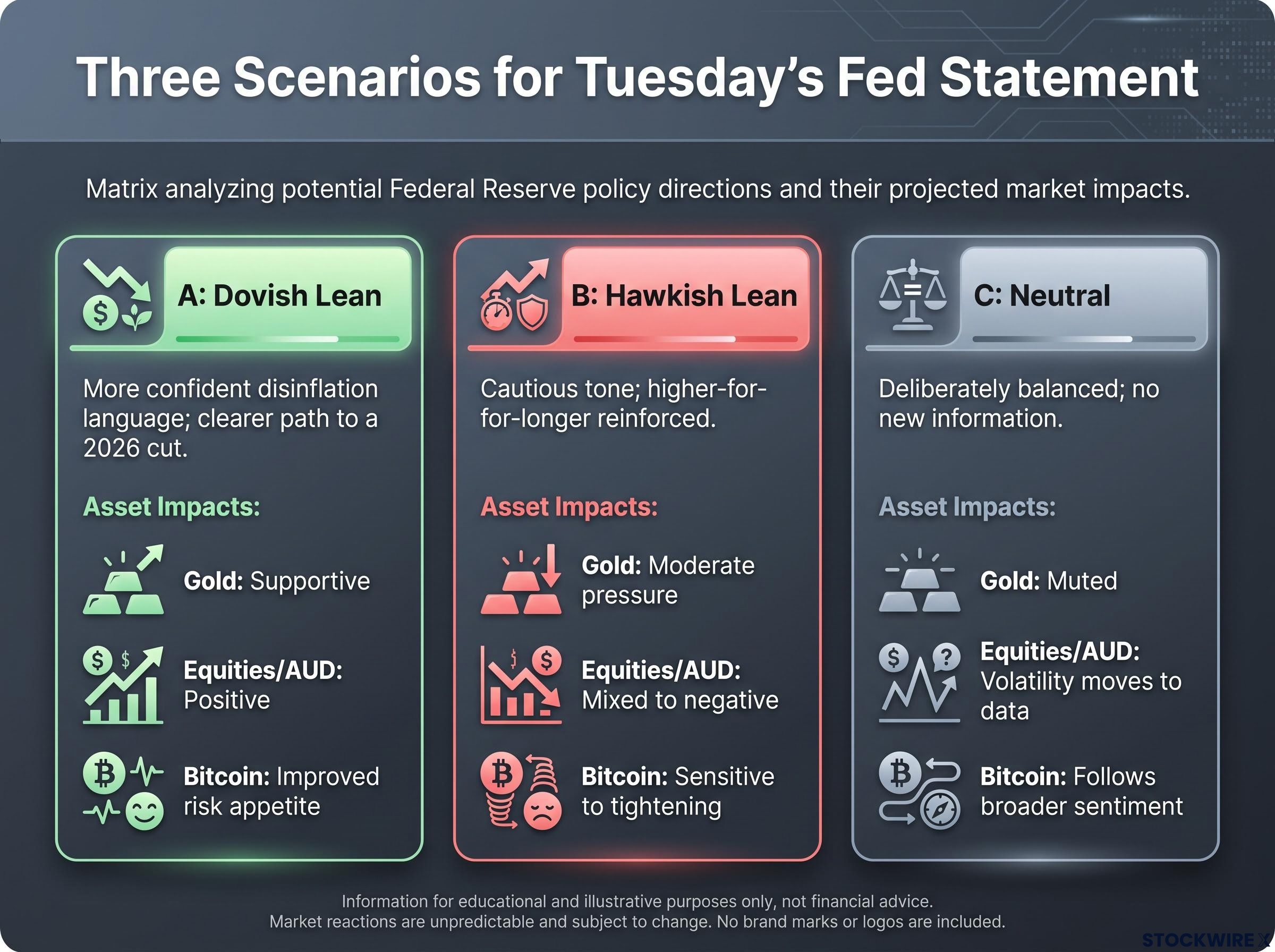
| Scenario | Tone Signal | Gold | Equities / AUD | Bitcoin / Risk Assets |
|---|---|---|---|---|
| A: Dovish lean | More confident disinflation language; clearer path to a 2026 cut | Supportive (lower real yields) | Positive for rate-sensitive growth stocks; weaker dollar supports AUD/USD | Improved risk appetite; historically positive for crypto |
| B: Hawkish lean | Cautious tone; higher-for-longer reinforced | Moderate pressure (higher or stable yields) | Mixed to negative equities; stronger dollar weighs on AUD/USD | Sensitive to tightening financial conditions |
| C: Neutral | Deliberately balanced; no new information | Muted reaction; shifts to data-driven | Volatility moves to earnings and GDP/PCE | Follows broader risk sentiment, not Fed-driven |
The neutral scenario carries its own signal. When the Fed says nothing new, the macro data becomes the Fed. If Scenario C materialises, everything shifts to July 30: Q2 GDP, PCE, and mega-cap earnings carry disproportionate near-term weight in determining direction.
The framework is not about predicting the Fed. It is about ensuring you have already done your thinking before the statement drops, so you are interpreting new information rather than scrambling to form a view under time pressure.
The 48-hour window: how GDP, PCE, and mega-cap earnings interact with the Fed signal
The Fed statement is only the first layer of a compressing information stack. The final market signal this week will be a composite, not a single event.
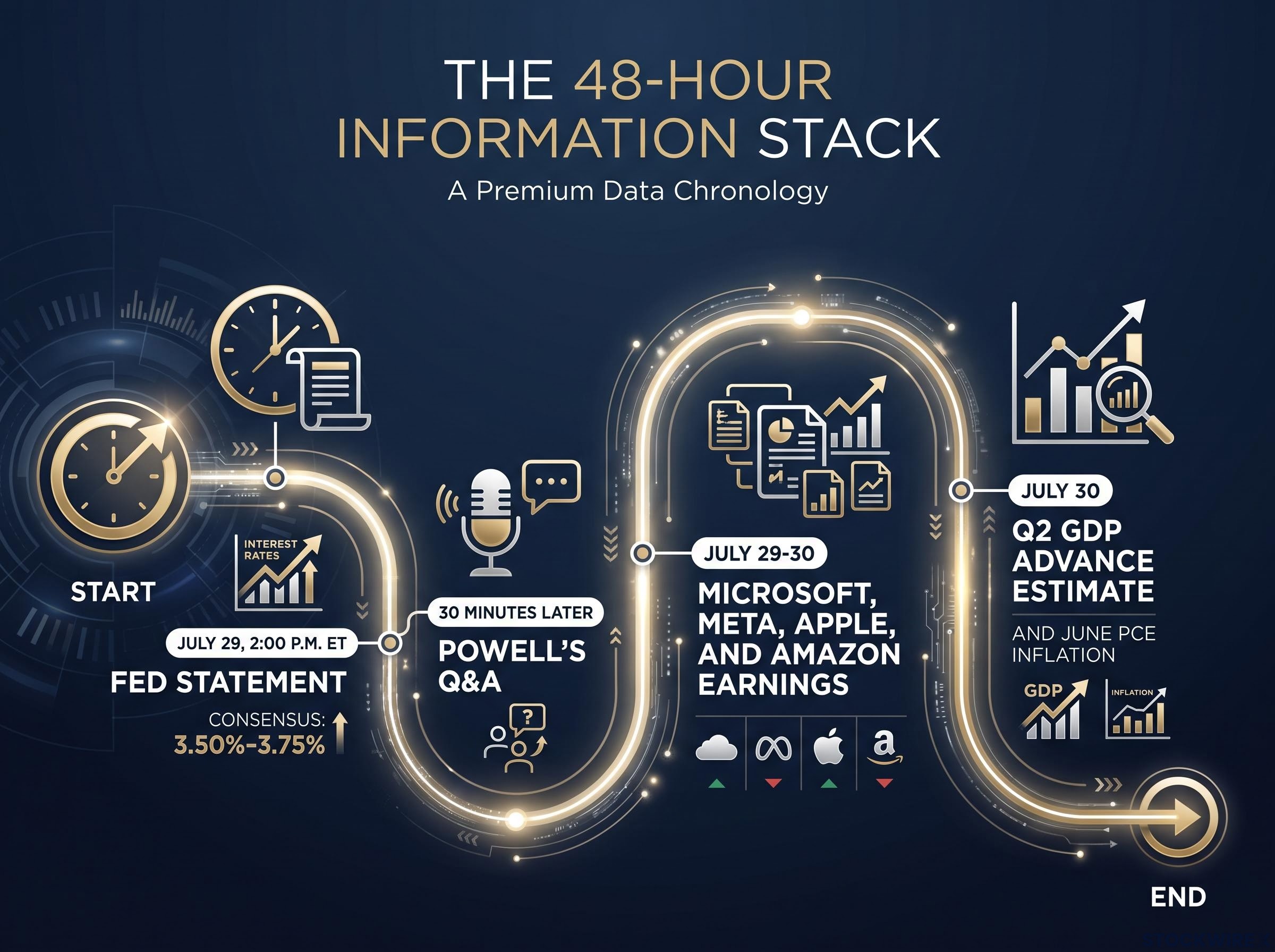
The three-step sequence:
- Fed statement and press conference: July 29, 2:00 p.m. ET, followed by Powell’s Q&A approximately 30 minutes later.
- Mega-cap earnings: Microsoft, Meta, Apple, and Amazon report July 29-30, running directly alongside the Fed communication window.
- Q2 GDP advance estimate and June PCE inflation: Both scheduled for July 30, the day after the decision.
That sequencing matters. Markets will immediately recalibrate the Fed’s message against fresh data. Strong growth plus sticky inflation points to a longer pause. Cooling growth plus cooling inflation leans into a late-2026 cut scenario. The composite signal from GDP and PCE, arriving within hours of the decision, will matter as much for medium-term positioning as the Fed’s own words.
When earnings and the Fed pull in opposite directions
Equity markets are simultaneously processing two distinct signals: from the Fed, the price of money and the trajectory of liquidity; from earnings, the profit outlook and sector-specific growth.
Strong tech earnings can absorb a hawkish statement. Weak earnings amplify it. If you treat Tuesday’s statement as the only signal that matters this week, you will likely misread the composite market direction that emerges from the GDP-PCE-earnings combination. The Fed’s words are the opening bid, not the final price.
Prior Fed communication and its cross-asset footprint
At the previous meeting, the rate outcome itself held no surprises, yet the Fed’s communication still generated meaningful price action across multiple asset classes, and that sequence offers a useful reference for this week.
The hawkish dot plot revision from June, which shifted the median year-end projection from 3.4% to 3.8% and triggered sharp equity selloffs in rate-sensitive and high-multiple growth names, is the direct precedent for how a similar communication surprise could transmit through asset classes if July’s statement leans in the same direction.
| Asset | Initial Move | Driver | Key Observation |
|---|---|---|---|
| Gold | Rose before reversing | Dovish reading of inflation language | Initial gains faded as traders absorbed the more restrictive elements in the projections |
| AUD/USD | Sharp two-way swings | Repricing of future US rate expectations | The pair whipped around as the statement and press conference sent conflicting signals |
| US equities | Pushed higher | Anticipation of eventual policy loosening | The advance was led by rate-sensitive and growth-oriented names |
| Bitcoin | Moved up | Broader improvement in risk appetite on softer rate expectations | The gain tracked general risk sentiment rather than any catalyst specific to crypto |
In each case the move was a product of how the market read the Fed’s words, not of any change in the policy rate itself. That dynamic is the working template for how these same assets are likely to behave when the July statement is published. If you hold exposure across any of these asset classes, the prior meeting’s sequence is the reference point for sizing your risk heading into Tuesday.
Reading the week without getting whipsawed by the noise
The three-step monitoring sequence for the 48-hour window:
- Watch the first 5-10 minutes after 2:00 p.m. ET on July 29. Initial moves in Treasury yields, S&P 500 futures, gold, and the dollar index reveal how algorithms and fast money are reading the statement text. These moves reflect the market’s first interpretation of the inflation and labour paragraphs, but they are not the final word.
- Focus on Powell’s press conference, roughly 30 minutes later. Historically, off-script comments and conditional framing have delivered the largest post-statement surprises. If Powell names explicit criteria for a September or December move, that becomes the strongest signal of the day.
- Reassess as July 30 data and earnings arrive. Q2 GDP, PCE, and mega-cap tech earnings will either reinforce or contradict the market’s initial read. This is when medium-term positioning decisions are best made, not the immediate post-statement window.
The reader who waits for the July 30 composite signal rather than reacting to the 2:00 p.m. headline is operating with a structural information advantage over participants who trade the initial algorithmic spike.
What the statement will settle, and what only July 30 can answer
The rate decision is a non-event. The statement language is the primary market catalyst. The July 30 data completes the picture.
What remains genuinely uncertain is whether Powell will provide a conditional roadmap or stay strictly data-dependent. That is unknowable in advance, which is precisely why the scenario framework matters more than any single prediction.
You now have the scenario map, the monitoring sequence, and the asset-level implications from the prior meeting. The composite signal from GDP, PCE, and mega-cap earnings on July 30 will determine whether Tuesday’s initial moves hold or reverse, and that will be the subject of the immediate post-event analysis.
This article is for informational purposes only and should not be considered financial advice. Investors should conduct their own research and consult with financial professionals before making investment decisions. These statements are speculative and subject to change based on market developments and Federal Reserve communication.