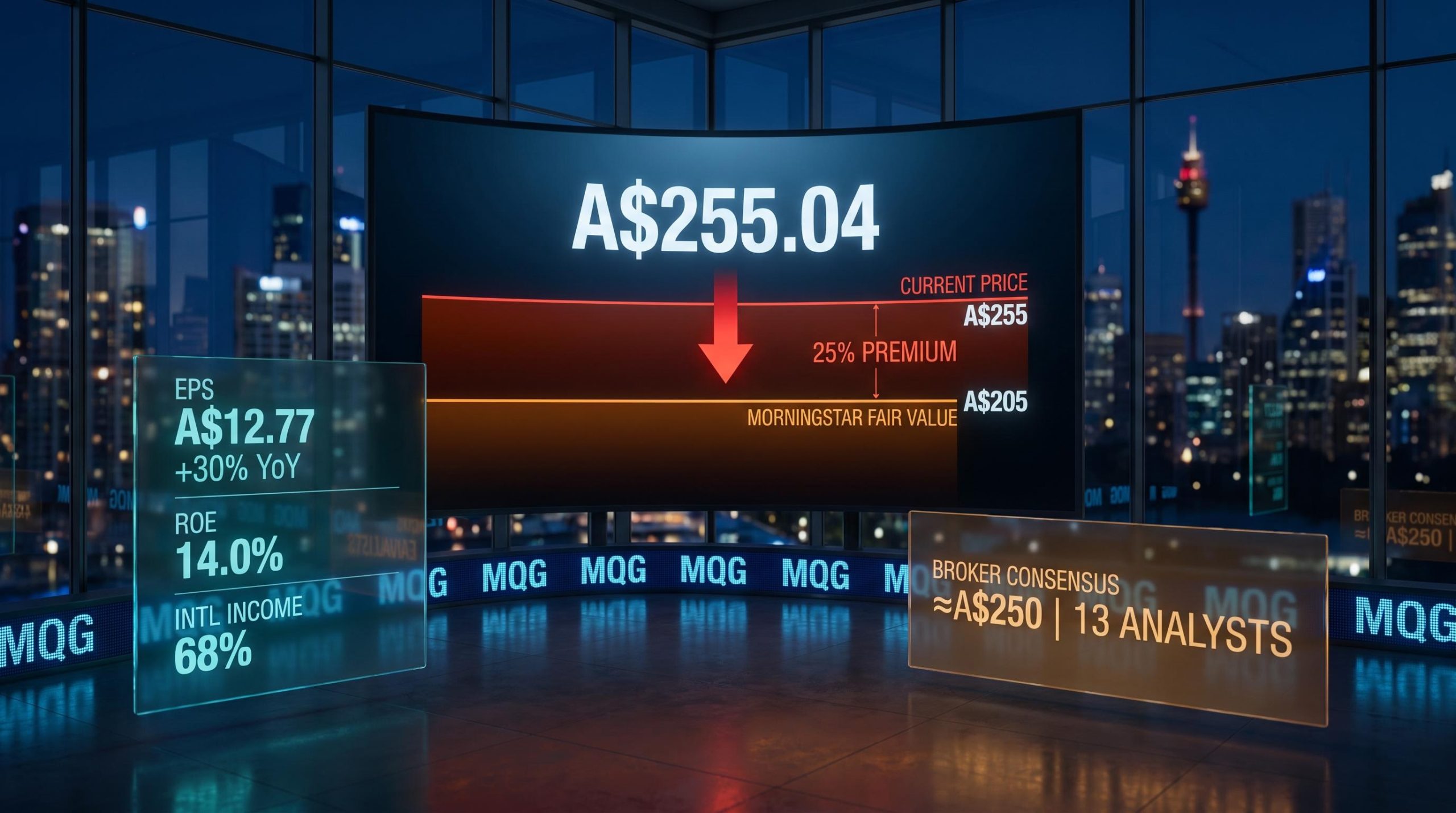
Macquarie Group is trading at roughly A$255 in late July 2026, which puts the stock approximately 25% above what Morningstar’s analysts calculate it is worth. That is a large gap for a business this closely watched, and it raises a question every current and prospective holder should be able to answer: what exactly is the market paying for that the fundamentals do not yet support?
The tension is real. FY2026 results showed 30% earnings-per-share growth and a return on equity of 14%, the kind of numbers that tempt investors to extrapolate. The business is genuinely high quality, and the market knows it. But quality and a good entry price are two separate questions, and at A$255 they are pulling in different directions.
Here is the case for and against the current price, built on the numbers: the valuation mathematics across multiple frameworks, the structural merits that justify some premium, the specific risks that complicate the bull case, and what different analytical lenses say about where fair value actually sits.
What you are actually paying for at A$255
At A$255.04 on 24 July 2026, Macquarie Group trades at a 24-25% premium to Morningstar’s fair value estimate of A$205, set by analyst Nathan Zaia and unchanged through the latest earnings cycle.
Morningstar fair value: A$205 (narrow moat, Nathan Zaia). According to Morningstar, the stock carries a substantial premium to their unchanged fair value estimate, with the narrow-moat designation reflecting durable but not unlimited competitive advantages. Current pricing is assessed as overvalued.
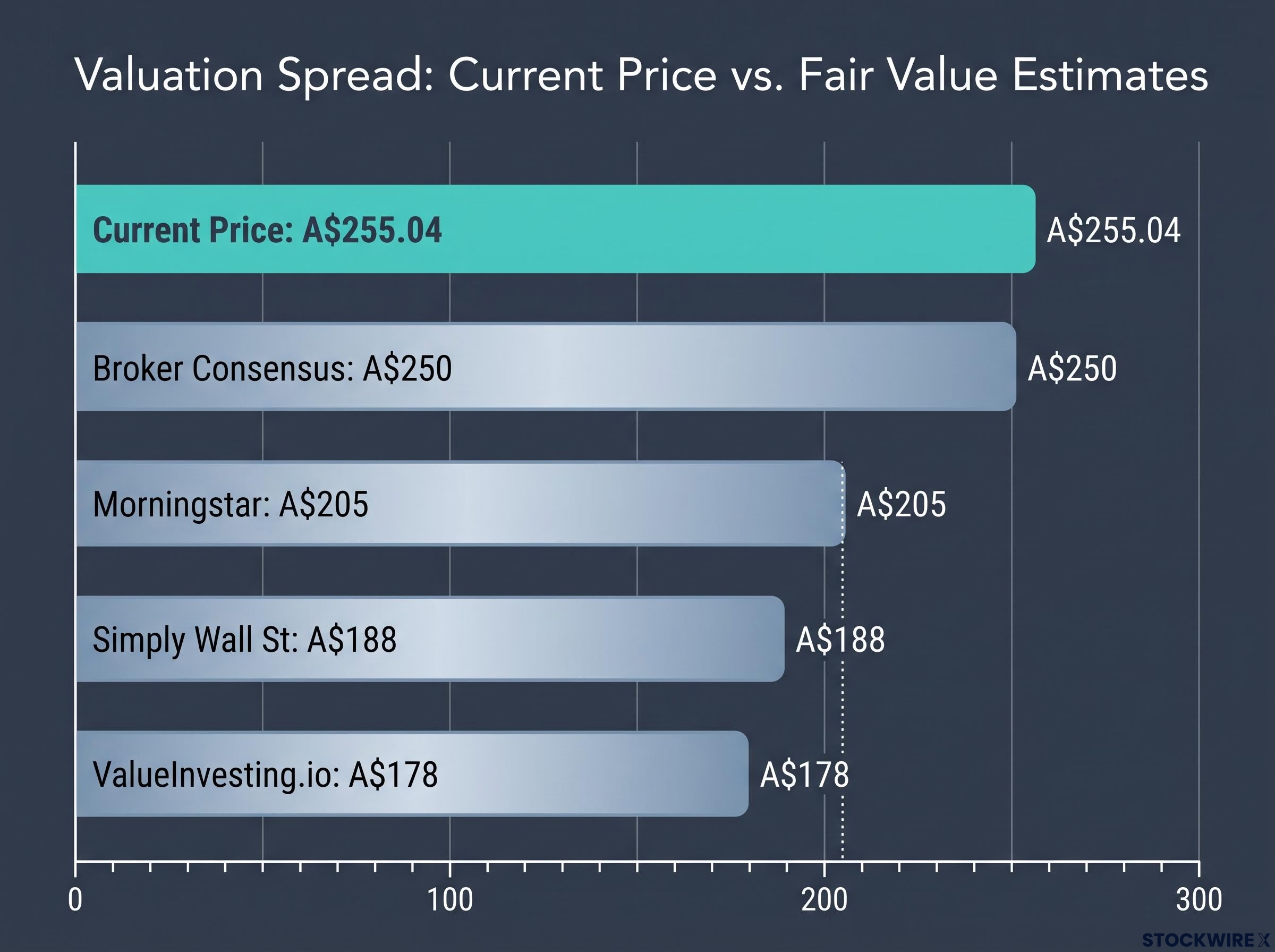
That A$205 figure is not an outlier. Simply Wall St’s discounted cash flow model arrives at approximately A$188. ValueInvesting.io’s Lynch fair value sits at roughly A$178. Only the broker consensus target, at approximately A$250 across 13 analysts (range A$205-272), clusters near the market price.
| Valuation Source | Fair Value / Target (A$) | Signal vs. Current Price |
|---|---|---|
| Morningstar (Nathan Zaia) | 205 | Overvalued |
| Simply Wall St DCF | ≈188 | Materially above fair value |
| ValueInvesting.io (Lynch) | ≈178 | Materially above fair value |
| Broker Consensus (13 analysts) | ≈250 | Near market price; limited upside |
On multiples, the stock is priced at around 19-20x forward earnings and roughly 2.7x book value, with a dividend yield in the 3-3.5% range. None of those are extreme for a high-quality financial, but they are demanding when the expected earnings growth rate is mid-single digits.
The spread between A$178 and A$250 across serious analytical frameworks tells you something important: valuation uncertainty around Macquarie is structurally high. That is itself an argument for a larger margin of safety, not a smaller one.
When big ASX news breaks, our subscribers know first
The genuine case for Macquarie’s quality premium
Before questioning the price, the premium itself deserves honest credit. The market is not making an irrational bet; it is pricing structural advantages that most ASX-listed financials simply do not have.
Morningstar assigns Macquarie a narrow economic moat, a designation that reflects durable competitive advantages. In practice, that moat is anchored by the firm’s standing as a globally significant infrastructure asset manager. It enjoys privileged access to fee-bearing assets and long-duration institutional capital from pension funds and sovereign wealth funds, the kind of clients that measure relationships in decades rather than quarters.
Where the earnings mix has shifted
Recurring funds management fees now account for a meaningfully larger share of revenue than the transactional investment banking income that once dominated the mix. That shift matters because fee-based income holds up better across market cycles, smoothing earnings volatility and supporting a valuation premium that generic diversified financials, whose revenues can lurch with capital markets activity, would not command.
FY2026 numbers illustrate the breadth of the franchise: EPS of A$12.77 (up 30% year on year), return on equity of 14.0% (from 11.2% prior year), and 68% of income sourced internationally. Morningstar’s mid-cycle ROE forecast of 13% is respectable, though it does not place Macquarie in exceptional territory among global asset managers.
The long-term structural tailwinds are real:
- Energy transition infrastructure investment globally
- Data centre build-outs requiring specialist capital allocation
- Transport infrastructure with long-duration revenue profiles
- Niche advisory and investment banking where Macquarie holds recognised competitive expertise
The business fundamentally merits some premium to average ASX financial sector multiples. The analytical question is not whether a premium is rational but whether 25% above a conservative fair value is the right size for it.
Why paying 25% above fair value is difficult to defend
The core mismatch: approximately 20x forward earnings for projected EPS growth of approximately 5% annually. That is growth-stock pricing applied to a mid-single-digit growth business.
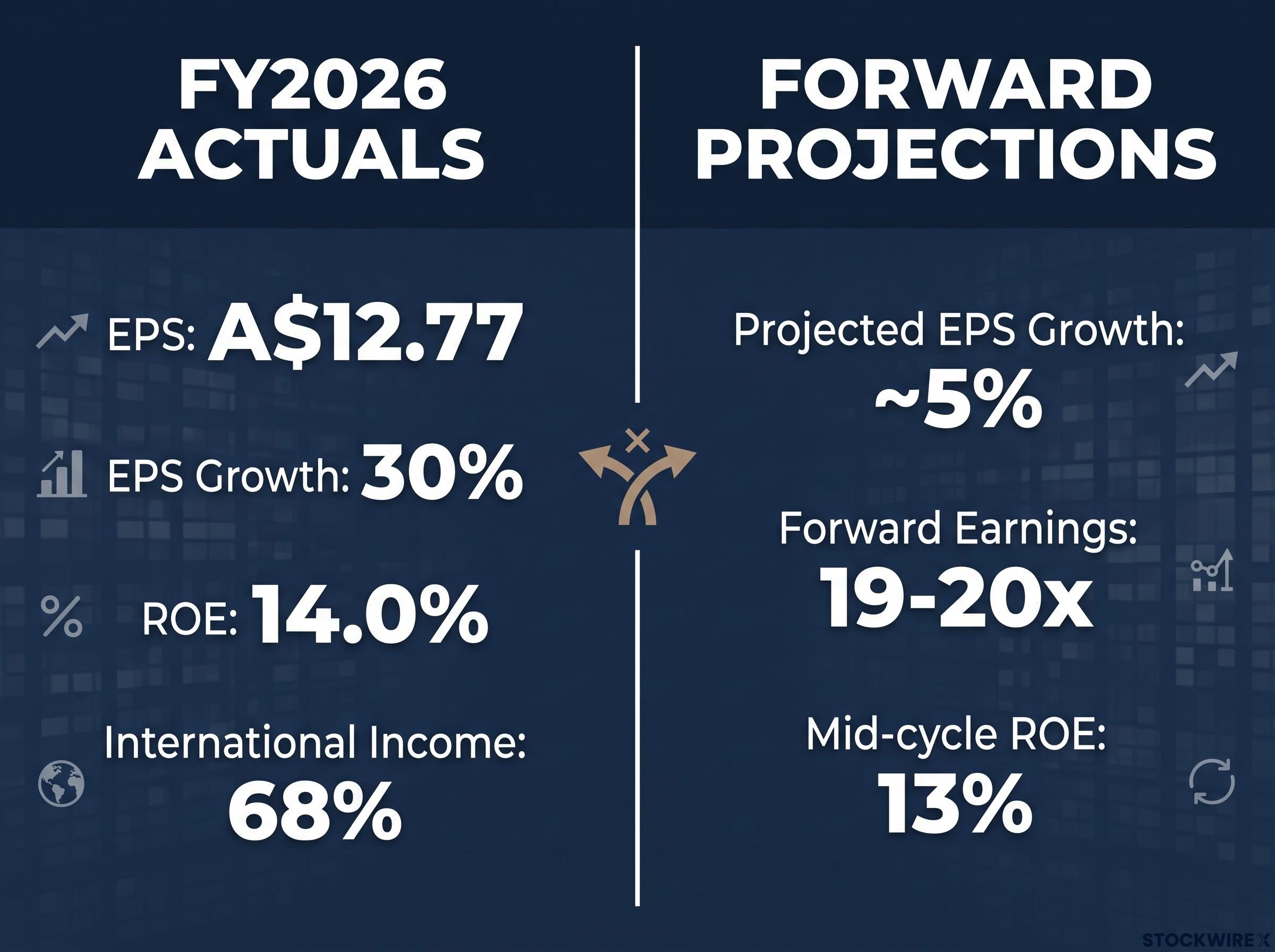
Three problems compound when you trace the implications of that mismatch.
- The growth-multiple gap. At 20x forward earnings, investors are paying for acceleration that consensus does not forecast. Morningstar projects average annual EPS growth of around 5% across the next five years, with near-term gains expected to be modest as the conditions that flattered recent results, including heightened energy market activity and a series of large asset disposals, normalise. The entry price requires either better-than-modelled growth, a further re-rating to an even higher multiple, or both. Neither should be a base-case assumption.
- The interest rate headwind. Morningstar’s bear case notes that when cash rates are not being cut toward zero, maintaining the elevated infrastructure returns seen in recent years becomes substantially harder, with performance fee income the most direct casualty. Higher discount rates compress infrastructure valuations directly. Performance fees, a meaningful profit source, are sensitive to those valuations. If rates stay higher for longer than currently priced, both performance fee income and asset realisation gains could undershoot.
Macquarie’s debt sensitivity is a material amplifier of this rate exposure: a debt-to-equity ratio above 250% means that earnings and equity value are not merely influenced by rate movements but structurally leveraged to them, making the higher-for-longer scenario considerably more damaging than a surface reading of the income statement would suggest.
- Asymmetric downside at this entry point. Morningstar’s fair value and several DCF models already embed fairly constructive assumptions. There is limited room for upside surprise while meaningful downside persists if conditions deteriorate. Consensus targets imply near-zero expected return over 12 months from current levels.
At approximately A$255, you are not just paying for what Macquarie is. You are paying for what it needs to become, and the numbers do not clearly support that leap.
The unlisted asset risk that most investors underestimate
There is a layer of risk in Macquarie’s balance sheet that headline earnings and broker targets can underweight: direct exposure to unlisted businesses and assets.
Unlisted holdings are not continuously marked to market. That means valuation pressure or operational problems can remain hidden until a write-down or disposal forces recognition. For an outside investor, the absence of a continuous public price means warning signs may not surface until significant damage has already occurred.
This exposure sits across three segments:
- Asset management: Infrastructure and real asset funds where Macquarie holds co-investment stakes alongside clients, tying returns partly to private valuations.
- Commodities and global markets: Direct positions in physical and financial markets where mark-to-model rather than mark-to-market may apply to certain holdings.
- Macquarie Capital: Direct investments in businesses and assets that are not listed, where the exit path depends on disposal timing and market conditions.
Morningstar specifically notes that the firm’s direct involvement in unlisted assets and businesses means that a significant write-down or insolvency event, even within an otherwise diversified portfolio, carries the potential to weigh materially on group-level earnings. The scale and variety of the portfolio means that external investors face genuine difficulty in monitoring the health of individual positions over time.
This is not a theoretical concern. Private and infrastructure valuations globally have already come under pressure in the 2025-2026 higher-for-longer rate environment.
| Risk Factor | Nature | Directional Impact |
|---|---|---|
| Energy volatility normalisation | FY2026 tailwind fading | EPS downside vs recent history |
| Higher-for-longer rates | Compresses infrastructure valuations | Earnings and multiple downside |
| Unlisted asset write-downs | Not continuously marked to market | Potential sudden earnings hit |
| Portfolio complexity | Limits early detection for outside investors | Higher uncertainty discount warranted |
| Modest growth vs current multiple | Growth-stock pricing for ~5% growth | Multiple compression risk |
For an investor evaluating Macquarie at a 25% premium, this is the risk they cannot easily price, which is precisely why it should move the required margin of safety upward rather than being absorbed into a broad quality discount.
The margin of safety required to justify entry at a given price is not fixed; it is a function of the underlying business risk profile, and a business with unlisted asset opacity, rate sensitivity, and a growth-multiple mismatch warrants a wider margin of safety than a simpler, more transparent franchise trading at similar multiples.
Existing holders versus new buyers: a different calculation
The correct decision for someone who bought at A$180 three years ago is genuinely different from the decision for someone placing fresh capital today. Conflating the two produces bad outcomes.
If you already hold Macquarie
The case to hold:
- High-quality franchise in a structurally attractive asset class
- Strong balance sheet and established risk management track record
- Recurring fee income and 68% international diversification reduce earnings volatility
- The business merits some long-run premium to average financials
The case to trim at the margin:
- Multiple independent fundamental models flag overvaluation at current levels
- Near-term EPS growth is expected to be steady but unspectacular, making sharp upside less probable
- Reducing exposure at a 24-25% premium to conservative fair value improves portfolio risk-reward without abandoning the name
If you are considering a new position
At A$255, there is no margin of safety relative to Morningstar’s A$205 fair value. The gap is roughly A$50 per share, and nothing in the consensus growth outlook closes it.
Broker consensus targets of approximately A$250 imply near-zero expected return over 12 months from current levels. The dividend yield of 3-3.5% provides a modest income return, but it does not compensate for the capital risk embedded in a 25% premium to conservative fair value, particularly when total return expectations imply near-zero price appreciation.
A price in the A$205-220 range would more clearly tilt expected outcomes in your favour. Patience is favoured over aggressive entry.
What would change the investment case in either direction
The valuation verdict is not fixed. Three conditions would strengthen the bull case, and three would confirm the bear case. Tracking them gives you a disciplined basis for acting when circumstances shift, rather than reacting emotionally to price moves.
Bull-case conditions to watch:
- EPS growth that runs meaningfully ahead of the 5% per annum consensus figure, maintained across several reporting periods rather than attributable to isolated one-off gains
- Evidence that energy and infrastructure market conditions have durably improved, supporting higher recurring performance fees
- A price correction toward the A$205-220 range, which would restore a genuine margin of safety for new capital
Bear-case triggers to monitor:
- Additional rate increases or a prolonged higher-for-longer rate setting that bears down on infrastructure asset valuations and reduces the returns Macquarie can generate in that segment
- Write-downs in unlisted holdings surfacing valuation pressure that was previously hidden
- Shortfalls in performance fee income as the conditions that supported strong FY2026 results, particularly elevated energy market activity and significant asset disposals, recede without comparable replacement drivers
The single most actionable signal: a correction toward the A$205-220 range. That is the price level at which the risk-reward profile materially improves for new buyers, based on the convergence of multiple independent valuation frameworks.
A quality business, but the price asks too much right now
Macquarie earns its premium as a business. The moat is real, the earnings mix is structurally better than it was a decade ago, and the international diversification provides genuine resilience. None of that is in dispute.
What is in dispute is the entry price. A 25% premium above a conservative fair value is difficult to defend when growth is mid-single digits, rate sensitivity is acknowledged, and unlisted asset opacity adds a layer of risk that outside investors cannot easily monitor. Acknowledging franchise quality is not the same as endorsing the current price, and investors who conflate the two tend to overpay for good businesses.
Morningstar’s own framework treats moat quality and valuation as independent dimensions, meaning a narrow-moat designation at A$205 fair value does not automatically support a narrow-moat designation at A$255; the quality of the business and the price paid for it require separate assessments before any conclusion about expected returns can be reached.
For existing holders, the case to continue holding with selective trimming is reasonable. For new buyers, patience is the stronger position. A target entry range of A$205-220 represents a materially better risk-reward profile, and the consensus data suggests the market may eventually offer it.
This article is for informational purposes only and should not be considered financial advice. Investors should conduct their own research and consult with financial professionals before making investment decisions. Past performance does not guarantee future results. Financial projections are subject to market conditions and various risk factors.