Datadog reported accelerating revenue growth, beat earnings estimates, and raised full-year guidance in the same week that Jefferies analyst Brent Thill downgraded the stock from Buy to Hold. In that same window, Morgan Stanley reiterated an Overweight on Microsoft, Mizuho named Meta its top large-cap pick, and Wedbush added both Alphabet and Reddit to its Best Ideas List.
Five analyst actions in a single week, and they point in what looks like opposite directions. They are not. Taken together, they reveal a shared shift in how Wall Street is now scoring AI stocks: not on the story, but on the receipt.
Here is a framework for reading that shift, built from the specific evidence behind each call. By the end, you will have a four-stage classification system and a set of business-model-specific KPIs you can apply to any AI-exposed position you hold or are evaluating ahead of this earnings season.
The AI narrative trade is over. The monetisation trade has begun
Through most of 2024 and 2025, the playbook was simple. Disclose a large AI capex commitment, reference GPU procurement, and the market would award a multiple premium. That dynamic has structurally changed.
The new implicit checklist emerging from this week’s analyst actions looks like this:
- Measurable AI usage or workloads: not strategy slides, but seats, queries, or compute consumption
- Conversion to paying customers or monetisable products: usage alone is no longer sufficient; it needs a revenue line attached
- Margin and EPS flow-through: AI revenue must show up in the income statement, not just the top line
- Valuation test: does the current stock price already assume the success the thesis describes?
All five calls this week, Morgan Stanley on Microsoft, Mizuho on Meta, Wedbush on Alphabet and Reddit, Jefferies on Datadog, map almost perfectly onto this checklist. That is what makes them a collective signal rather than five isolated opinions.
The context sharpens the point. Industry-wide AI capex is expected to total approximately $650 billion in 2026. When that much capital is flowing in, the market stops rewarding the spend and starts demanding evidence of return. Jefferies’ broader Q2 preview said it directly: the market is shifting away from indiscriminate positioning toward fundamental analysis and earnings estimate revisions.
Holding AI stocks based on capex announcements and strategy language is no longer a sufficient investment thesis. The evaluation framework has changed, and so should yours.
The new monetisation checklist emerging from this week’s analyst actions sits within a broader debate about AI stock valuation that four analytical frameworks, including the Shiller CAPE at 40.11 and Minsky’s financing stages, each approach from different angles, often reaching split verdicts on whether current prices reflect genuine revenues or speculative excess.
When big ASX news breaks, our subscribers know first
Microsoft and Meta: what monetisation evidence actually looks like
| Company | Analyst / Firm | Rating | Price Target | Key Monetisation Evidence |
|---|---|---|---|---|
| Microsoft | Morgan Stanley (Adam Wood) | Overweight | $650 | 20M paid Copilot seats; 41% projected Azure CC growth; three-stage ARPU expansion |
| Meta | Mizuho | Outperform | $835 | Anthropic compute deal up to $10B/2yrs; $1.00-$1.25 annual EPS contribution |
Microsoft: the three-stage Copilot monetisation machine
Morgan Stanley’s thesis rests on specific KPIs, not directional AI optimism. The number of paid Microsoft 365 Copilot seats reached 20 million by Q3, climbing from 15 million the prior quarter. That is the first stage: adoption.
The second stage is tier migration, where existing users move to higher-value subscription tiers. The third is consumption-based AI features, where tokens, queries, and workloads generate usage-linked revenue. Together, these three layers transform Copilot from a one-time add-on into a recurring ARPU expansion machine.
The M365 price increase that came into effect on 1 July adds a mechanical revenue layer on top: the uplift is forecast to contribute roughly $2 billion of additional revenue in FY2027, rising to $4 billion in FY2028 and $6 billion in FY2029. Morgan Stanley’s proprietary CIO survey reinforces the demand signal: the bank’s latest polling shows 7.6% forward software spending expectations for Microsoft, the strongest reading across all vendors surveyed, with 72% of CIOs expecting to lift Microsoft budgets over the coming year.
The stock sits at roughly 16 times fiscal 2028 GAAP EPS, a valuation that Morgan Stanley argues does not adequately reflect the company’s growth trajectory. Earnings are due 29 July 2026.
Meta: one deal that changes the capex narrative
Meta’s monetisation proof point is narrower but high-impact. According to reports, Meta has agreed to supply computing capacity to Anthropic in a deal worth as much as $10 billion across two years. Mizuho puts incremental margins on that arrangement at 50-75%, which the firm calculates would generate $1.00-$1.25 per share in tax-adjusted annual EPS contribution.
That arithmetic matters because it converts what had been a cost centre, Meta’s enormous AI infrastructure, into a revenue stream. Q1 2026 revenue already grew 33% year-over-year to $56.31 billion. If external monetisation of internal AI infrastructure proves repeatable, the market can justify a higher multiple on the same capex base.
When AI infrastructure starts generating measurable, recurring revenue rather than just absorbing capital, that is the moment a bullish thesis becomes defensible rather than speculative. Both the Copilot ladder and the Anthropic deal cross that threshold.
The Meta-Anthropic compute deal illustrates a monetisation dynamic that cuts both ways: Meta converts infrastructure into revenue, but foundation model economics for Anthropic remain structurally challenged, with token price declines and high capital intensity creating airline-like margin pressure on providers that lack proprietary data or network effects.
What the AI monetisation regime means for evaluating any tech stock
The company evidence above suggests a classification system. AI-exposed stocks sit at different stages of monetisation maturity, and knowing which stage a stock occupies tells you what kind of surprise or disappointment will move the stock most at earnings.
- Stage 1: Infrastructure Investment. Heavy capex, margin pressure, limited AI-specific revenue. The thesis rests on management credibility and the scale of the opportunity. Parts of Alphabet and Meta’s capex programmes sit here. Watch for capital efficiency signals and early usage data.
- Stage 2: Usage and Adoption. Clear AI usage metrics (seats, workloads, active users) are visible, but monetisation is still early. The question is whether usage can translate into pricing power and higher ARPU. Watch seat growth, attach rates, and early ARPU signals.
- Stage 3: Monetisation Evidence. AI revenue streams are visible, growing, and margin-accretive. Google Cloud’s 82% year-over-year revenue growth to $24.8 billion in Q2 2026, with an operating margin of 35.6% and a backlog of $514 billion, sits squarely here. So does Meta’s Anthropic deal and Reddit’s data-licensing revenue. Watch growth rates, margins, and backlog; any slowdown can trigger a re-rating.
- Stage 4: Thesis Realised (Priced In). The stock has already re-rated on the AI story. Business quality may be high, but valuation offers limited margin of safety. Datadog’s 94% year-to-date rally places it here. Watch valuation and expectations; even strong earnings prints may not help if too much is already in the price.

The core principle: A company can be a genuine AI winner and still be a poor entry point. Stage classification, not directional conviction, determines your risk.
Alphabet and Reddit: two business models where the AI revenue proof points diverge
Alphabet: justifying negative free cash flow with backlog
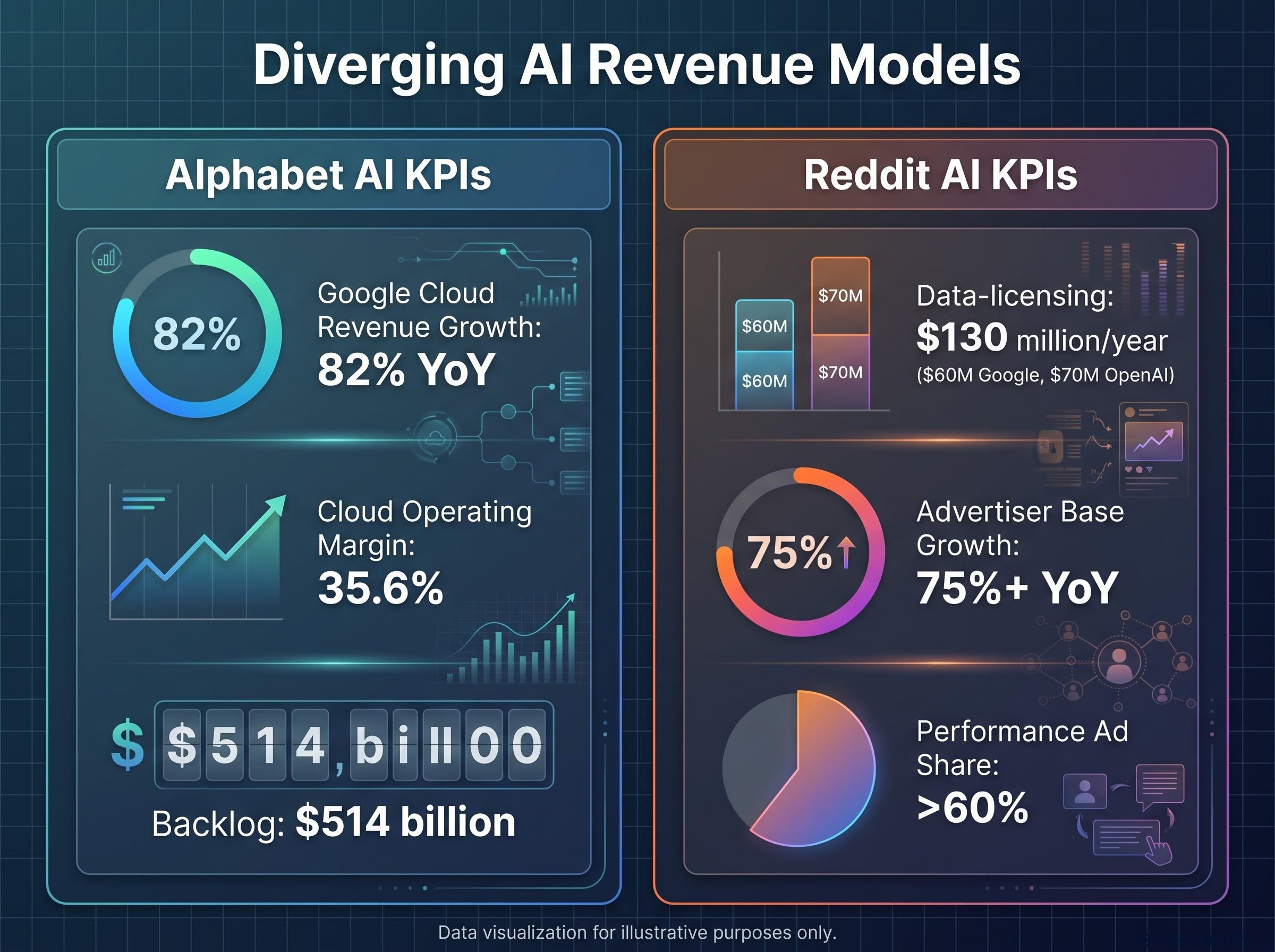
Wedbush analyst Ygal Arounian included Alphabet on the firm’s Best Ideas List following Q2 2026 results that he argued confirmed the bull case. Google Cloud revenue expanded 82% year-over-year to $24.8 billion, surpassing expectations and picking up speed from 63% growth recorded in Q1. Operating margin reached 35.6%, a significant improvement from 20.7% in the same period a year earlier.
The anchor that makes the current investment cycle defensible is the $514 billion backlog. That committed spend is the forward-revenue signal justifying Alphabet’s decision to lift its full-year 2026 capex target to $195-$205 billion, a move that pushed free cash flow to ($5.9) billion in the quarter. Arounian’s team at Wedbush anticipates that free cash flow will stay in negative territory through 2027 before recovering to positive in 2028.
The Alphabet AI scoreboard:
- Cloud revenue growth: 82% year-over-year
- Cloud operating margin: 35.6%, up from 20.7%
- Backlog: $514 billion
- Free cash flow trajectory: negative through 2027, projected positive 2028
Reddit: two revenue lines that most investors are not valuing correctly
Reddit’s AI monetisation looks nothing like Alphabet’s, and that is the point. Wedbush’s thesis rests on two distinct revenue lines. First, data-licensing arrangements with Google (worth around $60 million per year) and OpenAI (worth around $70 million per year), together producing roughly $130 million in annual recurring, high-margin revenue with a direct link to AI training demand. Arounian believes the terms achieved at renewal will exceed what the market currently assumes.
Second, advertising momentum: Reddit’s active advertiser base grew more than 75% year-over-year in Q1 2026, with performance ad formats surpassing 60% of total advertising revenue.
The Reddit AI scoreboard:
- Data-licensing revenue: approximately $130 million annually
- Advertiser base growth: 75%+ year-over-year
- Performance ad share: above 60% of total ad revenue
After an approximately 8% fall in Reddit’s share price on 22 July following reports that the company may limit Google‘s access to its content, Arounian said he expects the two companies to preserve a commercial relationship, with scope for deeper integration over time. Q2 results are due 30 July 2026.
The Alphabet and Reddit cases together illustrate that the right AI KPIs are business-model-specific. Applying a single metric across all AI stocks will produce systematic misreads, which is exactly the kind of dislocation Wedbush is capitalising on.
When a 94% rally prices in the thesis: what the Datadog case teaches active investors
Start with the fundamentals. Datadog reported Q1 2026 revenue of approximately $1.01 billion, up 32.2% year-over-year, accelerating from 25% growth a year earlier. Non-GAAP EPS of $0.60 beat consensus. Management raised FY2026 revenue guidance to $4.30-$4.34 billion.
By any conventional measure, this is a company executing well. So why did Jefferies analyst Brent Thill downgrade it?
The hardware and software divergence running through 2026, with semiconductor equipment up 47.6% year-to-date while software applications fell 22.7%, is the market-level backdrop against which Datadog’s 94% rally stands out as anomalous, a software name trading with hardware-cycle momentum in an environment where that combination is historically rare.
The answer is a valuation question, not a quality question. By the time Thill moved to Hold, the stock had surged 94% year-to-date and was changing hands at roughly 18 times EV-to-CY27 revenue, a gap of approximately 4 turns above Snowflake. In Thill’s assessment, the bull case that Datadog would emerge as a primary AI beneficiary had by that point substantially played out through the first six months of 2026.
- Fundamental metrics: 32.2% revenue growth, $0.60 EPS beat, raised guidance
- Valuation metrics: 18x EV/CY27 revenue, 94% YTD rally, 4-turn premium to nearest peer
Jefferies signalled it would look to rebuild a positive stance on the stock if a more favourable entry point emerges. In the same Q2 sector preview, the firm identified Amazon, Microsoft, and Atlassian as its preferred names into earnings on the basis of stronger cloud and AI momentum with achievable targets, while adopting a negative stance on Palantir given mounting comparison hurdles and competitive pressure.
The valuation discipline principle: A company can be a genuine AI winner and still be a poor entry point if the thesis is fully realised in the price. The question to ask about any AI stock is not “is the thesis real?” but “is the thesis already priced in?” Answering that requires specific valuation arithmetic, not directional conviction.
The KPIs that will separate AI winners from overpriced AI stories this earnings season
| Business Model Category | Key AI KPIs | What to Watch for Upside | What to Watch for Downside Risk |
|---|---|---|---|
| Cloud & Infrastructure | AI-sensitive revenue growth; operating margin trajectory; backlog and committed spend | Accelerating cloud growth; margin expansion; backlog beats | Margin compression without backlog growth; capex rising faster than revenue |
| Enterprise Software | Paid AI seats and attach rates; ARPU expansion via tier migration; consumption-based revenue share | Sequential seat acceleration; consumption revenue inflecting upward | Seat growth stalling; ARPU flat despite AI feature launches |
| Advertising & Platform | Performance ad format share; advertiser count growth; data/API licensing as recurring revenue | Licensing renewals at improved terms; performance ad share exceeding 65% | Licensing deal non-renewals; advertiser growth decelerating |
The fourth overlay applies across all three categories: stage classification. A stock’s position in the four-stage monetisation maturity model determines what kind of earnings surprise or disappointment will move the price most. For Stage 3 names, a margin miss hits harder than a revenue miss. For Stage 4 names, even a beat may not move the stock if the valuation already assumes it.
Applying the right KPI set to the right business model means you are evaluating AI stocks on the same criteria analysts are now using. That shifts your edge from sentiment-tracking to fundamental analysis at precisely the moment that shift matters most.
Owning the right AI names at the right stage and at the right price
The edge in AI investing has shifted. It is no longer enough to own AI exposure. What matters now is owning the right names at the right stage and at the right price.
Start with your existing AI holdings. Classify each position by its monetisation stage. Identify the two or three KPIs that matter most for its business model. Then assess whether the current valuation offers a margin of safety given the stage. A Stage 3 name with room to run on margins and backlog is a fundamentally different proposition from a Stage 4 name where the thesis is already in the price.
Microsoft earnings on 29 July and Reddit earnings on 30 July will be the first real-time tests of whether the monetisation evidence the analysts are citing holds up in the reported numbers. Those two prints are the most concrete near-term checkpoint for this framework.
The shift that matters: The edge has moved from sector exposure to stage-aware, valuation-disciplined stock selection. That is where AI stock analysis starts delivering returns rather than just tracking a theme.
For investors wanting to extend the stage-classification logic beyond the five stocks covered here, our deep-dive into moat-based AI investing examines why network-effect businesses and structural incumbents often deliver more durable returns than frontier lab exposure, with specific attention to valuation discipline at each portfolio layer.
This article is for informational purposes only and should not be considered financial advice. Investors should conduct their own research and consult with financial professionals before making investment decisions. Past performance does not guarantee future results. Financial projections are subject to market conditions and various risk factors.