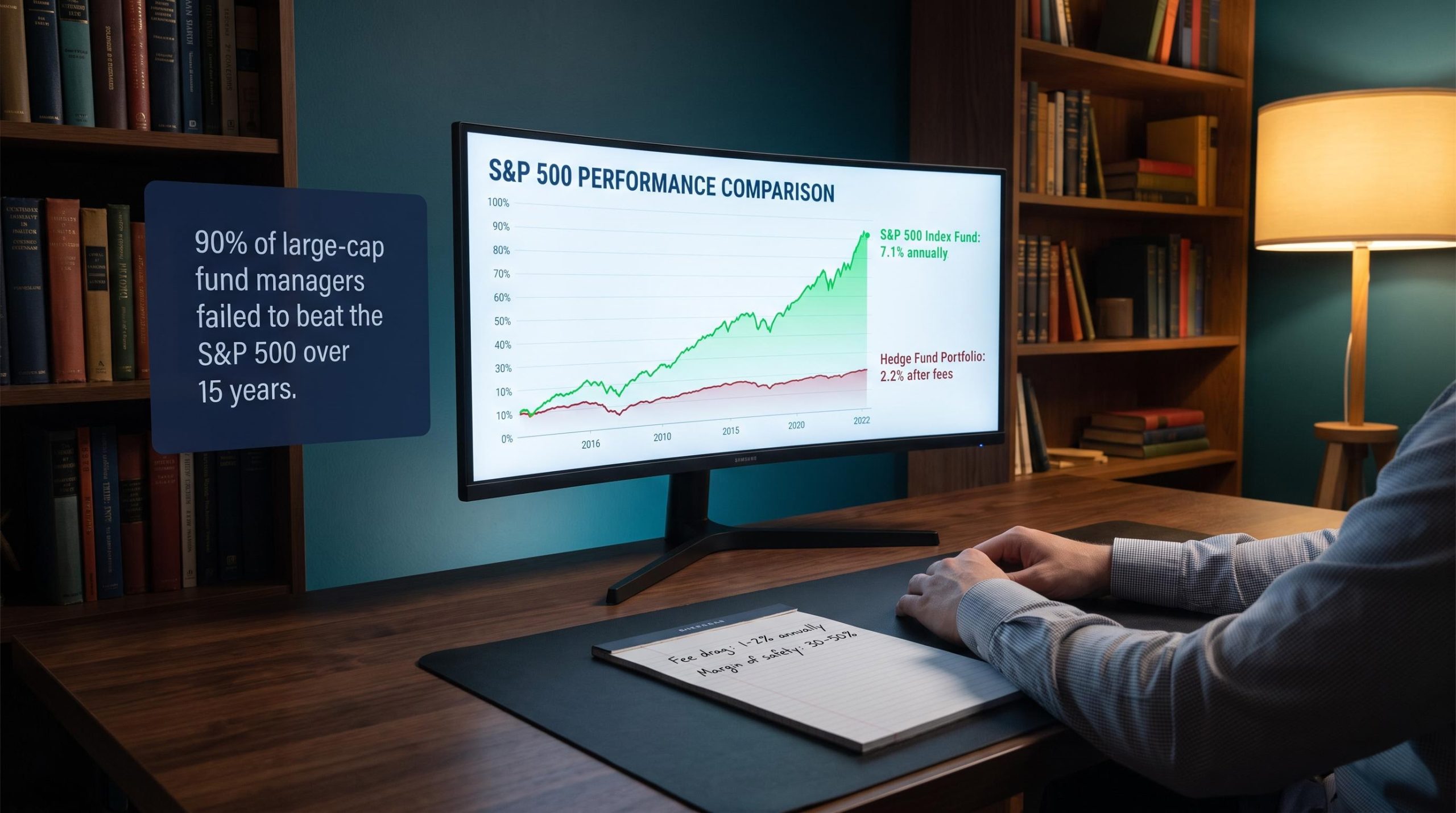
Roughly 90% of U.S. large-cap fund managers failed to beat the S&P 500 over a 15-year period, according to SPIVA data from S&P Dow Jones Indices. These are not amateurs. They are credentialed, well-resourced professionals with institutional research teams, sophisticated risk systems, and decades of collective experience. So why do individual investors keep hearing they should leave stock-picking to the experts?
The answer is not that fund managers lack skill. It is that the system they operate inside, the fee structures, the redemption pressures, the career incentives, is designed in a way that makes consistent outperformance nearly impossible. Understanding that distinction changes how you think about your own position as an investor.
The question this analysis answers is a practical one: does the individual investor actually hold a structural edge over professional fund managers, and if so, what does a disciplined version of that edge look like in practice?
Why the professionals keep losing to an index fund
The numbers start bad and get worse the longer you look. SPIVA data shows that 70-90% of actively managed equity funds lag their benchmark over 10-15 years, depending on category. Stretch the window to 15 years, and approximately 90% of U.S. large-cap funds have failed to beat the S&P 500.
Warren Buffett put this to a live test. Over a 10-year period, he wagered that a plain S&P 500 index fund would outperform a carefully selected portfolio of hedge funds. The result was not close.
The active vs passive investing data extends well beyond SPIVA’s equity scorecards: William Sharpe’s 1991 arithmetic principle establishes that active managers collectively cannot outperform after fees because their aggregate pre-cost returns equal the market return by definition, making underperformance a mathematical certainty rather than an empirical surprise.
The S&P 500 index fund returned 7.1% annually. The hedge fund portfolio returned 2.2% after fees over the same period.
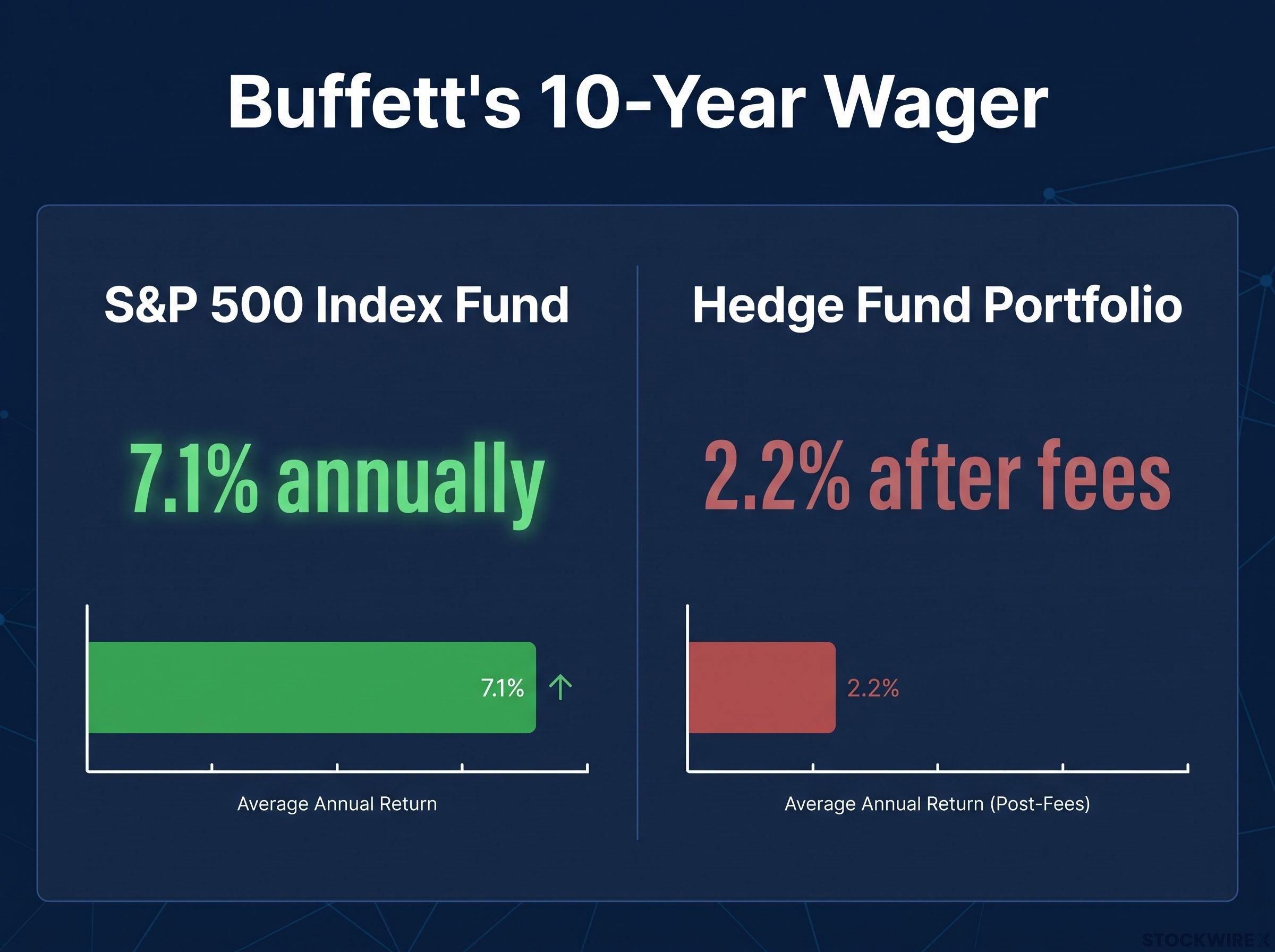
That is not a marginal gap. It is a structural one. And the fee drag explains a large portion of it:
- Active equity funds typically charge 1-2% annually in management fees plus trading and operational costs
- Broad index funds charge 0.03-0.20% in expense ratios
A 1-2% annual drag does not sound like much in any single year. Over 20 or 30 years of compounding, it erases a significant share of total returns, turning a strategy that roughly matches the market before fees into a chronic underperformer after them. The professionals are not failing because they cannot analyse companies. They are failing because the cost of running their business consumes the value their analysis creates.
When big ASX news breaks, our subscribers know first
The institutional cage: how fund structures work against their own managers
The underperformance is not a mystery once you understand the constraints fund managers operate inside. Each constraint is individually rational. Together, they produce an irrational collective outcome.
Three structural forces push institutional managers away from the behaviours that produce long-term outperformance:
- Benchmark pressure and herding: Managers are judged against peer groups and benchmarks, not absolute long-term outcomes. Underperforming the index by 5% when peers are similarly positioned is survivable. Underperforming by 5% while holding a portfolio that looks nothing like the benchmark is career-ending. The result is closet indexing, where portfolios cluster around the same names and styles, eliminating any chance of meaningful differentiation.
- Redemption risk and forced selling: Open-ended funds permit client withdrawals on demand. When markets fall sharply, outflows force managers to liquidate positions into declining prices, with those sales triggering taxable events for the investors who remain in the fund at the worst possible moment.
- Size and liquidity constraints: Large institutions managing billions cannot take meaningful positions in smaller companies without moving the price or violating liquidity rules, effectively removing much of the small-cap and micro-cap universe where mispricings are most common and research coverage is thinnest.
The redemption dynamic is particularly damaging. The very moment a stock becomes cheapest and most attractive to a long-term buyer is often the moment institutional managers are forced to sell it. The structural reversal means those recoveries, the sharpest and most profitable phase of any downturn, are disproportionately captured by whoever is not subject to that pressure.
Berkshire Hathaway is structured so that capital committed by shareholders stays within the business rather than flowing out on demand, as it would through a conventional fund. This permanence of capital lets Buffett pursue multi-year investment theses without the pressure of forced selling, and it is a central reason Berkshire’s performance record looks so different from that of the typical institutional manager.
What the individual investor actually brings to the table
The structural freedom that institutions lack is precisely what the individual investor already holds by default. It is not something you need to cultivate. It is something you need to recognise and protect.
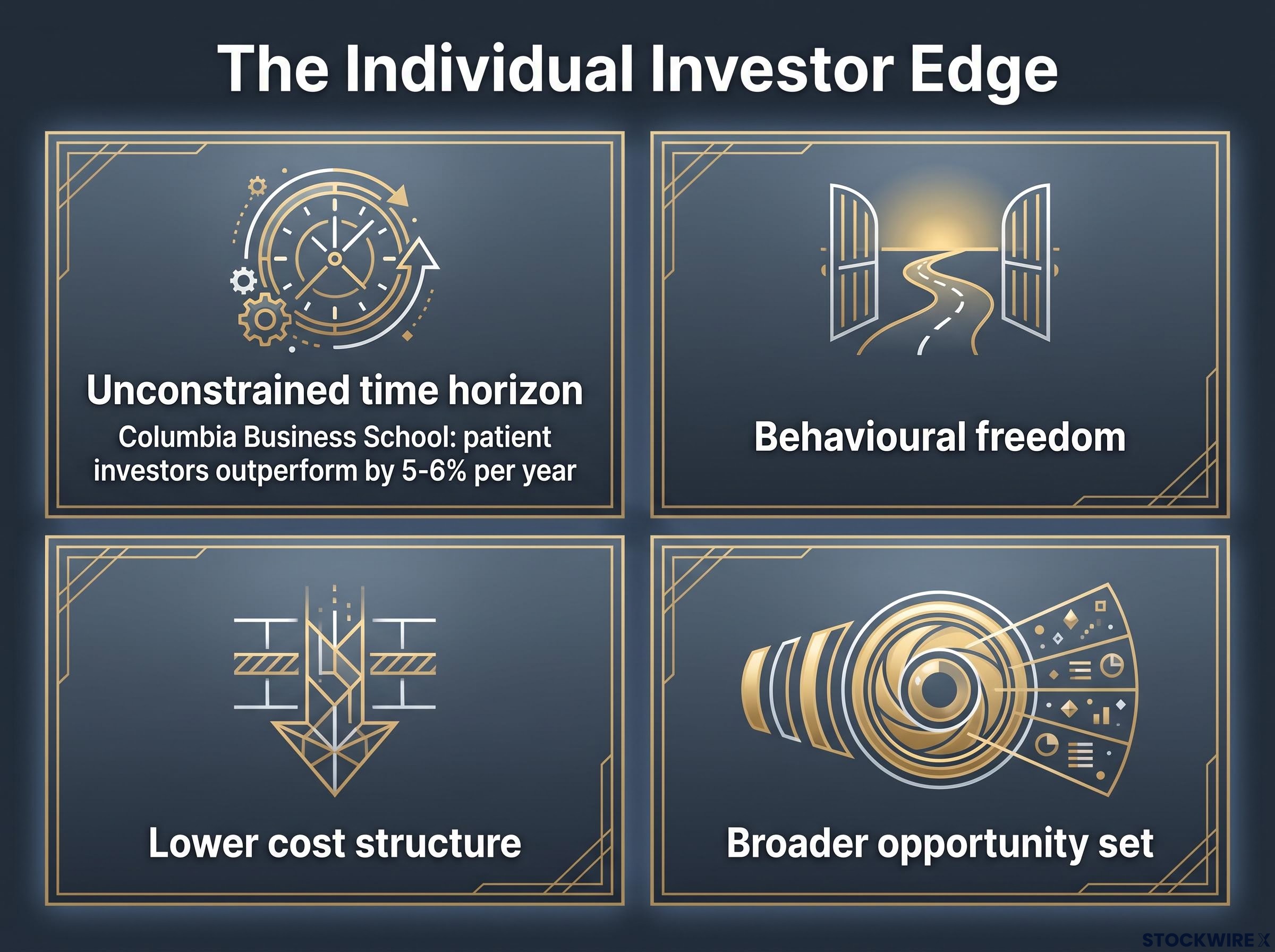
Four concrete advantages separate the individual investor from the professional:
- Unconstrained time horizon: You are not subject to quarterly performance reviews, peer comparisons, or client redemption cycles. Research from Columbia Business School suggests that patient, long-term investors outperform short-term traders by approximately 5-6% per year, rising to 7-8% for volatile or recently distressed stocks.
- Behavioural freedom: You do not lose clients for underperforming a benchmark in a given year. You can own what makes sense to you, hold through temporary drawdowns, and wait years for a thesis to play out without committee scrutiny.
- Lower cost structure: You pay only trading costs and fund expense ratios on the passive portion of your portfolio. There is no management fee or firm overhead to cover. Every 1% saved in fees compounds dramatically over decades.
- Broader opportunity set: You can invest in small-cap and micro-cap stocks that are effectively off-limits to large funds, take concentrated positions in your best ideas, and hold illiquid assets through multi-year inflection points.
The patience edge is not a personality trait. It is a structural freedom you already possess. Academic research on patient capital suggests that stocks neglected or abandoned by short-term funds earn 5-6% higher annual returns than the rest. Buffett himself has noted that across the entirety of Berkshire’s history, roughly 12 investments stand out as truly exceptional, drawn from hundreds of individual decisions made over decades. The edge is not about being right constantly. It is about being free to act decisively on the rare occasions when conviction and value align.
A practical framework for identifying and valuing quality stocks
The structural edge described above is only useful if paired with a disciplined process. What follows is a four-step filter sequence, not a checklist. A company that fails step one never reaches step four.
- Understand the business. Stay within industries you genuinely understand through work, experience, or sustained study. Focus on simple, durable cash-generating models. If you cannot explain how the company makes money in two sentences, move on.
- Identify the moat. A moat is a sustainable competitive advantage: brand strength, network effects, switching costs, or cost leadership. The question is not whether the moat exists today but whether it can realistically survive 10 or more years of plausible industry change.
- Assess management and capital allocation. Read shareholder letters and earnings transcripts. Examine how management behaved in bad years, not just good ones. Evaluate capital allocation decisions: reinvestment versus dividends versus buybacks versus acquisitions. Prefer teams that prioritise long-term per-share value.
- Value the business conservatively and demand a margin of safety. This is where structural theory converts into a concrete decision rule.
Running a DCF with a margin of safety
A discounted cash flow (DCF) valuation, which estimates what a business is worth today based on its projected future cash generation, is the quantitative backbone of this framework. The logic in plain language: project ten years of free cash flows, estimate a terminal value based on a conservative sale multiple, and discount the full stream at a 15% annual hurdle rate. Applying a 10% discount rate is generally considered too low to justify the effort of individual stock selection when a low-cost index fund is likely to deliver a comparable result.
The margin of safety is the final gate. A stock only clears this hurdle when its current market price sits at least 30% below the estimated intrinsic value, with a 50% discount representing the preferred threshold.
The margin of safety is not a conservative hedge against being slightly wrong. It is the mechanism that allows you to be meaningfully wrong on the growth trajectory of a high-quality business and still achieve strong returns. Berkshire began buying Apple shares in 2016, and the company’s subsequent path turned out to diverge substantially from what any contemporaneous valuation model would have forecast. Even so, the 50% margin of safety ensured that Berkshire earned exceptional returns in spite of the forecast being off. Lynch’s view on the same principle is equally clear: a stock picker who gets six out of every ten selections right can still build considerable wealth over time, as long as the winning positions are properly sized.
A rigorous margin of safety stock valuation framework calibrates the required discount to business quality: high-moat, predictable businesses justify a 30% buffer (buying at 70% of intrinsic value), while cyclical or leveraged firms demand a 40-50% discount before capital is committed.
The temperament question: why most investors fail to use the edge they have
Having the structural advantage means nothing if behavioural failure prevents you from holding through the periods when your thesis looks most wrong. According to Buffett, the quality that separates investors who outperform from those who do not is not raw intelligence but the right disposition, specifically the capacity to remain rational and patient under pressure.
When Buffett reflects on his most costly mistakes, he consistently points to inaction rather than poor execution: cases where he had identified an opportunity, done the work, and then held back because of some psychological resistance that prevented him from pulling the trigger.
Two failure modes account for the vast majority of wasted individual investor edge:
Sell-decision biases are more destructive than entry errors according to a University of Chicago study, which found that randomly selected exit decisions outperformed those of professional portfolio managers by up to 150 basis points annually, making the timing of selling a more consequential skill than the timing of buying.
- Errors of omission from hesitation: Recognising a high-quality business at an attractive price and failing to buy because the broader market environment feels uncomfortable or the consensus is negative.
- Premature selling from self-imposed pressure: Selling a winning position too early because of short-term volatility, even though no external party, no client, no committee, no quarterly scorecard, actually required the sale.
Genuine multi-bagger opportunities are rare, perhaps appearing only once or twice across an entire decade. When one does arrive, the task is spotting it early and having the resolve to hold it through the full compounding period. Brandon, the creator behind the investing channel New Money, has noted that his portfolio composition shifted over the years from roughly 70% passive and 30% active to the reverse, with the active portion now representing approximately 70% of the total, a change driven entirely by the outperformance of his highest-conviction holdings rather than by deliberate reallocation. Positions in Meta and Alphabet, both held for close to 10 years, are the clearest expression of that patience in his own portfolio.
Your structural freedom from institutional pressure is only as valuable as your willingness to use it. Most people who fail at active investing do not fail because they picked bad businesses. They fail because they sold them too early under pressure that no external party actually imposed on them.
Making an honest assessment of whether active investing is right for you
The individual investor’s structural edge is real, but it is only relevant in a specific context. Before adding any active satellite to a passive core, three conditions must be true:
- You are genuinely willing to do deep company analysis, not skim a summary, but read annual reports, assess competitive positioning, and build a valuation model.
- You have the capacity to hold through multi-year periods where your active positions underperform the index, without second-guessing the process.
- You have the temperament to sit through 30-40% drawdowns in individual holdings without selling, provided the business thesis remains intact.
If any of those conditions are not met, the index fund is not the consolation prize. It is the optimal choice. Low-cost index ETFs with expense ratios of 0.03-0.20% capture the equity risk premium at minimal cost and beat most professionals over time.
For any individual stock under consideration, the central question is: at today’s price, is this specific company likely to deliver returns meaningfully above what a low-cost index fund is expected to deliver over 10 or more years? If the honest answer is no, the index fund is superior.
The core-and-satellite portfolio structure, typically 75% broad index ETFs and 25% individual stock positions, provides the practical architecture for combining the passive returns the current article recommends as a baseline with the concentrated active positions its framework is designed to identify.
| Dimension | Passive index core | Active value satellite |
|---|---|---|
| Cost | 0.03-0.20% expense ratio | Trading costs only; no management fee |
| Opportunity set | Broad market exposure | Small-cap, micro-cap, concentrated positions |
| Required effort | Minimal (buy and hold) | Significant (deep company analysis, ongoing monitoring) |
| Ideal investor type | Anyone seeking market returns with minimal time | Patient, disciplined, high-conviction stock pickers |
The honest version of this analysis is that the active investing edge exists, it is structural and well-documented, but it applies only to investors who are willing to do the work and endure the discomfort. For everyone else, the data could not be clearer: buy the index, keep costs low, and let compounding do the rest.
This article is for informational purposes only and should not be considered financial advice. Investors should conduct their own research and consult with financial professionals before making investment decisions. Past performance does not guarantee future results.
—