
The fund you already own may be costing you more than its expense ratio suggests. If you hold IVV or VOO in a Singapore brokerage account, the single largest drag on your returns is not in the fee disclosure. It is in the tax treatment you never opted into.
US-domiciled ETFs are the most recognisable and liquid index products in the world, but for Singapore investors they carry a structural tax disadvantage that is invisible at the point of purchase. The gap between what a US-domiciled S&P 500 fund costs you and what an Ireland-domiciled equivalent costs you is not a rounding error. It is a compounding leak that widens every year you hold the position, and it sits alongside a binary estate tax exposure that most investors discover only when it is too late to restructure.
This piece gives you the product knowledge to act on that gap. You will see which specific Ireland-domiciled funds are available, how to choose between share classes, what the real trade-offs look like in dollar terms over 10, 20, and 30 years, and exactly when the Ireland-domiciled option is and is not the right call. Practical product literacy, not theory.
Why domicile matters more than ticker for Singapore investors
IVV and CSPX look like the same fund. Both are managed by BlackRock’s iShares brand. Both track the identical S&P 500 Index. Both give you exposure to the same 500 US large-cap companies. The divergence is in the domicile: IVV is incorporated in the United States, CSPX in Ireland. That single difference changes what happens to your dividend income before it reaches you.
Both CSPX and IVV grant identical exposure to the same 500 companies, but what you actually own in each differs structurally: the share class, the legal domicile, the custody arrangement, and the tax treatment at source are all set by the fund’s legal structure before any market return accrues to you.
Singapore investors are classified as non-resident aliens for US tax purposes, and there is no applicable US-Singapore tax treaty covering dividend withholding. The result is a 30% US withholding tax on every dollar of dividend income generated by a US-domiciled ETF. Ireland, by contrast, has a tax treaty with the United States that reduces the withholding rate to 15% at the fund level. Your Ireland-domiciled fund pays half the tax on the same underlying dividends.
That 15-percentage-point gap is not an abstract rate difference. On every dollar of dividend income your US equity fund generates, the US-domiciled version loses twice as much to withholding tax as the Ireland-domiciled equivalent. It applies every year, on every distribution, for as long as you hold the position.
The 15-percentage-point treaty advantage compounds into a measurable withholding tax bill difference across CSPX, SPYL, and their US-listed counterparts, with accumulating share classes reinvesting on 85 cents of every gross dividend dollar versus 70 cents under a US-domiciled distributing structure.
A quick way to check domicile before you buy:
- ISIN prefix “IE…”: Ireland-domiciled UCITS ETF, 15% US withholding on dividends
- ISIN prefix “US…”: US-domiciled ETF, 30% US withholding on dividends
The core tax gap: Singapore investors holding US-domiciled ETFs pay 30% withholding tax on US dividends. Ireland-domiciled UCITS ETFs reduce that to 15% via the US-Ireland treaty.
When big ASX news breaks, our subscribers know first
How the UCITS regulatory framework protects retail investors
UCITS, which stands for Undertakings for Collective Investment in Transferable Securities, is the European Union’s binding regulatory framework for retail investment funds. It is a legal structure with enforceable requirements, not a voluntary quality mark. Ireland-domiciled UCITS funds fall under the supervision of the Central Bank of Ireland, and incorporation under Irish law is what “domiciled in Ireland” actually means in practice. It does not mean the fund invests in Ireland or trades on Irish exchanges. Your CSPX still holds the same 500 US companies as IVV.
Three structural protections matter most for you as a retail investor:
- Diversification rules cap single-issuer concentration and constrain leverage, preventing the fund from taking outsized bets that could magnify losses in a stress event
- Independent depositary custody legally separates fund assets from the manager’s balance sheet, so if the fund management company fails, your assets are not on its creditor list
- Standardised Key Information Documents (KIDs) give you a consistent format for comparing costs, risks, and return scenarios across every UCITS product you evaluate
If you are concerned that moving away from US-listed ETFs means leaving behind US Securities and Exchange Commission oversight, the UCITS counterpart is substantive. The framework’s combination of diversification requirements, transparency obligations, and independent oversight has made it the structure of choice for cross-border fund distribution into Asia, the Middle East, and Latin America, and recent regulatory updates have reinforced those standards further.
UCITS VI and the 2026 liquidity management update
UCITS VI became effective on 16 April 2026, introducing mandatory Liquidity Management Tools (LMTs) for all UCITS funds. Two mechanisms matter most in plain terms. Swing pricing adjusts a fund’s net asset value to reflect the trading costs of large inflows or outflows, so remaining investors are not penalised when others buy or sell in size. Redemption gates allow temporary limits on withdrawals during extreme market stress, preventing a rush for the exit from forcing fire sales of underlying holdings.
These tools protect you in precisely the scenarios where ETF structure matters most: periods of severe market dislocation where liquidity dries up. The April 2026 update makes Ireland-domiciled UCITS funds more structurally resilient than the pre-2026 framework allowed.
The ESMA guidelines on UCITS liquidity management tools require fund managers to select at least two mandatory LMTs, with swing pricing and redemption gates among the qualifying mechanisms, giving the April 2026 framework binding force across all Ireland-domiciled UCITS funds.
The compounding cost of getting the tax structure wrong
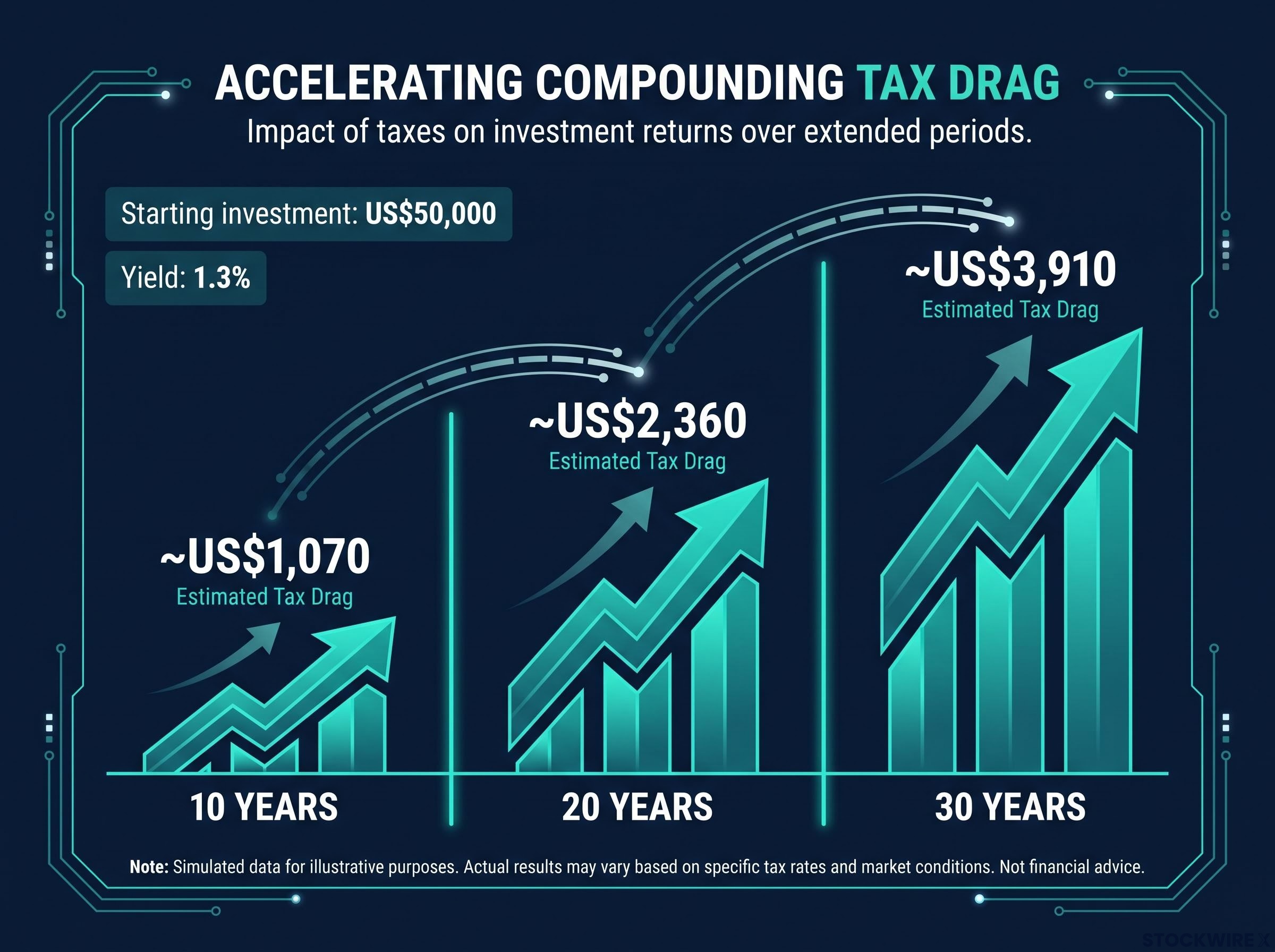
Because the 15-percentage-point withholding tax gap recurs every year, its effect accumulates over time. The illustration below starts with a US$50,000 investment and applies a 1.3% annual dividend yield (consistent with the S&P 500’s historical 1-2% range), setting price returns aside entirely so that only the withholding tax difference is captured. Both funds track the same index, so price returns cancel out by definition.
| Time horizon | Illustrative cumulative gap (USD) | What this means for you |
|---|---|---|
| 10 years | ~US$1,070 | The gap is already larger than a decade of expense ratio savings from holding the cheaper US fund |
| 20 years | ~US$2,360 | Compounding accelerates the divergence; the Ireland-domiciled fund pulls further ahead each year |
| 30 years | ~US$3,910 | Nearly US$4,000 of additional return from a single structural decision made at purchase |
These figures are illustrative only. They assume a fixed 1.3% annual dividend yield and are not a projection of actual performance or future returns.
The withholding tax drag is ongoing and proportional. The estate tax risk is something else entirely: binary and potentially catastrophic for larger portfolios.
US estate tax applies at up to 40% on the value of US-situated assets above the USD 60,000 exemption for non-resident aliens. US-domiciled ETFs (IVV, VOO, and direct US stock holdings) are classified as US-situated assets. Ireland-domiciled UCITS ETFs are classified as Irish-situated assets and are completely shielded from US estate tax.
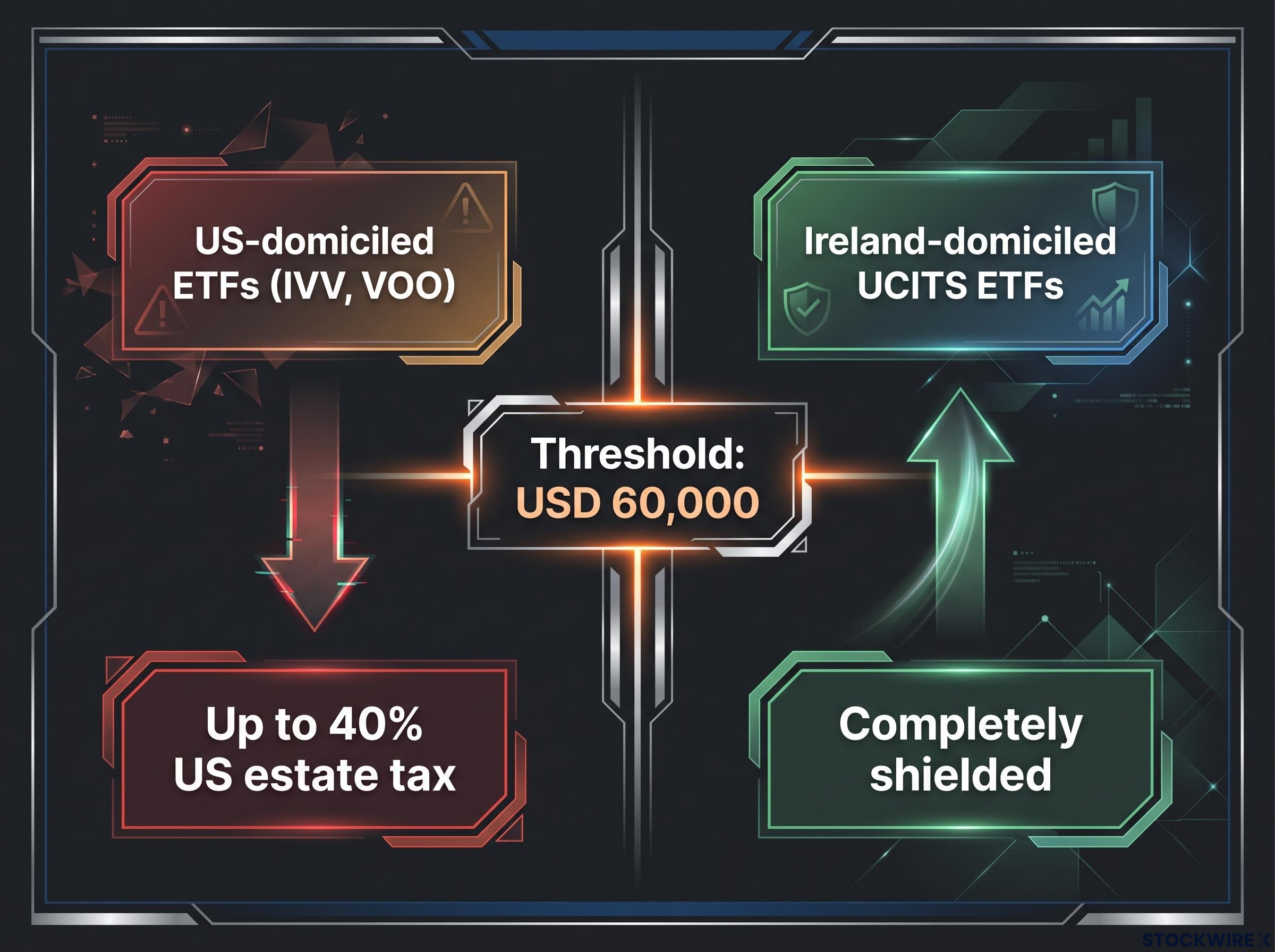
Once your US-domiciled holdings exceed USD 60,000, the full 40% rate structure applies. For a substantial portfolio, the potential estate tax liability dwarfs decades of expense ratio savings. This is not a cost that scales gradually like a fee. It is a binary exposure that either applies or does not, and it applies at a threshold most long-term investors will cross well before retirement.
The IRS estate tax rules for non-resident aliens confirm that Form 706-NA must be filed when a decedent’s US-situated assets exceed USD 60,000, establishing the threshold at which the 40% rate structure becomes operative for Singapore investors holding US-domiciled ETFs.
Past performance does not guarantee future results. Financial projections are subject to market conditions and various risk factors.
Core UCITS ETF options for building a Singapore portfolio
Understanding why Ireland-domiciled funds are structurally advantageous is one thing. Knowing which specific products are available is what lets you act. The range is broader than many investors expect, covering every core equity exposure most diversified portfolios require.
| Exposure category | Fund ticker | Manager | Index tracked | Share class |
|---|---|---|---|---|
| S&P 500 | CSPX | iShares (BlackRock) | S&P 500 | Accumulating |
| VUAA | Vanguard | S&P 500 | Accumulating | |
| VUSA | Vanguard | S&P 500 | Distributing | |
| IUSA | iShares (BlackRock) | S&P 500 | Distributing | |
| Nasdaq 100 | CNDX | iShares (BlackRock) | Nasdaq 100 | Accumulating |
| Global developed | SWRD | SPDR | MSCI World | Accumulating |
| Emerging markets | EIMI | iShares (BlackRock) | MSCI EM IMI | Accumulating |
| All-world | VWRA | Vanguard | FTSE All-World | Accumulating |
| VWRD | Vanguard | FTSE All-World | Distributing |
VWRA and VWRD deserve particular attention if you want single-fund global exposure. The FTSE All-World Index covers approximately 3,600 companies across 49 countries, spanning both developed and emerging markets. That means one fund replaces what would otherwise require a two-fund combination like CSPX plus EIMI or CSPX plus SWRD. The trade-off is less control over your developed versus emerging market weighting, but for many investors the simplicity is worth it.
Every fund in the table above is incorporated in Ireland and qualifies for the 15% US dividend withholding rate. Expense ratios and share class structures can change, so review the current factsheet and Key Information Document for each fund before you invest.
How the share class decision works independently of domicile
These are two distinct choices that investors frequently treat as one. Where a fund is domiciled governs which tax treaty applies to your US-source dividends. Whether you select an accumulating or distributing share class governs what happens to the net dividend income once withholding tax has already been taken at source.
Here is how each structure works:
- Accumulating share classes take the net dividends (after the 15% withholding tax at fund level) and reinvest them automatically within the fund, increasing the fund’s net asset value. You see no cash payment; your holding grows in value instead.
- Distributing share classes take the same net dividends and pay them out to you in cash. You receive the income and decide what to do with it.
The withholding tax rate is identical for both share classes. Selecting an accumulating fund does not lower or remove the 15% US withholding obligation. That deduction happens at source, before any reinvestment or distribution takes place. An accumulating class such as CSPX and a distributing class such as VUSA face exactly the same 15% charge on the underlying US dividends; only the subsequent handling of the remaining income differs.
Many Ireland-domiciled ETFs offer both classes for the same underlying exposure, so your choice does not force a change in market coverage. VWRA (accumulating) and VWRD (distributing) track the identical FTSE All-World Index. CSPX (accumulating) and VUSA (distributing) track the identical S&P 500.
For most Singapore investors in an accumulation phase, the accumulating share class is structurally optimal. Singapore does not tax foreign-sourced investment income for individuals and imposes no capital gains tax. That removes the main reason investors in other jurisdictions sometimes prefer distributing structures: the ability to manage income tax liability by controlling when returns are received. In Singapore, that consideration simply does not apply, and the automatic reinvestment eliminates the friction and potential delay of manually redeploying cash dividends.
If you need regular cash income from your portfolio, the distributing class serves a genuine purpose. Choose based on your cash flow needs, not on a belief that one class is more tax-efficient than the other.
Where Ireland-domiciled UCITS ETFs fall short
The structural case for Ireland-domiciled funds is strong for core equity exposure, but it is not without trade-offs. Three limitations deserve honest treatment.
- Higher expense ratios. CSPX and VUAA each carry a total expense ratio of around 0.07%, while IVV and VOO sit closer to 0.03%. That roughly 4 basis point difference is a genuine cost. The 15-percentage-point withholding tax saving typically more than covers it, but the arithmetic becomes tighter for portfolios with a low dividend yield or for investors who weigh every basis point carefully.
- Foreign exchange and trading costs. Ireland-domiciled ETFs are primarily listed on exchanges in the UK and continental Europe, with individual share classes priced in USD, GBP, or EUR. If your brokerage operates in SGD, currency conversion charges will apply on each transaction. For investors who trade frequently or hold smaller positions, these costs can chip away at the tax advantage.
- Narrower product range for complex strategies. The UCITS framework’s rules on diversification and leverage mean that certain products simply do not exist within it. Investors who need leveraged, inverse, or highly niche thematic exposure will find the US ETF market offers strategies for which no comparable UCITS version is available.
Beyond withholding tax and the expense ratio, tracking difference is a third cost layer that separates otherwise identical funds: rebalancing front-running, dividend reinvestment timing gaps, and partial securities lending pass-through each create a persistent shortfall that compounds against your returns independently of the fee you see on the fund card.
On liquidity, the major UCITS ETFs maintain strong trading volumes. CSPX and VWRA are among the most actively traded products on the London Stock Exchange. For less established or recently launched UCITS funds, bid-ask spreads can be noticeably wider, so it is worth verifying trading volumes before committing capital to smaller products.
When a US-listed ETF may still be the better choice
Three specific investor profiles are better served by US-domiciled products:
- You require leveraged or inverse strategies for which no UCITS-compliant fund exists
- You are targeting niche sector, factor, or thematic exposure where the UCITS range does not offer adequate coverage
- The currency conversion charges your brokerage applies to UK or European exchange trades would substantially offset the withholding tax saving at your typical transaction size
If none of those apply, the Ireland-domiciled option is the structurally stronger choice for core equity holdings.
Building your decision framework before switching
You now have the structural argument, the product range, and the trade-offs. The final step is a decision process that applies all of it to your specific situation. Work through these four questions in order:
- Does your target exposure have a UCITS equivalent? For S&P 500, Nasdaq 100, global developed, emerging markets, and all-world equity, the answer is yes. If your strategy requires leveraged, inverse, or highly specialised products, it may not be.
- Does your expected portfolio size make the withholding tax saving material? On a US$50,000 position with a 1.3% yield, the annual saving is modest in dollar terms but compounds meaningfully over decades. The larger your equity allocation, the more the 15-percentage-point gap matters.
- Does your US equity exposure exceed or approach the USD 60,000 estate tax threshold? If it does, or if it will within your investment horizon, the estate tax shield alone justifies the structural switch. The 40% rate on US-situated assets above USD 60,000 is a liability that no expense ratio saving can offset.
- Do you need periodic income or prefer automatic compounding? If you are in an accumulation phase with no need for cash distributions, the accumulating share class (CSPX, VUAA, VWRA) eliminates reinvestment friction. If you need income, the distributing equivalent (VUSA, VWRD) gives you the same exposure with cash payouts.
Evaluating total cost of ownership across UCITS and US-listed ETFs requires looking past the headline expense ratio to bid-ask spreads, tracking metrics, replication method, and securities lending pass-through rates, each of which affects the return you actually receive rather than the return the index records.
For most Singapore investors, the framework resolves clearly at questions one and three. The UCITS equivalents exist for core exposures, and the estate tax risk becomes material well before most investors realise it applies to them.
Here is how the product range translates into concrete portfolio construction:
- One-fund global: VWRA (FTSE All-World, accumulating), covering developed and emerging markets in a single holding
- Two-fund global: CSPX (S&P 500) plus SWRD (MSCI World) or CSPX plus EIMI (emerging markets), giving you control over regional weighting
- Income-oriented: VWRD (distributing all-world) or VUSA (distributing S&P 500) for regular cash income
These are illustrative structures, not personalised recommendations. The goal is maximising your after-tax, after-cost returns rather than achieving maximum UCITS exposure for its own sake. Domicile is a structural tool, not an end objective.
From structural advantage to actual portfolio: making the switch on your terms
For most Singapore investors building core equity exposure, the Ireland-domiciled UCITS option resolves the primary ongoing withholding tax cost and the binary estate tax risk simultaneously. The product range covers the exposures that matter for a diversified long-term portfolio, the share class choice is straightforward once you separate it from the domicile decision, and the trade-offs are specific enough to evaluate against your own situation.
Before you act, verify three things: check current fund factsheets and KIDs for up-to-date expense ratios and share class availability, confirm which Ireland-domiciled products your specific brokerage supports and what FX conversion costs apply, and consult a tax professional for estate planning implications if your US equity exposure is at or approaching the USD 60,000 threshold. The structural advantage is clear. Making it work for your portfolio requires those final checks.
This article is for informational purposes only and should not be considered financial advice. Investors should conduct their own research and consult with financial professionals before making investment decisions.