On the same trading day, one European chip stock surged 22% and another fell despite reporting 128.8% order growth. That gap is not a contradiction. It is the most important signal of the session.
July 23 2026 was a day when European semiconductor stocks did not move as a sector. They moved as five separate stories, each shaped by its own earnings catalyst, its own investor expectations, and the ambient pressure of an ECB rate decision running in the background. Soitec rerated upward sharply. BESI sold off on a subtle miss that was not in the headline numbers. ASML, Infineon, and ASM International all declined without company-specific bad news.
Understanding why each moved the way it did requires separating micro from macro, and separating fundamentals from positioning. Here is a clean read on the specific driver behind each stock’s move, the expectations mechanics that punished BESI despite blowout numbers, and a framework for diagnosing sessions where individual earnings reports pull the sector in opposite directions.
Soitec’s 22% surge reframes the AI data-centre materials story
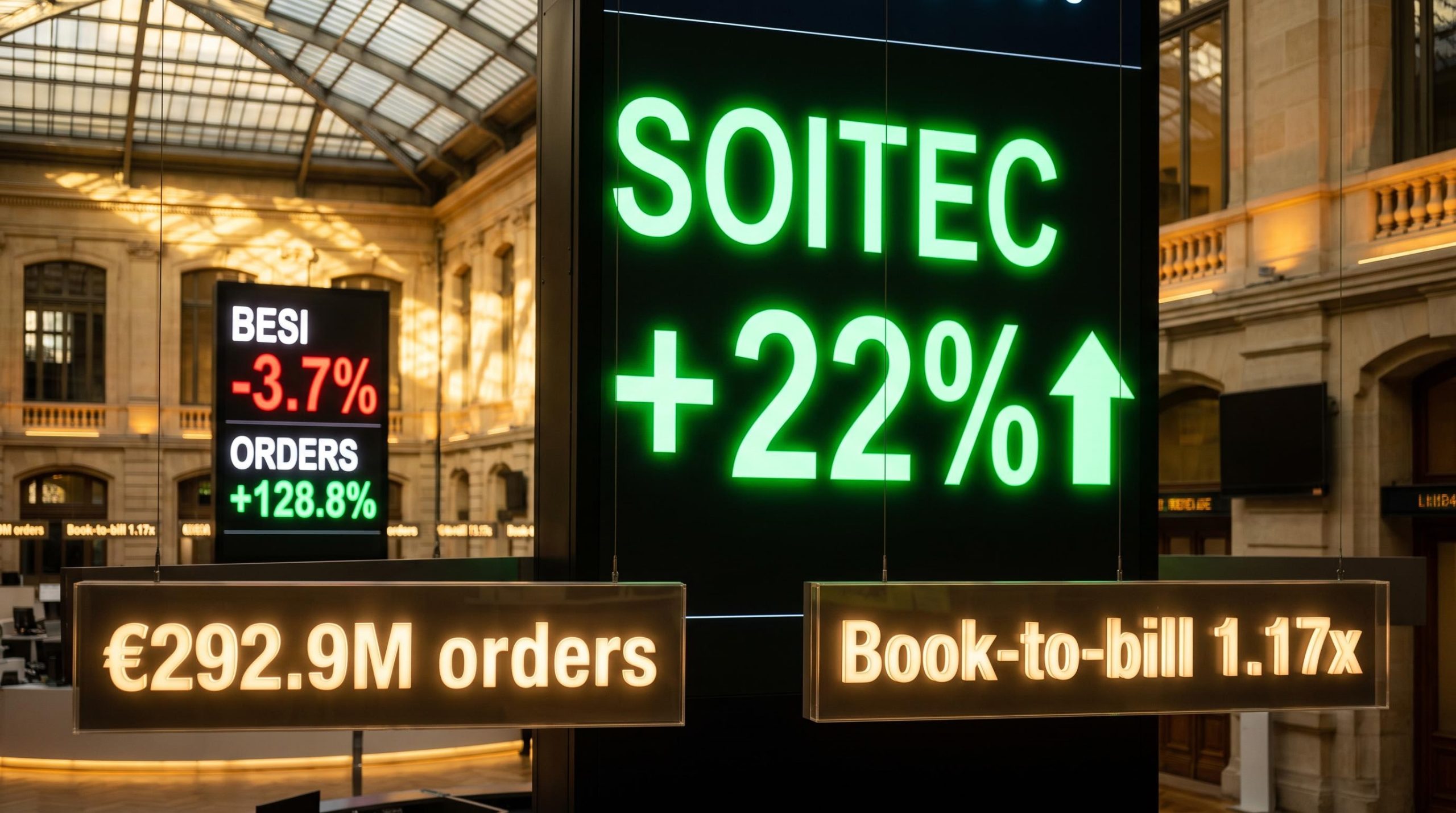
Soitec shares gained as much as 22% during early European trading today, the kind of single-session rerating that forces a reassessment of what the market had actually been pricing.
Soitec intraday gain: up to 22%, driven by photonics segment outperformance tied to AI data-centre demand.
The move was attributed to better-than-expected results, with the photonics segment delivering the upside surprise. A 22% move on a materials name tells you the market had significantly underweighted this company’s leverage to the AI build-out, and investors now need to reassess which other supply-chain names carry similar hidden exposure.
AI infrastructure capex running at roughly $770 billion in 2026 is the structural demand signal underneath Soitec’s photonics beat, BESI’s order surge, and the sector’s elevated multiples; the squeeze is that semiconductor suppliers capture the cycle’s most durable profitability while hyperscaler returns on equity compress under the weight of their own spending.
What silicon photonics actually does inside an AI data centre
Silicon photonics is optical data transmission using silicon-based components. It enables the high-bandwidth, low-latency interconnects that AI data centres require at scale, replacing electrical connections with light to move data faster between chips and across racks.
Soitec sits at the manufacturing foundation of that supply chain. Its substrate technology is the material layer on which silicon photonics components are built. Before today’s results, the market had not fully priced that relationship. The 22% surge is the repricing, and it suggests that other materials-layer names with similar AI optionality may carry more upside than their current multiples reflect.
When big ASX news breaks, our subscribers know first
Why BESI fell on its best quarter in years
Start with the numbers, because they need to land before the reaction makes any sense.
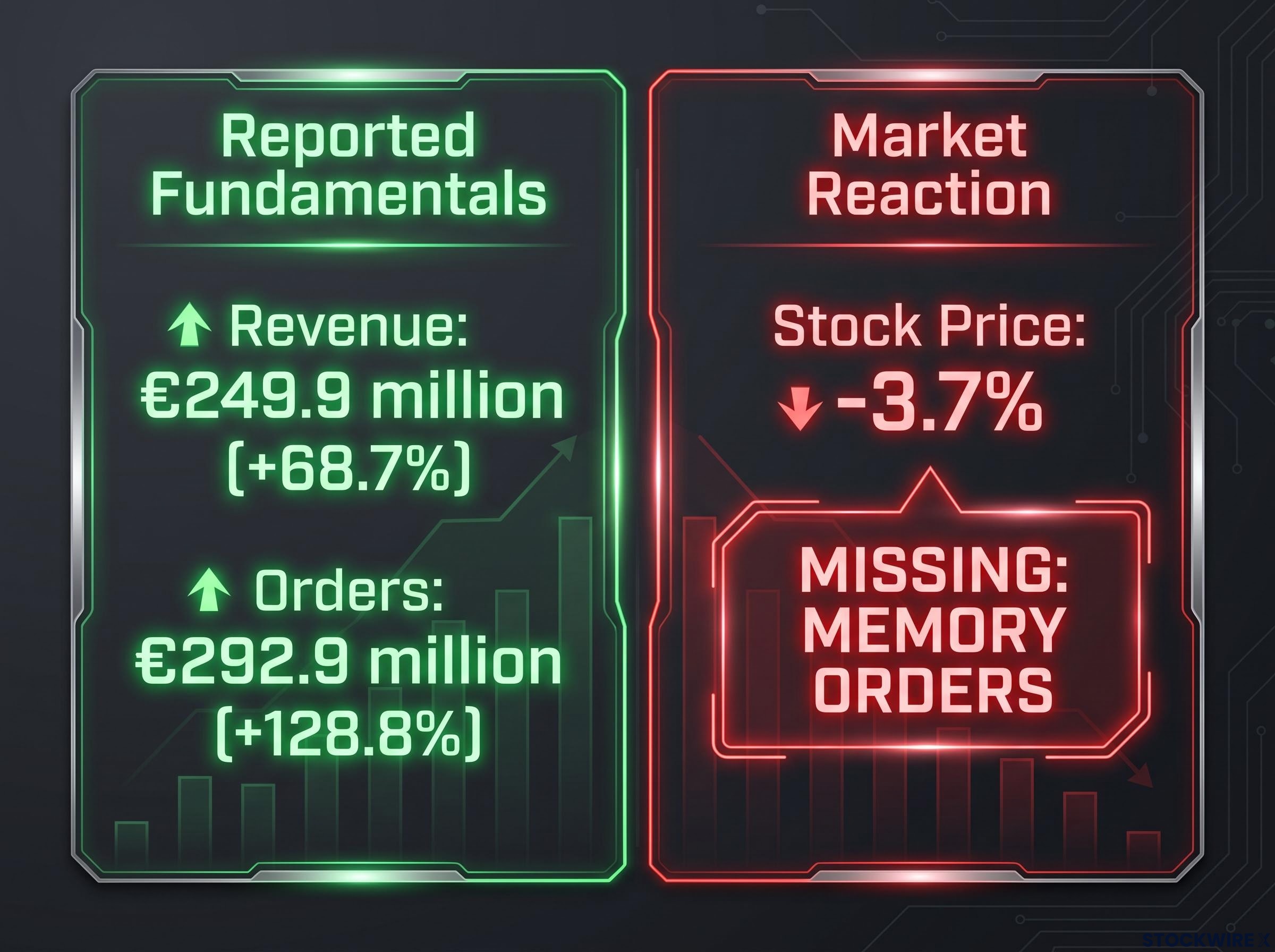
Q2 2026 revenue at BESI reached €249.9 million, representing 68.7% growth against the prior year period. Order intake landed at €292.9 million, a 128.8% year-on-year increase that came in 17.8% ahead of what analysts had forecast. That pushed the book-to-bill ratio to 1.17x. Q3 guidance implied 10-15% sequential revenue growth, above prior market expectations. Hybrid bonding customer numbers expanded to 21, up from 15 twelve months prior.
| Metric | Value | Year-on-Year Change | vs. Consensus |
|---|---|---|---|
| Revenue | €249.9 million | +68.7% | -0.9% below |
| Orders | €292.9 million | +128.8% | +17.8% above |
| Book-to-bill | 1.17x | — | — |
| Q3 guidance | +10-15% sequential | — | Above expectations |
| Hybrid bonding customers | 21 | vs. 15 a year earlier | — |
The stock fell approximately 3.7% in early trading. The reaction was not about what BESI reported. It was about what BESI did not say.
Morgan Stanley analysts identified the specific omission driving the negative pressure: no update on hybrid bonding orders from memory customers. The quarterly customer additions broke down across three distinct categories:
- A single first-time hyperscaler commitment
- Two orders from existing customers returning for additional capacity
- Deployment spanning logic, co-packaged optics, and consumer electronics applications
Memory was absent. For a high-multiple name where the market had specifically positioned for memory hybrid bonding confirmation, that silence carried more weight than 128.8% order growth. The gap between BESI’s actual numbers and its stock reaction tells you that for high-multiple AI infrastructure names, the market trades on narrative confirmation, not just reported figures.
What hybrid bonding is, and why the memory update mattered so much
Hybrid bonding is direct copper-to-copper chip bonding that eliminates traditional bump interconnects, the small solder balls that have historically connected chips to each other in a package. Removing those bumps allows denser, faster, lower-power chip packaging, which is why the technology is central to next-generation AI chip packaging and high-bandwidth memory (HBM) integration.
BESI is a key equipment provider in hybrid bonding for hyperscalers and AI infrastructure builders. The expansion from 15 to 21 customers across a single year traces an adoption curve that is clearly accelerating.
Hybrid bonding customer progression: 15 to 21 in twelve months, with wins across hyperscalers, logic, and co-packaged optics.
But understanding why the memory omission mattered so much requires knowing where hybrid bonding sits in its adoption cycle.
Why memory customers are the next inflection point
Logic chip adoption of hybrid bonding is already underway. Memory represents the next, larger wave of adoption, with a distinct customer base and different hyperscaler procurement cycles. Confirmation of memory orders would have validated BESI’s growth runway beyond its current AI logic pipeline, signalling that the addressable market is expanding into an entirely new segment.
The absence of memory orders from BESI’s quarterly customer additions is particularly striking given the broader context of a memory chip shortage that has pushed DRAM contract prices up 90-95% in a single quarter and forced hyperscalers into multi-year supply agreements, conditions that make memory hybrid bonding adoption commercially urgent.
The market was watching for that confirmation before the release. Its absence was not a trivial detail. It was a signal about the size and timing of BESI’s next growth phase, which is precisely the variable that supports the stock’s current multiple. If you understand hybrid bonding’s role in AI chip packaging, you can evaluate whether the sell-off reflects a genuine setback or a temporary delay in narrative confirmation.
ASML, Infineon, and ASM International: declining without a reason of their own
Not every stock that fell today had a story of its own.
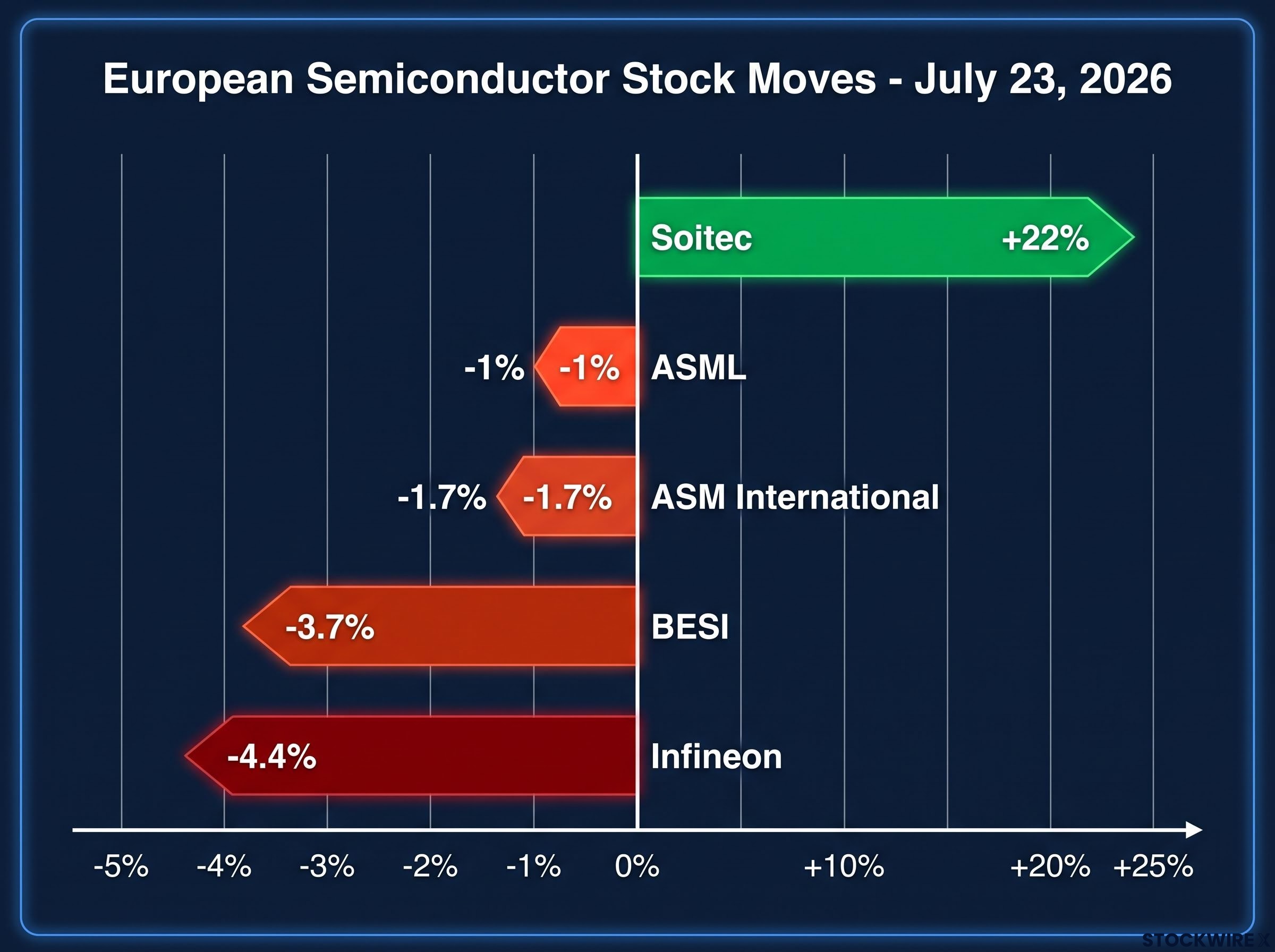
| Company | July 23 Move | Primary End-Market Exposure | Likely Driver of Decline |
|---|---|---|---|
| ASML | -~1% | Front-end lithography; global cycle barometer | Risk-off tone; no company-specific catalyst |
| Infineon | -4.4% | Power semiconductors; auto and industrial | Cyclical anxiety; ongoing inventory correction concerns |
| ASM International | -~1.7% | Process equipment; advanced deposition | Sympathy decline within equipment bucket |
Three structural characteristics made each name vulnerable to a risk-off drift today:
- No fresh earnings catalyst to anchor positioning
- A fragile macro tape shaped by the ECB decision day
- Broader sector caution following BESI’s mixed reception
The fact that ASML fell only 1% while Infineon fell 4.4% without company-specific news tells you the market is already embedding auto-industrial cycle anxiety into Infineon’s price in a way it is not doing for ASML. These declines reveal relative positioning as much as they reflect the day’s macro tone. When the tape is fragile and no positive catalyst arrives, gravity takes hold, and the size of the decline scales with each company’s cyclical exposure.
How the ECB’s rate decision shaped the magnitude of every move
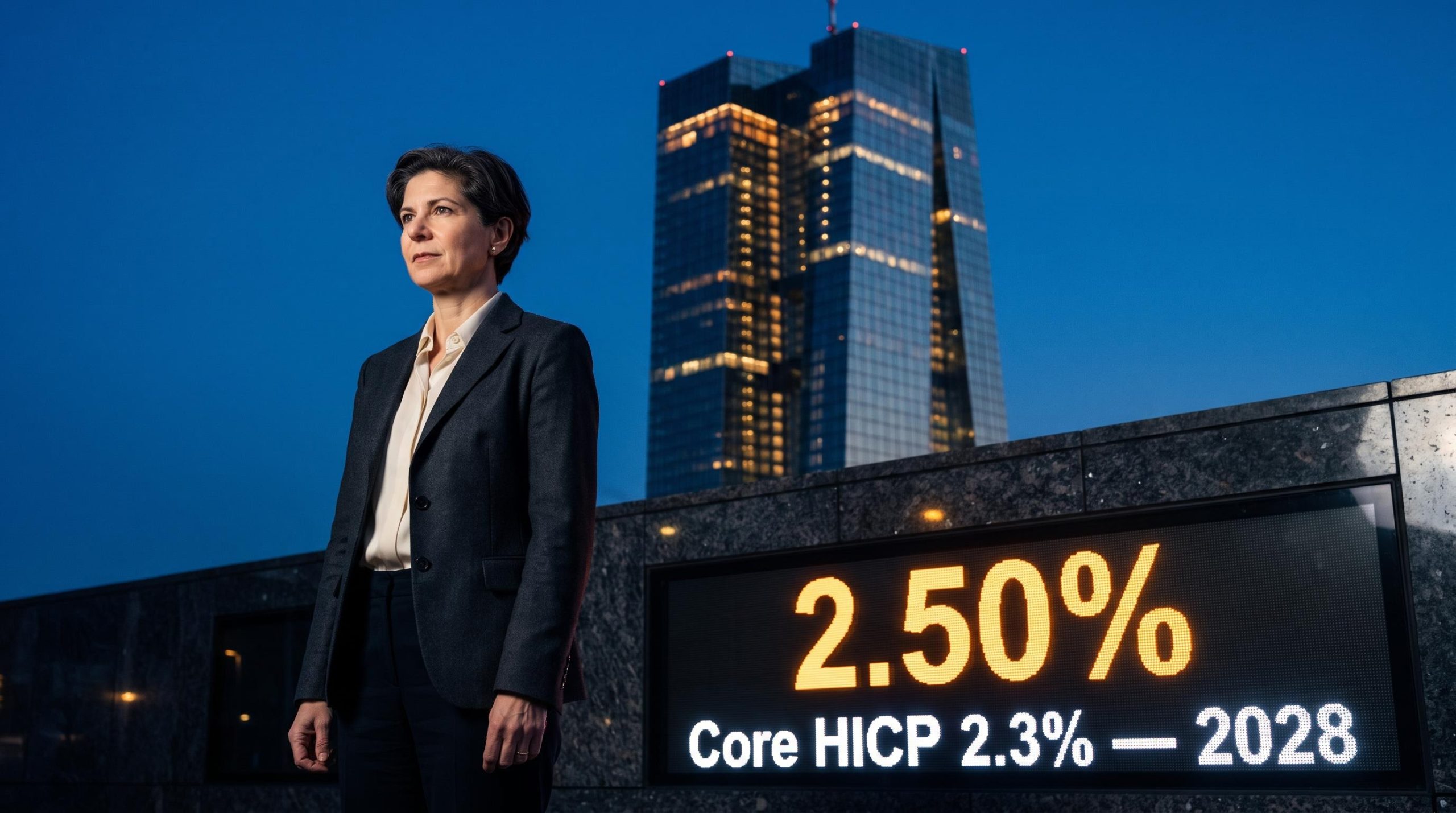
The ECB held its deposit rate at 2.25% today, a decision that was broadly expected. No immediate rate hike was priced in. The headline decision was not the variable that mattered.
What mattered was the language around future policy direction. Semiconductor stocks are rate-sensitive for two structural reasons:
- DCF valuation dependency: These companies trade on long-duration cash flow assumptions. A shift in the discount rate assumption moves the entire valuation.
- AI capex narrative duration: Many sector leaders trade on multi-year growth curves rather than near-term yield, making them more sensitive to “higher for longer” framing risk.
The ECB did not create the divergences on July 23. It set the conditions that determined how far they travelled.
That is the amplifier principle. The ECB did not cause BESI’s miss or Soitec’s beat. It set the tape’s fragility level, which determined how far each stock moved in response to its own specific catalyst. BESI, already dealing with a subtle expectations miss, was more vulnerable to amplified downside. Soitec, with a clean upside surprise, could power through the macro noise.
If you hold high-multiple semiconductor names, the ECB’s framing on future cuts matters more than its headline decision, because the language sets the discount rate assumption that your holding’s valuation depends on.
High-multiple semiconductor names are particularly exposed to the language around future policy direction because they trade on multi-year growth curves, and the 18-24 month capex-to-revenue lag that analysts have identified for the sector means valuation support depends on sustained discount-rate assumptions rather than near-term earnings delivery.
What July 23 tells investors about reading a split-sector session
Today’s session was more informative than a uniform sector move precisely because the divergences reveal what the market is specifically watching for. Three structural principles explain the dynamics:
European equity positioning in mid-2026 is defined by a structural underweight from institutional investors even as individual sectors rerate sharply, meaning that single-session divergences like July 23 carry more information about sector-specific conviction than about broad market direction.
- Sector heterogeneity means divergence is informative, not contradictory. Soitec’s 22% gain and BESI’s 3.7% decline do not cancel each other out. They tell you the market is repricing materials-layer AI optionality upward while demanding specific narrative confirmation from equipment names.
- Earnings reactions reflect expectations positioning as much as reported fundamentals. BESI’s 128.8% order growth was strong. It was not the right kind of strong for a market positioned for memory hybrid bonding confirmation.
- Macro overlays amplify directional moves without creating them. Infineon’s 4.4% decline versus ASML’s 1% decline tells you where cyclical anxiety is concentrated in the current consensus, not that the ECB caused either move.
The variable to watch before BESI’s next earnings event
The stocks that declined without company-specific news today remain fundamentally unchanged. The unresolved question sits with BESI.
The single data point most likely to determine whether the July 23 sell-off was a buying opportunity or an early signal of a narrative revision is the memory customer hybrid bonding order pipeline. That update did not arrive today. It will be re-tested at the next earnings event. Applying these three principles to the next split-sector session will tell you more about where investor positioning has drifted than any single earnings headline can, and that is where the actionable information in days like today actually lives.
This article is for informational purposes only and should not be considered financial advice. Investors should conduct their own research and consult with financial professionals before making investment decisions.