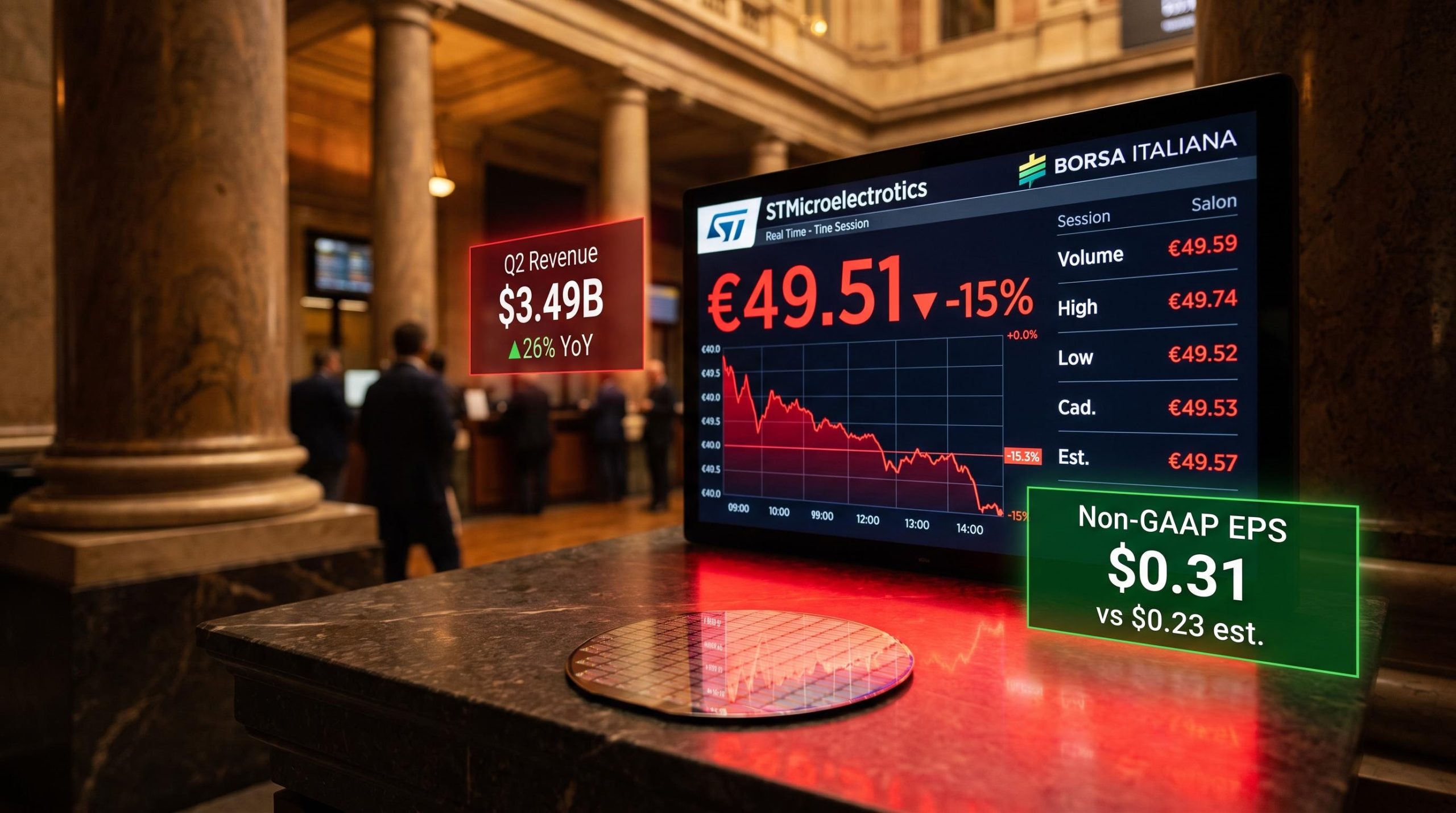
STMicroelectronics delivered one of its strongest quarterly performances in recent memory on 23 July 2026, and the market punished it with a 15% share price collapse in a single session.
The disconnect between a genuine Q2 earnings beat and a violent selloff is not a contradiction. It is a precise illustration of how semiconductor stocks trade: investors price the future, not the past. When the Q3 revenue guide landed roughly 1-2% below analyst consensus, the market rapidly repriced the pace of recovery. Milan-listed shares touched €49.51 during intraday trading, a move that had nothing to do with the backward-looking numbers and everything to do with what management signalled about the 90 days ahead.
Here is what actually happened across both the Q2 beat and the Q3 guidance miss, why semiconductor stocks react this way to even small forward shortfalls, and which signposts will determine whether today’s selloff eventually looks like an overreaction or an early warning.
The Q2 numbers that should have pleased investors
On the headline metrics, STMicroelectronics delivered a quarter that looked comfortably strong. Q2 net revenues reached $3.49 billion, advancing 26% year over year and 12.7% sequentially, clearing the analyst consensus figure of roughly $3.47 billion.
The earnings beat was even more striking. The adjusted profit per share figure (non-GAAP EPS, which strips out one-off items) came in at $0.31, well ahead of the $0.23 analyst estimate, representing a beat of roughly 35%. Underlying operating profit (EBIT) of $269 million topped analyst forecasts by close to 15%. GAAP gross margin reached 34.8%, and operating income came in at $187 million, a 5.4% margin, versus a loss a year earlier.
The standout number: Non-GAAP EPS of $0.31 versus the $0.23 analyst estimate, a 35% beat that, in isolation, would normally send a stock higher.
Not every metric cleared the bar. EBITDA of $679 million fell short of the approximately $798 million analyst expectation, and free cash flow of $83 million missed the $151 million consensus by a considerable margin.
One supply chain signal stood out as constructive: the inventory days figure dropped to 126 from a prior reading of 140. That matters because it suggests customer demand is absorbing product at a faster rate, which historically precedes a more durable order recovery rather than a temporary one.
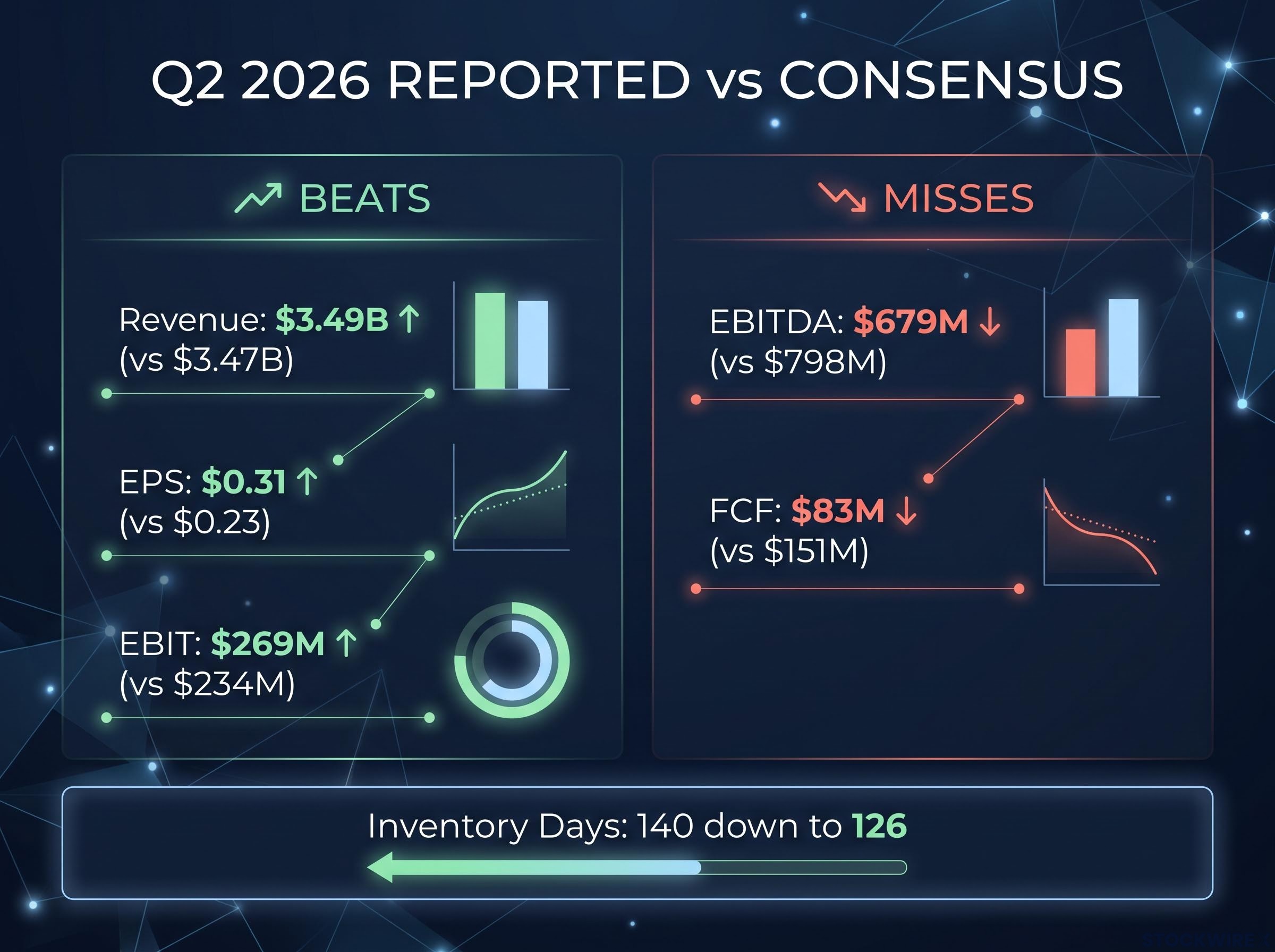
| Metric | Reported | Consensus | Beat / Miss |
|---|---|---|---|
| Net Revenue | $3.49B | ~$3.47B | Beat |
| Non-GAAP EPS | $0.31 | $0.23 | Beat (~35%) |
| EBIT | $269M | ~$234M | Beat (~15%) |
| EBITDA | $679M | ~$798M | Miss |
| Free Cash Flow | $83M | ~$151M | Miss |
On those numbers alone, the stock might normally have traded higher. What happened next explains why it did the opposite.
AI chip demand visibility into the second half of 2026 became the dominant earnings question across the sector before STM reported, with TSMC’s record Q2 revenue of $39.63 billion confirming that advanced node capacity was running at full utilisation even as investors scrutinised forward margin guidance rather than the top-line beat.
When big ASX news breaks, our subscribers know first
The guidance miss that erased those gains
For Q3 2026, STMicroelectronics set its revenue target at $3.70 billion, plus or minus 3.5%, implying approximately 6.2% sequential growth and approximately 16.2% year-over-year growth. That sounds healthy in isolation. It was not healthy relative to where the Street sat.
The gap between management’s midpoint and analyst consensus was modest in absolute terms but enough to shift the narrative. The range of consensus figures across sources made the miss concrete:
- Reuters/LSEG: approximately $3.72 billion
- Bloomberg: approximately $3.79 billion
- Primary consensus source: approximately $3.76 billion
Depending on which consensus figure you use, STM’s midpoint landed roughly 1-2% light on revenue.
The margin story, however, told a different tale. The Q3 gross margin forecast of approximately 37% (plus or minus 200 basis points) landed around 50 basis points ahead of analyst consensus. That above-consensus margin guidance tells you management is not seeing a pricing or mix deterioration. The revenue miss is a volume and timing question, not a signal that STM is losing competitive ground.
What management said about Q4 and beyond
Management set out a formal Q4 revenue target above $4 billion, with AI datacenter and low earth orbit (LEO) satellite communication programmes cited as the primary demand engines. The characterisation was deliberate: Q3 is a transitional step, not a demand deterioration. Management pointed to better-than-normal seasonality ahead, framing the Q3 shortfall as a timing issue on programme ramps rather than a structural softening.
Why a 1-2% guidance miss triggered a 15% share price fall
The arithmetic does not add up at first glance. A revenue shortfall of roughly $60-100 million at the midpoint produced a market capitalisation destruction many times larger. During the session on 23 July 2026, shares traded as low as €49.51 in Milan, closing the day down roughly 15%.
The explanation is not irrational panic. It is the logical outcome of several reinforcing pressures.
Once Q2 is reported, those numbers become history. Guidance is the actionable signal, the company’s own statement about what the next 90 days look like. When it lands below consensus, the trajectory implied by the stock’s pre-earnings price no longer holds.
Semiconductor stocks amplify this effect because they sit in a highly cyclical sector where investors constantly assess whether the recovery is accelerating or stalling. A light revenue guide can rapidly flip the narrative from “recovery gaining momentum” to “recovery slower and lumpier than hoped.” That binary framing compresses quickly into positioning: growth investors de-risk, short-term traders react to the headline miss, and analysts cut near-term estimates, which in turn compress the earnings multiple.
A small guidance miss in a cyclical growth stock can produce a large price move when investor positioning already reflects optimism. The magnitude of the reaction tells you more about the expectations embedded in the stock before the print than it does about the business itself.
The STM reaction is part of a broader sector pattern: semiconductor valuation discipline has replaced momentum pricing across the peer group, with TSMC’s record Q2 2026 quarter triggering a share price decline on the same day results landed, confirming that pre-priced expectations, not reported figures, now determine price direction.
For investors watching from the sidelines, the 15% move reflects the price that was already embedded in the stock before the print, not a new verdict on STM’s business quality.
The medium-term case that the selloff complicates but does not break
The near-term mechanics explain the move. The medium-term growth drivers explain why the selloff may not be the final word.
In its forward targets, STM committed to AI datacenter revenues exceeding $1 billion in 2026 and climbing well beyond $2 billion by 2027. These are quantified benchmarks, not aspirational commentary, and they give investors specific goalposts to track.
Bank of America’s concurrent Street-high target for STMicroelectronics, set in June 2026, was built around silicon photonics revenue targets scaling from $670 million in 2026 to $2.3 billion by 2028, alongside LEO satellite cumulative revenues of $3.6 billion across 2026-2028, giving the AI datacenter growth narrative a specific analyst framework to test against.
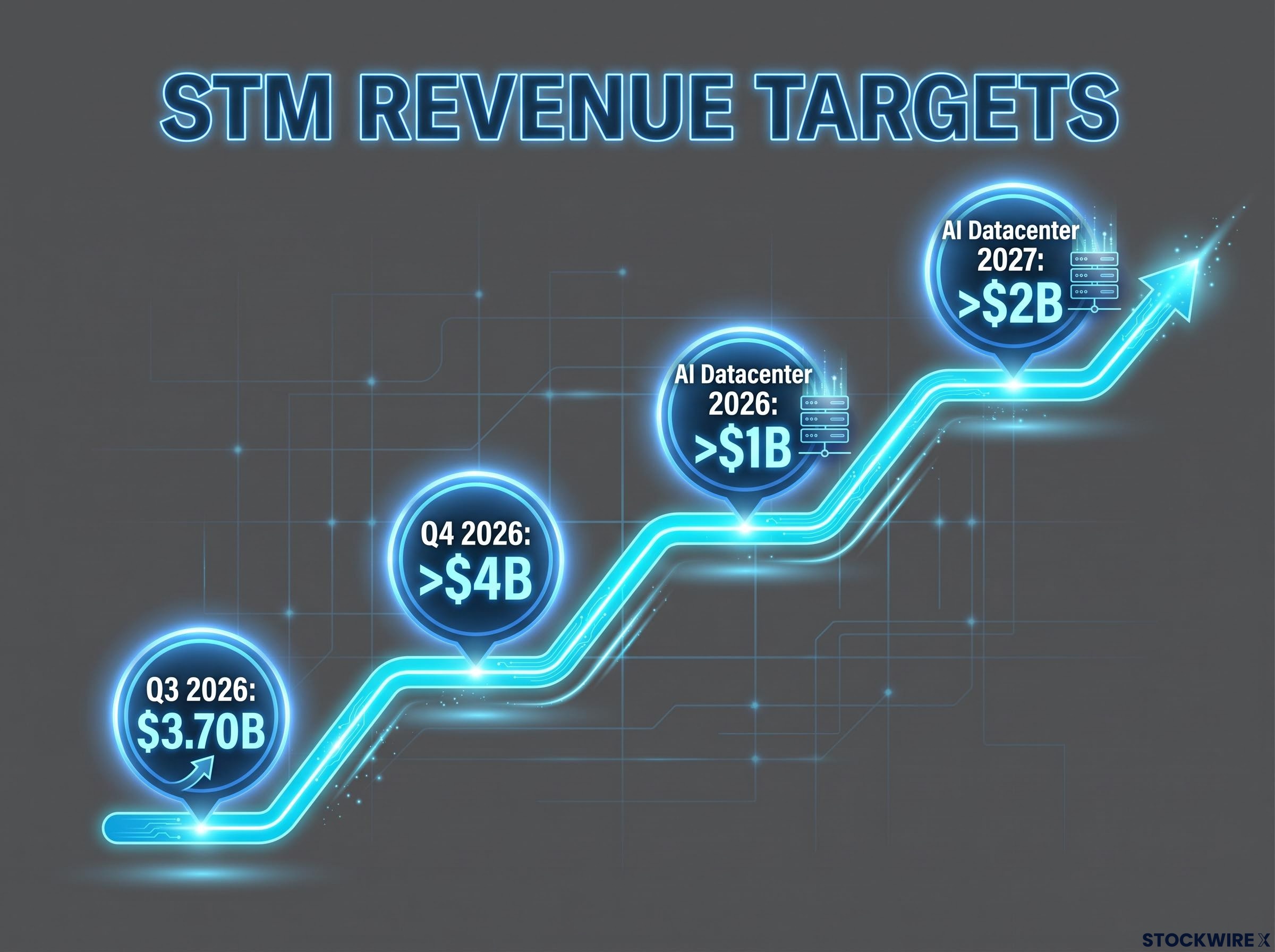
The number that matters most: STM’s AI datacenter revenue target of well above $2 billion for 2027. If the company delivers it, today’s selloff will look, in hindsight, like a short-term overreaction to a transitional quarter.
The Q2 data already showed concrete recovery across multiple end markets:
- Industrial: revenues grew 34% year over year in Q2, notably strong for the segment
- Automotive: recovering demand confirmed in management commentary, a core franchise for STM
- AI and data-centre optical: identified as the primary growth engine across both management commentary and independent coverage
- Consumer electronics: demand improving, adding breadth to the recovery
The cautious signal investors will weigh against these targets is free cash flow. At $83 million in Q2, cash generation fell substantially short of the $151 million consensus expectation, and programme timing risk in AI and communications remains real. Complex ramps can slip, which would pressure the Q4 above $4 billion narrative. The bullish case requires execution, not just ambition.
What the semiconductor cycle tells us about reading this earnings pattern
The STM earnings reaction illustrates a fundamental asymmetry that repeats across cyclical sectors. Backward-looking results and forward-looking guidance do not carry equal weight. The market assigns materially more pricing power to the guidance because it is the company’s direct statement about where demand and orders are heading, not where they have been.
STM’s Q2 revenue grew 26% year over year. That is strong by any measure. The 15% price decline on the same day is the market’s revealed preference: forward guidance, not historical results, is the pricing signal.
How to read inventory data as a forward indicator
Inventory days, the number of days of product a company holds before it ships, moved from 140 down to 126 across Q2. A drawdown of that magnitude typically signals that downstream customers are pulling product faster than the company is building it, a leading indicator of strengthening demand rather than a lagging confirmation.
That signal sits in mild tension with the Q3 revenue guidance miss. If demand is genuinely accelerating (as the inventory data suggests), the revenue shortfall may reflect programme timing rather than weakening orders. Resolving that tension requires watching Q3 order commentary and booking trends closely, which leads directly to what investors should monitor from here.
The signals that will determine whether today’s selloff was an overreaction
The answer to whether today’s 15% decline was an overreaction or an early warning cannot be given today. That is the honest investor posture. What can be given is a specific monitoring framework. Five signals, in order of timing, will shape the verdict:
- Q3 order and booking commentary: Any indication of strengthening or weakening order trends in automotive, industrial, and AI/datacenter segments will drive near-term sentiment and estimate revisions
- Gross margin delivery against the approximately 37% Q3 guidance: Hitting or exceeding this target confirms pricing power and mix quality are intact
- Free cash flow recovery in H2: Given Q2’s $83 million result well below the $151 million consensus, investors will need to see cash generation normalise as revenues scale
- Q4 revenue confirmation above $4 billion: This is the threshold management committed to publicly. If STM reiterates and delivers it when Q3 results are reported (expected in late October 2026), the narrative shifts from “guidance miss” to “transition quarter”
- AI datacenter programme disclosure: Whether management continues to increase, maintain, or walk back the $1 billion-plus (2026) and $2 billion-plus (2027) targets at future calls and investor conferences is the medium-term re-rating test
The benchmark to watch: STM’s management has publicly committed to Q4 revenues clearing $4 billion. If that threshold is confirmed and delivered, today’s entry point looks materially different.
If Q4 revenues come in above $4 billion and AI datacenter disclosures show the programme is on schedule, the narrative shifts from “guidance miss” to “transition quarter,” and the pricing reset of 23 July starts to look like opportunity rather than warning.
Investors exploring whether AI-driven semiconductor demand represents durable structural growth or an overextended cycle will find our full explainer on semiconductor supercycle risks, which examines the key distinctions between the current AI capex cycle and historical speculative episodes.
This article is for informational purposes only and should not be considered financial advice. Investors should conduct their own research and consult with financial professionals before making investment decisions. Forward-looking statements, including management’s revenue and programme targets, are subject to change based on market conditions, programme timing, and various risk factors.