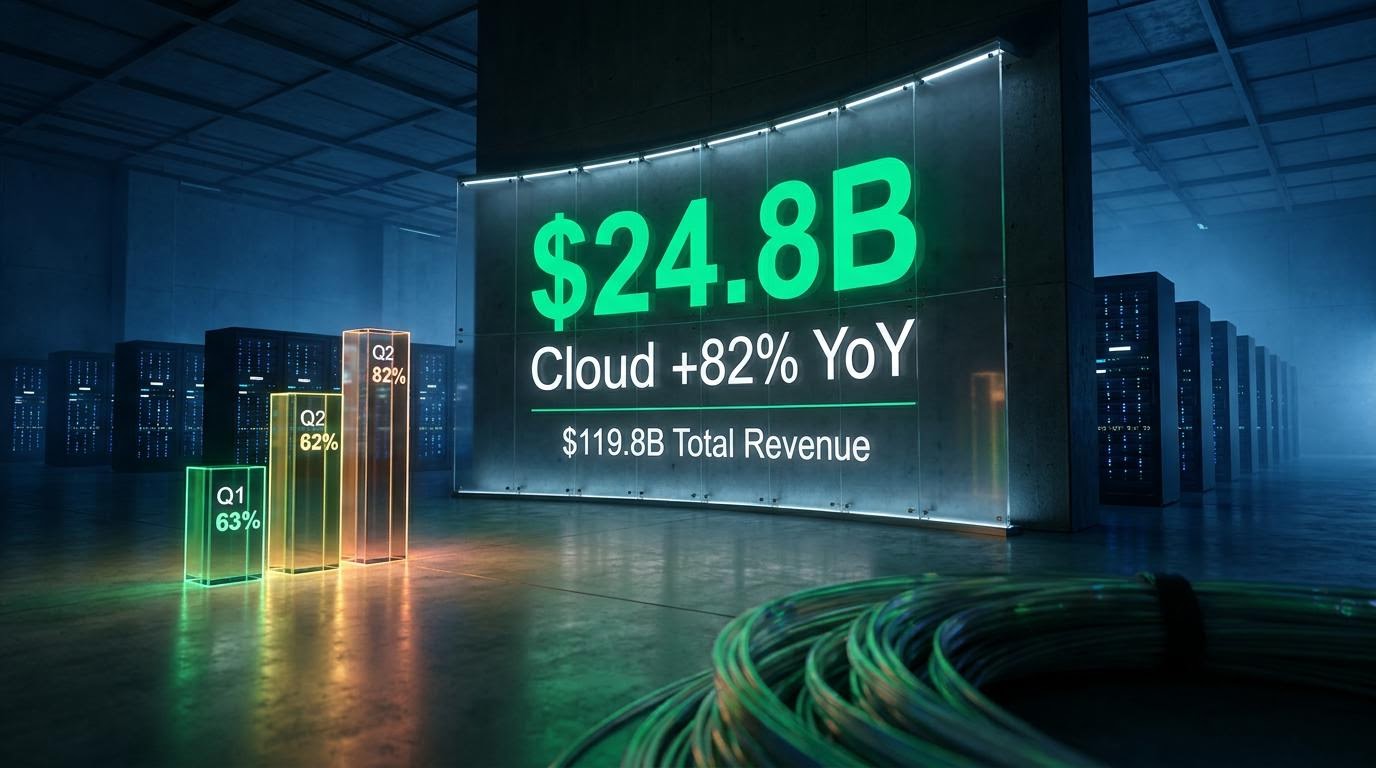
Alphabet just reported $119.8 billion in Q2 2026 revenue, beating Wall Street’s consensus by more than $3 billion. The number that stopped analysts mid-sentence was not the top line. It was Google Cloud growing 82% in a single quarter.
The results, published 22 July 2026, mark twelve consecutive quarters of double-digit year-over-year revenue growth for Alphabet. Operating margin hit 34%, operating income expanded 30%, and earnings per share of $9.11 obliterated the $2.88 consensus estimate. This is not a company squeezing cost efficiencies to prop up results. Revenue is accelerating while margins widen, a combination that signals genuine business momentum rather than financial engineering.
Here is what the quarter tells you about whether Alphabet’s AI spending is actually working, grounded in the specific metrics that matter, and the three variables that will determine whether this performance holds through the rest of 2026.
Google Cloud’s 82% surge changes the competitive calculus
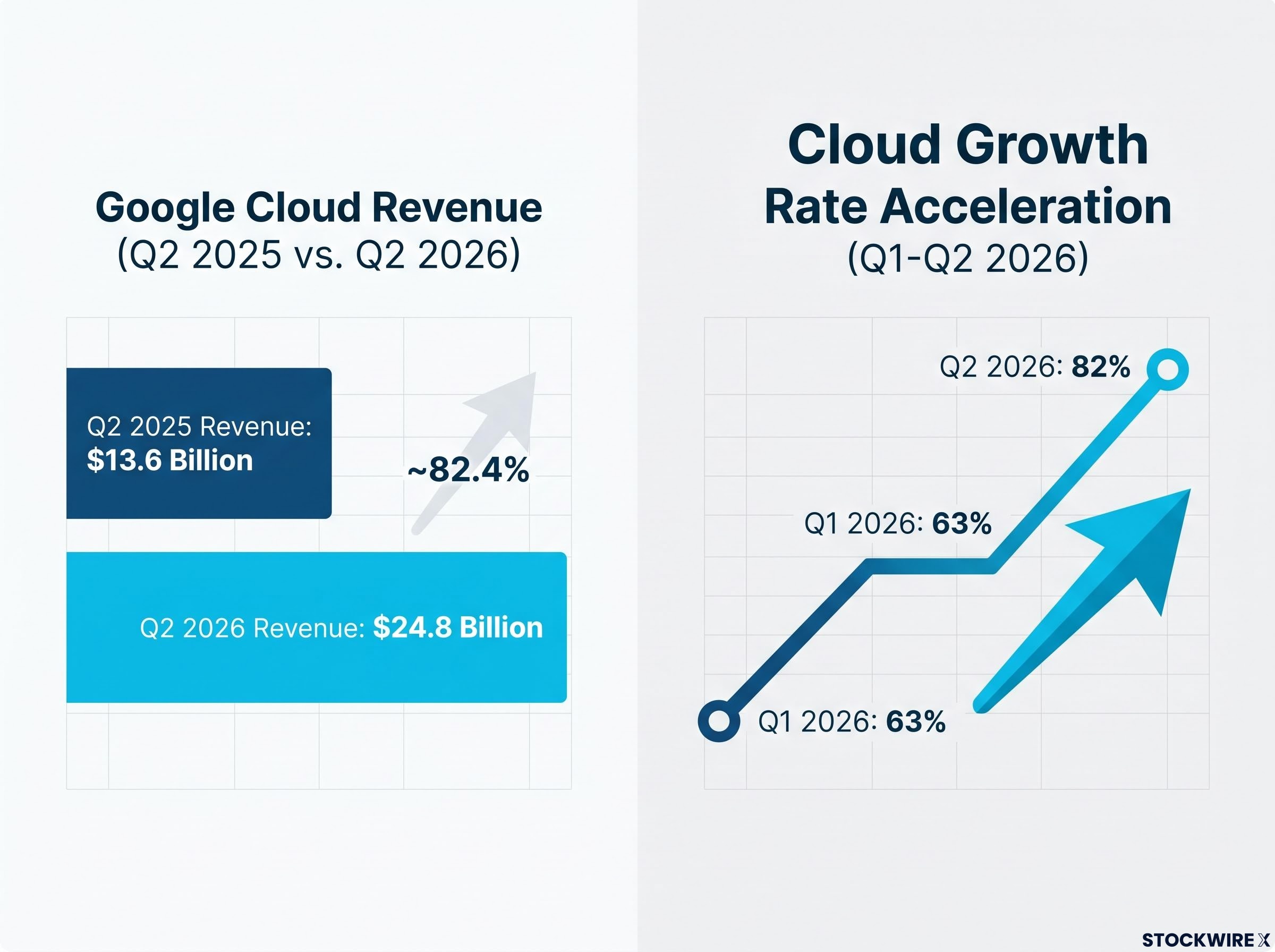
Google Cloud posted $24.8 billion in revenue for Q2 2026, an 82% year-over-year increase that blew past consensus expectations of roughly 64-65% growth. This was not a modest upside surprise. It was a meaningful acceleration from Q1 2026’s 63% growth rate, which itself was already considered strong.
The acceleration from 63% to 82% in a single quarter, on a base that was already approaching $20 billion, tells you that enterprise AI demand is not plateauing. It is compounding, and Google Cloud is capturing a disproportionate share of that expansion.
Gene Munster, Managing Partner at Deepwater Management, cited Cloud segment outperformance as the most consequential element of the quarterly results for evaluating Alphabet’s competitive market position.
The key Cloud metrics in context:
- Q2 2026 Cloud revenue: $24.8 billion
- Year-over-year growth: 82%, versus consensus of approximately 64-65%
- Q1 2026 Cloud growth rate: 63%, establishing a clear acceleration trend
That performance repositions Google Cloud as a genuine peer to AWS and Azure in AI-centric enterprise workloads, not a distant third.
When big ASX news breaks, our subscribers know first
What Gemini’s enterprise penetration actually means
Close to 90% of Fortune 100 companies had adopted Gemini Enterprise as of Q2 2026. That is not a competitive alternative finding its footing. That is a de facto standard already embedded in the infrastructure of most major corporations.
The scale extends well beyond enterprise contracts:
- 950 million monthly active users on the Gemini application
- 22 billion API tokens processed per minute
- Gemini Enterprise paid monthly active user growth of 40% quarter over quarter as of Q1 2026, with continued momentum into Q2
Near-universal Fortune 100 penetration means Alphabet has already won the adoption race at the enterprise level. The question you should now be asking is how much revenue per customer remains to be unlocked as pilots convert to full production workloads. That conversion rate, not the headline adoption number, is what will determine Gemini’s incremental profit contribution over the next several quarters.
Why search and advertising are not the story Wall Street feared
The most persistent bear case against Alphabet’s AI push was straightforward: AI-generated answers would cannibalise search queries, and advertising revenue would follow them down. Q2’s numbers say otherwise.
Google Search and related products generated $63.3 billion in revenue, up 17% year over year. Google Services revenue grew 15% over the same period. YouTube advertising and subscriptions contributed to Services segment margin resilience, even without precise sub-segment figures being broken out.
CEO Sundar Pichai attributed Search query volume growth directly to AI-powered features, framing them as an augmentation of the search experience rather than a replacement.
The key Services metrics:
- Google Search and related revenue: $63.3 billion
- Search revenue growth: 17% year over year
- Google Services revenue growth: 15% year over year
A 17% growth rate in Search revenue, sustained while Alphabet is simultaneously deploying AI answer features across its search interface, tells you the feared trade-off between AI and advertising has not materialised. At least not yet at a scale that shows up in the financials.
Understanding the capex commitment and what it signals
Alphabet spent $44.9 billion on property and equipment in Q2 2026, compared to $22.4 billion in Q2 2025. That is a near-doubling in a single year. And the company supplemented operating cash flow with an equity raise of $49.6 billion (as pre-verified from Alphabet corporate reporting; separate reporting cites a figure as high as $84.75 billion, and readers should watch Alphabet investor relations for the final confirmed number).
| Metric | Q2 2025 | Q2 2026 | Change |
|---|---|---|---|
| Capital expenditure | $22.4B | $44.9B | +100% |
| Total revenue | $96.6B | $119.8B | +24% |
| Cloud revenue | $13.6B | $24.8B | +82% |
| Operating margin | ~29% | 34% | +~5pp |
Full-year 2026 capex guidance sits at $195-$205 billion. Management’s stated rationale is clear: the AI infrastructure build-out window is time-sensitive, and under-investing now carries more risk than the dilution or leverage required to fund the spend.
- Full-year 2026 capex guidance: $195-$205 billion
- Equity raise: $49.6 billion pre-verified; up to $84.75 billion cited in separate reporting
When a company nearly doubles its infrastructure spend in a single quarter and simultaneously raises external capital to fund it, that is management signalling demand visibility strong enough to justify locking in capacity now rather than waiting for certainty. The 34% operating margin reported in the same quarter is the most direct evidence available that returns are keeping pace.
How Alphabet’s headline results compare to what analysts expected
For readers encountering the headline and wanting the full picture, here is every major metric set against the analyst consensus:
- Total revenue: $119.8 billion reported versus $116.52 billion consensus
- Revenue growth: 24% year over year
- EPS: $9.11 reported versus $2.88 consensus
- Operating margin: 34%
- Operating income growth: 30% year over year
Alphabet has now delivered twelve consecutive quarters of double-digit year-over-year revenue growth.
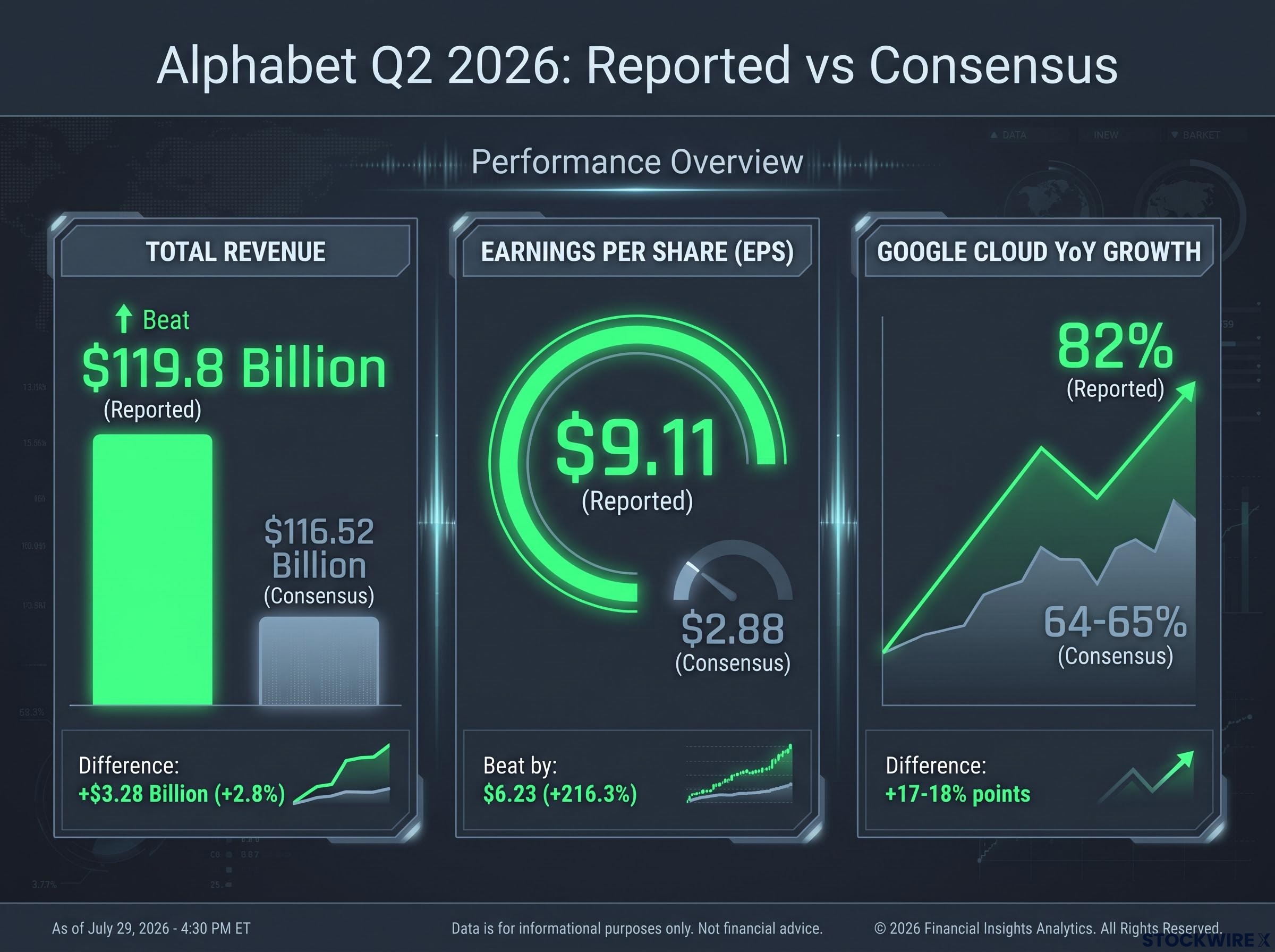
An EPS (earnings per share, the portion of a company’s profit allocated to each outstanding share of stock) of $9.11 against a consensus of $2.88 is not a marginal beat. Either analyst models were significantly miscalibrated, or something changed in the business faster than the Street expected. Both possibilities are worth understanding before drawing conclusions about valuation.
CEO Sundar Pichai attributed the broad-based business growth to AI investments across multiple product lines. The 34% operating margin alongside a 24% revenue growth rate represents the combination that typically signals a business at an inflection point, not just a company printing a good quarter.
Three variables that will define whether this performance holds
The Q2 numbers are strong. The question now is whether they represent a new trajectory or a particularly exceptional quarter. Three specific metrics will answer that:
- Cloud growth durability. Google Cloud’s quarterly revenue base now exceeds $25 billion. Sustaining growth rates above 80% on that base, while year-over-year comparisons become more demanding, is the first test.
- Gemini monetisation depth. Near-universal Fortune 100 penetration is the floor. The metric to watch is how quickly pilot deployments convert to full production workloads, which determines incremental profit contribution.
- Capex productivity. With full-year guidance at $195-$205 billion, investors will measure whether incremental AI and cloud revenue continues to scale faster than infrastructure spending, thereby preserving or expanding margins.
Microsoft (Azure) and Amazon (AWS) are both investing aggressively in AI infrastructure. Their pricing and bundling responses to Google Cloud’s Q2 outperformance will shape enterprise AI competition through the rest of 2026 and into 2027. The number to look at first when Q3 results are published is Cloud revenue growth rate on the larger base, because that single figure, rather than headline revenue, will tell the clearest story about whether Q2 marked a real inflection or a peak quarter.
What Q2 confirms and what remains genuinely open
Q2 confirmed two things definitively. AI investment is generating measurable, accelerating financial returns across Cloud, Search, and operating margin. And Gemini has achieved enterprise-level adoption at a scale that cements its role in Alphabet’s revenue mix.
What Q2 left unresolved is whether Alphabet can sustain margin expansion while nearly doubling infrastructure spend annually. No single quarter can fully answer that question. Q3 2026 earnings, and specifically the Cloud revenue growth rate on a larger base, will be the next direct test.
This article is for informational purposes only and should not be considered financial advice. Investors should conduct their own research and consult with financial professionals before making investment decisions. Past performance does not guarantee future results. Financial projections are subject to market conditions and various risk factors.