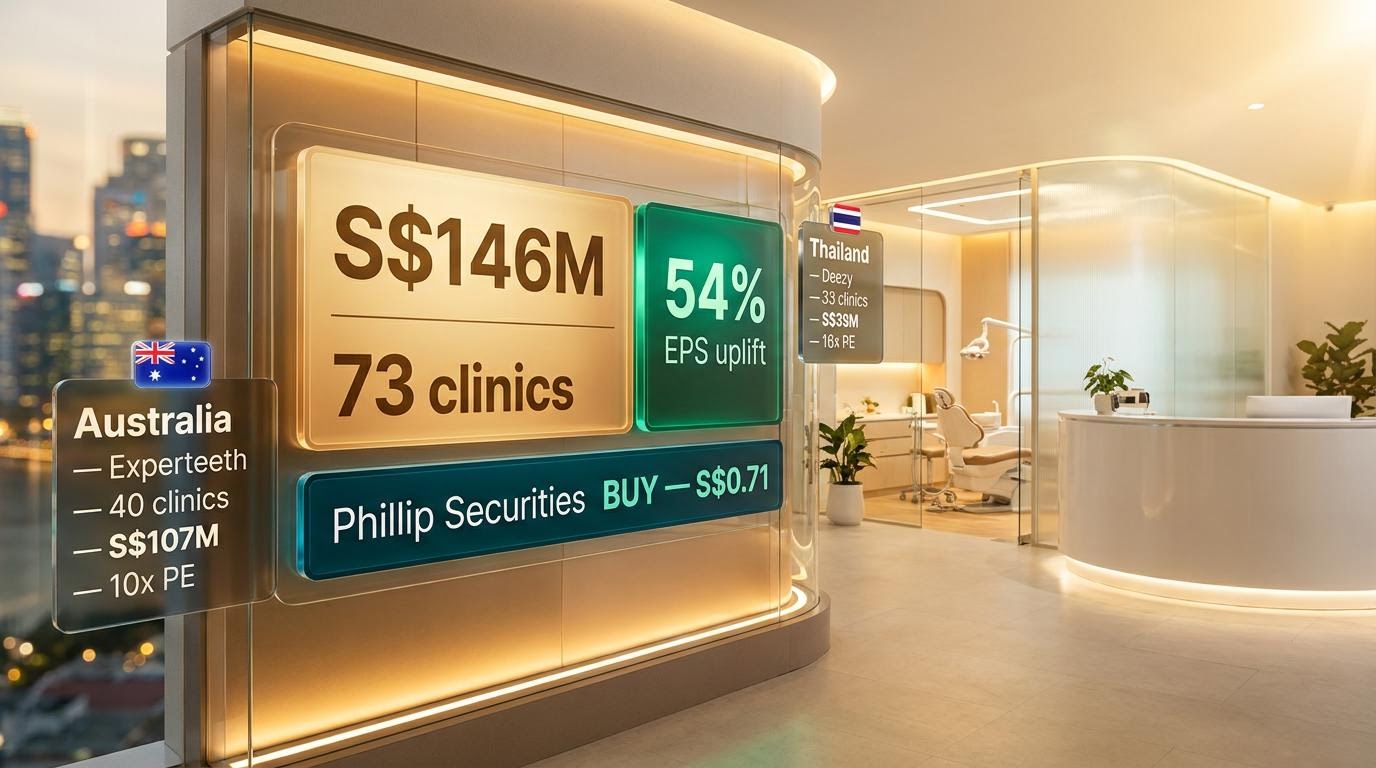
Q & M Dental Group just announced two acquisitions in a single week, spending a combined S$146 million to add 73 clinics and more than 150 dentists across Australia and Thailand. For a Singapore-listed dental company that built its reputation on a domestic and China-focused footprint, this is not incremental growth. It is a full-scale geographic repositioning.
The timing matters. The deals were announced on 12 July 2026, and Phillip Securities published its analyst research note today, 22 July 2026, projecting a 54% EPS uplift for FY26 and maintaining a BUY rating. The story is live, the numbers are fresh, and the implications are still being priced in.
Here is a complete breakdown of the deal mechanics, what the analyst numbers actually mean (and what they leave out), and the five specific risks that will determine whether the projected upside materialises. After this, you will have the framework to evaluate the stock on your own terms.
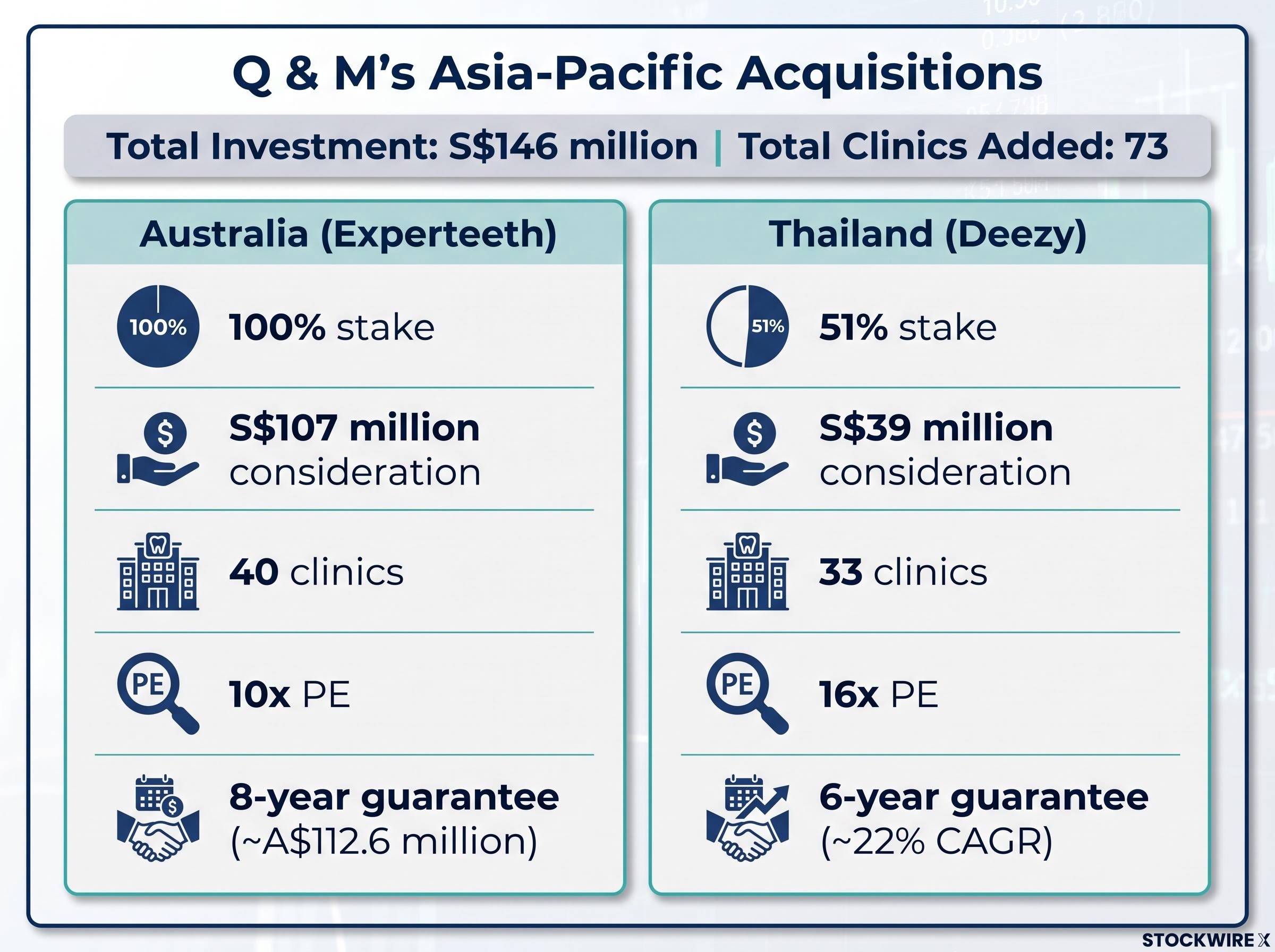
Two deals, S$146 million, 73 new clinics: the full scope of Q & M’s Asia-Pacific push
The first deal is Experteeth Dental Group in Australia: a 100% stake for S$107 million, adding a network of 40 clinics staffed by roughly 120 dentists spread across five states and territories, namely New South Wales, Victoria, Queensland, Tasmania, and the Australian Capital Territory.
The second is Deezy Q & M Dental in Thailand: an effective 51% stake for S$39 million, adding 33 clinics across Bangkok and northeastern Thailand. The majority-stake structure here is equally intentional, retaining local partners to navigate Thai regulatory requirements and cultural expectations.
Six distinct brands sit under the Experteeth umbrella: Elevate, Lumiere, Ace, Yiruda, Prestige, and Bubble Teeth, each operating as a separate patient-facing identity within a centralised group structure. That multi-brand structure is deliberate, designed to preserve local patient loyalty while centralising procurement and back-office functions underneath.
Both target companies were established in 2017. Both announcements landed on 12 July 2026. Together, they add 73 clinics and over 150 dentists in a single move.
This is not bolt-on M&A. It is a network-scale acquisition that materially repositions where Q & M earns its revenue, and investors should assess it on those terms.
| Market | Stake acquired | Consideration (S$) | Clinic count | Key structural feature |
|---|---|---|---|---|
| Australia (Experteeth) | 100% | ~S$107 million | 40 | Six-brand roll-up; ~120 dentists across 5 states/territories |
| Thailand (Deezy) | 51% effective | ~S$39 million | 33 | Majority stake; local partners retained for regulatory/cultural navigation |
When big ASX news breaks, our subscribers know first
How Q & M is paying for it: cash, shares, and a 15-year lock-up
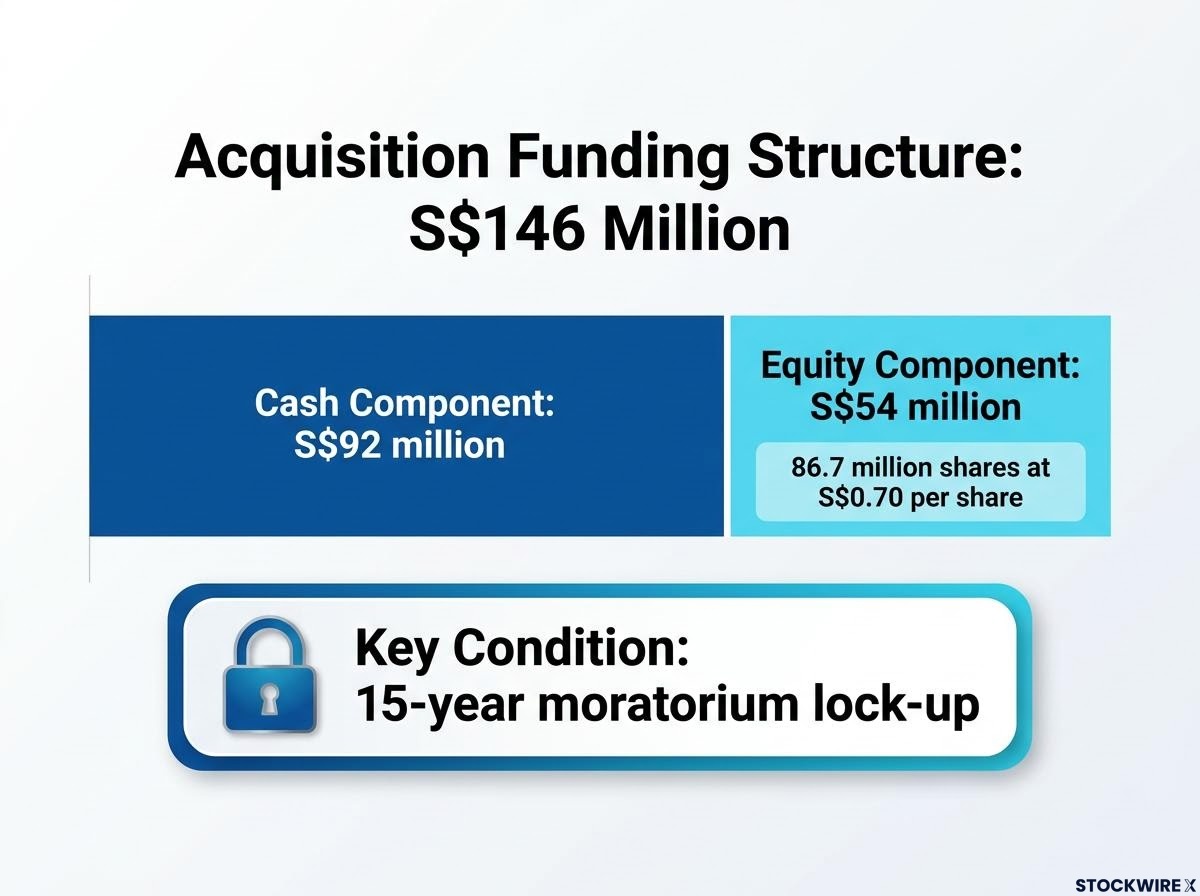
The S$146 million breaks down into two components:
- Cash: roughly S$92 million deployed across the two transactions
- Equity: 86.7 million newly issued Q & M shares, priced at S$0.70 apiece and totalling approximately S$54 million in consideration
- Lock-up: vendor shares are subject to a 15-year moratorium, alongside 15-year service agreements covering key dentists and founders
The issued shares amount to roughly 9.1% of the total shares in existence prior to this transaction. That is moderate dilution, not severe, and manageable within the context of a deal that projects a 54% EPS uplift.
The mix of cash and newly issued equity shares a structural logic with other Asia-Pacific professional services roll-ups: the acquisition funding structure Count used to absorb Oracle Group similarly combined an institutional placement with targeted leverage, keeping post-deal net debt manageable while preserving balance sheet flexibility.
The more significant detail is the lock-up structure.
15-year moratorium and 15-year service agreements. By M&A standards, this is an unusually long alignment structure. It limits near-term insider selling and, more importantly, retains the clinical talent whose patient relationships and operational expertise generate the earnings underpinning the entire deal valuation.
That length signals how much of the deal’s value sits in the human capital of the founding dentists rather than in physical clinic assets. If the people leave, the guarantees become harder to hit. The lock-up is the primary protection against that risk.
What Q & M paid per dollar of profit: reading the valuation multiples
Taken together, the two transactions imply a combined entry valuation of approximately 11.4x PE. That blended figure, however, masks a deliberate split.
The 11.4x blended PE entry point sits comfortably within the range that traditional value frameworks consider disciplined: a PE ratio at that level on a business with contractual earnings guarantees and projected double-digit CAGR is meaningfully different from the same multiple applied to a cyclical or structurally declining company.
Experteeth in Australia was priced at 10x PE, consistent with a mature, developed-market dental platform carrying established patient volumes and stable demand. Deezy in Thailand carried a 16x PE price tag, a premium reflecting projected growth of approximately 22% CAGR over the guarantee period. Averaging across both transactions, the implied earnings growth rate is around 13%.
The gap between 16x in Thailand and 10x in Australia is not an accounting anomaly. It reflects how much faster the Thai dental market is expected to grow, driven by rising urban incomes and expanding demand for elective and cosmetic dentistry. Whether that premium is justified depends on whether the underlying demand thesis holds.
The two transactions together are underpinned by contractual profit guarantees with a combined value of approximately S$126 million, running across six to eight years. Experteeth’s guarantee spans eight years at approximately A$112.6 million, backed by escrow. Deezy’s spans six years with an implied 22% CAGR. These guarantees provide meaningful earnings visibility, but they are contractual floors with counterparty risk, not unconditional income protection.
| Market | Acquisition PE | Guarantee duration | Guarantee quantum | Implied CAGR |
|---|---|---|---|---|
| Australia (Experteeth) | 10x | 8 years | ~A$112.6 million | ~13% (blended) |
| Thailand (Deezy) | 16x | 6 years | Part of ~S$126M combined | ~22% |
What a 54% EPS uplift actually means, and what it leaves out
In a research note dated 22 July 2026, Phillip Securities analyst Paul Chew estimated that the two acquisitions would add approximately 1.04 Singapore cents to FY26 EPS, a 54% improvement that brings the FY26 EPS forecast to 2.96 cents on a pre-amortisation basis. The note keeps a BUY recommendation in place, with the target price held at S$0.71, derived from a 25x PE multiple on FY26 earnings.
54% EPS uplift projected for FY26. Phillip Securities estimates the acquisitions add approximately 1.04 Singapore cents to FY26 EPS, supporting a BUY rating and S$0.71 target price (Phillip Securities research note, 22 July 2026). The acquisitions have not yet been fully incorporated into the target price, implying potential further upside if execution holds.
Here is the detail that matters just as much as the headline number. That 1.04 cent uplift is stated before amortisation of acquired intangibles, meaning the brands, customer relationships, and similar assets that arise from purchase price allocation. When those amortisation charges flow through, reported headline EPS will be lower.
The practical distinction:
- Cash/adjusted EPS: captures the operational earnings benefit from the acquisitions and profit guarantees. This is the basis for the 54% uplift figure and the analyst’s BUY thesis.
- Reported EPS: reduced by non-cash intangible amortisation charges. This is what drives the headline PE ratio most investors see at first glance.
- Which matters more for valuation: adjusted EPS gives a cleaner read on underlying cash generation, but reported EPS is what the market’s screening tools will surface.
The gap between these two metrics is where most retail investor confusion will originate. Understanding it is the difference between misreading the stock as expensive and correctly reading it as transitional.
From Singapore and China to Asia-Pacific: the strategic logic behind the pivot
These two acquisitions do not sit in isolation. They shift Q & M from a primarily Singapore-China operating base toward a broader Asia-Pacific dental platform, and each market serves a different strategic purpose.
Australia provides stable, high-income market exposure with established healthcare infrastructure and predictable patient volumes. Thailand provides exposure to an urbanising, higher-growth market where rising middle-class incomes are driving demand for elective and cosmetic dentistry. The 22% CAGR projection for Deezy reflects that structural demand growth, not just post-acquisition integration assumptions.
The Asia-Pacific dental market is attracting attention well beyond listed dental groups: medical device companies are also positioning for structural demand growth, with Singapore’s 1,147-clinic infrastructure increasingly cited as a distribution anchor for regenerative dental technologies being rolled out across the region.
The synergy thesis across both markets rests on four operational levers:
- Group procurement: centralised purchasing across a larger clinic network to drive supplier pricing improvements
- Clinical training: shared training programmes and clinical protocol standardisation across markets
- Technology transfer: deployment of Q & M’s existing dental technology and systems to acquired clinics
- Process standardisation: unified best practices across operations, scheduling, and patient management
The 15-year service agreements are the retention mechanism that makes all four actionable. Without the founding dentists and clinical leaders staying in place, the synergy playbook has no one to execute it.
If Q & M can standardise procurement and clinical protocols across a 73-clinic cross-border network, the margin improvement potential is material. That is the medium-term story that matters more than the short-term EPS headline.
Five risks that will determine whether the projected upside arrives
These are the specific variables that separate the projected outcome from the actual outcome. Each one is testable through company disclosures.
- Integration and execution complexity. Q & M is absorbing two large, multi-brand networks across different regulatory regimes and cultures simultaneously. What to watch: management commentary on integration milestones, clinic count stability, and any restructuring charges in quarterly updates.
- Foreign exchange exposure. Australian dollar and Thai baht earnings will be translated into Singapore dollars for reporting purposes. What to watch: currency movement against SGD and any hedging disclosures in financial statements.
- Intangible amortisation drag on reported EPS. The 54% uplift is pre-amortisation. Reported headline numbers will look less impressive. What to watch: the spread between reported and adjusted EPS in interim and full-year results, and whether the market values the stock on adjusted or reported metrics.
- Balance sheet and leverage impact. The S$92 million cash component requires deployment of existing reserves, new debt, or both. What to watch: leverage ratios, interest costs, and any dividend policy changes flagged by management.
- Profit guarantee enforceability. The guarantees are only as valuable as the escrow backing them and the vendors’ ability to deliver. What to watch: escrow balance disclosures, annual guarantee target attainment, and any shortfall or enforcement actions reported by the company.
Profit guarantee enforceability sits at the intersection of contract law and cross-border regulatory complexity: the same jurisdictional fragmentation that complicates enforcement in financial promotions also means that guarantee shortfall remedies must navigate different legal systems, escrow regimes, and counterparty rights across Singapore, Australia, and Thailand simultaneously.
Guarantee enforceability is the most operationally novel risk element for investors accustomed to Q & M’s domestic business model. The company has not previously managed cross-border profit guarantee structures of this scale and duration, and any shortfalls in years two or three would be the earliest signal that the deal economics are underperforming vendor representations.
What the deal leaves open, and what investors should do before the next update
The strategic logic behind these two acquisitions is coherent. The valuation multiples are reasonable by sector standards. The profit guarantees provide meaningful, though not unconditional, earnings visibility over the next six to eight years. The outstanding question is execution across two new markets simultaneously.
Three near-term catalysts will shape how this story develops from here:
- Deal completion and regulatory approval updates in both Australia and Thailand
- The first post-acquisition financial reporting period that includes the new clinics
- Early guarantee disclosures or operational KPIs from management, particularly clinic count, dentist retention, and guarantee target progress
For investors already holding Q & M shares, the priority is monitoring those three catalysts before adjusting position sizing. For those considering entry at current prices, the analyst’s BUY rating and S$0.71 target price provide a framework, but adjusted EPS rather than reported EPS should be the valuation basis. For those watching from the sidelines, the first post-deal reporting period will provide the clearest read on whether integration is tracking.
This article is for informational purposes only and should not be considered financial advice. Investors should conduct their own research and consult with financial professionals before making investment decisions. Financial projections referenced are subject to market conditions, foreign exchange fluctuations, and various execution risk factors.