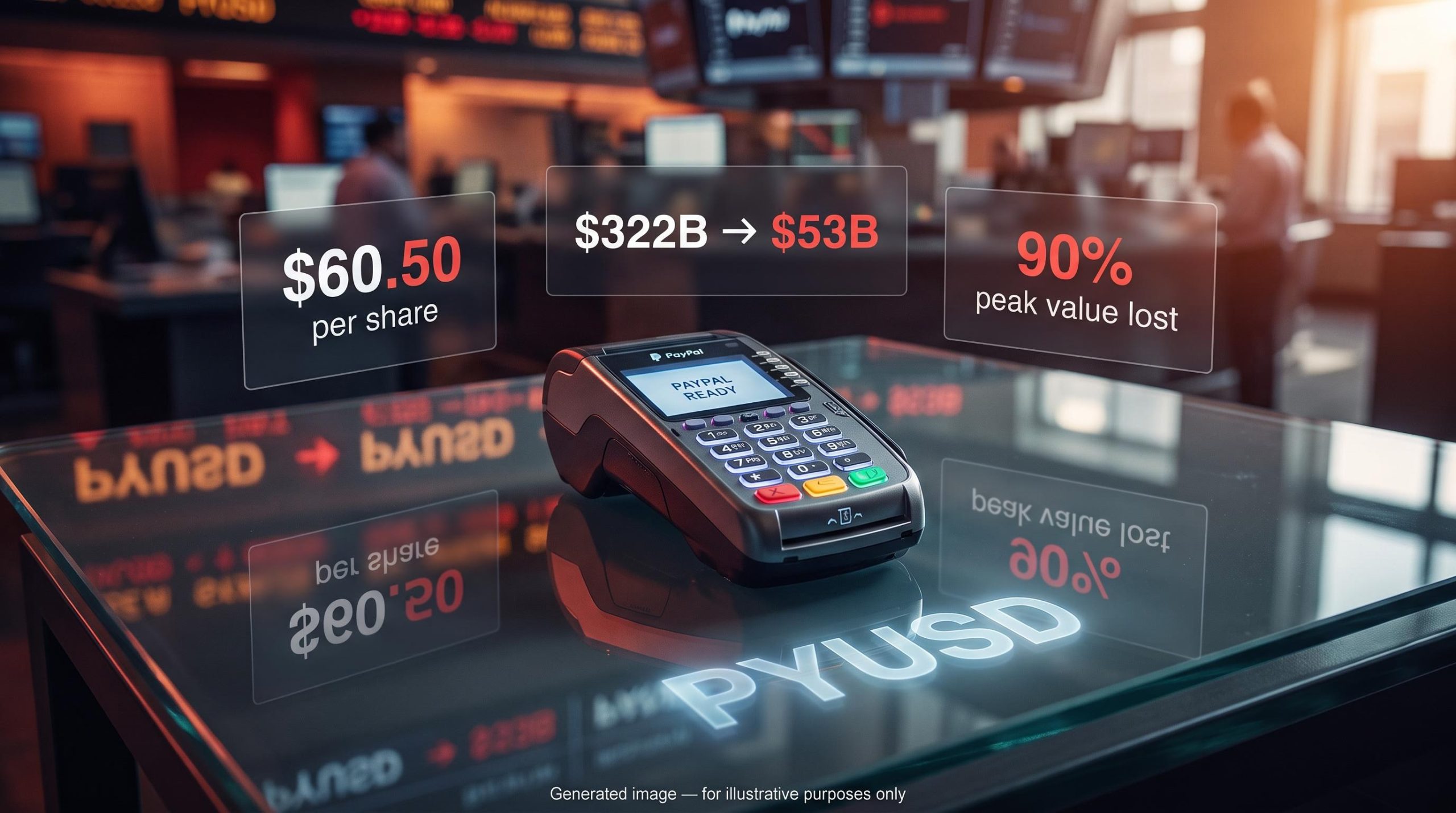
PayPal‘s market capitalisation peaked at roughly $322 billion. By the time Stripe and Advent International tabled their unsolicited offer in July 2026, that figure had collapsed to somewhere between $30 billion and $40 billion. One of the internet’s original payments giants had shed more than 90% of its peak value, enough to transform it from acquirer to target.
The $60.50-per-share all-cash bid, with Block participating in the equity financing pool, values PayPal at just over $53 billion. It remains unsolicited and unaccepted. But its existence forces a question that extends well beyond a single transaction: is this an opportunistic grab at a beaten-down stock, or is it the most visible example of a broader thesis about what happens when AI-native operators start buying first-generation internet businesses?
Here is the deal structure, the strategic logic behind combining Stripe’s merchant rails with PayPal’s consumer wallet, and a repeatable framework for identifying which other legacy internet platforms may be next.
What the Stripe and Advent offer actually says about PayPal’s value
The arithmetic is straightforward. Stripe and Advent International have offered $60.50 per share in cash, implying a total valuation of just over $53 billion. That represents a 28-30% premium to PayPal‘s prior closing price of approximately $47-$47.37.
The financing behind the bid is split across two pools: roughly $50 billion in committed bank financing and approximately $17 billion in equity contributed by Stripe, Advent, and Block combined. Block‘s role is as an equity financing participant, not a formal co-acquirer with governance rights. Post-deal, Stripe and Advent would each hold approximately 50% of PayPal.
| Metric | Figure |
|---|---|
| Offer price | $60.50 per share (all-cash) |
| Implied valuation | Just over $53 billion |
| Premium to prior close | 28-30% |
| Bank financing | Approximately $50 billion |
| Equity (Stripe, Advent, Block) | Approximately $17 billion |
| Post-deal ownership | ~50% Stripe / ~50% Advent |
The board’s response
PayPal‘s board has not accepted the offer. It has characterised the bid as undervaluing the company and flagged both regulatory and financing risks. No signed merger agreement exists as of July 2026.
The gap between a $322 billion peak and a $53 billion acquisition bid tells you something specific: the market had already written off PayPal‘s operational prospects. The bid is a direct bet against that consensus.
When big ASX news breaks, our subscribers know first
Why combining Stripe’s rails with PayPal’s wallet changes the competitive equation
The strategic case builds across three layers, each reinforcing the others.
On the merchant side, Stripe brings infrastructure that powers payments for developers and businesses at scale. On the consumer side, PayPal brings 400 million-plus active accounts, the kind of wallet distribution that no payments company can build from scratch in less than a decade. Combining both creates meaningful presence on each side of a very large number of transactions.
The third layer is where the longer-term value sits. Stripe‘s 2025 acquisition of Bridge, a stablecoin infrastructure and fiat on/off-ramp platform, for approximately $1.1 billion gives it the technical plumbing for cross-border settlement outside card rails. PayPal‘s PYUSD stablecoin carries approximately $2.9 billion in supply distributed across its consumer base, the largest consumer stablecoin footprint of any existing operator. Combine Bridge’s infrastructure with PYUSD’s distribution and you have the foundation for a settlement network that does not yet exist at scale anywhere else.
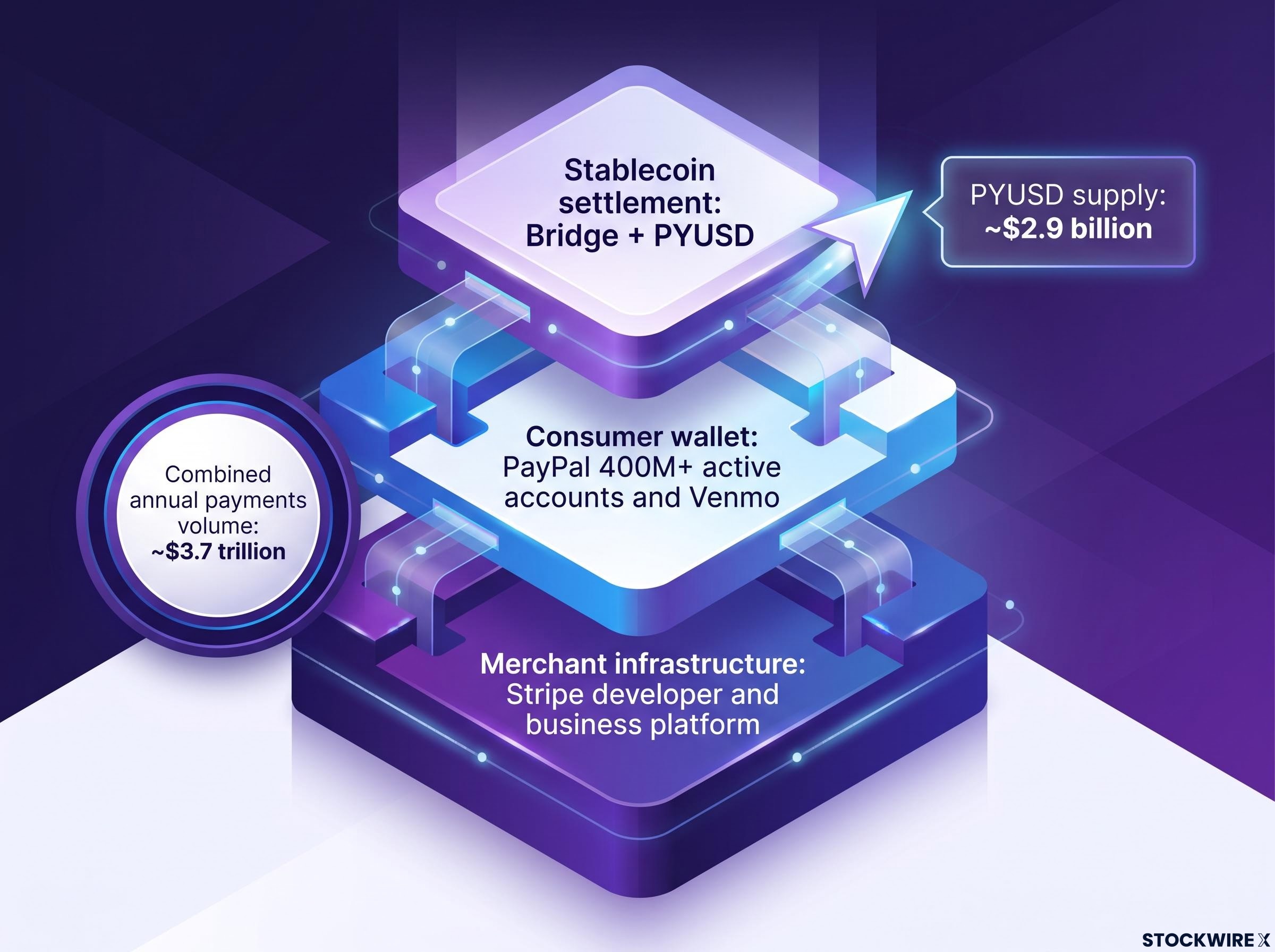
The strategic layers break down as follows:
- Merchant infrastructure: Stripe’s developer and business payments platform
- Consumer wallet: PayPal’s 400M+ active accounts and Venmo
- Stablecoin settlement: Bridge (Stripe) plus PYUSD (PayPal) creating a full-stack cross-border settlement capability
Combined annual payments volume across Stripe and PayPal reaches approximately $3.7 trillion, according to TechSpot, giving the merged entity scale to route more transactions off Visa and Mastercard rails.
Commentators have noted that this combined volume could meaningfully reduce dependence on card network fees and capture more revenue per transaction. That framing is analyst commentary rather than a stated acquirer objective, but the arithmetic behind it is real. For investors evaluating the bid premium, the stablecoin layer is where the deal’s long-term upside sits: PYUSD distributed across 400 million accounts plus Bridge‘s infrastructure is a settlement capability the market has not yet priced.
How AI-driven operators are targeting stalled legacy digital businesses
Before evaluating whether the PayPal bid is fairly priced, it helps to understand what kind of acquisition this is. A pattern is forming, and the Stripe–Advent offer fits it precisely.
AI-native operators and capital providers are targeting mature, founder-absent digital businesses with durable assets but suppressed valuations. The operational thesis: acquire these platforms, restructure costs aggressively using AI-driven efficiencies, and revitalise products that current management has left largely untouched.
The broader legacy software repricing triggered by AI disruption is the macro condition that created this acquisition opportunity: $2 trillion in enterprise value was destroyed across headcount-dependent platforms in early 2026 as capital migrated toward consumption-based and AI-native models, compressing valuations across the exact category of first-generation internet businesses the Stripe-Advent thesis targets.
Three diagnostic criteria define whether a business fits this category:
- Founder absence: The company is no longer run by its founder or founding team, and operational intensity has declined as a result.
- Product stagnation: The core product is largely unchanged from its original design, and the company has not meaningfully adopted AI tooling for product development, operations, or customer experience.
- Valuation disconnection: The market capitalisation has collapsed relative to peak while underlying assets (user base, brand, infrastructure) remain intact.
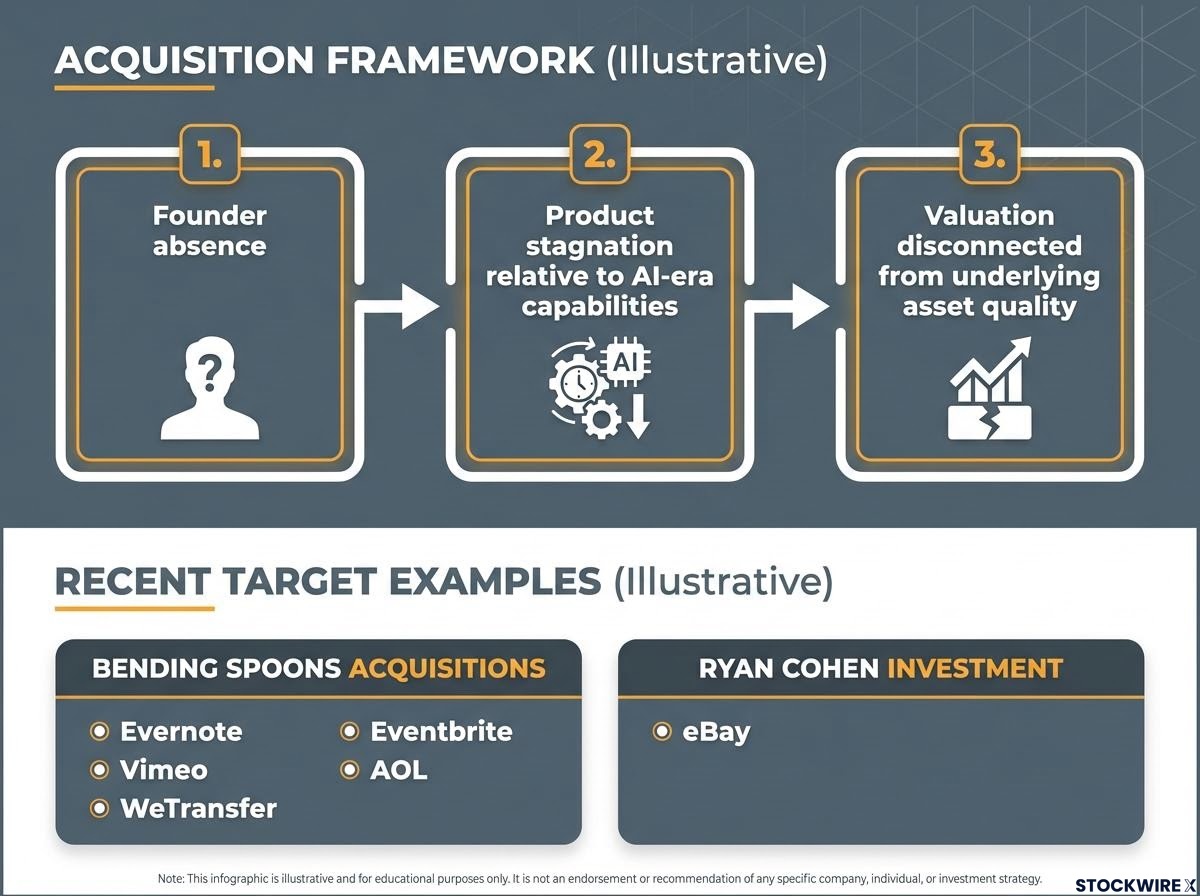
Milan-based Bending Spoons has already built a track record executing this model. It has assembled a portfolio spanning Evernote, Vimeo, WeTransfer, Eventbrite, and AOL, each a first-generation internet platform that it acquired and then restructured operationally. The reported interest from Ryan Cohen in eBay indicates that this playbook is no longer the preserve of one operator.
Ryan Cohen’s reported eBay pursuit follows the same diagnostic logic: eBay satisfies the founder-absence and product-stagnation criteria, and Cohen’s compensation structure, tied to GameStop reaching a $100 billion market capitalisation, gives him a personal financial imperative to complete a transformational deal rather than simply explore one.
Applying the framework to PayPal’s specific profile
PayPal satisfies all three criteria. Annual revenue growth has slowed to approximately 7%. The core product has changed relatively little since it was built, with observers noting it bears a strong resemblance to what existed roughly two and a half decades ago. And founder leadership has been absent for years while the valuation fell from $322 billion to below $40 billion.
Stripe‘s existing work on agentic payments, machine-driven checkout flows built on programmable infrastructure and shared payment tokens, is the operational intervention the acquirer brings to the table. This is not a financial engineering exercise. It is a bet that AI-forward management can extract value that current operations have left on the table.
If you can name those three criteria from memory, you have a functional filter for evaluating the next rumoured acquisition of a legacy internet company before the bid arrives.
What the antitrust environment means for deal probability
The regulatory question facing this deal is structurally different from a standard horizontal consolidation, and the outcome turns on a single variable: how regulators define the relevant market.
Two framings compete:
- Consolidation within payments: If the relevant market is defined as digital payments broadly, combining Stripe and PayPal concentrates two large competitors and raises standard antitrust concerns about reduced competition.
- New competitor to the card duopoly: If the relevant market is defined as payments infrastructure dominated by Visa and Mastercard, the combined entity can be framed as a new challenger to an entrenched duopoly, routing more transactions off card rails in a way that benefits merchants and consumers.
Whether regulators conclude the deal is pro-competitive or anti-competitive will hinge entirely on how they draw the boundaries of the relevant market. No public regulatory analysis has yet defined the relevant market or labelled this deal as pro-competitive.
Antitrust market definition has already proven consequential in the Alphabet search case, where regulators drew boundaries narrowly enough to force structural remedies; the same definitional exercise applied to digital payments could produce outcomes that cut either for or against the Stripe-Advent combination, depending on whether authorities treat Visa and Mastercard as the primary incumbents.
Commentators and deal participants have flagged a more permissive M&A environment following the change in US administration as a factor enabling deal activity that faced greater constraint under prior FTC leadership. That is participant commentary rather than an official regulatory determination, but it shapes how both sides are likely to approach the process.
For investors tracking deal completion probability, the regulatory framing is as important as the premium. The deal’s financial terms are only relevant if the transaction is permitted to close.
How to evaluate the bid premium and what comes next
PayPal‘s board rejection carries analytical weight rather than representing a reflexive defensive move. The board’s claim that the offer undervalues the business rests on a specific argument: that Venmo, Braintree, and PYUSD, preserved as a unified asset base under the proposed structure, justify a price above $60.50.
Commentators close to the situation have pointed to a potential clearing price of around $70 per share. That number reflects investor opinion rather than a consensus derived from formal valuation work, and it is better read as one marker in a range of fair-value views than as a figure with independent analytical backing.
The post-deal structure is relevant here. Stripe and Advent have indicated they plan to keep PayPal whole, with no immediate move to break up its subsidiaries. When an acquirer commits to preserving the full asset base, it is signalling a long-term integration thesis rather than an asset-stripping exercise. For investors thinking about the premium, this means any revised offer will need to reflect the option value embedded in PYUSD at scale, something the current market price has not captured.
| Valuation anchor | Price / value | Status |
|---|---|---|
| Prior close | ~$47 | Market price |
| Current offer | $60.50 | Confirmed bid |
| Speculative clearing price | ~$70 | Investor commentary |
| Peak market cap | ~$322 billion | Historical reference |
No competing bid has been confirmed as of July 2026.
What this deal pattern signals for investors beyond PayPal
The PayPal bid is the most prominent current example of a thesis that extends well beyond a single company. The combination of stalled founder-absent businesses, available AI tooling, and a more permissive M&A environment creates a distinct category of legacy internet platforms worth monitoring.
The three variables that define whether a specific legacy internet business is a credible candidate for this kind of acquisition:
- Founder absence: No founding-era leadership driving product iteration
- Product stagnation relative to AI-era capabilities: The core product is functionally the same as it was years ago, and AI-driven improvements have not been adopted
- Valuation disconnected from underlying asset quality: Market cap has collapsed while user base, brand, and infrastructure remain intact
The acquisitions carried out by Bending Spoons across Evernote, Vimeo, WeTransfer, Eventbrite, and AOL demonstrate that the operational model is executable in practice. Ryan Cohen‘s reported pursuit of eBay shows the approach is spreading to other buyers. The pattern has moved beyond a single data point, though it is still taking shape rather than fully established.
The limits of the thesis to watch for
Two failure modes deserve attention. The first is overpaying for stale assets in the absence of a genuine operational edge; not every AI-forward acquirer has the infrastructure expertise to revitalise a payments platform or a productivity tool. The second is regulatory risk where market definition cuts against the acquirer, exactly the open question facing the Stripe–Advent bid right now.
The practical takeaway is not a buy or sell signal on PayPal specifically. It is a screening lens: investors who can identify the next candidate in this category before the bid emerges are the ones who capture the premium rather than react to it.
The variables that will determine whether this bid becomes a deal
Three live variables will shape whether this offer becomes a completed transaction:
- Board acceptance at a revised premium: The current offer of $60.50 sits below what the board believes the intact asset base, including Venmo, Braintree, and PYUSD, is worth, leaving meaningful room for further negotiation. Those following the deal have suggested a negotiated price somewhere in the $65-$70 range is conceivable, though any such figure is speculative at this stage.
- Regulatory market definition: How authorities choose to characterise the combination, whether as a consolidation of payments rivals or as the creation of a new challenger to the Visa–Mastercard duopoly, will be the central factor in whether the deal survives regulatory scrutiny.
- Financing execution at scale: Assembling roughly $50 billion in committed bank debt alongside approximately $17 billion in equity represents a capital raise of considerable size, and the execution risks that come with a transaction of this magnitude should not be underestimated.
The leveraged financing environment shapes how credible the $50 billion bank debt commitment actually is: Q2 2026 bank results showed strong fee income and healthy capital ratios across major US institutions, conditions that support large acquisition financing packages but also mean banks will scrutinise deal structure more carefully on a transaction of this size.
Any revised offer figure is the single most important data point to watch. It will signal whether Stripe and Advent have absorbed the board’s valuation of PYUSD‘s option value or whether the two sides remain far apart.
PayPal‘s decline from a $322 billion peak to a sub-$55 billion takeover candidate is the underlying condition that makes this offer possible. What remains to be seen is whether Stripe and Advent have arrived at the right price to bring it back.
This article is for informational purposes only and should not be considered financial advice. Investors should conduct their own research and consult with financial professionals before making investment decisions. These statements regarding deal outcomes, regulatory framings, and potential bid revisions are speculative and subject to change based on market developments and company performance.