

EMVision’s AI stroke-detection methods earn Nature-portfolio validation
EMVision Medical Devices (ASX:EMV) has confirmed that its ‘EMView’ study, built on the emu™ radio-frequency (RF) brain scanning platform and proprietary deep-learning models, has been published in npj Digital Medicine, part of the Nature portfolio and recognised as one of the world’s highest-impact digital health journals.
The publication delivers independent, peer-reviewed validation of results previously announced to the market and reports new scientific insight into the dielectric behaviour of brain tissue across stroke types. The performance figures referenced were originally reported in May 2025 and November 2024.
The paper, titled “Portable RF brain scanner enables deep-learning-based stroke type detection and ordering of brain-event dielectric permittivity” (Khandan, Xu et al 2026), provides external credibility to the AI foundations underpinning the emu™ Brain Scanner and has generated new intellectual property in the process.
When big ASX news breaks, our subscribers know first
What the peer-reviewed study confirmed
Drawing on data from the EMView study and EMVision’s non-invasive emu™ scanner, the Company’s AI team developed deep-learning models designed to discriminate between the two principal types of stroke.
To address the constraints of working with a limited dataset, the team applied masked-autoencoder-based self-supervised learning and supervised contrastive learning. These techniques are intended to extract robust signals from smaller volumes of data.
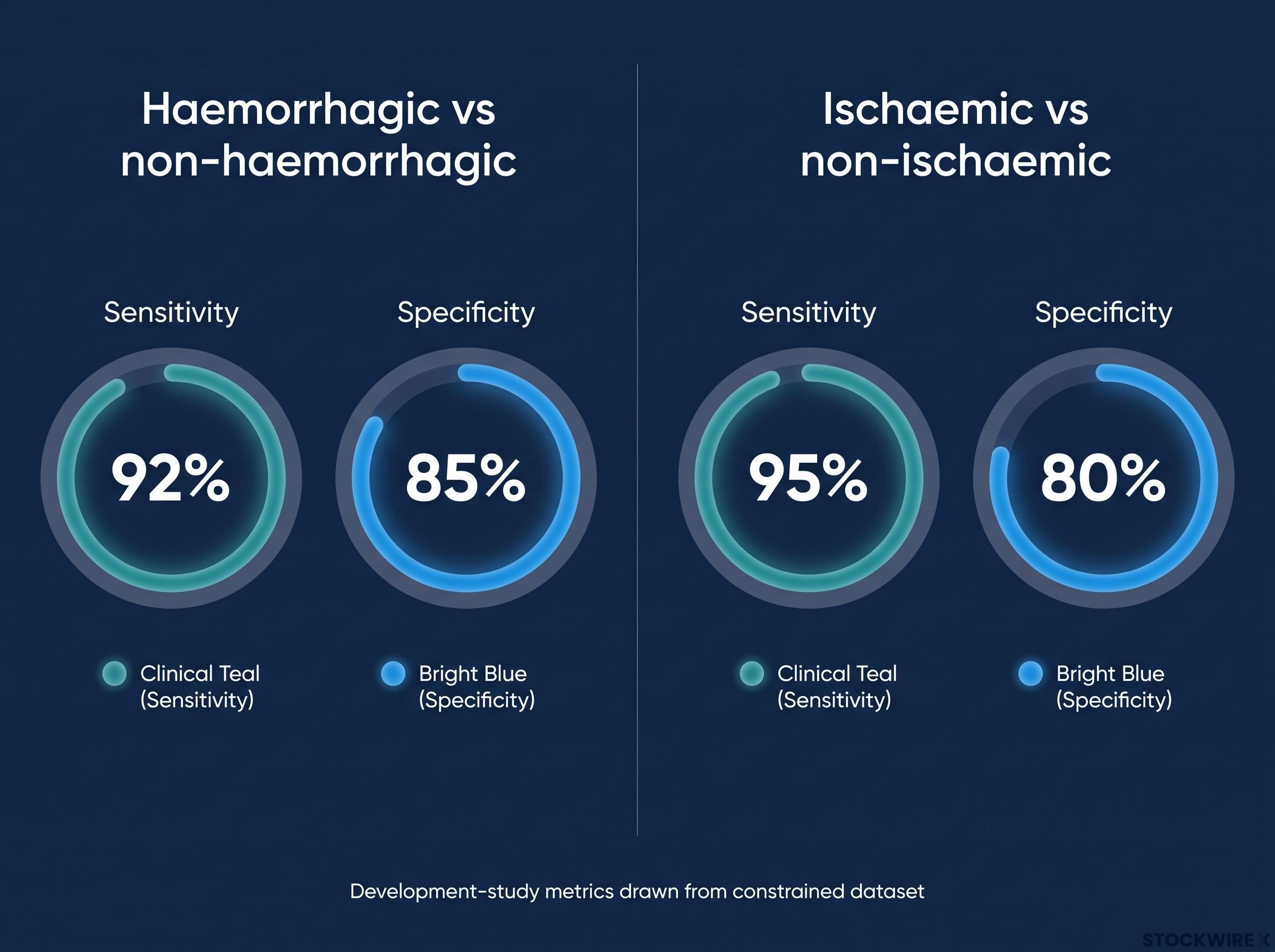
As previously reported, the reported performance of the emu™ on unseen data was as follows.
| Classification | Sensitivity | 95% CI (Sensitivity) | Specificity | 95% CI (Specificity) |
|---|---|---|---|---|
| Haemorrhagic vs non-haemorrhagic | 92% | 66.1%–98.2% | 85% | 73.8%–92.4% |
| Ischaemic vs non-ischaemic | 95% | 75.1%–99.9% | 80% | 66.3%–90% |
These are development-study metrics drawn from a constrained dataset. As the Company notes, diagnostic performance from a development study may differ from results obtained in larger, prospective, controlled clinical validation, and should not be interpreted as final clinical-trial results.
A new scientific insight into how the brain behaves during stroke
Beyond classification, the study identified a distinctive and consistent ordering of relative dielectric properties across different suspected stroke event types. Dielectric properties describe how brain tissue responds to electromagnetic signals, and the study found these varied in a repeatable pattern.
The ordering spanned four states, including differences across the stages of ischaemia:
-
Haemorrhagic (bleeding in the brain)
-
Ischaemic (including hyperacute, acute, subacute and chronic stages)
-
Stroke mimic
-
Healthy
According to EMVision, these findings challenge historic assumptions about the dielectric properties of brain tissue. The Company believes they reinforce the potential of its non-invasive technology to support faster differentiation of stroke types at the point-of-care, a critical factor given that treatment pathways for stroke subtypes differ significantly.
Understanding why stroke-type detection matters
Stroke is a medical emergency that occurs when blood flow to part of the brain is interrupted. There are two principal types: ischaemic stroke, caused by a blocked vessel, and haemorrhagic stroke, caused by bleeding into the brain.
The distinction matters because each type requires different, and sometimes opposite, treatment. Rapid and accurate differentiation is therefore vital, as delays or misclassification can affect patient outcomes.
For investors, this is the clinical problem EMVision is targeting. A portable, non-invasive point-of-care scanner capable of accelerating triage represents the commercial opportunity underpinning the Company’s product pipeline.
Why this validation strengthens the investment case
The publication connects directly to EMVision’s clinical and commercial programs, adding external credibility to work that had previously been disclosed only to the market.
Key points for investors include:
-
Independent peer-review helps de-risk the AI foundations underpinning the emu™ point-of-care Brain Scanner.
-
New intellectual property has been generated, with a patent application filed, further strengthening EMVision’s IP portfolio.
-
The self-supervised and contrastive-learning methods continue to advance through the Continuous Innovation Study.
-
The same underlying technology and algorithm pipeline supports EMVision’s second-generation, ultra-portable First Responder Brain Scanner, designed for pre-hospital use via road and air ambulances.
CEO and Co-Founder Scott Kirkland noted that the same validated approach is being advanced through the Company’s pivotal trial, though no trial results or status details were disclosed in the announcement.
The pivotal trial site network now spans eight hospitals across the United States and Australia, with the trial targeting more than 300 participants to demonstrate the haemorrhage detection accuracy required for FDA De Novo clearance.
CEO and Co-Founder, Scott Kirkland
“Peer-reviewed publication in a respected Nature portfolio journal is meaningful external validation of the AI methods that form the core of our brain scanning platform. Encouragingly, this work reinforces the same approach we are now advancing through our pivotal trial. I want to recognise our team and collaborators, whose work has not only advanced our diagnostic algorithms but uncovered genuinely new insight into how brain tissue behaves across different stroke types, which deepens our understanding of what our novel scanners detect.”
What comes next for EMVision
The validated methods now feed into two active pathways: the ongoing Continuous Innovation Study and the Company’s pivotal trial. No new timelines, dates or trial milestones were disclosed in this announcement.
The emu pivotal trial expansion to include acute ischaemia detection builds directly on the AI classification methods validated in this publication, extending the same deep-learning pipeline to cover approximately 80% of all stroke presentations rather than haemorrhagic cases alone.
The strategic thread is clear. Peer-reviewed validation combined with newly filed intellectual property reinforces the credibility of EMVision’s point-of-care stroke-detection platform as it progresses toward broader clinical validation.
Don’t Miss the Next Healthcare Breakthrough on ASX
Big News Blast delivers FREE breaking ASX healthcare news directly to your inbox within minutes of release, complete with in-depth analysis already done for you. Join 20,000+ investors who never miss a market-moving moment. Click the “Free Alerts” button at StockWire X to start receiving alerts the moment news breaks.