


Immutep posts 30.9-month survival data in first-line lung cancer as it probes failed Phase III
Immutep (ASX: IMM; NASDAQ: IMMP) has reported mature median Overall Survival (mOS) of 30.9 months from its investigator-initiated INSIGHT-003 Phase I trial in first-line non-squamous non-small cell lung cancer (1L NSCLC).
The update, released on 13 July 2026, carries a dual message. Alongside the strong survival signal, the biotechnology company confirmed that its root cause analysis of the discontinued TACTI-004 Phase III trial remains ongoing.
In the INSIGHT-003 trial, eftilagimod alfa (efti) is combined with MSD’s anti-PD-1 therapy KEYTRUDA® (pembrolizumab) and chemotherapy in 51 evaluable non-squamous patients.
When big ASX news breaks, our subscribers know first
Strong survival signal from INSIGHT-003
With a minimum of 30 months of follow-up and a data cutoff of 27 March 2026, the trial recorded a mature mOS of 30.9 months in the overall population (N=51), regardless of PD-L1 expression. The same 30.9 months was observed in patients with a Tumour Proportion Score (TPS) below 50% (N=47), while those with TPS ≥50% (N=4) reached 37.8 months.
Roughly 92% of enrolled patients had no or low PD-L1 expression (TPS <50%), a group in which PD-L1 inhibitor-based therapies typically perform suboptimally and where unmet medical need remains high.
These results continue to compare favourably with a 22.0-month mOS benchmark drawn from a registrational trial of anti-PD-1 plus doublet chemotherapy in the same setting. Notably, TPS <50% patients were overrepresented in INSIGHT-003 relative to that benchmark, at approximately 92% versus 68%. No new safety signal was identified since the previous data cutoff.
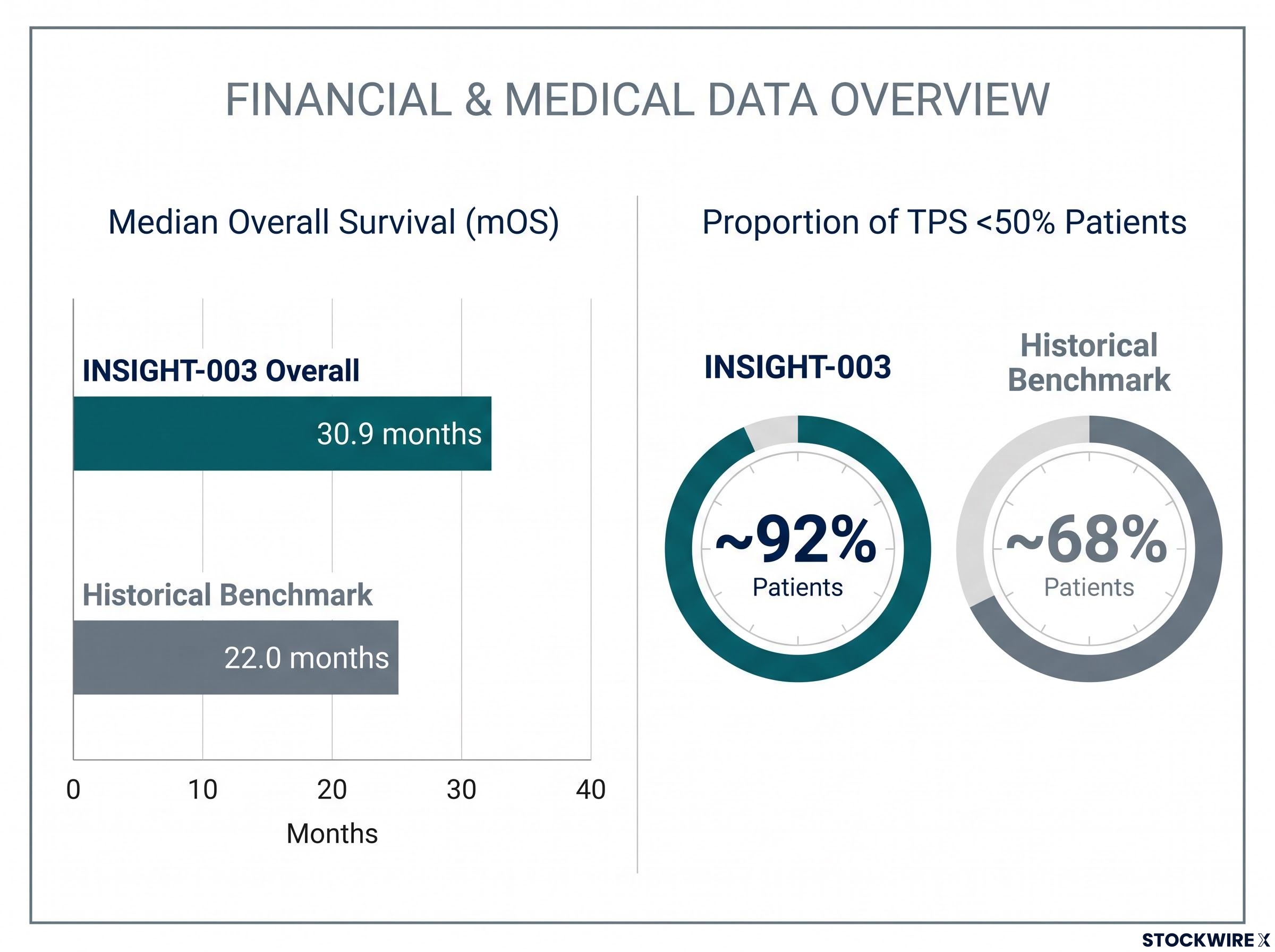
| Metric | INSIGHT-003 Overall | INSIGHT-003 TPS <50% | Historical Benchmark |
|---|---|---|---|
| Median Overall Survival | 30.9 months | 30.9 months | 22.0 months |
| % TPS <50% patients | ~92% | N=47 | ~68% |
| Objective Response Rate (ORR) | 62.7% | — | — |
For investors, a survival result materially above the historical benchmark in a hard-to-treat population strengthens the differentiation case for efti, particularly where existing immunotherapies have delivered less favourable outcomes.
What the TACTI-004 root cause analysis is uncovering
In March 2026, Immutep discontinued the TACTI-004 Phase III trial in 1L NSCLC following a recommendation from the Independent Data Monitoring Committee (IDMC) after a planned interim futility analysis.
In that futility analysis (N=173), the objective response rate (ORR) in the efti arm was 42.9%, compared with 55.1% in the control arm receiving standard of care plus placebo. The efti arm did not demonstrate superiority in any TPS subgroup, and the difference was observed across both squamous and non-squamous histologies. By comparison, the ORR in INSIGHT-003 has been 62.7%, despite the high proportion of TPS <50% patients.
Preliminary immune monitoring data offer a possible explanation. Patients treated with efti in TACTI-004 exhibited a “markedly different immune activation profile” compared with previous studies, based on analyses of absolute lymphocyte counts (ALC) and circulating monocyte counts in blood.
These findings contrast with observations from almost 600 patients treated with efti across five earlier studies, presented at ASCO 2026, and also with INSIGHT-003. The earlier studies were:
Data presented at ASCO 2026 covering nearly 600 patients across five earlier studies showed that efti-induced immune activation markers correlated with improved overall survival in metastatic cancer patients, forming part of the translational evidence base now being compared against TACTI-004 immune profiles.
-
AIPAC
-
AIPAC-003
-
TACTI-mel
-
TACTI-002
-
TACTI-003
To date, no new safety signals have been observed in TACTI-004, pending a final analysis of all patients.
The differing immune profile suggests trial-specific factors, including manufacturing, may be at play. For investors weighing the forward path, that distinction is material.
How efti works and why the immune profile matters
Eftilagimod alfa (efti) is a novel immunotherapy and MHC Class II agonist. It directly activates antigen-presenting cells (APCs) such as dendritic cells and monocytes via the MHC Class II pathway to fight cancer.
By activating these cells, efti engages both the adaptive and innate immune systems. This initiates a broad anti-cancer response that includes priming and activating cytotoxic T cells (immune cells that destroy cancer cells) alongside generating co-stimulatory signals and cytokines that further support the immune system.
Efti is under evaluation across a range of solid tumours and has received FDA Fast Track designation in 1L HNSCC and 1L NSCLC. Target indications include:
Efti also holds FDA Orphan Drug Designation for soft tissue sarcoma, secured in April 2026, providing seven years of potential market exclusivity and underpinned by Phase II EFTISARC-NEO data showing tumour hyalinisation well above historical benchmarks with radiotherapy alone.
-
Non-small cell lung cancer (NSCLC)
-
Head and neck squamous cell carcinoma (HNSCC)
-
Soft tissue sarcoma
-
Breast cancer
What comes next for Immutep
Additional results from the TACTI-004 root cause analysis are expected in Q3 CY2026. That analysis covers all recruited and evaluable patients who received a minimum of 12 weeks of treatment, with the company continuing to examine a range of potential factors, including manufacturing.
Immutep is being assisted in the process by its partners, including Dr. Reddy’s and WuXi Biologics. The mature INSIGHT-003 data, meanwhile, reinforces the company’s stated confidence in efti’s development path.
Marc Voigt, CEO of Immutep
“We are encouraged by the mature overall survival data from INSIGHT-003 in 1st line non-squamous NSCLC, which continue to compare favourably with historical benchmarks, particularly given the high proportion of patients in this study with no or low PD-L1 expression. The observed median overall survival of 30.9 months especially in patients with no or low PD-L1 expression reinforces our confidence in efti’s potential to enhance anti-tumour immune responses, including in patient populations that have historically experienced less favourable outcomes. At the same time, we are completing a comprehensive root cause analysis of TACTI-004 to better understand the factors underlying the outcome of that trial and their implications for the potential future development of efti. Importantly, the differences observed in the immune activation profile between TACTI-004 and prior studies are providing valuable insights to inform our strategy as we evaluate efti’s potential path forward.”
The update presents a story of validation through INSIGHT-003 and diagnostic transparency around TACTI-004. Investors will be watching Q3 CY2026 for clarity on efti’s next development steps.
Don’t Miss the Next ASX Healthcare Breakthrough
Big News Blast delivers FREE breaking ASX healthcare news directly to your inbox within minutes of release, complete with in-depth analysis already done for you. Join 20,000+ subscribers staying ahead of market-moving announcements. Click the “Free Alerts” button at StockWire X to make sure you never miss a critical update the moment it drops.