A stock rockets 10% in a single session. A financial creator with a polished channel and a confident delivery is talking about it across every platform. Three weeks later, every point of that gain has evaporated, and the creator has moved on to the next ticker.
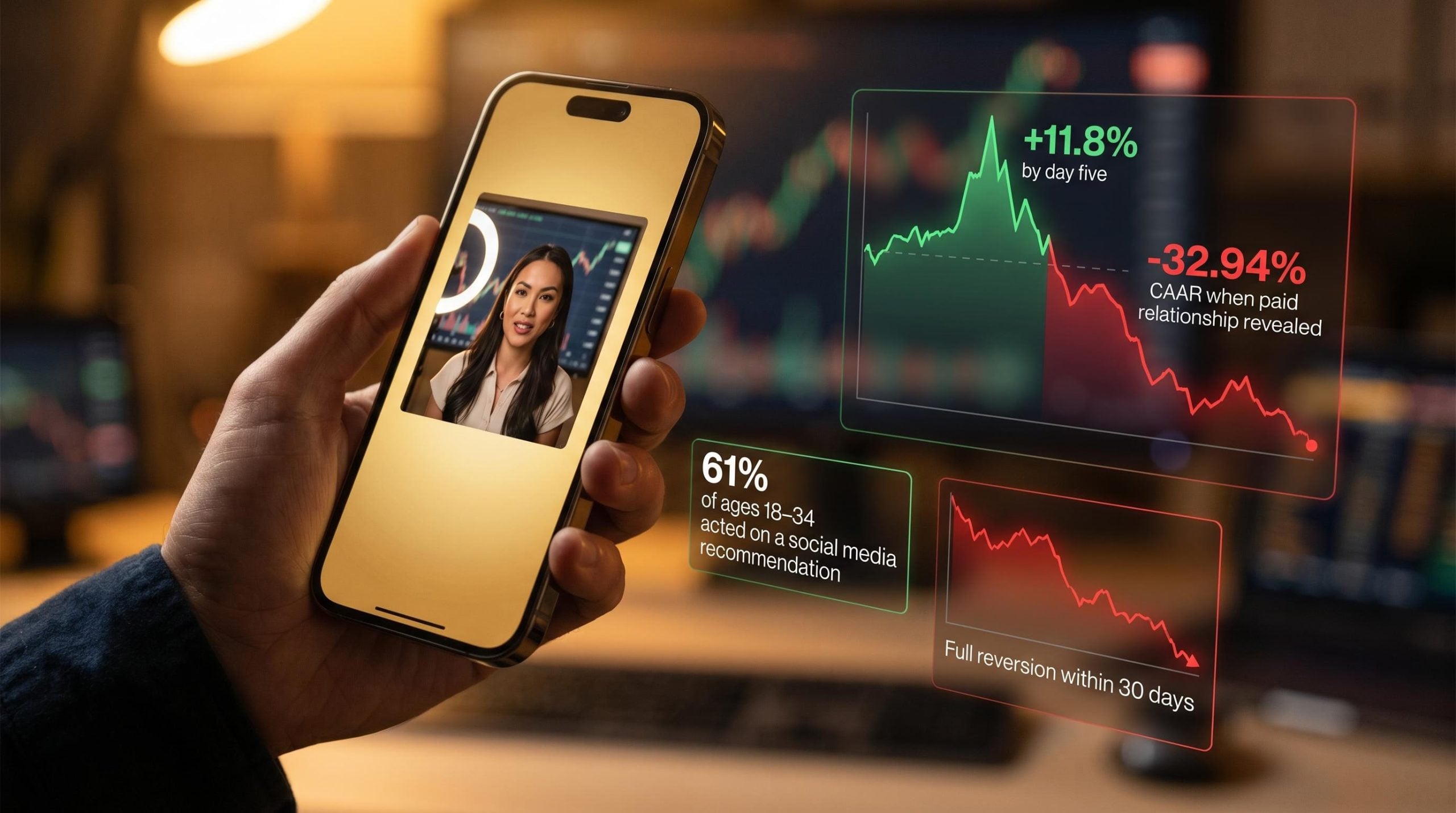
That pattern is not random, and it is not the market correcting a misunderstanding. It is engineered. According to FINRA Foundation survey data, 61% of people between the ages of 18 and 34 have acted on an investment recommendation from a social media personality. Paid stock promotion is a documented, researched phenomenon with a consistent price footprint, and the academic evidence on what happens after the promotion ends is striking in its uniformity.
Here is what you need to understand before you encounter the next one: how compensated promotions are structured, what three independent studies say happens to prices once the promotion runs its course, and exactly which filings and disclosures you can check in minutes to protect yourself. This is a practical capability, not an abstract warning.
The architecture of a paid stock promotion
Every paid promotion has three structural roles:
- The issuer or insider: the company (or its shareholders) that benefits from a rising share price and funds the campaign.
- The compensated tout: the influencer, newsletter writer, or channel operator paid in cash or shares to present the stock favourably to an audience.
- The retail audience: the viewer, follower, or subscriber who is the target of the campaign, not the client.
When compensation comes in shares, the promoter’s financial incentive is tied directly to price movement. Their interest is not your education. It is a higher exit price. That misalignment is baked into the structure from the moment the video goes live: the creator profits when you buy, and you are the last link in the chain.
These campaigns are distributed across YouTube, TikTok, Instagram, and X, with YouTube appearing to carry the greatest volume of activity. The content creators involved cover a wide range of subject areas, from personal finance and geopolitics to science, meaning their audiences are not necessarily seeking investment material and may not identify a paid promotion when they encounter one.
The same influencer promotion model is increasingly amplified by AI-generated promotional content, including deepfake celebrity endorsements and algorithmically produced scripts, which makes the surface-level credibility of video content a weaker signal of legitimacy than it has ever been.
Companies featured in these campaigns often record no revenue at all. In some cases, their expenditure on investor relations activity, including paid promotions, exceeds what they allocate to developing their actual business. The companies chosen for promotion are typically small, speculative, and thinly traded, precisely because their prices are easiest to move with coordinated attention.
Macro stories in place of financial reality
The narrative layer is where these campaigns earn their credibility. Themes like “critical minerals,” “energy transition,” or “AI infrastructure” are legitimate macroeconomic concepts. Promoters borrow them to frame companies that have no demonstrable connection to those trends.
The SEC, FINRA, and FCA all explicitly flag this tactic. Story-driven promotion built on speculative future claims rather than verifiable company performance is a primary pump-and-dump indicator. If the investment case relies entirely on a macro tailwind and never addresses revenue, cash flow, or proven assets, that substitution is deliberate.
When big ASX news breaks, our subscribers know first
What published research shows happens to prices
Three independent bodies of research, spanning different platforms, methods, and time periods, converge on the same pattern.
The most directly relevant is the study Pay to Pump by Rodrigo Leite and colleagues, published in Applied Economics Letters in 2025. YouTube-promoted stocks delivered an average return of around 7.9% on the day the content was released, climbing to roughly 11.8% over the following five days, before giving back those gains entirely by the 30-day mark. Trading volume spiked on the release day and declined thereafter.
Thierry Renault and colleagues found the same dynamic on Twitter (now X) in their EFMA working paper. Analysing millions of messages around OTC stocks, they documented large positive abnormal returns on the event day when message volume spiked, followed by sharp negative reversals over the following week, consistent with pump-and-dump dynamics rather than genuine news revaluation.
The sharpest finding comes from Massoud, Ullah, and Scholnick, published in the Journal of Financial Stability in 2016. When firms secretly paid promoters without disclosing the relationship, cumulative average abnormal returns hit +11.94% over a five-day window at the start of the promotion. When regulators later revealed the paid relationship, returns collapsed: -32.94% over a five-day window. The study also found a significant decrease in insider holdings and an increase in insider share sales during the promotion, consistent with insiders selling into the inflated price.
The -32.94% cumulative average abnormal return documented by Massoud et al. when secret promoter relationships were exposed is one of the starkest findings in the manipulation literature. That is not a tail risk. It is the average outcome when the paid relationship surfaces.
| Study | Platform / Context | Short-term return | Reversal timeline |
|---|---|---|---|
| Leite et al. (2025) | YouTube influencer promotions | +7.9% day one, +11.8% by day five | Full reversion within 30 days |
| Renault et al. (2017) | Twitter / OTC stocks | Large positive abnormal returns on event day | Sharp negative reversal within one week |
| Massoud et al. (2016) | Secretly paid promoters | +11.94% CAAR over five days | -32.94% CAAR when paid relationship revealed |
These numbers tell you precisely where you are likely to sit in the timeline when you encounter promoted content through shares or reposts. By the time the content reaches you, the initial spike may already be behind you. What remains ahead is the reversion.
A real promotion, examined
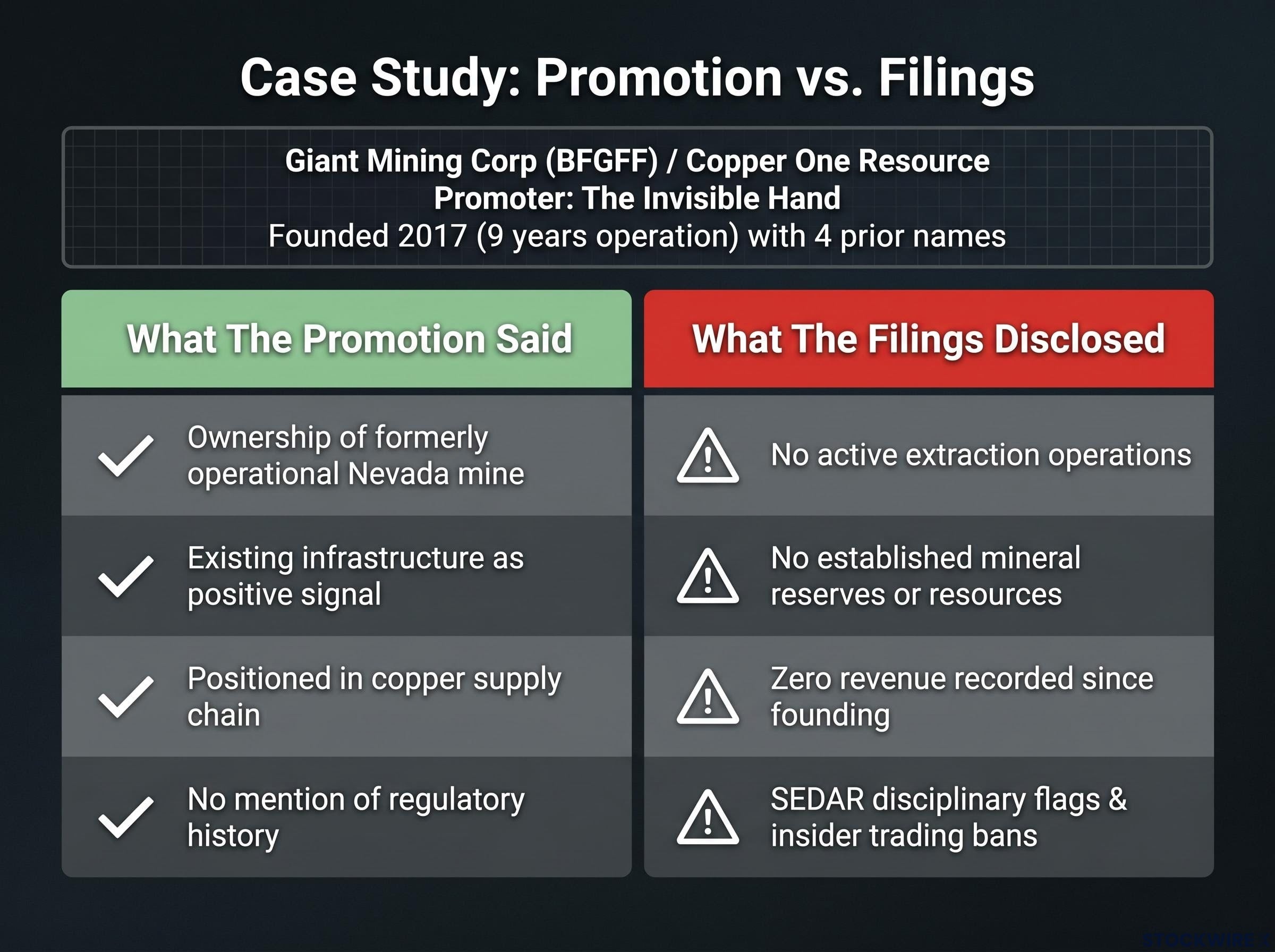
A geopolitics-focused YouTube channel called The Invisible Hand ran a paid promotion for Giant Mining Corp, trading under ticker symbol BFGFF. The company was operating under the name Copper One Resource at the time the video was published. The content highlighted rising US copper demand, pointed to the company’s ownership of a Nevada copper mine that had previously been in production, and presented the site’s existing physical infrastructure as a meaningful advantage for investors.
The macro framing was credible enough on its surface. Copper demand is genuinely increasing. But the company’s own regulatory filings told a different story.
What the filings actually contained
| What the promotion said | What the filings disclosed |
|---|---|
| Ownership of a formerly operational Nevada mine | No active extraction operations at the site |
| Existing infrastructure as a positive signal | No established mineral reserves, mineral resources, or economically extractable ore body confirmed |
| Company positioned in copper supply chain | Zero revenue recorded since founding in 2017, approximately nine years of operation |
| No mention of regulatory history | SEDAR profile included disciplinary action flags for false or misleading statements, with prior trading bans on certain insiders |
By the time this promotion ran, Copper One Resource had already gone through four prior names since the company was incorporated. That detail alone, repeated rebranding paired with no revenue across roughly nine years, is one of the clearest signals that a company’s primary activity is marketing its stock rather than building a business.
Repeated rebranding is one of several observable behaviours that professional investors use to assess small-cap management quality, alongside insider share sales, capital raise timing, and the gap between public statements and filed financial outcomes.
SEDAR is Canada’s regulatory filing system, equivalent in function to EDGAR in the United States. Checking a company’s filing profile for disciplinary flags, going-concern disclosures, name change histories, and insider trading data takes minutes. Every piece of information the promotion chose to omit was publicly available. Your protection in situations like this is knowing where to look, not trusting the presenter to be complete.
Why these promotions work on the people they target
The FINRA Foundation finding is worth pausing on.
FINRA data shows that 61% of people aged 18-34 have made an investment decision on the back of a social media personality’s recommendation. For those aged 55 or older, the equivalent figure is around 6%. When measured across all survey respondents, the share was 26%.
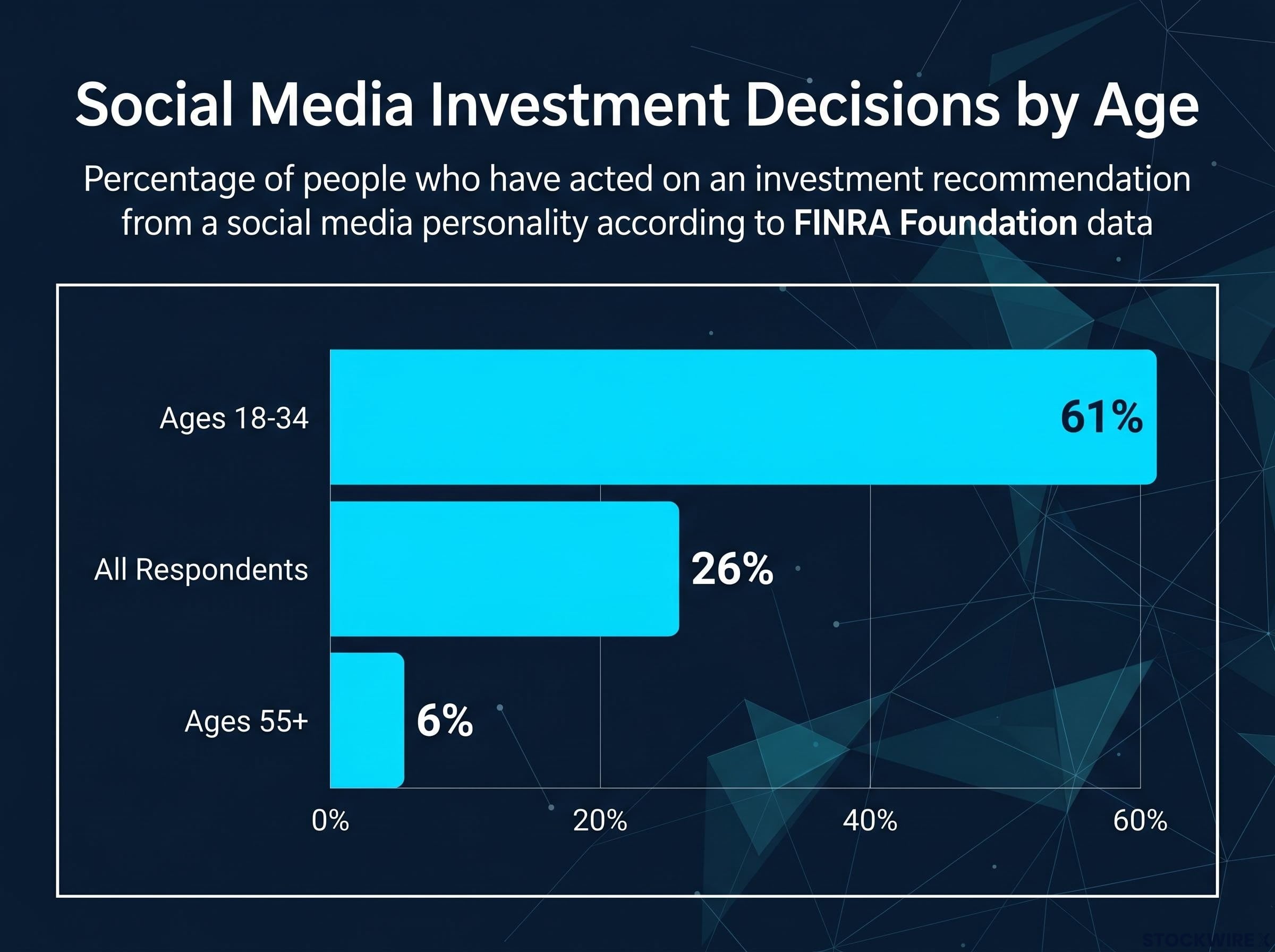
That generational gap is not a coincidence. Younger investors are more likely to encounter investment content on social media, more likely to trust creator-driven media formats, and, according to research, more susceptible to persuasive high-return narratives when under financial stress.
The FINRA Foundation survey research published in April 2026 confirmed that 61% of investors aged 18-34 had made an investment decision based on a social media personality’s recommendation, compared with roughly 6% of those aged 55 or older, a gap that reflects both platform usage patterns and differences in trust toward creator-driven media formats.
Promotional content deliberately engineers fear of missing out. FINRA has identified three specific tactics used in these campaigns:
- Urgency language: framing the opportunity as time-sensitive, with “act now” pressure and implied scarcity.
- Exclusivity framing: positioning the recommendation as insider-level insight available only to followers of a particular channel or group.
- Encrypted group pressure: using private group chats and “investment clubs” to create social proof and consensus around a position, making dissent feel like missing the crowd.
Research shows that individuals experiencing financial hardship are more likely to engage with narratives promising high returns, and promotional content is frequently framed as a direct answer to that kind of pressure. A poor decision to buy a consumer product carries limited consequences, but a harmful investment can erode savings that took years to build, making the potential damage in an entirely different category.
The boundary between commentary and licensed financial advice is rarely made clear by creators, and regulators in multiple jurisdictions have now confirmed that most social media investment content carries no legal obligation to be accurate or suitable for any individual viewer.
The targeting of this content toward younger, financially stressed audiences is a design feature, not a side effect. Understanding this reframes the “opportunity” framing of promotions as the mechanism of harm, not the promise of benefit.
Six signals that a social media stock tip is a paid promotion
- Narrative without fundamentals. The investment case relies entirely on a macro trend (critical minerals, AI infrastructure, reshoring) with no discussion of revenue, profits, cash flow, or audited results. The FCA, SEC, and FINRA all advise caution when price movements are not supported by verifiable fundamental news.
- Unclear or downplayed compensation. The SEC requires promoters compensated to tout a security to disclose that compensation, but disclosures are often buried or vaguely worded. Massoud et al. found that undisclosed compensation is associated with +11.94% short-term gains that reverse to -32.94% when the paid relationship surfaces.
The FCA finalised guidance on financial promotions published in March 2024 sets out explicit requirements for firms and influencers communicating investment content on social media, including mandatory risk warnings and clear identification of paid relationships, extending these obligations to affiliate arrangements with finfluencers operating across platforms.
- Low-priced, thinly traded securities. Pump-and-dump schemes predominantly target microcap and penny stocks with limited disclosure and low liquidity. Sudden spikes in volume and price in such names, especially following coordinated social media activity, are a primary warning sign.
Signals that require checking public records
- Multiple name changes and promotional cycles. Repeated rebranding with no corresponding operational progress. Giant Mining Corp had accumulated four prior names before its most recent rebrand, all without generating any revenue across roughly nine years since founding, which reflects a pattern seen across many promoted companies.
- Going-concern warnings and regulatory flags in filings. Certain promoted companies have included disclosures in their filings acknowledging material doubt about whether the business can continue operating. Filing profiles on regulatory platforms may also carry flags recording prior violations or disciplinary proceedings. These disclosures are almost never mentioned in promotional content.
- The price is already spiking when you encounter the content. Research from Leite et al. shows that most abnormal positive return is concentrated on the day of promotion. If you are seeing the content days later through shares or reposts, the evidence says you are likely entering near the temporary peak, with the documented reversion still ahead.
You can find insider trading filings on EDGAR (Form 4 in the US) or SEDI in Canada. Going-concern disclosures sit in the auditor opinion section of a company’s annual report. Disciplinary flags appear on SEDAR in Canada, EDGAR in the US, and Companies House in the UK. Compensation disclosures, when they exist, appear in the video description or in filing exhibits.
Each of these signals is independently available in public records or observable in the content itself. Acting on a social media stock recommendation without running this checklist is an avoidable risk.
What the documented pattern means before you act on the next recommendation
Across Leite et al. (2025), Renault et al. (2017), and Massoud et al. (2016), the evidence points in one direction: an initial price rise in the range of roughly 7.9-11.94% depending on the study and measurement window, which then gives back those gains entirely within 30 days on average, with steeper declines when undisclosed paid relationships are later uncovered. Insiders profit by selling into inflated prices. Retail buyers who entered based on the promotion absorb the losses.
This is not a tail risk or a worst-case scenario. It is the average outcome across multiple studies, platforms, and time periods. Independent tracking of more than 100 pieces of paid promotional content points to this activity continuing at meaningful scale.
Scepticism toward aggressively promoted stocks is not pessimism. It is the rational response to a documented pattern. Before acting on any social media stock recommendation, these are the minimum verification steps:
- Check revenue and cash flow in the company’s regulatory filings. Zero revenue over multiple years is a signal, not an oversight.
- Search for going-concern language in the auditor opinion section of the annual report.
- Look for compensation disclosure in the video description and in filing exhibits.
- Check insider trading records on EDGAR, SEDI, or the relevant jurisdiction’s equivalent.
The research does not say promoted stocks sometimes underperform. It says the average outcome for retail buyers who enter based on promotions is negative. Verifying before acting is not optional caution. It is basic self-protection.
For readers ready to build a systematic process for evaluating promoted names before committing capital, our comprehensive walkthrough of small-cap stock research covers how to read primary source documents, filter promotional noise from credible analysis, and stress-test an investment thesis from the ground up.
This article is for informational purposes only and should not be considered financial advice. Investors should conduct their own research and consult with financial professionals before making investment decisions.