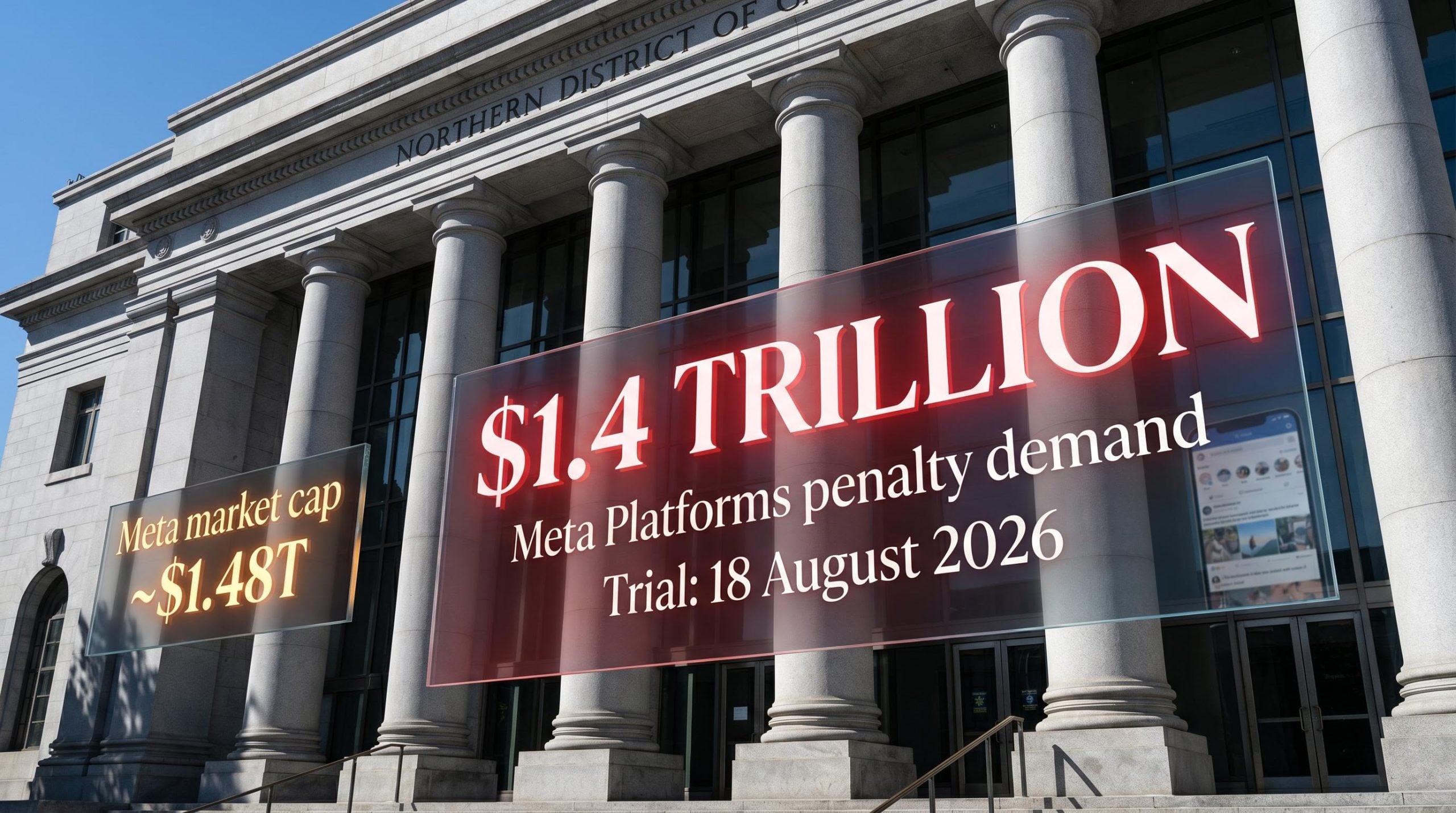
Four state attorneys general in the US are pursuing penalties of up to $1.4 trillion against Meta Platforms, claiming that Facebook and Instagram were built in ways that hooked minors on their platforms. That figure sits within striking distance of Meta’s entire market capitalisation, which stood at roughly $1.48 to $1.52 trillion in early July 2026.
The demand was disclosed publicly on 6 July 2026, when Meta revealed the number in a court filing responding to penalty calculations that California, Colorado, Kentucky, and New Jersey had outlined at a June 2026 hearing. Trial is scheduled for 18 August 2026 in the Northern District of California. This is not a historical footnote or a settled matter. It is a live case with a court date six weeks away.
Here is what the demand actually tells you about Meta’s legal and financial position heading into August, and why the headline number, while extraordinary, is not a realistic forecast of what the company will pay.
Four states are seeking a penalty that would nearly erase Meta’s entire market value
The four plaintiff states contend that Meta built Facebook and Instagram with deliberate design choices aimed at holding the attention of young users in ways that caused addiction-like harm, and that the company gave the public and regulators a false picture of how safe its platforms were. The core claims include violations of the Children’s Online Privacy Protection Act (COPPA), the federal law governing how companies collect data from children under 13, as well as state consumer protection statutes.
The FTC’s COPPA framework governs how companies collect, use, and disclose personal information from children under 13, and its provisions form a central pillar of the states’ case against Meta alongside state consumer protection statutes.
The states bringing the case:
- California
- Colorado
- Kentucky
- New Jersey
Each contends that the platforms were built to maximise the time young users spent on them in harmful ways, and that Meta concealed what it knew about those risks from the public.
The $1.4 trillion figure is the theoretical statutory maximum the states assert is available under their combined statutes. It is not a projected or expected award. Meta’s market capitalisation at the time of disclosure, approximately $1.48 to $1.52 trillion, provides the scale comparison that makes the number extraordinary: if awarded in full, the penalty would nearly erase the company’s entire market value.
“A sanction of that size has no analog in the history of consumer protection enforcement.” — Meta Platforms, court filing, 6 July 2026
That comparison tells you how unprecedented this claim is in dollar terms. It does not tell you what a court is likely to award, and the distinction between a statutory ceiling and a probable outcome is where the real analysis begins.
When big ASX news breaks, our subscribers know first
How the states reached $1.4 trillion: a per-violation multiplication methodology
At a June 2026 court hearing in the Northern District of California, the states described how they arrived at the figure. The states said their approach takes the estimated number of young users who were affected by Meta‘s conduct and applies per-violation fine amounts defined in state law, with the count of violations derived from that affected-user population. Aggregate those across four states and a large user population, and the sum scales rapidly.
The specific statutory provisions, per-user fine amounts, and multipliers remain under seal. The states’ penalty filings have not been made public, so the precise arithmetic behind $1.4 trillion cannot be independently verified from available docket materials. That gap matters: without access to the underlying assumptions, neither investors nor analysts can assess whether the figure is a defensible aggregate of statutory penalties or an extreme construction designed to establish a negotiating ceiling.
Why the statutory maximum is not the expected outcome
Courts, including the US Supreme Court, have established due process limits on damages that are grossly disproportionate to actual harm. Appellate review of outlier statutory penalty aggregates routinely results in substantial reductions. The $1.4 trillion figure represents the theoretical ceiling of the states’ legal theory; the expected outcome in litigation of this scale and complexity is typically far lower.
What Meta is actually being accused of, and why the addiction argument is contested
At the heart of the case is the claim that Meta deliberately engineered platform features to hold the attention of young users and that the resulting harm resembled addiction, while the company withheld or distorted the truth about those effects from regulators and the public. The states’ legal theory treats platform design choices (infinite scroll, algorithmic content recommendations, notification systems) as features that were optimised for young users in ways that caused measurable harm.
Meta’s defence challenges the theory at its foundation. The company’s three core arguments:
- The penalty is unsupported: Meta maintains that the $1.4 trillion figure is not grounded in the evidence and has no parallel anywhere in the history of consumer protection enforcement.
- No recognised psychiatric condition: Meta’s position is that “social media addiction” has no standing as a formal psychiatric diagnosis, and that because no such recognised medical category exists, the company’s prior statements about its platforms not being addictive cannot be characterised as false or misleading.
- No evidence of consumer deception: Meta denies that it misled the public about platform safety, contending the states have not demonstrated that consumers received materially false information.
The psychiatric-condition argument is not a technicality. If the court accepts that no recognised diagnosis of “social media addiction” exists, it narrows the entire legal theory on which these states, and others pursuing similar claims, are building platform liability cases. Judge Yvonne Gonzalez Rogers denied key portions of Meta’s summary-judgment motion around 30 June 2026, allowing the case to proceed. That ruling means the court found sufficient factual disputes to warrant trial, but it does not indicate how the definitional question will ultimately resolve.
For investors and anyone following platform regulation, the outcome of this argument will shape how courts treat social media liability claims for years, regardless of what happens with the penalty figure itself.
Where the case stands and what happens on August 18
The case is pending as of 7 July 2026 in the Northern District of California before Judge Yvonne Gonzalez Rogers in Oakland. Trial for the state claims is scheduled for 18 August 2026.
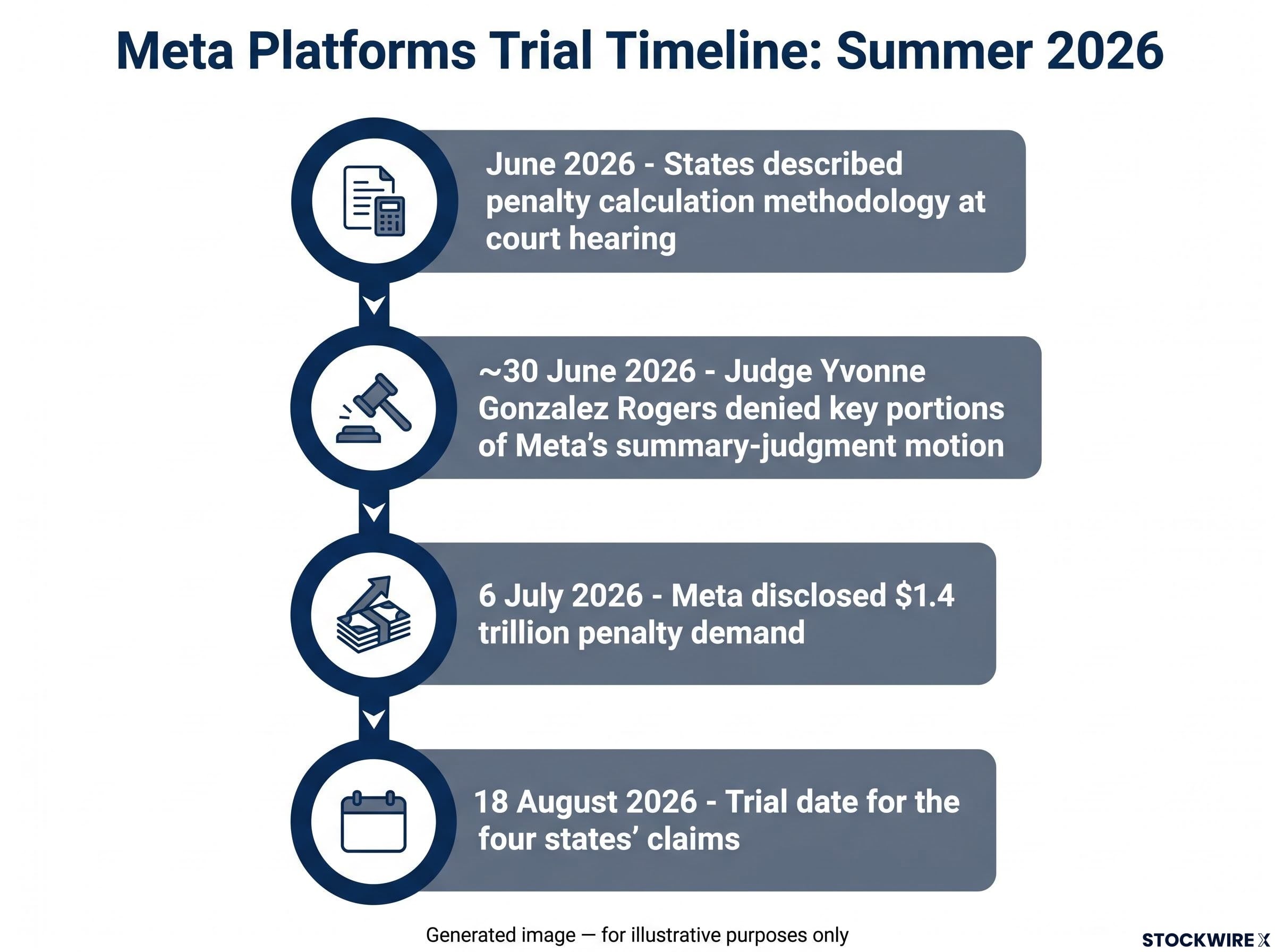
Key procedural milestones:
- June 2026: States described their penalty calculation methodology at a court hearing
- Approximately 30 June 2026: Judge Gonzalez Rogers denied key portions of Meta’s summary-judgment motion, finding sufficient factual disputes to proceed
- 6 July 2026: Meta disclosed the $1.4 trillion penalty demand in a court filing
- 18 August 2026: Trial date for the four states’ claims
The summary-judgment denial is procedurally significant. It tells you that the court found the states’ claims legally sufficient to reach trial, which is a different question from whether those claims will succeed. Both liability and penalty exposure remain live issues. The states’ penalty filings remain under seal, so the full scope of their legal theory is not yet public.
For investors and analysts tracking Meta, the 18 August date is a concrete near-term catalyst. It is six weeks away and represents the point at which the legal arguments that have been building for months will be tested in open court.
Putting $1.4 trillion in context: what historical settlements tell us about likely outcomes
No consumer protection enforcement action in US history has produced a penalty anywhere near $1.4 trillion. Reuters coverage characterised the demand as unprecedented, and Meta‘s filing stated that no enforcement action in the history of consumer protection has produced a comparable sanction.
For illustrative scale, consider these historical benchmarks:
| Settlement or Penalty | Amount | Verified Status |
|---|---|---|
| 1998 Tobacco Master Settlement Agreement | $206 billion | Unverified comparison |
| 2019 FTC settlement with Facebook | $5 billion | Unverified comparison |
| Current state AG penalty demand | ~$1.4 trillion | Confirmed |
Note: The Tobacco MSA and FTC settlement figures are cited as illustrative comparisons and have not been independently verified for this article.
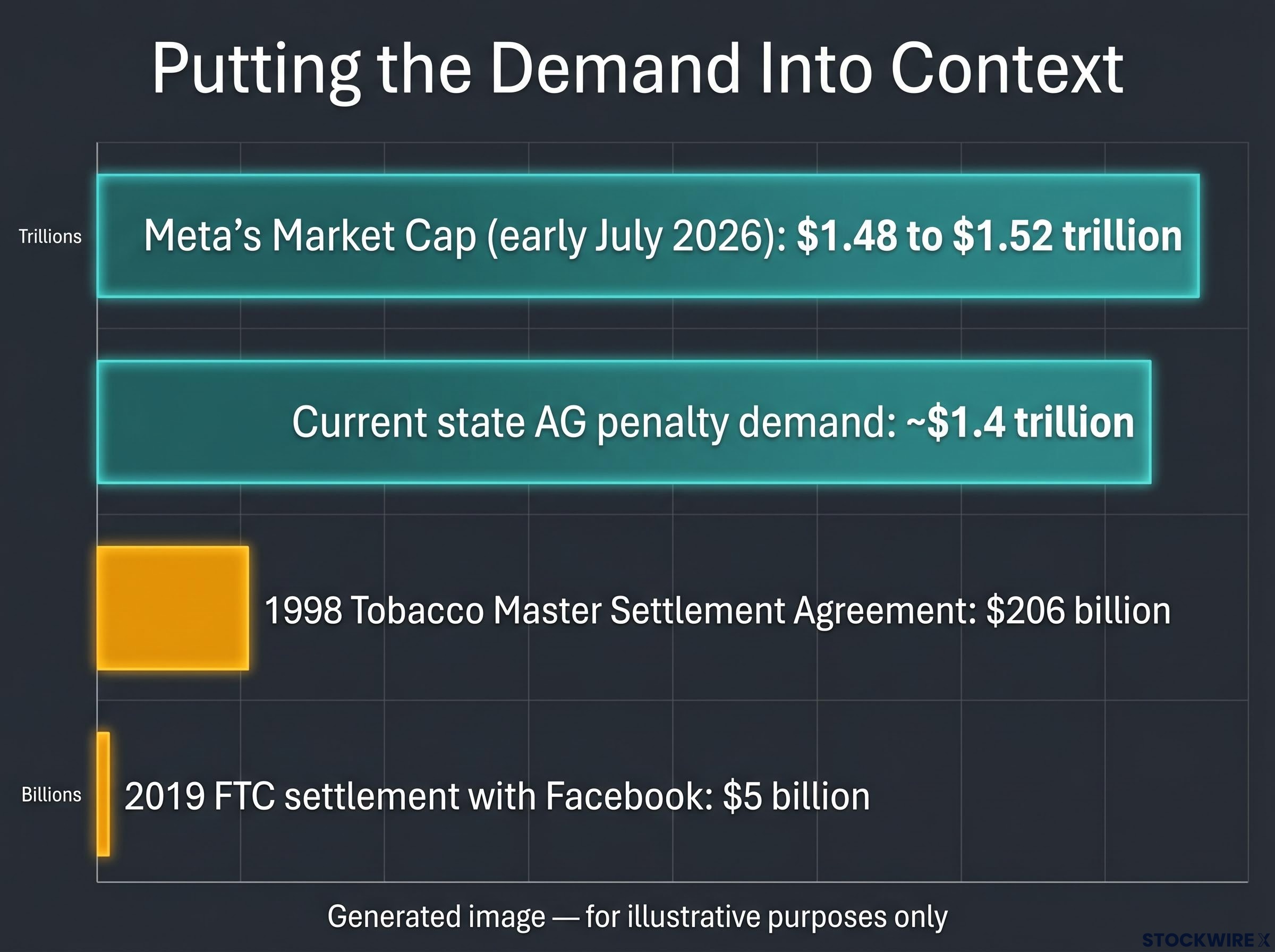
The gap between $1.4 trillion and any historically precedented outcome tells you the headline figure is better understood as a legal opening position than a financial forecast. Appellate due-process review of grossly disproportionate awards routinely results in substantial reductions, and settlement or a reduced judgment remains consistent with how complex, high-stakes civil litigation of this nature typically resolves.
Platform liability litigation had already surfaced as a flagged risk in Meta’s own management disclosures before the states’ penalty demand became public, with a $375 million New Mexico verdict and an advancing Massachusetts lawsuit over youth harm on Instagram each cited by the company as potentially material to its financial statements.
What a reduced judgment or settlement would mean for Meta investors
Even a penalty in the tens of billions of dollars would represent a significant but not existential financial event for Meta, given the company’s balance sheet and ongoing revenue generation. This is illustrative reasoning, not a forecast: the purpose is to give you proportionality. The question for investors is not whether Meta pays $1.4 trillion (it will not) but what a materially reduced outcome would look like, and whether that figure falls in the range of financially manageable or financially disruptive relative to the company’s scale.
Meta’s free cash flow trajectory adds a second layer of context for investors assessing penalty proportionality: revised analyst estimates following the Q1 2026 capex guidance raise cut projected 2026 free cash flow from approximately $35 billion to $25 billion, reducing the financial cushion available to absorb any substantial judgment.
What the August trial changes, and what it does not
The 18 August trial will adjudicate the four states’ claims on liability and penalties. It will not resolve all other related litigation Meta faces across other jurisdictions; the case is part of broader multidistrict litigation in the Northern District of California that includes other parties and claims beyond the scope of this trial.
Meta denies all allegations. Whether the courts will ultimately treat “social media addiction” as a formally recognised condition is a question that remains open and will be put to the test at trial. This is not a minor procedural issue; the answer will affect how courts treat platform liability claims well beyond this single case.
Analysts who have modelled Meta’s legal risk as a per-share discount rather than an unquantifiable qualitative factor treat litigation exposure as a valuation input, with estimates for the multidistrict litigation trial range translating to approximately $30-$61 per share depending on the scenario applied.
The $1.4 trillion figure is the states’ theoretical statutory maximum claim, not a probable outcome. The trial will determine whether liability is established and, if so, what penalty is proportionate, supportable, and constitutional.
The trial is a genuine near-term legal catalyst that warrants close attention. The $1.4 trillion headline captures the scale of the states’ legal theory, but the realistic range of outcomes, whether through judgment, settlement, or appeal, sits in a fundamentally different order of magnitude. Both truths need to coexist: real legal risk is on the table, and the headline figure is not a financial forecast.
This article is for informational purposes only and should not be considered financial advice. Investors should conduct their own research and consult with financial professionals before making investment decisions. These statements regarding potential trial outcomes are speculative and subject to change based on legal developments and court rulings.