ASIC Cancels Capital Guard Licence Over Fake Macquarie Bond
6 hrs ago


A Western Australian company director has pleaded guilty to dishonestly exploiting investors who trusted him with more than $1.5 million for forex trading, and ASIC alleges the money largely never traded at all.
The case matters beyond the individual. Forex investment fraud is a recurring pattern in Australia, and the mechanism here, collecting investor funds under a trading premise and redirecting them for personal use and payments to earlier investors, is precisely the structure regulators warn about most often. ASIC confirmed the guilty pleas on 29 June 2026, and sentencing is not scheduled until 21 August 2026, which means this story remains live and unresolved.
Here is a clear picture of how the forex fraud scheme worked, what the criminal charges actually mean, and the specific warning signs that could help you identify a similar arrangement before your capital is at risk.
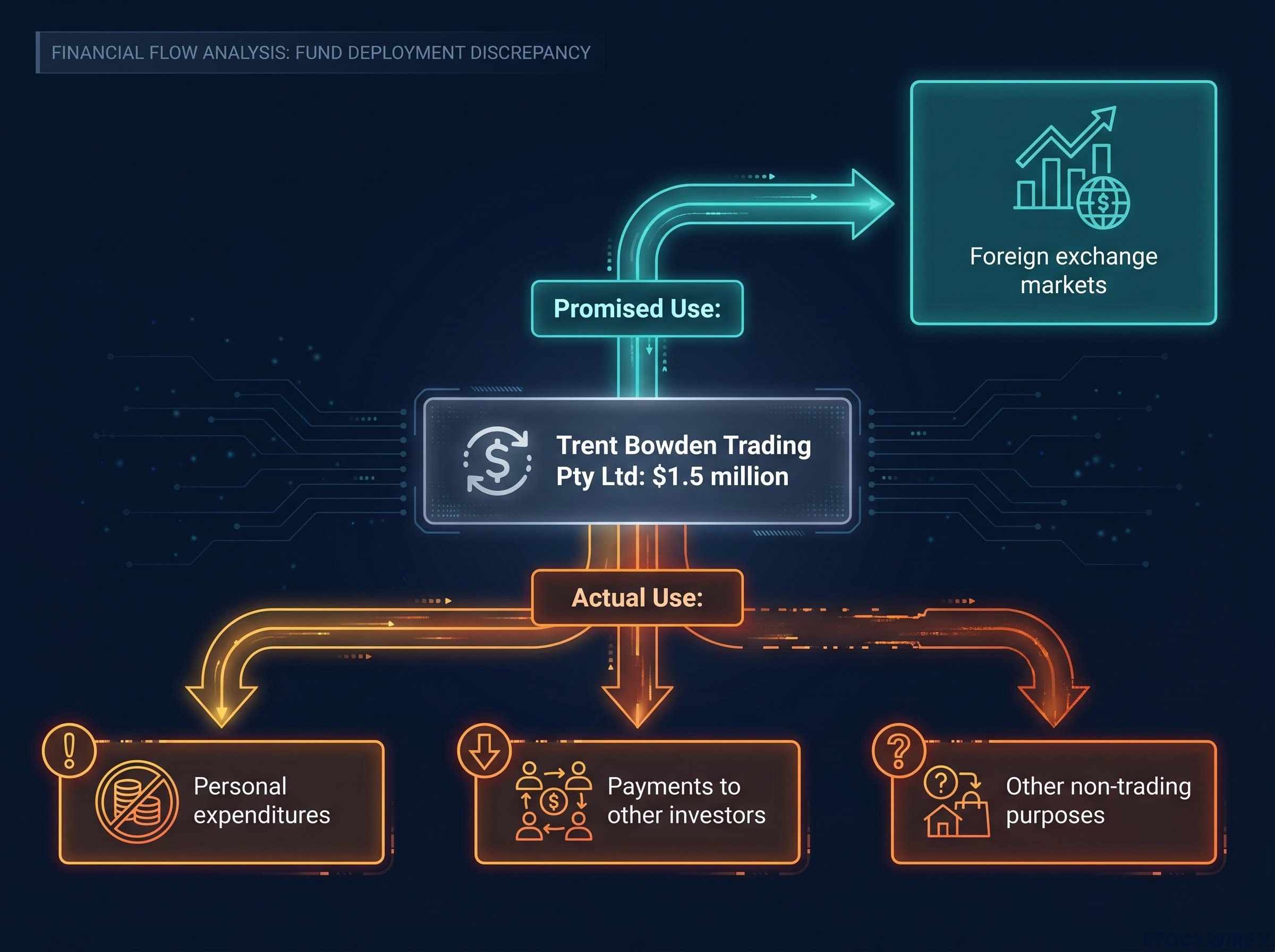
Trent Bowden ran Trent Bowden Trading Pty Ltd from his base in Seville Grove, Western Australia, soliciting investor funds on the premise that the company would put them to work in foreign exchange markets. For many, the early payments they received appeared to confirm it was working.
ASIC alleges the reality was different. The regulator claims that across the roughly four-and-a-half years from 13 March 2019 to 1 November 2023, Bowden collected in excess of $1.5 million from investors whose money, rather than being traded, was diverted to other ends. According to ASIC, the funds were used for:
ASIC alleges that investor funds were used for purposes other than the forex trading activity that had been represented to investors.
At a hearing on 26 June 2026, Bowden stood before Perth Magistrates Court and admitted guilt on three charges of dishonestly using his position as a director to obtain a personal advantage.
The four-and-a-half-year timeframe is telling. This was not a short-lived scam caught quickly. The scheme persisted precisely because payments to earlier investors made the arrangement appear functional, buying time and trust in equal measure.
The three charges fall under section 184(2)(a) of the Corporations Act 2001 (Cth). In plain terms, this provision targets company directors who dishonestly use their position to gain a personal advantage or to cause detriment to others. It is the criminal version of the director’s duty provisions, meaning it carries custodial penalties rather than civil fines or bans alone.
The fact that prosecution is handled by the Commonwealth Office of the Director of Public Prosecutions (CDPP), not ASIC itself, signals the seriousness with which the federal legal system treats this category of offence. ASIC investigates; the CDPP decides whether the evidence meets the threshold for criminal proceedings.
The maximum penalty available for each offence is 15 years’ imprisonment. Three charges means the theoretical exposure is substantial.
Beyond the criminal prosecution pathway, ASIC’s director disqualification powers under section 206F of the Corporations Act allow the regulator to ban a person from managing any corporation for up to five years without a court order, criminal conviction, or formal legal proceeding.
No final sentence has been handed down as of 2 July 2026. Perth District Court has the matter listed on 21 August 2026 for a sentencing mention.
Australian sentencing principles, including totality and parity, mean the court will not simply stack three maximums together. The possible outcomes include:
Investor compensation remains an open and unresolved question pending the sentencing process.
The structural feature that sustained this scheme for years is one regulators identify repeatedly: using incoming investor money to make payments to existing investors, rather than generating returns through genuine trading.
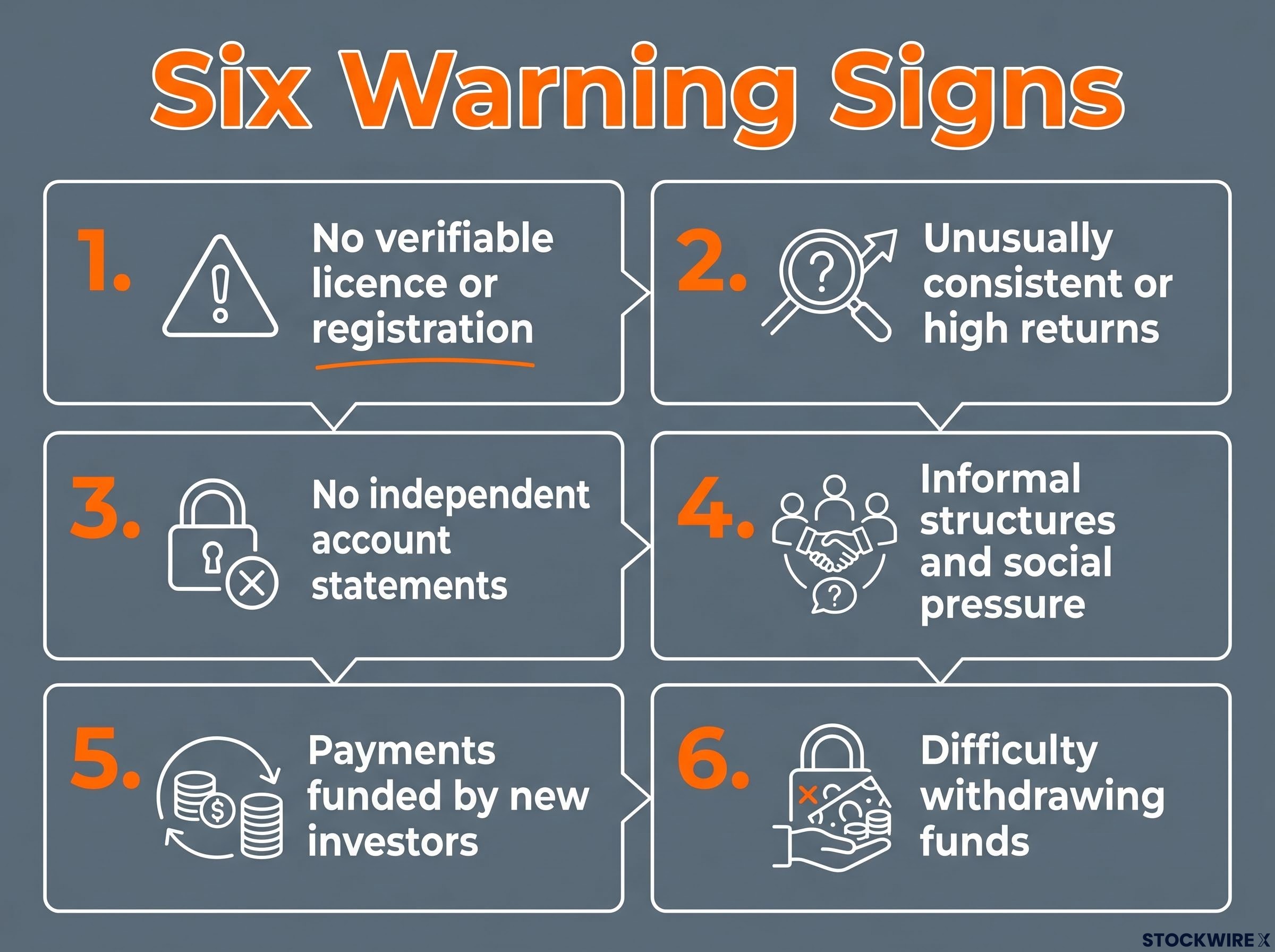
The defining feature of a Ponzi-style structure is that payments to investors are funded by new investors’ capital, not by genuine trading returns or investment performance.
This is not just dishonest. It is specifically designed to delay the moment of collapse. When a scheme makes regular payments that appear to confirm it is working, the natural impulse is to reinvest or recommend it to others. That response is precisely the dynamic a Ponzi structure depends on. Understanding that mechanism protects you from that specific manipulation.
Forex is a legitimate, widely used financial market. Banks, hedge funds, and sophisticated traders use it daily. But its complexity and volatility make it particularly attractive as a cover story for fraudsters, because claims about strategy and returns are difficult for retail investors to verify independently.
ASIC’s description of the payment pattern in this case, investor funds used to pay other investors across a four-and-a-half-year period, matches the Ponzi model closely. The scheme sustained itself not through performance, but through the appearance of performance.
The Bowden case sits within a broader national pattern: investment scam losses across Australia reached $837.7 million in 2025 alone, even as ASIC removed nearly 12,000 scam websites that year, a 90% increase on the prior year’s takedown volume.
MoneySmart’s Ponzi scheme guidance sets out the structural hallmarks regulators use to identify these arrangements, including the use of new investor funds to pay existing participants and the absence of genuine underlying returns, matching closely what ASIC alleges occurred here.
Each of these signals draws directly from the conduct alleged in this case and from ASIC’s regulatory guidance on fraudulent investment schemes. Individually, any one may be inconclusive. Two or more together should prompt you to pause, verify independently, and question whether what you have been shown is sufficient to trust with real capital.
You can check whether an individual or company holds an AFS licence by searching ASIC’s publicly accessible registers before committing capital to any managed investment arrangement.
For investors wanting a systematic approach to detecting investment fraud before committing capital, our dedicated guide covers AFS licence verification, deepfake warning signals, and the specific steps ASIC recommends for reporting suspected misconduct.
ASIC has statutory powers to investigate suspected breaches of the Corporations Act, but it does not prosecute criminal matters itself. The enforcement pathway in this case followed a clear institutional sequence:
ASIC published the details of the guilty pleas in media release 26-137MR on 29 June 2026.
For retail investors, this chain matters. The fact that ASIC investigates but does not itself prosecute criminal matters means a complaint will not lead to automatic prosecution. The referral step involves a separate institution applying its own prosecutorial threshold. That is not a reason to delay reporting; early reports give ASIC more material to work with and can accelerate investigation timelines.
Australian investors who believe they have been misled can lodge reports directly with ASIC through the regulator’s online channels.
At the Perth District Court hearing on 21 August 2026, the court will determine what penalty Bowden faces, with possible outcomes spanning imprisonment, financial penalties, and disqualification from directing companies.
What it will not resolve is the question of investor compensation. As of 2 July 2026, that question remains open and unresolved. For investors who lost money, the sentencing date is not the moment their losses are addressed. The compensation question is separate, slower, and dependent on what assets, if any, remain available after the criminal process concludes.
| Date | Event |
|---|---|
| March 2019 | Alleged scheme begins |
| November 2023 | Alleged scheme ends |
| 26 June 2026 | Guilty pleas entered at Perth Magistrates Court |
| 29 June 2026 | ASIC media release 26-137MR published |
| 21 August 2026 | Sentencing mention scheduled, Perth District Court |
This case is one of a pattern of enforcement actions ASIC pursues against unlicensed or fraudulent investment operators. The outcome will either reinforce or weaken the deterrent value of criminal prosecution for director misconduct. Criminal conviction and financial recovery are distinct processes, and the second does not automatically follow from the first. If you are in a similar situation with another scheme, understanding that distinction matters.
The Capital Guard enforcement action, announced on the same day ASIC confirmed Bowden’s guilty pleas, illustrates a parallel dynamic: fraud can operate inside a legitimately licensed entity for years, with a routine licence check returning a clean result throughout the period of misconduct.
This article is for informational purposes only and should not be considered financial advice. Investors should conduct their own research and consult with financial professionals before making investment decisions.
A forex fraud scheme involves collecting investor funds under the premise of foreign exchange trading, then diverting those funds for personal use or payments to earlier investors rather than conducting genuine trading activity. The Bowden case in Western Australia followed this exact pattern across a four-and-a-half-year period from 2019 to 2023.
Bowden pleaded guilty to three charges of dishonestly using his position as a company director to obtain a personal advantage, under section 184(2)(a) of the Corporations Act 2001, with each charge carrying a maximum penalty of 15 years imprisonment.
Investors can check whether an individual or company holds an Australian Financial Services (AFS) licence by searching ASIC's publicly accessible registers before committing any capital to a managed investment arrangement.
ASIC investigates suspected breaches of the Corporations Act but does not prosecute criminal matters itself; it refers cases to the Commonwealth Office of the Director of Public Prosecutions, which applies its own prosecutorial threshold before proceeding with criminal charges.
Sentencing at Perth District Court on 21 August 2026 will determine Bowden's penalty, but investor compensation is a separate and slower process that depends on what assets remain available after the criminal proceedings conclude and is not automatically resolved by a conviction.