
Two of the ASX’s most closely watched stocks are being shorted more aggressively right now, and in both cases the timing tells you something important: one into an earnings event, the other into a 40% rally.
The latest short selling data from ASIC disclosures, with a reference date of 22 June 2026, shows Cochlear and A2 Milk sitting at the top of the week’s most significant short interest moves on the ASX. The stories diverge sharply in their circumstances but converge on the same theme: institutional investors using short positions as a precision tool around specific catalysts, not simply as a reaction to falling prices.
This piece breaks down what the positioning data actually shows for each stock, what it signals about professional sentiment, and what the upcoming catalysts are that will determine whether these short sellers are right.
Cochlear’s short interest just hit a recent-period high heading into results
Cochlear’s short interest surged to 8.88% as of 22 June 2026, up 3.05 percentage points in a single week and 4.03 percentage points over the month. That weekly jump is the largest on the ASX in the current data set.
The scale of the move makes more sense when you trace the stock’s 2026 price history:
- 13 February 2026: Shares dropped 18.9% following disappointing first-half earnings.
- 22 April 2026: A second selloff of 40.7% followed further earnings weakness and a guidance downgrade.
- Late June 2026: Having shed roughly 54% year-to-date, the stock recovered approximately 24% from its early-June trough.
That 24% rebound is where the short interest story begins. Rather than interpreting the bounce as a sign the worst is over, short sellers treated it as an improved entry point. The recovery gave them a higher price to sell into ahead of annual results, and they moved in size.
Post-downgrade short positioning on the ASX follows a counter-intuitive pattern: institutional bears frequently treat a large earnings-day selloff as an improved entry point rather than a reason to cover, using the lower price simply as a more attractive strike for the next catalyst.
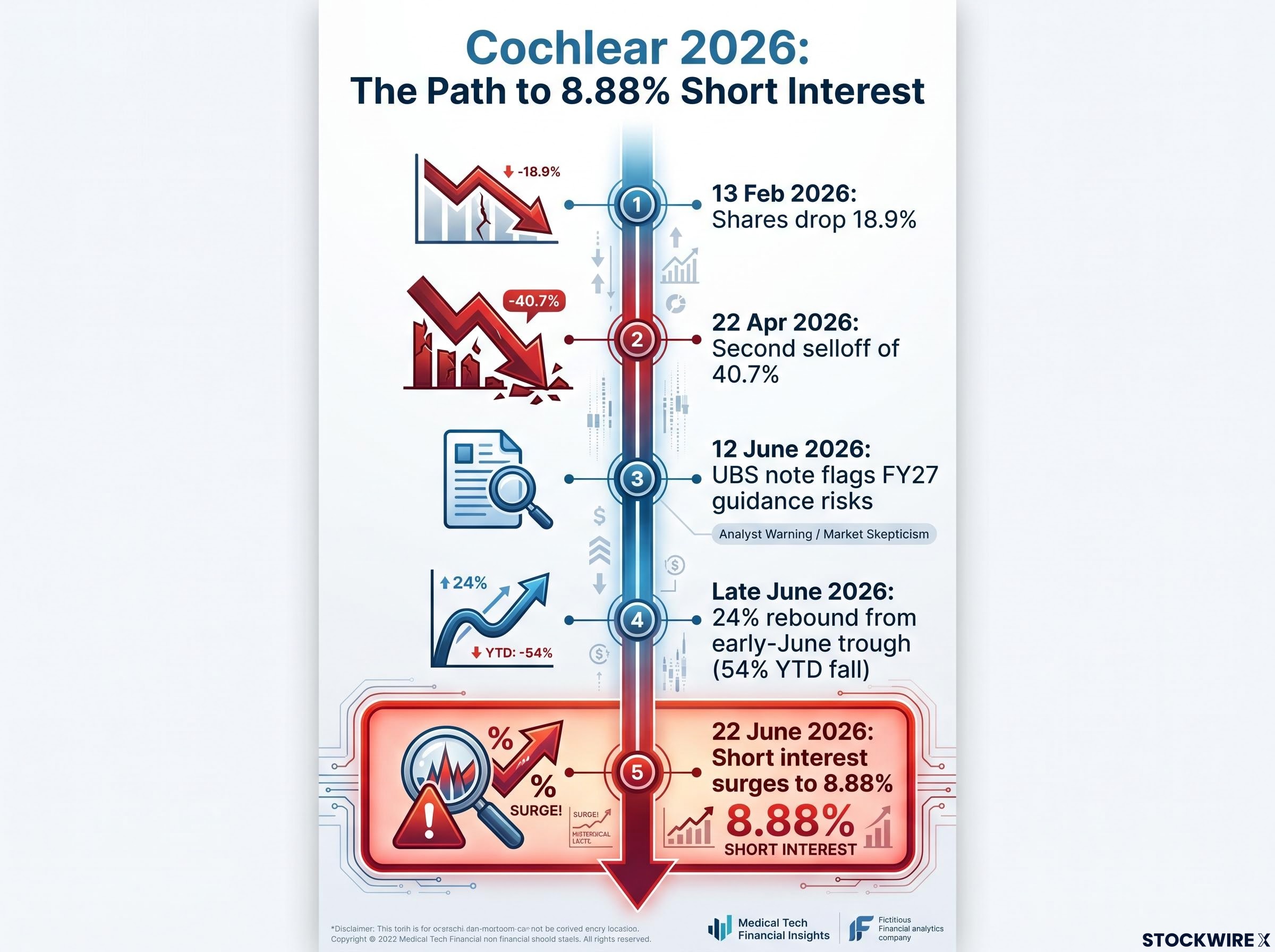
External analysis supports the thesis. A research note from UBS dated 12 June 2026 raised concerns that Cochlear’s management would take a conservative approach to FY27 guidance in light of the recent series of downgrades.
UBS anticipated that FY27 guidance would present investors with a broad profit range, with the central scenario reflecting a continuation of the challenging conditions seen in recent periods and the bottom end leaving room for conditions to worsen further.
The combination of a 54% year-to-date fall, a partial rebound, and now the largest single-week short interest increase on the ASX tells you that sophisticated investors see the recent recovery as a selling opportunity, not a turning point. For anyone tracking Cochlear into its annual results, this is a positioning signal worth taking seriously.
When big ASX news breaks, our subscribers know first
A2 Milk’s short sellers are holding their nerve through a 40% rally
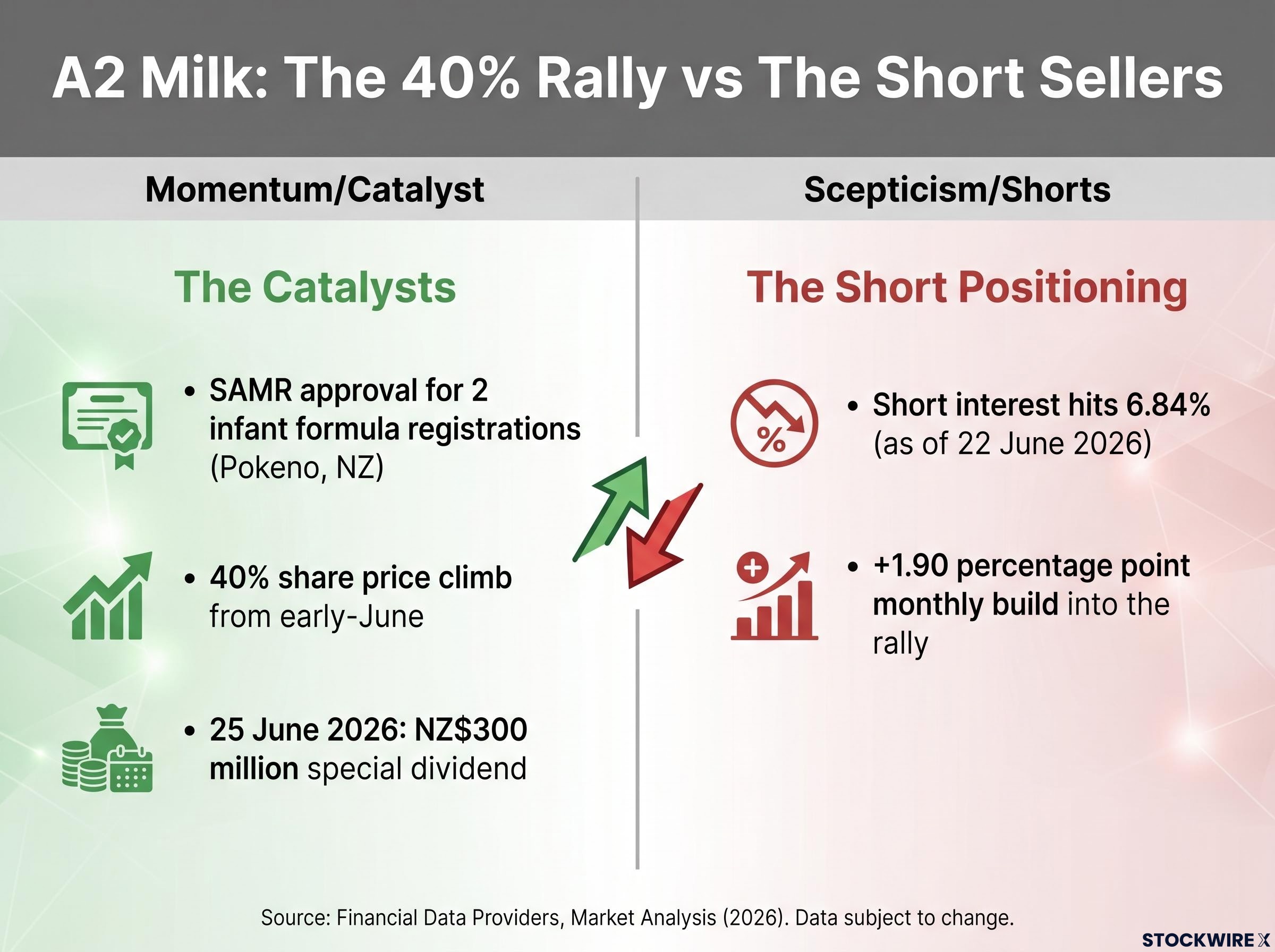
The bull case for A2 Milk has rarely looked this strong on paper. China’s regulators at the State Administration for Market Regulation (SAMR) granted approval for two infant formula product registrations, originally held under China-label classifications and connected to A2 Milk’s Pokeno facility in New Zealand, to be converted into a2-branded products. The approval directly supports the company’s long-standing strategy of expanding its premium infant formula presence in China.
The market responded accordingly: the share price climbed roughly 40% from its early-June position, with buyers pricing in the regulatory breakthrough. On 25 June 2026, management added further confidence by declaring a fully franked special dividend of NZ$300 million, a signal of balance-sheet confidence at a moment of regulatory tailwind.
What the short interest figures actually show
Against that backdrop, the short interest data lands as a genuine surprise. A2 Milk’s short interest rose to 6.84% as of 22 June 2026, up 1.69 percentage points week-on-week and 1.90 percentage points month-on-month.
The monthly increase is the telling figure. The entire 1.90 percentage point build occurred during the period in which the stock rallied 40%, making the directionality unambiguous: short sellers were adding positions into strength, not covering.
Why hold or add to a short position through a rally of that magnitude? The hypotheses are distinct:
- Some traders may believe the market has overstated the medium-term earnings impact of the SAMR approval.
- Others may view the post-rally valuation as stretched, regardless of the regulatory news.
- A cohort may doubt A2 Milk’s long-term competitive position in China’s infant formula market against domestic brands.
- A portion of short interest may reflect hedging activity across the broader dairy and infant formula supply chain.
As of 29 June 2026, no trading update confirming revenue conversion from SAMR-approved products has been released. That gap between regulatory approval and confirmed earnings impact is where the short seller thesis lives. Rising short interest alongside a 40% share price move tells you that a meaningful group of institutional investors believes the market has over-priced the approval’s medium-term value, and that doubt should factor into any assessment of current valuation.
What short interest data actually measures, and why it matters here
Short selling means borrowing shares from another investor, selling them on the open market, and aiming to buy them back later at a lower price. The difference between the sale price and the buyback price is the short seller’s profit (or loss, if the price rises).
Short interest is the percentage of a company’s total shares currently held in short positions. When that percentage rises, it means more investors are positioning for the price to fall. The data is reported under ASIC’s mandatory disclosure framework, with weekly releases; the figures used in this article carry a reference date of 22 June 2026.
The data is reported under ASIC’s mandatory disclosure framework, with weekly releases; the figures used in this article carry a reference date of 22 June 2026.
The interpretive layer is where the data becomes useful. Short interest is a positioning and sentiment indicator, not a prediction. Key principles for reading it:
- Rising short interest before results (as with Cochlear) signals event-driven risk expectations.
- Rising short interest through a positive catalyst (as with A2 Milk) signals valuation scepticism.
- Short interest is directional data, not a timing signal.
- It should always be read alongside price action and fundamentals, never in isolation.
Understanding that distinction is what allows you to interpret the Cochlear and A2 Milk data correctly without either dismissing it or treating it as a certainty.
Two different setups, one shared signal about institutional conviction
The contrast between the two stocks is sharp. Cochlear is a case of event-driven shorting: bears are building positions ahead of annual results, betting that a bounce from deeply distressed levels will not survive the next earnings print. A2 Milk is the opposite setup: shorts are positioned against a stock that has just delivered genuinely positive news, betting that the market’s enthusiasm has outpaced the earnings follow-through.
In both cases, short sellers are not simply reacting to price weakness. They are actively positioning around their read of future earnings. That makes the signal more informative than directional shorting driven by momentum alone.
| Company | ASX Code | Short Interest (22 Jun 2026) | Week-on-Week Change | Month-on-Month Change |
|---|---|---|---|---|
| Cochlear | COH | 8.88% | +3.05 pp | +4.03 pp |
| A2 Milk | A2M | 6.84% | +1.69 pp | +1.90 pp |
Seeing the two stories side by side clarifies the different ways ASX short interest data can be read: one as an event-risk flag, the other as a valuation-scepticism signal. Both are forward-looking bets on earnings outcomes, not reactions to past prices.
The catalysts that will resolve both short theses
The data tells you where professional conviction sits right now. The upcoming catalysts will tell you whether that conviction was right.
- Cochlear: Annual results and FY27 guidance are the event that will either validate current short positions or trigger a squeeze. If management delivers the wide, cautious guidance range that UBS anticipates, the bear case strengthens. If guidance resets expectations more constructively than the market fears, short covering could drive a sharp move higher.
- A2 Milk: The next trading updates are the test. The specific number shorts are waiting on is the conversion of SAMR-approved products into confirmed Chinese revenue and profit. As of 29 June 2026, that data has not yet been released. Strong early conversion figures could force covering; weak or delayed conversion would validate the view that the 40% re-rating ran ahead of the earnings reality.
These are not symmetrical situations. Both could resolve in the same reporting period or on staggered timelines, making the coming weeks unusually data-rich for anyone tracking ASX short interest.
For anyone watching either stock, these data releases are not just corporate milestones. They are the specific events that will force a large cohort of institutional investors to either close their positions or double down, and that secondary effect on the share price can be as significant as the news itself.
Short covering dynamics on the ASX can move share prices as significantly as the underlying catalyst itself, particularly when a large short position meets a positive surprise that invalidates the original bearish thesis at scale.
What the current positioning tells you before the data arrives
The week ending 22 June 2026 produced two of the most instructive short interest stories on the ASX this year. Each illustrates a different mechanism by which institutional investors express conviction through short positioning: one ahead of a known earnings risk, the other against the grain of a major positive re-rating.
The practical takeaway is in the time horizon. Weekly changes capture tactical moves; month-on-month figures capture sustained conviction. Cochlear’s monthly increase of 4.03 percentage points is the strongest sustained-conviction signal in the current data set, built steadily rather than arriving in a single burst.
Month-on-month short interest builds carry more interpretive weight than weekly snapshots precisely because they capture sustained institutional conviction rather than tactical repositioning around a single session or announcement.
For you, the interpretive principle is straightforward: rising short interest ahead of known catalysts is a risk flag worth building into any position assessment, regardless of whether you are long, short, or watching from the sidelines. Track the monthly change, not just the weekly figure, and you will get a cleaner read on whether a positioning shift is noise or genuine institutional conviction.
This article is for informational purposes only and should not be considered financial advice. Investors should conduct their own research and consult with financial professionals before making investment decisions.
—