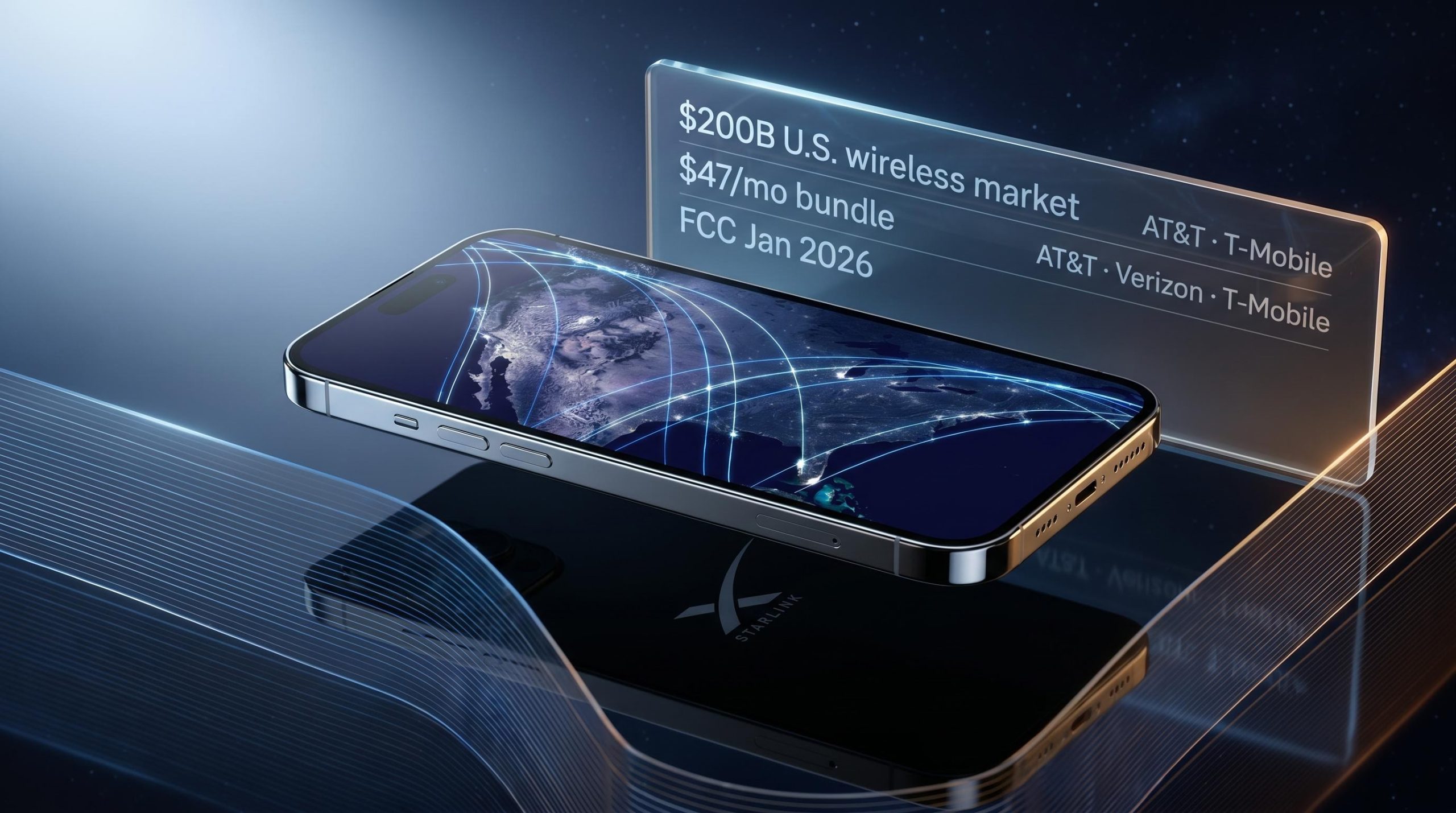
Plans for a Starlink-branded consumer mobile phone service in the United States emerged publicly on 26 June 2026, when SpaceX President Gwynne Shotwell outlined the proposal during the company’s IPO roadshow. The framing is worth pausing on: an infrastructure company pitching itself to public market investors as a future wireless carrier.
The SpaceX IPO valuation context matters here: Starlink is the only profitable segment contributing approximately 69% of quarterly revenue, which explains why a phone service announcement surfaced at the roadshow rather than in a product launch, because subscriber growth is the narrative the $2 trillion price tag most urgently needs.
The U.S. wireless market generates roughly $200 billion in annual revenue, and AT&T, Verizon, and T-Mobile have spent decades building the spectrum portfolios, tower networks, and customer relationships that make entry extraordinarily difficult. SpaceX is not approaching that market from zero. It already operates satellite-to-handset technology in partnership with T-Mobile, holds Federal Communications Commission (FCC) authorisations for direct-to-cell Gen2 Starlink satellites granted in January 2026, and is actively bundling home internet with third-party mobile plans through US Mobile. The infrastructure layer exists. The question is whether SpaceX has the intention, the regulatory clearance, and the economics to turn that infrastructure into a consumer brand competing directly for wireless subscribers.
Here is a framework for separating the credible medium-term threat from the noise, identifying which carriers face the most structural exposure, and knowing specifically what signals to track before adjusting a telecom position.
How Starlink already works as a wireless product
The starting point is what is actually deployed and operational today, not what SpaceX might build in the future.
T-Mobile currently markets “T-Mobile Starlink” as a space-based extension of its terrestrial network. When a T-Mobile subscriber moves into a coverage dead zone, their handset automatically connects to a Starlink satellite overhead. The service is framed as seamless supplemental coverage, filling gaps where towers do not reach.
The FCC granted authorisations for SpaceX’s Gen2 Starlink satellites with direct-to-cell capabilities in January 2026, confirming regulatory legitimacy for this product category. That authorisation matters. It means satellite-to-handset connectivity is not a regulatory grey area; it is a permitted, operational technology.
The current state of the product in practice:
- What it does: Provides automatic satellite connectivity for voice, text, and limited data when a subscriber moves outside terrestrial tower range.
- What it does not do: Replace a primary wireless connection. It is not designed or authorised as a standalone consumer carrier service.
- FCC authorisation status: Approved for supplemental coverage and emergency connectivity, not for full-scale consumer mobile operation.
- Consumer uptake: Public industry commentary indicates usage has been well below initial expectations so far, suggesting modest real-world adoption.
The technology being live and FCC-authorised matters less than what it is authorised to do. Supplemental coverage is a very different regulatory and commercial category from a standalone consumer carrier, and that gap is where the execution risk sits for anyone sizing this as an imminent competitive threat.
When big ASX news breaks, our subscribers know first
The T-Mobile partnership: ally today, blueprint for tomorrow
The T-Mobile relationship is where the competitive analysis gets structurally complicated.
T-Mobile contributes its subscriber base, retail distribution, and consumer brand trust. SpaceX contributes the satellite constellation and the direct-to-cell technology. On paper, the partnership strengthens both parties: T-Mobile gets a rural coverage advantage no other carrier can match, and SpaceX gets real-world consumer data without needing to build its own retail operation.
The asymmetry is quieter but more consequential. T-Mobile is extending consumer familiarity with satellite-assisted mobile service under its own brand, normalising the concept for millions of subscribers who might otherwise have no awareness of the technology. Meanwhile, SpaceX is accumulating operational data on handset behaviour, traffic patterns, and network load, the exact knowledge it would need if it ever chose to compete independently.
The structural tension: T-Mobile is both the beneficiary of and the potential trainer for a future competitor. The same partnership that strengthens T-Mobile’s rural positioning today is quietly reducing the barriers SpaceX would face to launching a standalone offering tomorrow.
The partnership terms, including exclusivity, revenue sharing, and scope, have not been disclosed publicly. Any change to those terms would be among the clearest signals that the competitive dynamic is shifting. For investors holding T-Mobile, this relationship is currently accretive to coverage differentiation. But it carries a structural risk that does not appear on a current balance sheet.
What a Starlink phone service actually costs to compete at
The economics of a standalone Starlink mobile product are the least resolved part of this story, but there are live data points to work from.
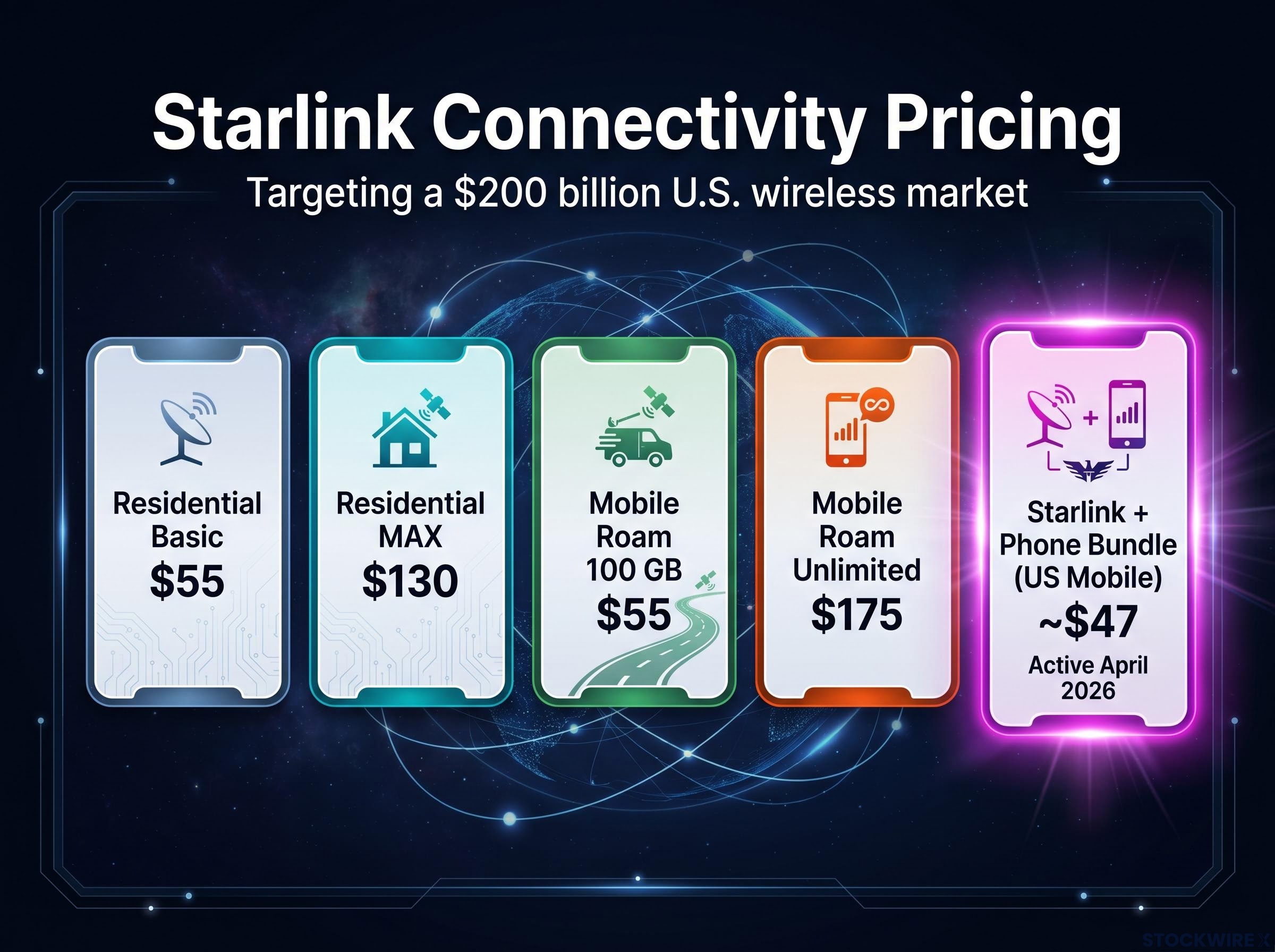
SpaceX already prices consumer connectivity products in the U.S. market across multiple tiers. Its residential broadband runs from $55 to $130 per month depending on speed tier. Its mobile “Roam” satellite internet products range from $55 per month for 100 GB to $175 per month for unlimited data.
The closest live proxy for what a bundled Starlink phone service might look like is the US Mobile partnership. Announced in April 2026 and active as of today, the bundle combines Starlink residential broadband with a US Mobile phone plan starting at approximately $47 per month for the entry tier.
| Product | Provider | Monthly price | Coverage type | Status |
|---|---|---|---|---|
| Residential Basic | Starlink | $55 | Home broadband | Active |
| Residential MAX | Starlink | $130 | Home broadband | Active |
| Mobile Roam 100 GB | Starlink | $55 | Satellite mobile | Active |
| Mobile Roam Unlimited | Starlink | $175 | Satellite mobile | Active |
| Starlink + Phone Bundle | US Mobile + Starlink | ~$47 | Home + mobile | Active (April 2026) |
Market context: The U.S. wireless market generates approximately $200 billion in annual revenue, establishing the scale of the financial opportunity a Starlink phone service would be targeting.
That $47 entry-level bundle is not proof of viability at scale. It is an experiment. Whether it converts into meaningful subscriber volume over the next 12 months will be a leading indicator worth tracking closely. The central unanswered economic question remains: whether satellite capacity and cost structure can support mass-market pricing without a terrestrial network partner subsidising the economics.
The operational leverage behind any standalone Starlink mobile product is rooted in direct-to-cell franchise economics: once the constellation is funded for broadband, enabling cellular connectivity requires limited incremental capital, meaning each new revenue layer arrives without proportional additional infrastructure cost.
Which carriers face the most structural exposure
Not all incumbent carriers are exposed equally. The threat concentrates in specific subscriber segments, and understanding which ones sharpens the investment read considerably.
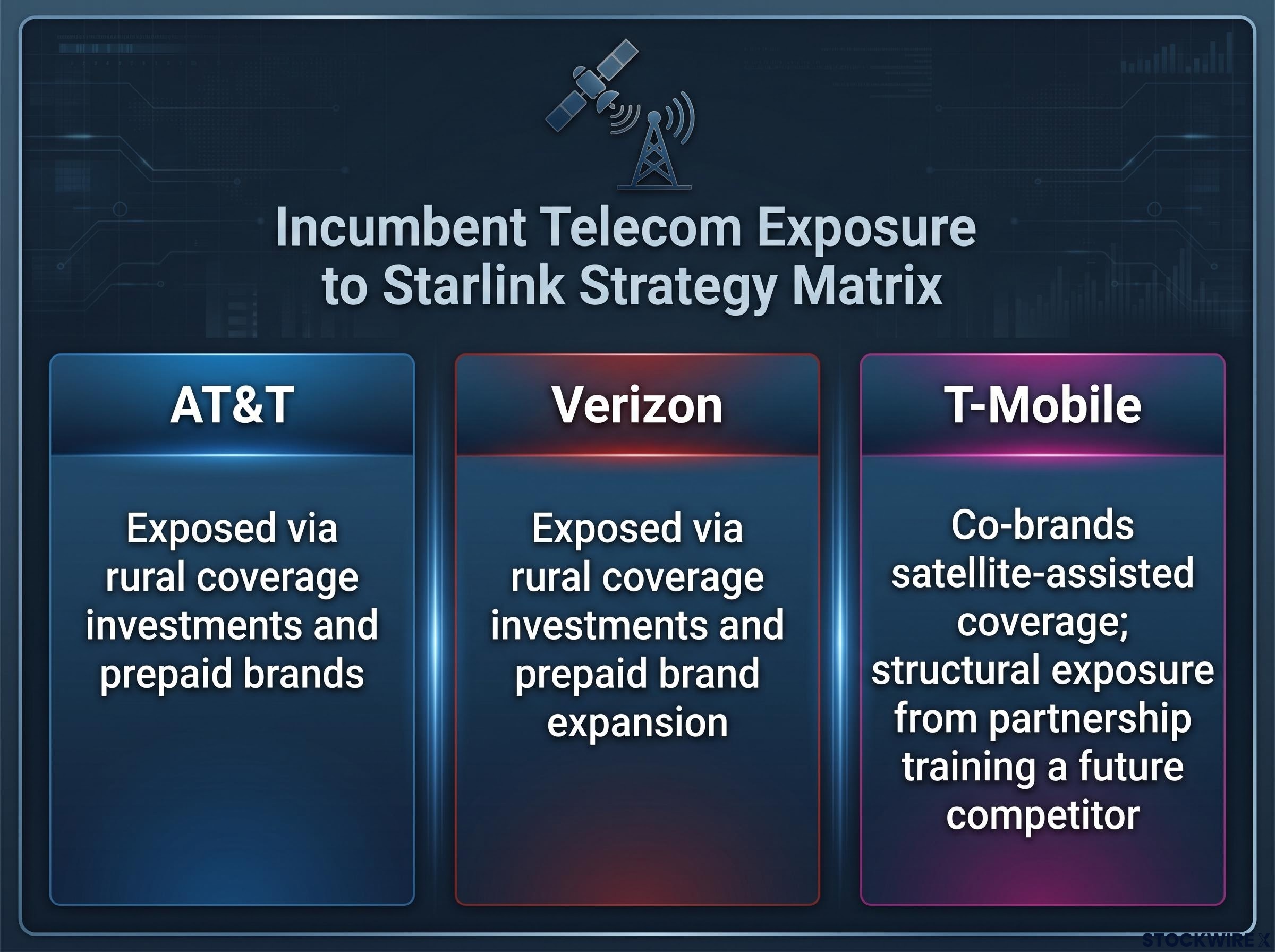
- AT&T: Has invested heavily in spectrum and tower infrastructure specifically to claim superior rural coverage, and has expanded aggressively into prepaid and value-oriented brands. Both of those growth priorities sit directly in the path of a competitively priced Starlink bundle. Rural subscribers and price-sensitive prepaid customers are the two cohorts where a satellite-plus-broadband offering becomes a genuine competitive alternative, not an incremental option.
- Verizon: Carries a similar exposure profile to AT&T. Its rural coverage investments and prepaid brand expansion target the same subscriber segments most likely to evaluate a bundled Starlink product on price and coverage. The concentration of recent growth investment in these segments amplifies the risk.
- T-Mobile: Exposed differently. Its direct competitive risk from a standalone Starlink mobile offering is tempered by the fact that it already co-brands the satellite-assisted coverage product. But its structural exposure is more complex, because the partnership itself, as outlined above, creates the conditions for a future competitor to emerge from inside the relationship.
The incumbent carriers retain meaningful competitive advantages. Deep spectrum portfolios, mature 5G networks, nationwide retail distribution, and sticky customer bases with multi-year contracts are not assets a satellite startup can replicate quickly. None of those moats are immediately threatened.
The SpaceX segment architecture matters for sizing this threat accurately: the Direct-to-Cell business is classified as early commercial rollout, not an operating-at-scale segment, and sum-of-the-parts discipline requires treating it with a different risk weighting than the broadband franchise that already generates recurring revenue at high margins.
But rural coverage differentiation and prepaid value positioning are the two specific moats where a Starlink mobile product creates the most direct competitive pressure, and those are precisely where AT&T and Verizon have concentrated growth investment over the past three years.
Regulation: the pace-setter for how fast any of this materialises
The regulatory environment is not a footnote to this story. It is the single variable with the most power to accelerate or arrest the competitive threat.
SpaceX’s current direct-to-cell operations function under FCC authorisations granted in January 2026, framed specifically as supplemental coverage and emergency connectivity. That is a long way from the regulatory framework required to operate as a full-scale consumer mobile carrier.
Transforming supplemental satellite coverage into a nationwide wireless product would require resolution of how satellite and terrestrial spectrum coexist at scale, and potentially mobile virtual network operator (MVNO) style wholesale arrangements with existing carriers. An MVNO is a wireless provider that does not own its own network infrastructure but instead leases capacity from an established carrier. Nothing in the current public record indicates SpaceX has a clear or imminent path to operating as a conventional nationwide carrier.
The three regulatory milestones worth tracking, in order of likely timing and impact:
- FCC movement on satellite-terrestrial spectrum coexistence rules. How the Commission resolves shared spectrum use at scale will determine the technical ceiling for any Starlink mobile product.
- Any MVNO licensing or wholesale agreement involving SpaceX. A filing or partnership announcement in this category would signal concrete operational intent.
- Rural build-out equivalency determination. This is the highest-impact regulatory signal of the three.
The key trigger: If the FCC moves toward treating satellite coverage as equivalent to terrestrial rural build-out obligations, the competitive clock for AT&T and Verizon accelerates materially. Until that signal appears, the regulatory environment functions as a structural brake on the pace of disruption.
What to watch before repositioning a telecom portfolio
The evidence today supports watchful engagement, not alarm. The incumbent carriers’ competitive moats are intact. The satellite-to-handset technology works but remains framed as supplemental coverage with modest consumer uptake. The bundling economics are being tested, not proven. The regulatory path to a standalone Starlink carrier does not yet exist in concrete form.
That calibration is correct given where the evidence sits. But it can change, and three specific, trackable signals will tell you whether it is changing:
- Carrier management language on earnings calls. Listen for whether AT&T and Verizon management teams are escalating or minimising their framing of satellite-to-device competition. A shift from dismissal to acknowledgement is a sentiment leading indicator that typically precedes strategic repositioning.
- Partnership term changes. Any disclosed modification to exclusivity, revenue sharing, or scope in the T-Mobile and SpaceX arrangement, or any new wholesale agreement involving SpaceX, would signal that the power dynamics between satellite infrastructure and terrestrial carriers are shifting.
- FCC regulatory signals on rural build-out equivalency. Any formal proceeding, staff report, or commissioner commentary treating satellite coverage as functionally equivalent to terrestrial build-out obligations would be the single most consequential near-term development for carrier competitive positioning.
These are not predictions. They are calibration tools. Tracking them across the next two to three earnings cycles will tell you far more than today’s headline about whether the Starlink competitive threat is compressing or accelerating.
The central unresolved question, whether satellite capacity and cost structure can support mass-market consumer pricing without a terrestrial partner subsidising it, will be answered by data, not by IPO roadshow ambition. Position accordingly.
For investors wanting to situate SpaceX’s satellite-to-handset ambitions within a broader portfolio framework, our deep-dive into the commercial space economy maps the recurring-revenue pillars, key public companies, and the critical filter separating capital-intensive build-out phase companies from those generating high-margin operating revenue at scale.
This article is for informational purposes only and should not be considered financial advice. Investors should conduct their own research and consult with financial professionals before making investment decisions. These statements regarding SpaceX’s potential competitive positioning are speculative and subject to change based on market developments, regulatory decisions, and company performance.