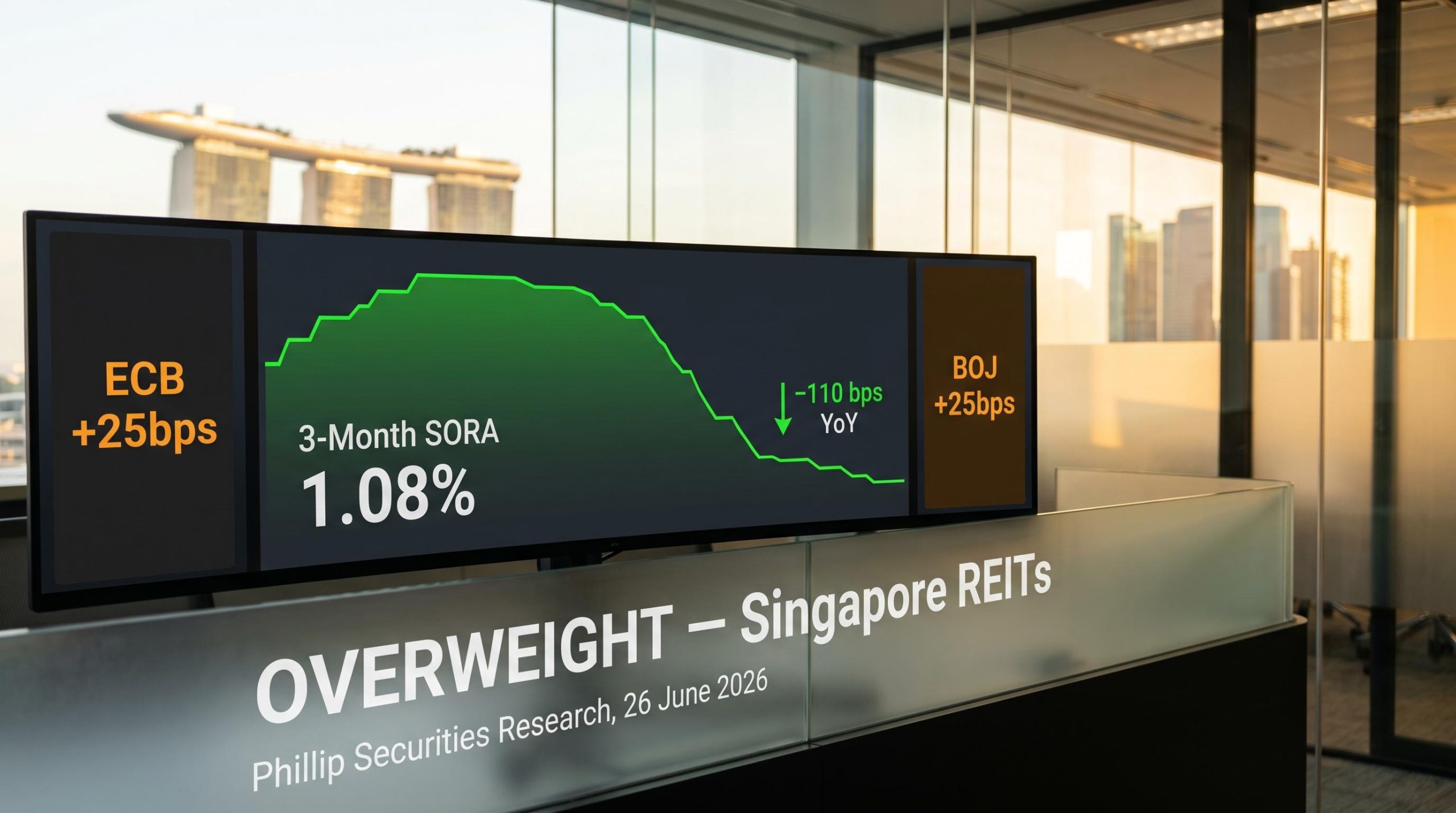
Global rate headlines in mid-2026 are loudly bearish for real estate investment trusts. The European Central Bank is hiking. The Bank of Japan is hiking. The Federal Reserve is holding at levels that make “higher for longer” the default assumption. And yet, Phillip Securities has just rated Singapore REITs OVERWEIGHT.
The contradiction only holds if you assume every REIT market prices off the same benchmark. Most do not. The operative rate for the majority of S-REIT financing costs is not the Fed funds rate, the ECB deposit rate, or the BOJ policy rate. It is SORA, the Singapore Overnight Rate Average, and SORA has spent the past twelve months moving in the opposite direction to the global narrative.
Here is the framework for assessing which S-REITs benefit from this environment and which do not, built on the specific inputs that actually drive financing costs rather than the ones that dominate the headlines.
The global rate picture is more complicated than the headlines suggest
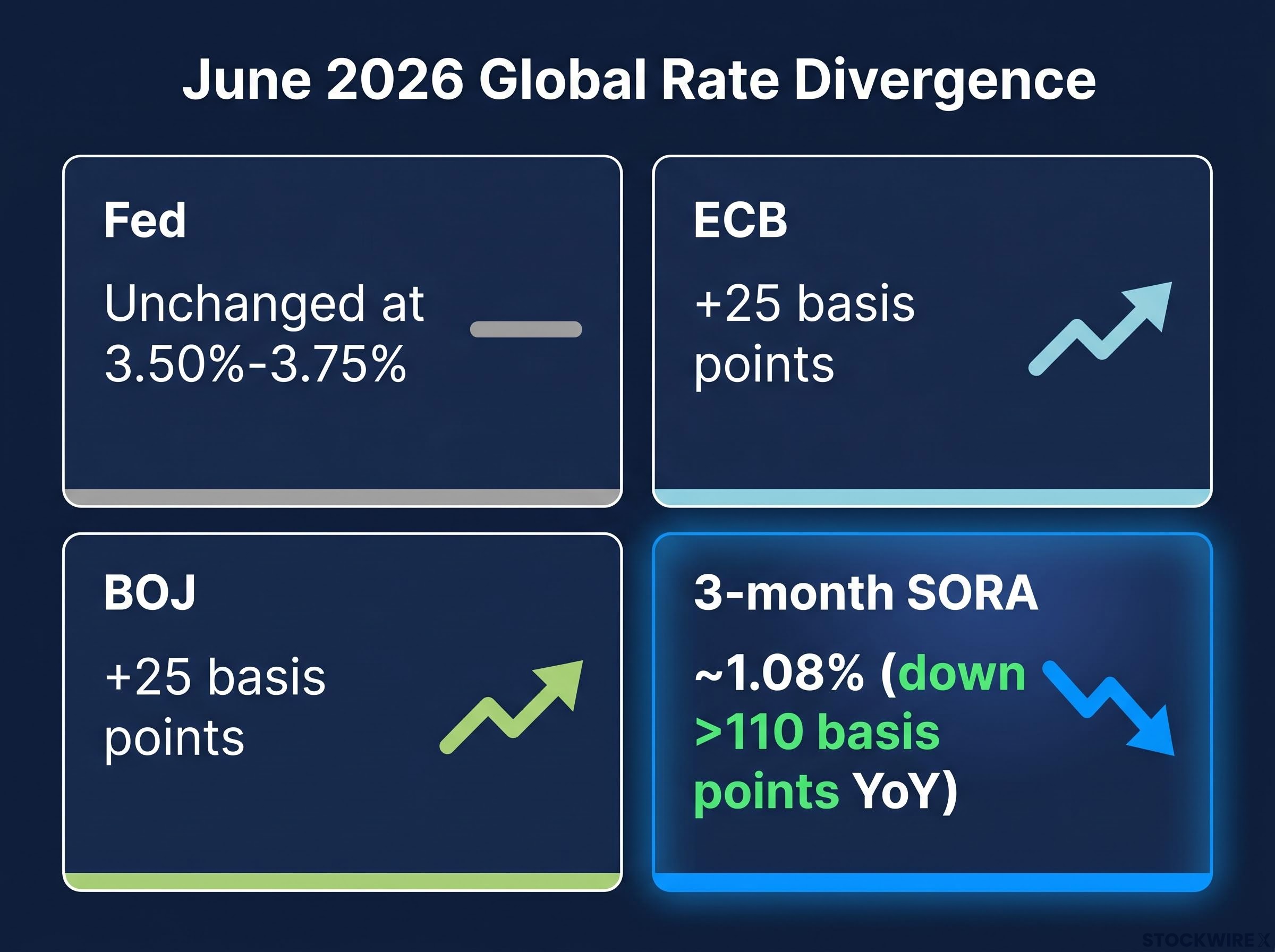
Three central bank decisions landed in June 2026, and they pointed in three different directions:
- ECB: delivered a 25 basis point increase to its policy rate, pressing ahead with normalisation.
- BOJ: also moved its policy rate up by 25 basis points, continuing its tightening trajectory.
- Fed: left its target range unchanged at 3.50%-3.75%, opting for neither a hike nor a cut.
Two major central banks are still tightening. The world’s most-watched central bank is on pause. That is not a coordinated tightening cycle. It is a fragmented global picture, and applying “rates are rising” as a blanket framework to every REIT market misses the divergence entirely.
The uncertainty runs deeper than the policy stances themselves. According to the Fed’s dot plot, one further hike is pencilled in for 2026, yet futures markets are currently pricing in two increases before year-end.
The gap between the dot plot (one hike) and market pricing (two hikes) tells you that uncertainty about the Fed’s next move is genuinely unresolved. Waiting for a clean signal before positioning may mean waiting for something that does not arrive.
That divergence is why headline extrapolation, taking the loudest rate narrative and applying it to every asset class, is unreliable. For S-REITs, the headline is not the signal. The signal is local.
Global REITs are pricing in a more complex set of rate transmission channels than any single central bank move captures; the discount rate effect on future cash flows, the cost of debt financing, and yield competition with government bonds all operate simultaneously and can move in opposing directions across jurisdictions.
When big ASX news breaks, our subscribers know first
Why SORA is the number that actually determines S-REIT financing costs
SORA, the Singapore Overnight Rate Average, is the benchmark against which most SGD-denominated floating-rate debt is priced. When an S-REIT borrows in Singapore dollars on a floating-rate basis, the interest cost is set by SORA plus a credit spread, not by the Fed funds rate, not by the ECB deposit rate, and not by whatever the BOJ is doing.
The MAS SORA framework defines SORA as a volume-weighted average of actual overnight interbank SGD transactions, making it a transaction-based benchmark that reflects genuine funding market conditions rather than a panel-quoted rate subject to estimation bias.
That distinction matters because SORA has moved decisively in the opposite direction to the global rate narrative.
3-month SORA has fallen by more than 110 basis points compared with a year ago, reaching roughly 1.08% in the current reporting period.
That is a significant move. It means the benchmark rate that governs floating-rate SGD debt has compressed sharply, even as global headlines scream about rising rates elsewhere.
What the 110 basis point decline means in practice
A trust that was paying approximately 2.18% or more on its floating SGD debt twelve months ago is now repricing that same debt at roughly 1.08%. On a large debt book, the saving compounds materially.
The mechanism is direct: lower SORA reduces the interest expense on floating-rate SGD borrowings. Lower interest expense means more of the trust’s rental income flows through to distributable income, the figure that determines the distribution payments unitholders actually receive. Distributable income is the portion of a REIT’s earnings available to be paid out to investors as distributions, after deducting operating and financing costs.
For an income-oriented investor, this is the figure that matters most, and SORA is the input that moves it.
How funding structure determines which REITs capture the tailwind
The SORA decline is a sector-level tailwind, but not every trust catches it equally. According to Phillip Securities Research (published 26 June 2026), the majority of S-REITs, roughly 80% of the sector, are expected to see their financing costs hold steady or fall. That leaves 20% facing a different trajectory entirely.
The split comes down to funding structure.
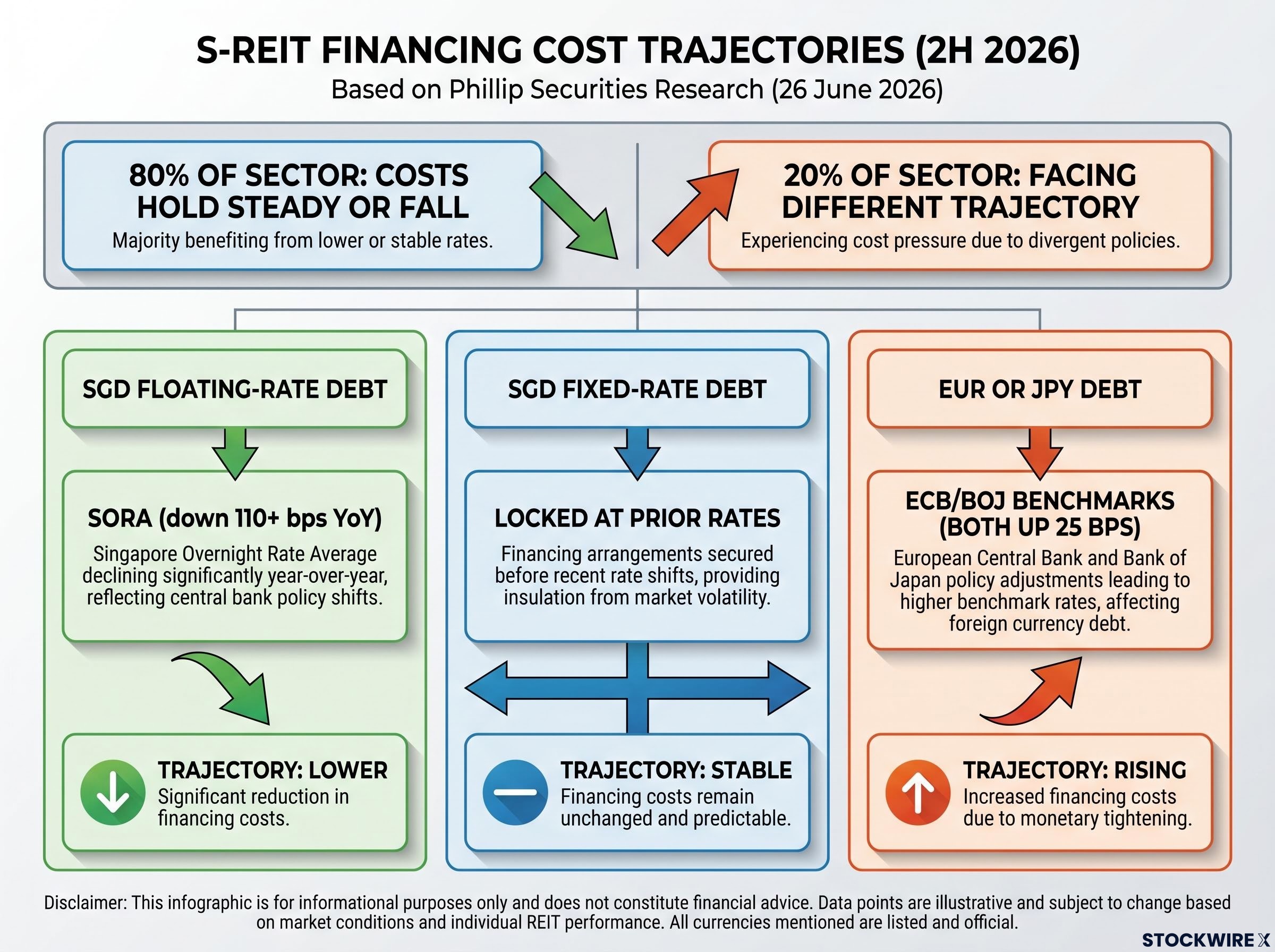
| Funding Type | Rate Benchmark Exposure | Financing Cost Trajectory in 2H 2026 |
|---|---|---|
| SGD floating-rate debt | SORA (down 110+ bps YoY) | Lower, capturing the full tailwind |
| EUR or JPY debt | ECB/BOJ benchmarks (both up 25 bps) | Rising, moving against the sector trend |
| SGD fixed-rate debt | Locked at prior rates | Stable; benefit deferred but downside protected |
SGD-funded trusts with floating-rate exposure capture the full SORA benefit. Their financing costs are falling in real time as debt rolls over at lower benchmarks.
EUR and JPY borrowers face the opposite dynamic. The ECB and BOJ both hiked 25 bps in June 2026, pushing their local benchmarks higher. The SORA decline is irrelevant to foreign-currency debt. These trusts are experiencing a materially different, and potentially adverse, financing cost trajectory.
The ECB June 2026 rate decision, confirmed in the Governing Council’s official press release, raised all three key ECB interest rates by 25 basis points, directly increasing the benchmark cost of EUR-denominated debt that some S-REITs carry on their balance sheets.
Fixed-rate trusts sit in between. Those that locked in higher rates when SORA was elevated do not immediately benefit from today’s lower benchmarks. But they gain resilience: if global tightening eventually lifts SGD rates again, their costs are already locked. The selection framework embedded in the Phillip Securities call tilts toward trusts carrying a greater share of fixed-rate debt, reflecting a view that protecting the balance sheet from benchmark rate swings takes precedence over maximising near-term floating-rate gains.
The 80% projection is a sector-level signal, not a stock-picking shortcut. It tells you the centre of gravity is positive, but the 20% facing headwinds will drag returns if held indiscriminately alongside the beneficiaries.
What the OVERWEIGHT call is actually based on
Phillip Securities Research maintains an OVERWEIGHT sector rating on Singapore REITs, published 26 June 2026.
The label is one thing. The reasoning behind it is what matters.
Phillip’s constructive stance rests on three supporting pillars, not just the SORA trajectory. First, easing financing costs for approximately 80% of the sector, driven by the SORA decline and the predominance of SGD-denominated debt among domestically focused trusts. Second, stronger capital structures across the sector, with manageable gearing levels, staggered debt maturity profiles, and demonstrated access to capital markets. Third, retail sub-sector conditions that are supportive, with healthy occupancy levels, income backed by tenant performance, and a new supply pipeline that remains constrained.
The stock selection criteria embedded in the call reinforce that the rating is selective, not a blanket endorsement:
- Contained gearing ratios combined with extended debt maturities, keeping near-term refinancing pressure low.
- Earnings defensiveness via stable, recurring income streams and resilient tenant bases.
- A higher weighting toward fixed-rate debt, which limits exposure to benchmark rate movements regardless of direction.
- Retail sub-sector exposure, where occupancy trends and a limited pipeline of competing new supply provide a supportive backdrop.
The fact that Phillip anchors its call on balance sheet quality and sub-sector dynamics, not just SORA trajectory, tells you the analysts see this as a durable setup. If the constructive thesis were purely a rate trade, the selection criteria would focus on floating-rate exposure alone. Instead, they emphasise resilience, which signals a view that the sector’s positioning can withstand further global rate volatility.
S-REIT sub-sector dynamics diverge significantly beneath the sector-level OVERWEIGHT label, with industrial and logistics assets benefiting from e-commerce and near-shoring tailwinds while office REITs face a structural demand reset that balance sheet strength alone cannot offset.
Understanding these pillars lets you track whether they remain intact quarter by quarter. If retail occupancy deteriorates or gearing creeps up, the same framework that justified the OVERWEIGHT becomes the basis for revisiting it.
Where the constructive case could break down
The constructive thesis has specific failure points. Knowing them is what separates monitoring the position from simply holding it.
Four risk channels warrant attention:
- Upward pressure on SORA via capital flows if global tightening drives capital out of SGD assets, raising SGD funding costs independently of official monetary policy.
- Wider credit spreads offsetting the SORA benchmark decline at the point of refinancing.
- Adverse FX and funding dynamics for EUR and JPY-exposed trusts, following confirmed ECB and BOJ rate increases.
- Persistence of higher global rates eventually lifting SGD benchmarks, eroding the current tailwind.
The credit spread risk is the one most likely to catch investors off guard. All-in borrowing costs are calculated as benchmark (SORA) plus credit spread. Even if SORA holds steady at 1.08%, a trust facing wider credit spreads at refinancing can see its total borrowing cost rise. A trust can be fully SGD-funded with floating-rate debt and still face rising all-in costs if its credit quality is questioned when debt rolls over.
The relationship between benchmark rate movements and REIT returns is not linear in either direction; the 10-year Treasury yield, credit spread dynamics, and sub-sector fundamentals each introduce variables that can decouple distributable income outcomes from what a central bank policy rate change alone would imply.
The capital flow channel is more indirect but equally important. Singapore’s monetary policy framework operates through the exchange rate rather than a domestic policy rate. If global tightening drives sustained capital outflows from SGD assets, SGD funding costs may rise through market mechanisms rather than central bank action, a pathway most retail investors do not monitor.
EUR and JPY borrowers face a confirmed, not hypothetical, headwind. Both the ECB and BOJ moved 25 bps higher in June 2026. For trusts with material foreign-currency debt, the SORA story is simply not their story.
Knowing which specific variables could invalidate the thesis allows you to monitor the setup actively rather than treating a sector call as a set-and-forget decision.
Three debt metrics to check before taking a position in any S-REIT
The analysis points to a constructive sector setup. Translating that into individual trust selection requires a screening process, not a sector-level conviction applied uniformly.
Three debt metrics, assessed in sequence, separate the trusts that benefit structurally from those that merely look attractive under the sector-level OVERWEIGHT label:
- Debt currency breakdown: How much is denominated in SGD versus foreign currencies (EUR, JPY, USD)? This determines which benchmark rate applies. A trust with 80% SGD debt prices off SORA. A trust with 40% EUR debt prices a significant portion off ECB benchmarks, which are moving higher.
- Fixed versus floating ratio and maturity profile: What proportion of debt is fixed, at what rates, and when do fixed tranches roll off? This determines how quickly rate changes feed through to actual interest expense.
- Weighted average cost of debt and near-term refinancing schedule: What proportion of total debt matures in the next 12-24 months, and at what implied cost? This is the specific pressure point where SORA levels and credit spreads converge to set the trust’s forward financing cost.
These three metrics connect directly to the analytical framework already established. Currency links to the SORA versus ECB/BOJ discussion. Fixed/floating ratio links to the hedging tradeoff. Refinancing schedule links to the risk layer.
Beyond the debt screening, Phillip Securities’ approach implies a two-filter investment structure:
| Filter Level | What to Assess |
|---|---|
| Primary filter: balance sheet strength | Gearing ratio, debt maturity profile, capital market access |
| Secondary filter: sub-sector and asset quality | Location quality, tenant mix durability, occupancy rates within the favoured sub-sector |
The retail sub-sector is where the second filter applies most directly in this cycle, given the occupancy and limited supply dynamics supporting the Phillip Securities call. But the primary filter, balance sheet strength, comes first. A trust in the right sub-sector with a weak balance sheet is not a beneficiary; it is a risk.
Investors wanting to apply the three-metric debt screening process to specific trusts will find our dedicated guide to evaluating Singapore REITs covers the full seven-part analytical framework, including how to assess interest coverage ratios and weighted average lease expiry alongside debt structure.
What the current cycle actually rewards in an S-REIT investor
The central argument is straightforward: investors who apply global rate headlines to S-REITs as a bloc will systematically reach the wrong conclusions. Investors who work from SORA, debt structure, and balance sheet quality will find a sector with a more constructive underlying setup than the headlines suggest.
The durability of that setup depends on two variables you can track. First, SORA staying near or below year-ago levels, sustaining the financing cost tailwind for SGD-funded trusts. Second, credit spreads remaining contained, so the SORA benefit is not offset at the point of refinancing.
Phillip Securities’ OVERWEIGHT rating, published 26 June 2026, is the current-period starting frame. The 80% projection, that the majority of S-REITs will experience stable or lower financing costs, holds while SORA remains supportive and credit conditions cooperate. It is not a perpetual verdict. It is a position anchored to specific conditions that you now have the tools to monitor.
The investor who walks away from this analysis with a monitoring framework, not just a directional signal, is better positioned to act decisively when conditions shift rather than reacting after the move has already happened.
This article is for informational purposes only and should not be considered financial advice. Investors should conduct their own research and consult with financial professionals before making investment decisions. Forward-looking statements, including rate projections and financing cost estimates, are subject to change based on market developments and monetary policy decisions.