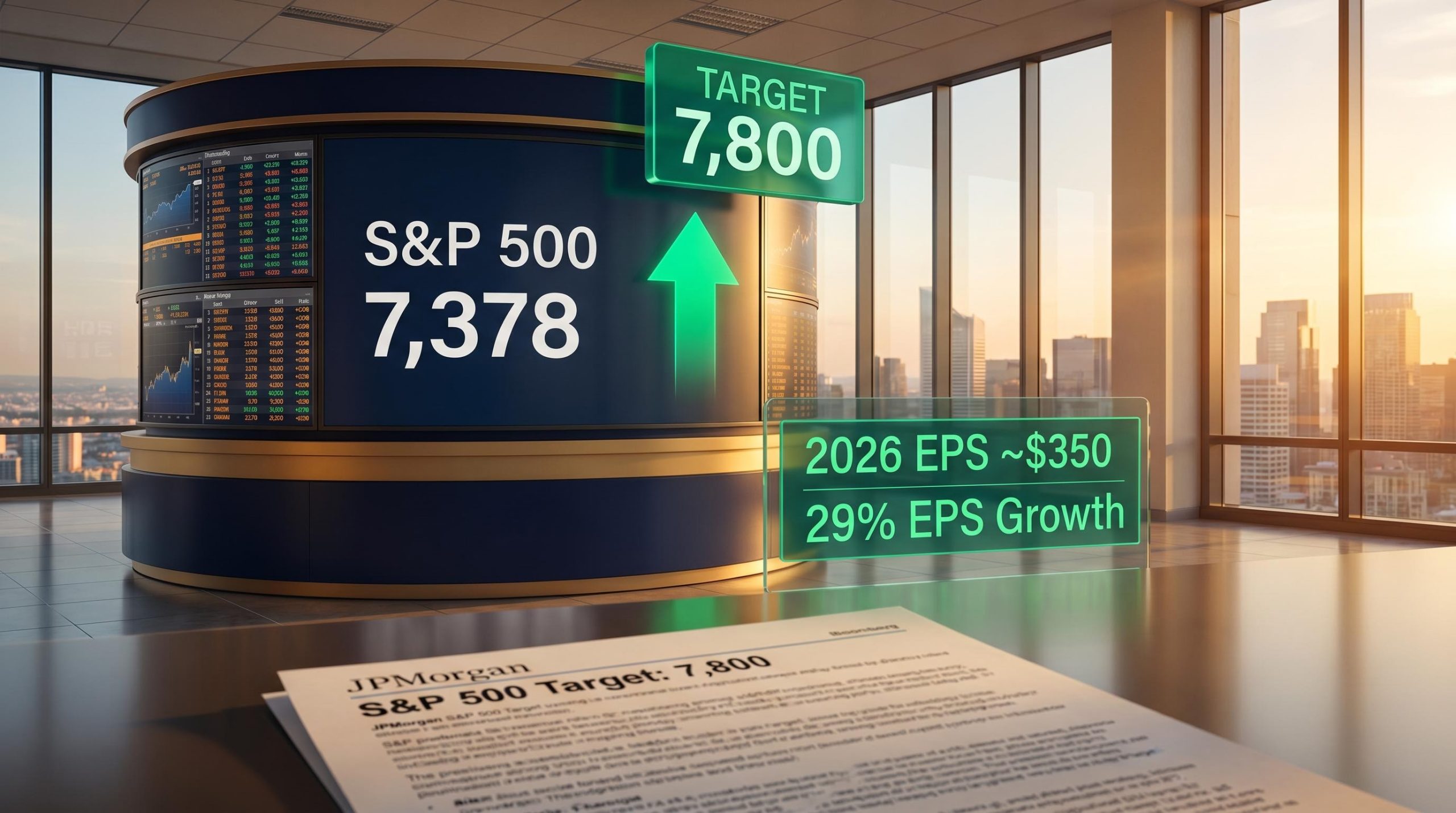
The S&P 500 is sitting near 7,378. JPMorgan just told clients it should be at 7,800 by year-end, and the reason is not a recovering economy. It is artificial intelligence spending generating earnings upgrades at a magnitude the bank says is almost never seen outside a post-downturn rebound.
When Dubravko Lakos-Bujas, Head of Global Markets Strategy at J.P. Morgan, publishes a mid-year revision, institutional and retail investors use it to recalibrate positioning. The note landed today, 24 June 2026. The prior target was 7,600, set in April 2026, making this the second upward revision in under three months.
Here is the full architecture of JPMorgan’s view: the EPS numbers driving the call, the sectors they favour, the risks they say could still break this rally, and the below-consensus 2027 signal most investors will miss. That is what you need before deciding how to respond.
What the new 7,800 target actually implies for the market right now
The arithmetic is straightforward. JPMorgan’s revised target of 7,800 implies roughly 5-6% upside from the late-June level of approximately 7,350-7,400. That puts the bank at the most bullish end of Wall Street’s forecast range, a positioning choice that signals conviction.
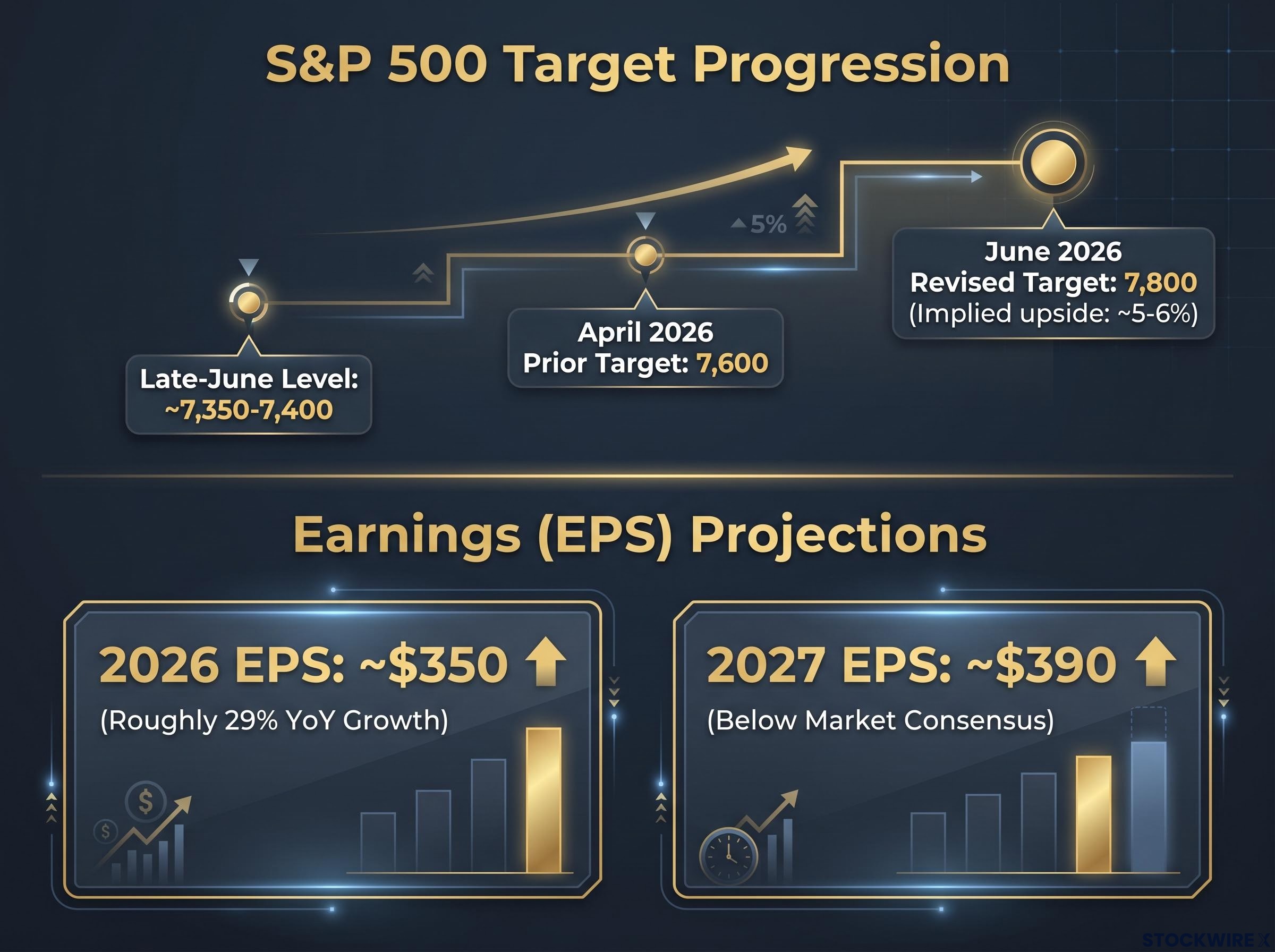
| Metric | Prior (April 2026) | Revised (June 2026) |
|---|---|---|
| Year-end S&P 500 target | 7,600 | 7,800 |
| S&P 500 level at note date | ~7,350-7,400 | |
| Implied upside | ~5-6% | |
But the 5-6% sounds modest for a reason. JPMorgan is explicitly framing this as an earnings-delivery story, not a valuation re-rating story. The bank believes the market is appropriately valued right now and that only EPS growth can carry it higher. That distinction matters: if multiples are already full and the thesis rests entirely on earnings delivery, any guidance miss hits harder than it would if valuation headroom existed.
Bank of America’s parallel analysis complicates the picture: the bank raised its 2026 EPS estimate to $335 while holding its year-end price target at 7,100, an explicit signal that extraordinary earnings are already priced in at a market trading 20% above its historical forward P/E average, which sits as a direct counterpoint to JPMorgan’s conviction that EPS delivery alone can drive further index gains.
JPMorgan expects the path to 7,800 to be “uneven rather than a straight-line progression,” a qualifier that tempers the headline optimism with an acknowledgement of positioning risks along the way.
When big ASX news breaks, our subscribers know first
How AI capital spending is producing earnings growth at a historically unusual pace
Start with the spending itself. AI-related capital expenditure has roughly doubled in scale, flowing into data centres, semiconductors, power infrastructure, and software. That is not a single-quarter spike. It is a sustained reallocation of corporate budgets that is now showing up directly in S&P 500 earnings estimates.
The areas absorbing the bulk of AI capex include:
- Data centres and cloud infrastructure
- Semiconductor production and design
- Power infrastructure to support compute demand
- Enterprise AI software and services
What makes this cycle unusual is the speed and scale of the earnings revisions it has triggered. Across the next two years, consensus earnings growth estimates have been lifted by around 20%, tracking closely with the acceleration in AI capital spending. JPMorgan characterises this as a “pseudo-recovery” dynamic, meaning the pattern of upward earnings revisions is of a type the bank says is almost exclusively associated with post-shock or post-recession recoveries, even though no recession has taken place. The spending itself is doing the work that an economic rebound normally does.
The hyperscaler AI capex commitments underpinning this cycle are not evenly distributed across the year: Amazon, Microsoft, Alphabet, and Meta collectively spent $130 billion in Q1 2026 alone, with full-year combined guidance reaching approximately $725 billion, the direct pipeline feeding the earnings upgrades JPMorgan is now projecting.
In April 2026, Anthropic made an announcement that JPMorgan pointed to as evidence the AI buildout is converting into real commercial revenue rather than remaining a purely infrastructure story, lending further credibility to the earnings thesis.
The EPS numbers behind the call
JPMorgan’s 2026 S&P 500 EPS estimate sits at approximately $350, reflecting projected year-over-year growth of roughly 29%. That is extraordinary for a non-recessionary environment. A 29% earnings growth projection outside of a post-downturn rebound has very little historical precedent, and it tells you exactly what the load-bearing pillar of this entire bull case is. If AI capex growth stalls or AI services fail to monetise at scale, the earnings story unravels.
JPMorgan’s 2027 EPS projection lands at roughly $390, a figure the bank has consciously placed beneath where the broader market currently expects earnings to land, and that gap deserves attention. JPMorgan is bullish on the near term and cautious beyond it.
How JPMorgan is positioning across sectors, and where it sees diminishing upside
The sector calls translate the macro thesis into specific portfolio choices. JPMorgan’s overweight positions span four areas: technology and AI infrastructure (direct capex beneficiaries), defence, banks, and higher-quality healthcare names selected on a case-by-case basis. The connecting logic is that each offers exposure to the AI-driven cycle without carrying the full concentration risk of the largest AI names. Defence and banks, in particular, are JPMorgan’s way of participating without adding to the most crowded positions.
| Sector | JPMorgan stance |
|---|---|
| Technology and AI infrastructure | Overweight |
| Defence | Overweight |
| Banks | Overweight |
| Healthcare (higher-quality, selective) | Overweight |
| Energy | Profit-taking |
Then there is the energy call, the most counterintuitive recommendation in the note.
With roughly 19% in gains accumulated year-to-date and a genuine connection to AI-driven power demand, energy is nonetheless a sector where JPMorgan believes the available upside has already been absorbed into current prices. The bank is telling investors that even a sector with a real fundamental tailwind can be too expensive to own when the gains have already run.
Progress in U.S.-Iran diplomatic talks was noted as a contributing factor to the bank’s more constructive overall stance, though it sits alongside the AI thesis rather than driving it. That is useful discipline for evaluating any crowded trade: a genuine tailwind is not the same as remaining upside.
Three risks JPMorgan says could still break this rally
JPMorgan pairs the upgraded target with three specific risk mechanisms, each credible enough that the bank uses them to explain why the path to 7,800 will be uneven. These are not boilerplate disclaimers. They are the structural reasons the call comes with qualifiers.
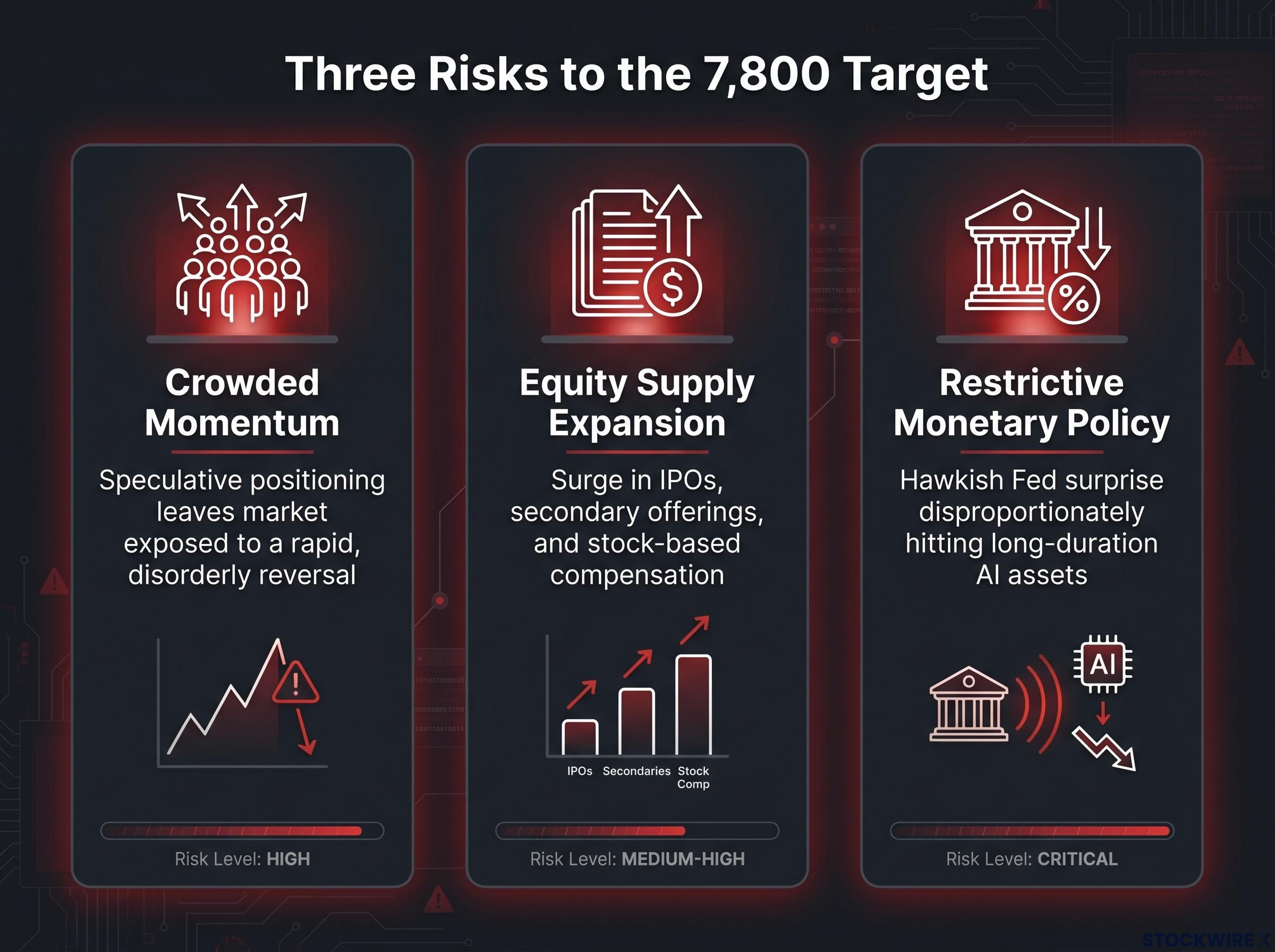
- Crowded momentum and speculative positioning. Heavy positioning in momentum-driven strategies, concentrated especially in lower-quality and speculative growth names, leaves the market exposed to a rapid, disorderly reversal. JPMorgan identifies this as the most acute near-term risk. When positioning is this extended, the trigger for a flash-crash event does not need to be large.
The crowded momentum risk JPMorgan flags connects to a documented structural feature of the current rally: narrow market breadth, with only 23% of S&P 500 constituents outperforming the benchmark in April 2026, the fourth-lowest reading in nearly four decades, a concentration dynamic that leaves the index disproportionately exposed if the handful of AI and semiconductor names driving headline gains stall.
- Equity supply expansion. A surge in new share issuance across IPOs, secondary offerings, and stock-based compensation programmes is adding materially to the pool of equities in circulation. Even if earnings hold, more shares chasing the same pool of capital weighs on multiples. This is a structural headwind to further valuation re-rating.
- Monetary policy becoming more restrictive. A hawkish surprise from the Fed would pressure the long-duration growth assets that currently dominate index weights.
Why the Fed risk hits hardest on the AI trade specifically
AI and high-growth assets are long-duration by nature, meaning their valuations are more sensitive to changes in discount rates than value or cyclical stocks. When the Fed tightens more than the market expects, the present value of distant future earnings compresses disproportionately.
The FOMC June 2026 rate decision, issued one week before JPMorgan’s note, held the federal funds rate steady while acknowledging persistent uncertainty in the inflation outlook, a backdrop that makes any hawkish deviation in the months ahead a more credible risk than it would be in a clearly easing cycle.
The S&P 500 is AI-heavy at current index weights. A Fed surprise would not hit the index evenly; it would hit the sector JPMorgan is most constructive on the hardest. If you hold large-cap AI and growth positions, this is the risk scenario that deserves the most attention.
What JPMorgan’s below-consensus 2027 earnings view reveals about the limits of this trade
The headline number is 7,800. The more strategically significant signal may be JPMorgan’s 2027 EPS projection of approximately $390, which the bank has positioned meaningfully below where current market consensus sits.
JPMorgan is saying something specific with that gap: the bank believes AI services will commoditise as the market matures, compressing the pricing advantages that are currently sustaining the extraordinary 29% earnings growth rate projected for 2026. The current phase of AI-driven upgrades is powerful, but it has a finite shelf life.
JPMorgan explicitly frames the current extraordinary phase of AI-driven upgrades as having a finite shelf life that investors need to watch closely.
For investors wanting to stress-test the monetisation assumptions inside JPMorgan’s 2027 earnings projections, our full explainer on AI commoditisation risks examines how token price declines, near-zero switching costs, and airline-style capital intensity dynamics could compress foundation model margins well before the bank’s normalisation timeline arrives.
This creates a two-act structure embedded in JPMorgan’s own thesis. Act 1 is the near-term AI capex boom that drives 2026 earnings above consensus. Act 2 is the normalisation risk that makes 2027 more complicated, as competition compresses margins and the spending impulse matures.
Raising the 2026 target while staying below consensus on 2027 earnings is the bank telling investors the window for this trade is open but not infinite. Timing the transition from extraordinary to ordinary earnings growth is the actual hard problem here, and JPMorgan’s own numbers suggest it arrives sooner than the market currently expects.
What the JPMorgan call changes, and what investors still need to answer for themselves
JPMorgan’s 7,800 target is credible if AI capex flows into earnings as projected, sector positioning captures the cycle’s beneficiaries without excessive concentration, and the below-consensus 2027 call is the built-in caution that keeps the thesis from being naive. That is a coherent framework, not a simple buy signal.
The question now is what observable data will confirm or challenge this view over the next six months. Four signals to monitor:
- AI capex announcements from major cloud and semiconductor companies in upcoming earnings seasons
- S&P 500 EPS revision trends, particularly whether the upward revision cycle sustains or plateaus
- Federal Reserve communications on the rate path, especially any hawkish surprises
- Equity issuance volumes, including IPO activity and secondary offerings that expand share supply
JPMorgan’s upgraded target is not a prediction that markets rise in a straight line. It is a framework for understanding what a validated bull case looks like, and what the early warning signs of a breakdown would be.
This article is for informational purposes only and should not be considered financial advice. Investors should conduct their own research and consult with financial professionals before making investment decisions. Past performance does not guarantee future results. Financial projections are subject to market conditions and various risk factors.