Cerebras Posts 94% Revenue Growth, Stock Falls 7% on Margin Fears
9 hrs ago

Westpac has just pulled its new Chief Information Officer directly out of Macquarie Group, one of the ASX’s strongest performers in 2026. That alone tells you something about how seriously the bank is treating the next phase of its technology programme.
The appointment of Richard Heeley comes as Westpac accelerates its core banking modernisation, with the incoming CIO taking responsibility for the bank’s infrastructure, cybersecurity, and engineering functions at an institution that has placed technology execution at the centre of its strategy. The hire lands against a backdrop of meaningful share price divergence between the two institutions this year, with Macquarie up roughly 22% year-to-date while Westpac sits approximately 7% lower.
What follows is a clear read on what this hire tells investors about where Westpac’s technology strategy is heading, and whether the market’s modest reaction on announcement day reflects the appointment’s actual significance.
Westpac confirmed the appointment via an ASX release on 24 June 2026. Richard Heeley holds the CIO position covering Banking and Financial Services at Macquarie Group and is set to move across to Westpac at some point later this year, taking on the role vacated by Scott Collary, who is stepping down into retirement.
CEO Anthony Miller pointed to Heeley’s depth of experience running significant digital transformation programmes inside retail banking environments as the key qualification for the role. That characterisation understates the depth of the resume.
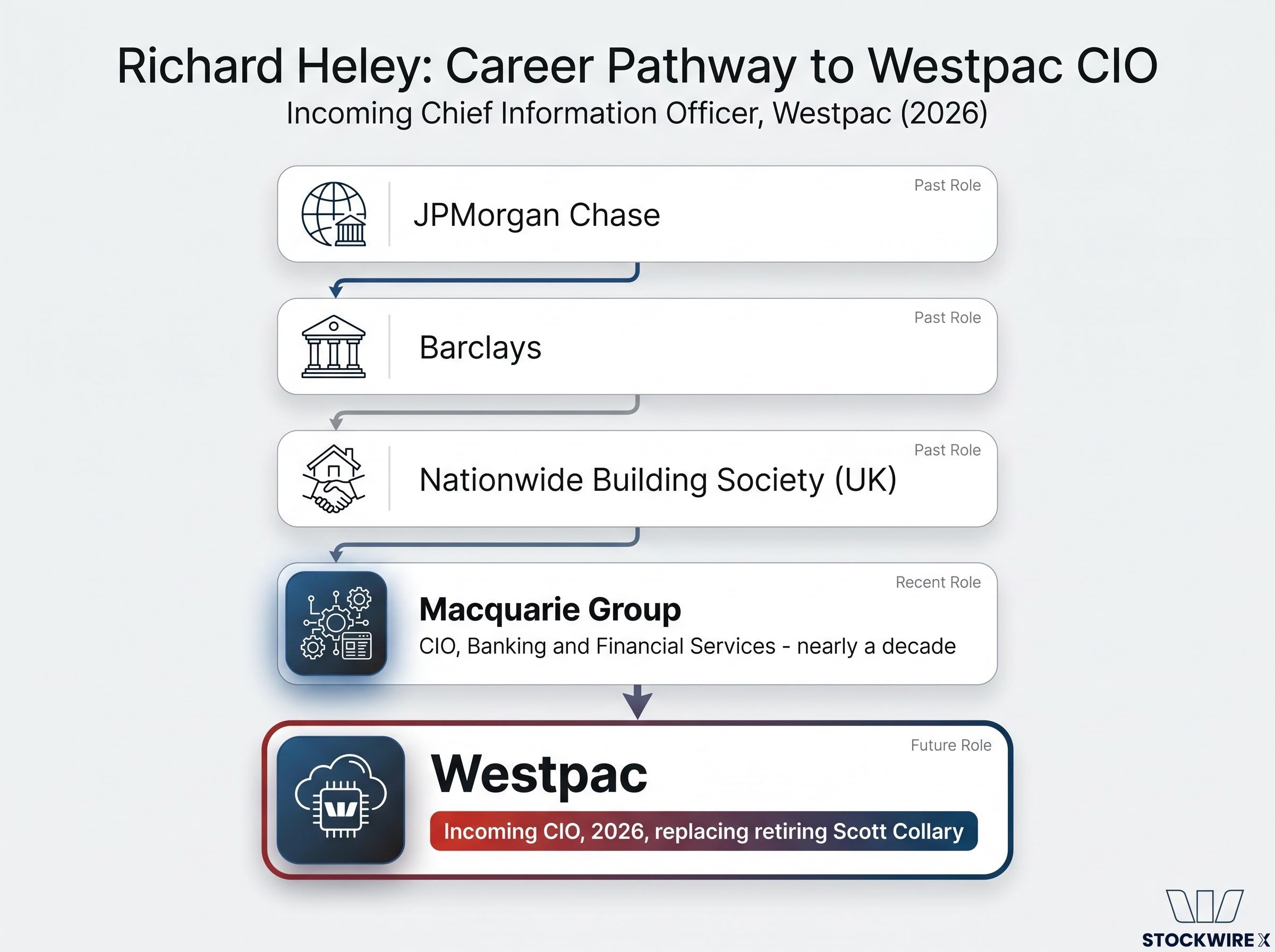
Heeley’s career spans nearly a decade at Macquarie’s banking division, preceded by senior technology leadership at some of the largest financial institutions in the UK and the US:
Nearly a decade at Macquarie’s banking division, combined with major UK and US institutional experience, means Heeley arrives with a track record in exactly the kind of complex, high-stakes technology environments Westpac now needs to navigate. This is not a lateral move within the same tier. It is a hire from a demonstrably higher-performing institution.
The scope of the role tells you more than the title does.
Heeley will have direct oversight of three core functions:
He will also collaborate closely with four divisions that sit at the forward edge of Westpac’s digital ambitions:
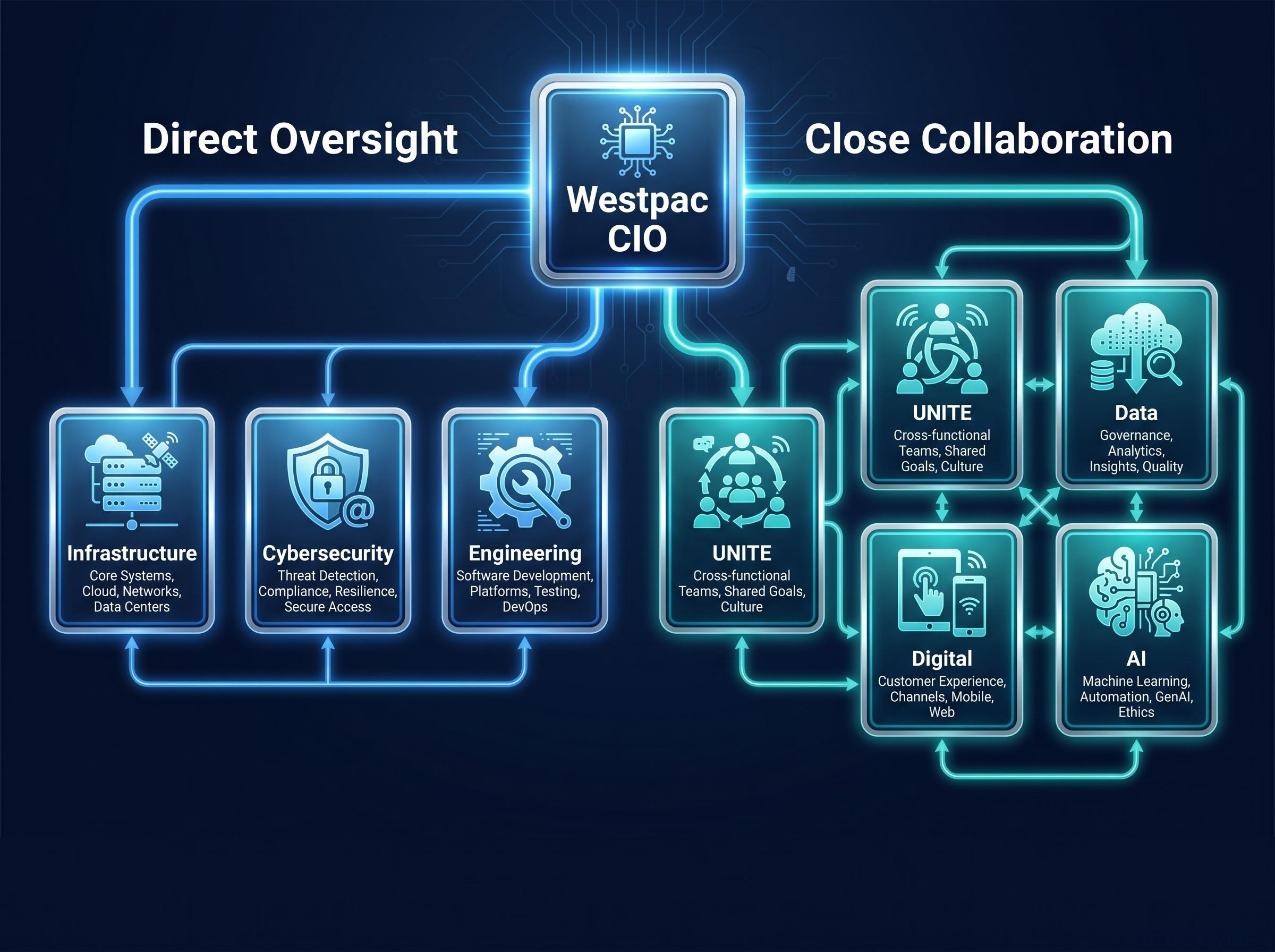
That structure means the CIO role is not a back-office technical position. Heeley’s remit spans both the legacy system modernisation that underpins the core banking programme and the AI and data functions that represent the bank’s growth-facing technology investments.
For investors, the breadth of this mandate is the most direct indicator of how Westpac is organising its technology spend. The bank is treating the CIO as a connective layer between its infrastructure overhaul and its digital ambitions, not a narrowly siloed engineering job. The execution risk sits in exactly that connective space.
CBA’s technology leadership restructure, announced just days earlier, took a structurally different approach: splitting the single CIO role into a dedicated Group CIO for customer-facing delivery and a Group CTO for enterprise infrastructure and AI, a comparison that sharpens the question of whether Westpac’s consolidated CIO model will carry equivalent execution accountability.
The UNITE programme sits at the centre of Heeley’s incoming remit: it has completed 8 of 57 initiatives, decommissioned 27 legacy systems, and committed $850-900 million in FY26 investment, yet roughly 90% of the targeted application reduction still lies ahead, making it one of the most consequential technology deliverables in Australian banking.
Westpac has been directing sustained investment toward core system modernisation, cybersecurity, and operational simplification. The bank has consistently articulated a goal of becoming a simpler, faster, and more digitally capable organisation.
Westpac’s 1H26 financial results showed the cost-to-income ratio at 51.7%, approximately 3.7 percentage points above the major bank peer average, a gap that frames the technology programme not as an IT project but as the primary mechanism by which the bank narrows a structural efficiency deficit versus its competitors.
That sounds like corporate boilerplate until you consider the scale of what core banking modernisation actually involves. A programme of this kind requires a bank to replace or rebuild the systems that process every transaction, every account, and every customer interaction, while those systems remain live. The execution risks are real and well-documented: cost overruns, delivery delays, and operational disruptions that can affect both customers and earnings.
Core banking modernisation is among the most complex technology undertakings a retail bank can attempt. The cost profile is measured in billions, the delivery timeline in years, and the failure modes range from budget blowouts to service outages.
When programmes of this kind are delivered well, the benefits typically include stronger customer outcomes, lower operational complexity, and efficiency improvements that compound over time, but these benefits are medium-term rather than immediate. Westpac’s outlook on this front is tied to programme milestones, not next quarter’s earnings.
APRA’s CPS 234 information security standard sets binding requirements for Australian banks to maintain information security capabilities commensurate with the size and extent of threats to their operations, which places the cybersecurity component of Heeley’s mandate inside a tightly defined regulatory framework from day one.
Westpac CEO Anthony Miller noted that Heeley has a strong background in large-scale digital transformation within retail banking and will lead the next stage of the bank’s technology overhaul.
For investors evaluating Westpac as a technology-led transformation story, the appointment of a high-calibre external CIO is a governance signal that the board takes execution risk seriously. It is not a guarantee of delivery.
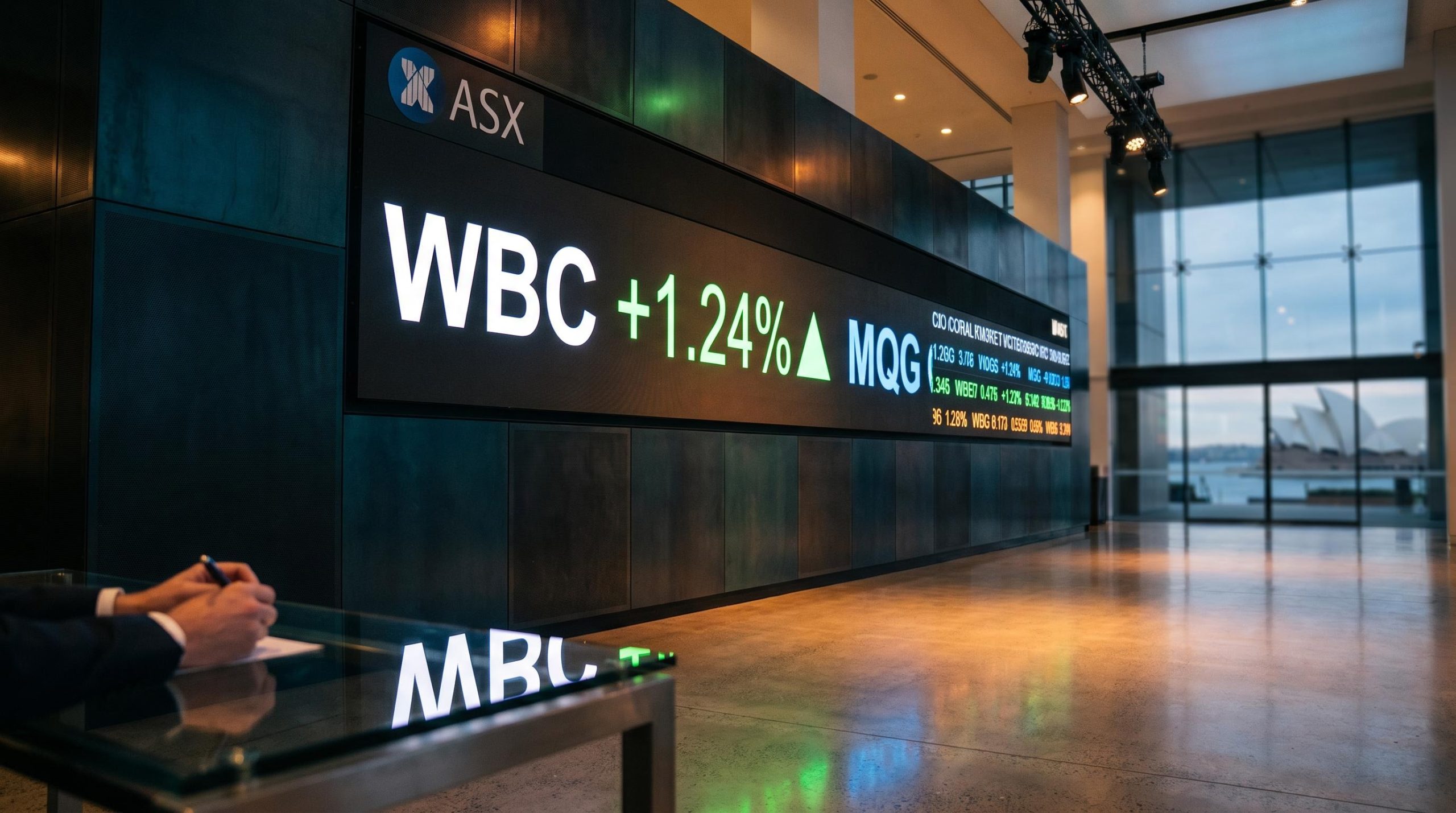
The market’s reaction on 24 June 2026 was positive but contained. Westpac shares gained 1.24% through the session, reaching $35.92 at their intraday peak. Macquarie barely moved, edging down 0.05% to close at $249.28.
The more instructive picture is the year-to-date divergence between the two institutions.
Macquarie’s record FY26 result, a $4.85 billion net profit up 30% on the prior year with all four divisions delivering double-digit growth, is the institutional context behind the 22% year-to-date share price gain that makes Heeley’s departure a more significant signal than a standard CIO transition would carry.
| Metric | Westpac (ASX: WBC) | Macquarie (ASX: MQG) |
|---|---|---|
| Share price on 24 June 2026 | $35.92 | $249.28 |
| Intraday movement | +1.24% | -0.05% |
| YTD 2026 performance | Approximately -7% | Approximately +22% |
The 29-percentage-point YTD gap between the two institutions tells you the market is assigning materially different growth narratives to a domestically focused retail bank and a globally diversified capital markets group. That narrative gap is the backdrop against which Heeley’s move should be read. He is leaving a stock that has rewarded shareholders handsomely in 2026 for one that has not.
A 1.24% intraday move is not the market pricing in a transformation. It is the market acknowledging a sensible appointment. The distinction matters.
The Heeley hire is best understood as a constructive governance and execution signal, not a near-term earnings catalyst.
Westpac’s valuation headwinds are structural: domestic retail bank growth has been slower than global capital markets growth, and that gap explains most of the performance divergence with Macquarie. A CIO appointment does not change the revenue mix. What it can change is the probability of credible delivery on a technology programme that the bank has staked a significant portion of its medium-term strategy on.
The execution risks remain. Cost overruns, delays, and operational disruptions are features of programmes at this scale, not edge cases. But bringing in a CIO with nearly a decade at Macquarie and deep UK institutional experience improves the odds that the programme is led by someone who has navigated comparable complexity before.
Investors who view Westpac purely through a near-term earnings lens will underweight this hire. Those assessing the bank’s medium-term digital transformation credibility will recognise it as a meaningful signal about management’s seriousness, even if it moves no numbers today.
This article is for informational purposes only and should not be considered financial advice. Investors should conduct their own research and consult with financial professionals before making investment decisions.
Westpac has appointed one of the ASX banking sector’s most credentialed technology leaders to run the next phase of its core modernisation programme. Heeley’s remit is broad, his experience is specific to the challenge, and the hire from a high-performing institution adds weight to the board’s intent.
The market’s verdict will not arrive on announcement day. It will arrive through programme milestones, technology investment disclosures in future results, and whether Heeley’s start date later in 2026 marks the beginning of a measurably different execution trajectory. Those are the data points to watch.
—
Richard Heeley has been appointed as Westpac's new Chief Information Officer. He joins from Macquarie Group, where he served as CIO of Banking and Financial Services for nearly a decade, and previously held senior technology roles at Nationwide Building Society, Barclays, and JPMorgan Chase.
UNITE is Westpac's core banking modernisation programme, which has completed 8 of 57 initiatives, decommissioned 27 legacy systems, and committed $850-900 million in FY26 investment. Roughly 90% of the targeted application reduction still lies ahead, making it one of the most consequential technology deliverables in Australian banking.
Heeley will have direct oversight of Westpac's infrastructure, cybersecurity, and engineering functions, and will collaborate closely with the bank's UNITE, Data, Digital, and AI divisions, spanning both legacy system modernisation and the bank's growth-facing technology investments.
Westpac shares gained 1.24% on 24 June 2026, reaching an intraday peak of $35.92, a positive but contained reaction that reflects the market acknowledging a sensible appointment rather than pricing in a near-term earnings catalyst.
As of the announcement date, Macquarie was up approximately 22% year-to-date in 2026 while Westpac sat approximately 7% lower, a 29-percentage-point gap that reflects materially different growth narratives between a globally diversified capital markets group and a domestically focused retail bank.