
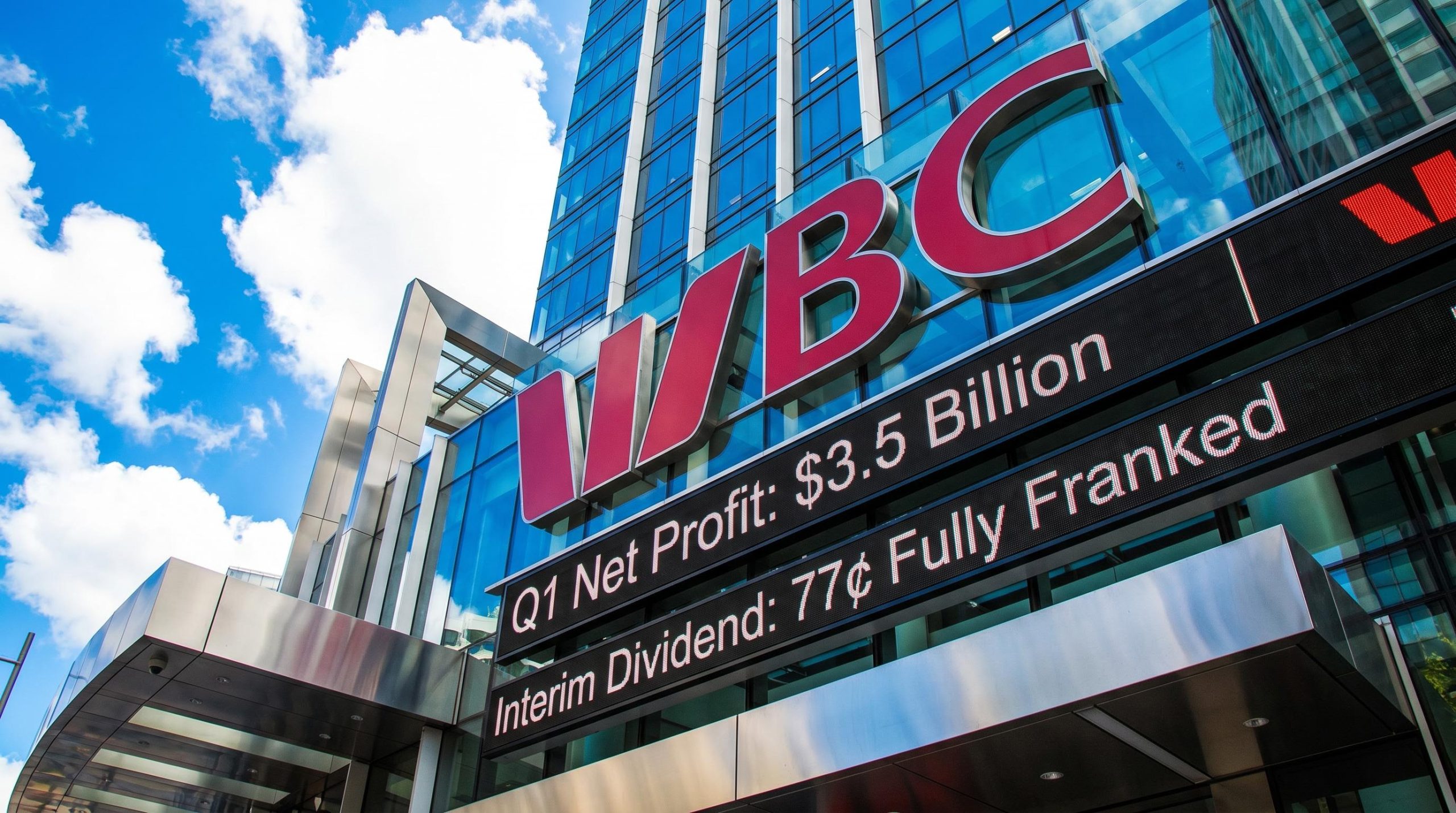
Westpac delivers $3.5 billion profit as lending momentum accelerates
Westpac Banking Corporation has reported a net profit excluding notable items of $3.5 billion for the first half of 2026 (1H26), down 1% on the second half of 2025 but up 1% on the prior corresponding period. The results, detailed in its April 2026 investor presentation, highlight the bank’s ability to balance shareholder returns with balance sheet strength while advancing its multi-year transformation programme.
The bank declared an interim ordinary dividend of 77 cents per share, fully franked, representing a 1% increase on 1H25. With a Common Equity Tier 1 (CET1) capital ratio of 12.4%, Westpac maintains $2.7 billion in surplus capital above its 11.25% operating target, providing optionality for future distributions or strategic investment. Return on tangible equity excluding notable items stood at 11.0%, down 7 basis points on 1H25.
Management emphasised the stable profit and maintained dividend signal the bank’s capacity to deliver consistent returns in a challenging operating environment characterised by geopolitical uncertainty and elevated interest rates.
When big ASX news breaks, our subscribers know first
What is pre-provision profit and why does it matter for bank investors?
Pre-provision profit measures a bank’s core operating performance before accounting for loan losses, stripping out impairment charges that can fluctuate with economic conditions to reveal the durability of the underlying franchise. Westpac’s pre-provision profit rose 4% to $5.5 billion in 1H26, demonstrating underlying business strength despite the challenging external environment.
This improvement was driven by disciplined cost management. Operating expenses fell 6% to $5.8 billion, or 2% excluding a restructuring charge taken in the second half of 2025. The cost-to-income ratio improved 16 basis points to 51.7%, reflecting productivity initiatives including a simpler operating model, reduced property footprint, and early benefits from the UNITE transformation programme.
For investors, rising pre-provision profit indicates Westpac’s revenue engine and cost discipline are improving regardless of credit cycle volatility, underpinning the bank’s ability to sustain returns through different economic scenarios.
Loan and deposit growth outpaces major bank system
Westpac reported balance sheet momentum across both sides of its ledger. Gross loans grew 7% over the year to $890 billion, while customer deposits increased 7% to $745 billion. The deposit-to-loan ratio of 84% is up 15 percentage points over the past decade, reflecting a more stable funding base that reduces reliance on wholesale markets.
Mortgage performance lifts as proprietary channel strengthens
Australian mortgage balances (excluding RAMS) reached $518 billion, growing at 1.2 times system in 1H26. The presentation outlined how proprietary mortgage flow improved to 34% of new lending, up from 32.4% in 1H25, as the bank invested in Home Finance Managers and accelerated onboarding.
Service levels improved materially, with median proprietary time-to-decision falling to 3.8 days from 4.6 days in 1H25. Brand consideration rose to #2, up from #4, indicating the bank’s customer experience initiatives are gaining traction in a competitive market.
Business and institutional lending surges
Business lending within the Business & Wealth segment grew 13% to $120 billion, with 70% of new lending directed to existing customers. Institutional lending rose 23% to $131 billion, with Westpac maintaining its position as Australia’s largest lender to renewable energy and project finance.
Growth was concentrated in target sectors aligned with the bank’s strategic focus: Agriculture up 15%, Health up 19%, and Professional Services up 11%.
| Metric | Mar-25 | Mar-26 | Change |
|---|---|---|---|
| Gross loans | $829bn | $890bn | +7% |
| Customer deposits | $697bn | $745bn | +7% |
| Deposit-to-loan ratio | 84.5% | 84.2% | Stable |
Revised economic outlook drives higher impairment provisions
Impairment charges rose to 10 basis points of average loans (annualised), up from 4 basis points in the second half of 2025, as the bank revised its base case economic forecasts to incorporate the impacts of the Middle East conflict. Total credit impairment provisions reached $5.2 billion, with $1.9 billion held above the base case scenario, providing a significant buffer against potential credit deterioration.
The bank reduced its GDP growth forecast to 1.0% for December 2026 (previously 2.4%), raised its inflation forecast to 4.6% (previously 2.7%), and increased its cash rate forecast to 4.85% (previously 3.6%). These more conservative assumptions drove the increase in collective provisions, particularly for Stage 1 and Stage 2 exposures.
Despite the higher provisioning, asset quality metrics remained resilient. Stressed exposures fell to 1.16% of total committed exposures from 1.28% at September 2025. Australian mortgage 90+ day delinquencies declined to 0.57% (excluding RAMS), down from 0.63%, indicating borrowers continue to manage repayment obligations despite cost-of-living pressures.
The increased provisioning reflects prudent risk management in an uncertain environment, while falling delinquencies and stressed exposures indicate the underlying loan book remains resilient. Management noted that business and household conditions have significantly improved since 2019, with business liquidity up 20%, customer mortgage buffers up 24%, and customers ahead on repayments up 23%.
UNITE transformation reaches critical milestones
Westpac’s multi-year UNITE simplification programme continued to progress, with 8 of 57 initiatives now complete. Of the remaining initiatives, 38 are rated green, 7 yellow, and 1 red, indicating the majority are tracking to plan. Cumulative UNITE spend reached $1,208 million from October 2023 to March 2026, targeting approximately 40% of total investment by the first half of 2029.
Key achievements in 1H26 included completing the customer migration from the Asgard wealth platform to BT Panorama, consolidating over 300,000 accounts with more than $150 billion in funds under administration onto a single award-winning platform. The bank also announced the migration of approximately 75,000 commercial customers to One Commercial Bank, expected to complete in December 2027, which will deliver an estimated $40 million in annual direct benefits.
BizEdge drives business lending efficiency
The presentation highlighted BizEdge as a tangible example of UNITE delivery. Since launching in March 2025, the digital lending origination platform has processed over 15,000 applications representing $10.5 billion in new lending. Time-to-decision has been reduced by approximately 49%, with more than 2 hours of banker time saved per application through automation and streamlined processes.
The platform has already enabled the removal of 9 legacy systems and tools, with 27+ targeted for decommissioning as the rollout scales. Banker adoption reached 64% in 1H26, up from 49% in the second half of 2025, demonstrating increasing confidence in the new platform.
UNITE execution de-risks the multi-year transformation, with tangible productivity benefits already flowing through to the cost base. Management expects UNITE spend to increase to $850-900 million in FY26, with approximately 75% expensed rather than capitalised.
Customer service rankings improve across segments
Westpac reported service improvements across its franchise. Consumer Net Promoter Score (NPS) ranking improved to equal #2, up 4 points, while Business NPS ranking reached #1, up 10 points. The bank’s Institutional FX business maintained #1 ranking for market share and relationship strength for the third consecutive year.
Westpac’s mobile banking app was ranked #1 by Forrester for the third consecutive year, supported by enhanced functionality and security features. Digital initiatives delivered measurable customer outcomes:
- $181 million in potential customer scam losses prevented in 1H26
- 18% reduction in reported customer losses
- Consumer digital sales up 41%
- Business digital sales up 62%
The presentation outlined how SafeCall, an Australian-first in-app calling capability, has been made available to approximately 1 million customers to help prevent scammers impersonating the bank. The SaferPay alert system challenged over 590,000 transfers, with customers abandoning $586 million in payments, averting $73 million in scam losses.
Management outlook and strategic targets
Management noted that costs are expected to be seasonally higher in the second half of 2026, with technology costs weighted to the latter part of the year. The structural hedge tailwinds from the replicating portfolio are expected to deliver a benefit of approximately 2 basis points to net interest margin in the second half.
Looking to FY29, the bank is targeting Consumer NPS ranking of #1 (currently equal #2), a cost-to-income ratio less than peer average (currently 4.5 percentage points above), and return on tangible equity greater than peer average (currently 1.8 percentage points below).
CEO Anthony Miller
“We are accelerating execution on our transformation while maintaining financial strength. Our surplus capital position provides flexibility as we navigate geopolitical uncertainty.”
Capital position provides optionality
Westpac’s CET1 ratio of 12.4% provides substantial capacity above the 11.25% operating target. Remaining on-market share buyback capacity exists from announcements in November 2023, May 2024, and November 2024. The RAMS portfolio sale, expected to complete in the second half of 2026, will add approximately 22 basis points to the CET1 ratio.
Management highlighted upcoming regulatory changes, including APRA’s phase-out of Additional Tier 1 (AT1) capital instruments from January 2027. Westpac’s existing AT1 instruments will remain eligible until their first call dates, which extend through to 2031 at the latest.
The dividend payout ratio of 75.6% exceeded the 65-75% target range, with a $3.7 billion franking credit balance post-dividend. The combination of surplus capital, pending RAMS proceeds, and franking balance provides management with multiple levers for shareholder returns or strategic reinvestment as the bank continues to execute its transformation agenda while navigating an uncertain operating environment.
Want the Next Banking Winner in Your Inbox?
Join 20,000+ investors getting FREE breaking ASX news delivered within minutes of release, complete with in-depth analysis. Click the “Free Alerts” button at StockWire X to receive real-time alerts the moment market-moving announcements hit across financials, tech, healthcare, and beyond.