
A company’s CEO received a report from KPMG flagging serious anti-money laundering control failures, and he did not raise it clearly with the Board. The company’s most senior lawyer knew about the risks and framed them down rather than up. On 17 June 2026, the Federal Court of Australia delivered its response: a $700,000 fine for the CEO, a $400,000 fine for the lawyer, and disqualification bans of six and seven years respectively.
This is not an abstract governance case. ASIC pursued individuals, not just the company. The penalty judgment in ASIC v Bekier ([2026] FCA 756) arrived three months after Justice Michael Lee’s liability findings on 5 March 2026, and it sits within a broader regulatory tightening around casino operators and AML/CTF controls in Australia. The executives are named. The dollar figures are specific. The career consequences are structural.
What follows is a detailed breakdown of what the ruling found, why the penalties were differentiated by role, and what the judgment now tells anyone in a senior executive, legal, or risk position about their personal exposure when compliance oversight fails.
What the Federal Court ordered on 17 June 2026
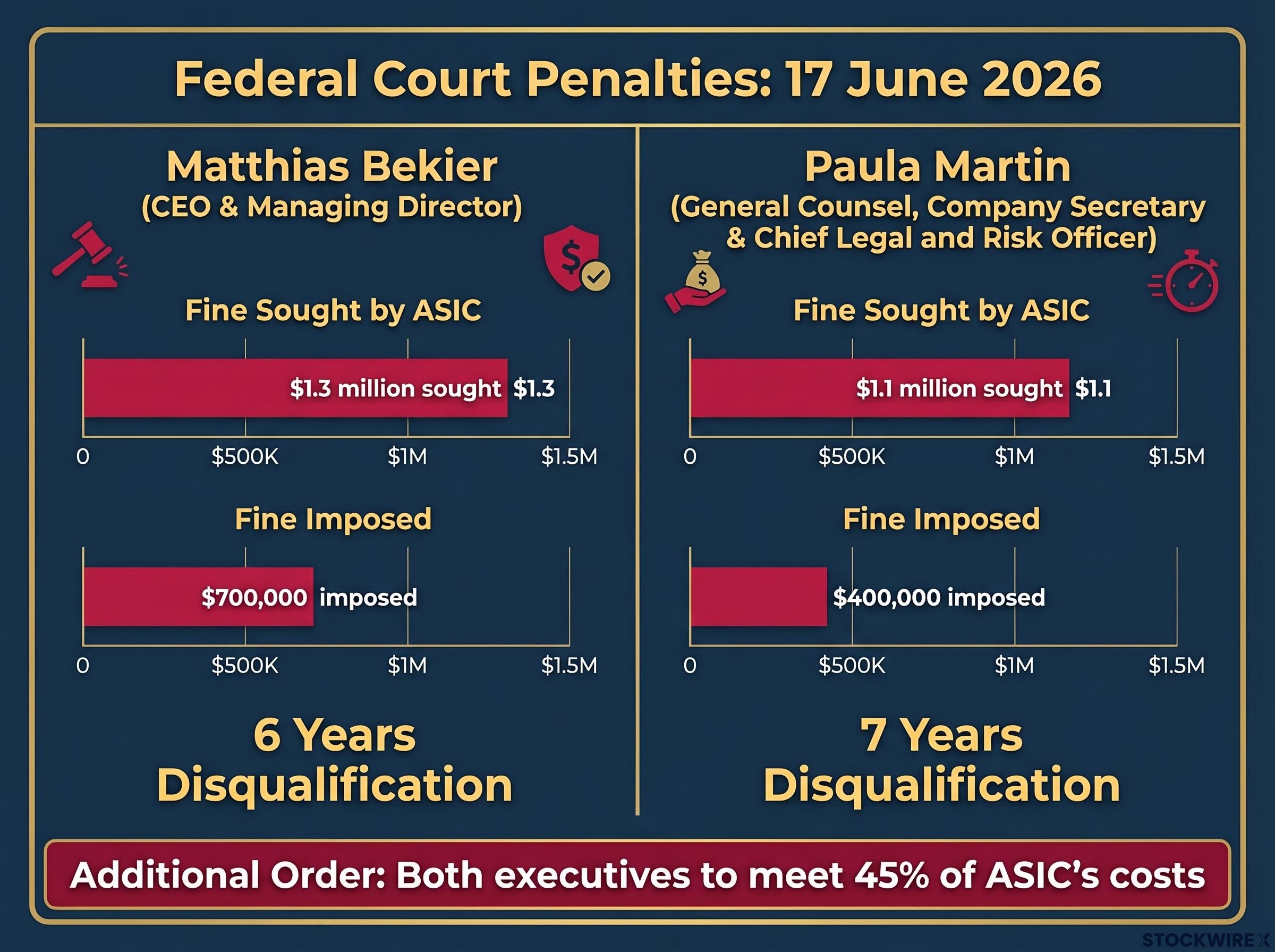
Justice Michael Lee imposed the following penalties on Star Entertainment Group’s two former senior executives:
| Executive | Role | Fine imposed | Fine sought by ASIC | Disqualification |
|---|---|---|---|---|
| Matthias Bekier | CEO & Managing Director | $700,000 | $1.3 million | 6 years |
| Paula Martin | General Counsel, Company Secretary & Chief Legal and Risk Officer | $400,000 | $1.1 million | 7 years |
The Court also directed both executives to meet 45% of ASIC’s costs arising from the proceeding. The Court dismissed the case against seven former non-executive directors, drawing a clear line between executive and non-executive culpability.
ASIC disqualification powers extend beyond court-ordered bans: under section 206F of the Corporations Act, ASIC can administratively ban a person from managing any corporation for up to five years without a court order, criminal conviction, or formal legal proceeding, a pathway that operates in parallel to the court-imposed bans delivered in cases like ASIC v Bekier.
The gap between what ASIC sought and what the Court awarded is itself significant. ASIC pursued $1.3 million from Bekier and $1.1 million from Martin. The Court imposed roughly half those amounts, calibrating proportionality rather than adopting a punitive maximum. That makes the outcome harder to dismiss as regulatory overreach; this was a measured judgment, not a symbolic one.
ASIC Chair Sarah Court, following the liability findings on 5 March 2026, stated that ASIC will continue to pursue individuals where governance failures occur at the executive level, reinforcing that section 180(1) duties carry real personal consequences for senior leaders in regulated industries.
When big ASX news breaks, our subscribers know first
What Bekier and Martin were each found to have done wrong
Both executives breached section 180(1) of the Corporations Act 2001 (Cth), the statutory duty of care and diligence that applies to directors and officers. The contraventions occurred between 2017 and 2019, a period during which Star Entertainment operated as one of Australia’s major casino operators in a heavily regulated environment. Both failures share a structural root: neither executive escalated material risk information clearly to the Board. But the specific conduct diverges sharply.
The penalty judgment builds directly on the liability findings against Bekier and Martin handed down on 5 March 2026, which established for the first time that section 180 of the Corporations Act extends to non-financial compliance failures, covering AML/CTF risk identification, management, and escalation obligations across all ASX-listed regulated entities.
Matthias Bekier: failure to act and failure to warn
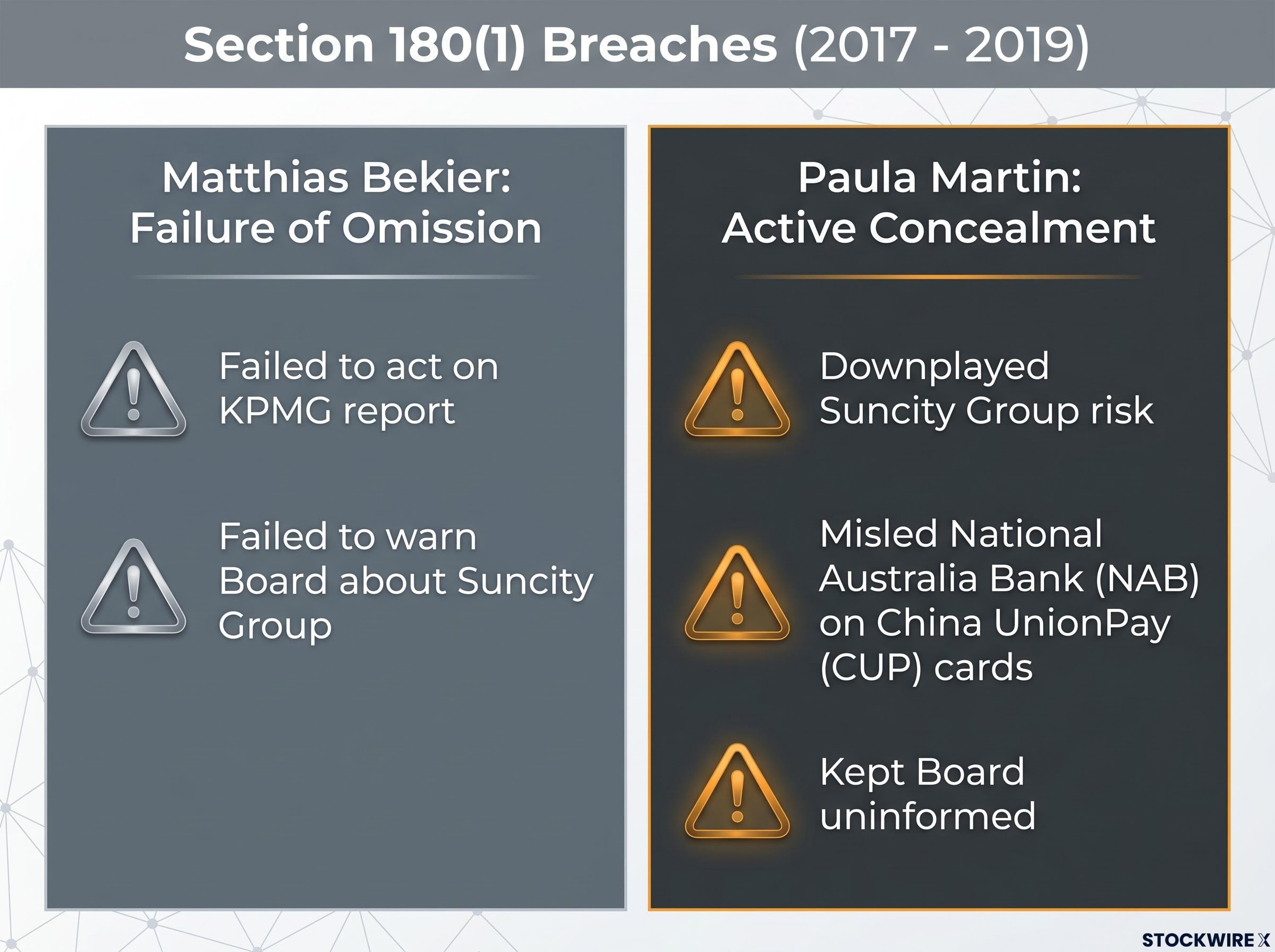
- Failed to act on a KPMG report that flagged serious deficiencies in Star’s anti-money laundering and financial crime controls.
- Failed to ensure that compliance, risk management, and regulatory obligations were actually being met, not merely documented.
- Failed to adequately inform and warn the Board about risks associated with Suncity Group, a high-risk Asian junket operator at the centre of the AML concerns.
Bekier’s breach was a failure of omission. He had the warnings. He did not act on them, and he did not ensure the Board understood what those warnings meant.
Paula Martin: downplaying, concealment, and the NAB conduct
- Held knowledge of numerous serious warning signs concerning Suncity Group’s overseas junket activities, yet kept the Board uninformed of those matters in breach of her obligations.
- Downplayed the seriousness of the risk information she received rather than escalating it clearly.
- Was involved in misleading National Australia Bank about the use of China UnionPay (CUP) cards by Star customers, and failed to inform the Board of those issues.
Martin’s involvement in the NAB conduct elevates her breach beyond passive failure. The Court was dealing with active concealment, not just an omission. That distinction explains why her disqualification was longer than Bekier’s, even though her fine was lower.
Why the lawyer received a longer ban than the CEO
On the surface, the penalty split looks counterintuitive. Martin received a lower fine ($400,000 versus Bekier’s $700,000) but a longer ban (7 years versus 6 years). The logic becomes coherent when you look at what the Court expected from each role.
Martin was not just a senior executive. She held three titles simultaneously: General Counsel, Company Secretary, and Chief Legal and Risk Officer. She was the most senior legal professional employed by Star Entertainment. The Court found that her position demanded a markedly higher standard of professional independence, accuracy, and judgment than that expected of other officers, together with a personal duty to bring material compliance and legal risks clearly before the Board.
Justice Lee’s reasoning established that for those occupying the chief legal and risk position, the standard is not merely equivalent to other senior executives. The professional independence and accuracy expected of the most senior legal officer in an organisation intensify the obligation to act, particularly when the organisation’s culture or controls are weak.
Legal commentary from Clayton Utz and the Australian Institute of Company Directors (AICD) reinforces the point. When an organisation’s internal culture is problematic, the responsibility of those in legal and risk roles increases rather than diminishes. A dysfunctional culture is not a defence; it is an aggravating factor.
For anyone holding a Chief Legal Officer, General Counsel, or Chief Risk Officer role, the judgment delivers a direct message: the governance failures happening around you do not reduce your personal liability. They increase it.
The board reporting doctrine: what “buried in a board pack” now means legally
The most practically significant element of Justice Lee’s reasoning concerns information flows between management and the Board. The Court drew a sharp line between two groups, and the line turned on one question: who had the obligation to surface the risk?
What the NED dismissal reveals about where the burden sits
The seven former non-executive directors escaped liability not because they were passive or disengaged. They escaped because management had not drawn their attention to the material risk information. Key warnings were buried in voluminous board packs without being flagged. The NEDs had no clear signal to interrogate.
The burden of surfacing material risk sits with management, not with NEDs who had no distinct flag to challenge. That allocation of responsibility has direct practical consequences.
The obligations that flow from this doctrine are sequential:
- Awareness: If an executive knows or ought to know that information is materially significant, including AML/CTF weaknesses, dealings with high-risk counterparties, or misleading conduct towards banks, the duty is activated.
- Active escalation: Simply including material in lengthy board papers does not satisfy the duty. The executive must ensure the Board’s attention is drawn to the significance of the information.
- Clear communication: Downplaying seriousness or framing risk information in ways that obscure its implications is treated as a breach, not a communication choice.
Commentary from Clifford Chance and Wotton Kearney underscores the operational implication. If you know something is material, your duty is to make that materiality unmistakable to the Board, not to include it somewhere in the documentation and hope it gets noticed. The legal standard on this is now explicit.
What section 180(1) now demands in regulated industries
Section 180(1) of the Corporations Act 2001 (Cth) imposes a duty of care and diligence on directors and officers of Australian corporations. In plain terms, it requires that anyone in a director or officer role exercises their powers and discharges their duties with the degree of care and diligence that a reasonable person in their position would exercise. It is the statutory basis on which ASIC pursued both Bekier and Martin.
The Court’s application of section 180(1) in this case assessed each executive’s conduct against the specific warnings available to them, the resources at their disposal, and the obligations attached to their particular role, not against an abstract or generalised standard of care.
What this ruling makes clear is that section 180(1) is not a compliance checkbox. It is an active, role-calibrated obligation. Courts will assess what you knew, when you knew it, and what your specific role required you to do about it.
The judgment also confirms a broader enforcement pattern. ASIC is pursuing individuals, not just companies. Star’s case sits alongside intensified scrutiny of Crown Resorts and other high-risk sectors for AML/CTF failures. The casino sector is illustrative, but the standard applies across regulated industries: banking, financial services, energy, and any sector where compliance obligations carry statutory weight.
The Bekier and Martin judgment sits within a broader shift in how ASIC pursues enforcement, with personal liability for disclosure failures emerging as a parallel front: ASIC is separately pursuing former Electro Optic Systems CEO Dr Ben Greene under sections 180 and 674 of the Corporations Act for a 14-week delay in disclosing a $48 million revenue shortfall, reinforcing that individual accountability is now a standing ASIC posture rather than a case-by-case exception.
One further point bears emphasis. The ruling makes clear that CEOs cannot treat compliance and risk as fully delegated functions. The obligation to ensure those functions actually operate, and to communicate their findings to the Board, remains personal. Delegation does not extinguish the duty; it just distributes the operational work.
What boards and executives should take from this ruling
The governance obligations that emerge most clearly from this judgment are specific enough to function as a checklist for anyone leading a legal, risk, or compliance function in an Australian regulated business:
- Active risk oversight: AML and compliance risk must be regularly and meaningfully reported, challenged, and reviewed at the board level. Documentation alone is not oversight.
- Clear escalation protocols: Legal, risk, and compliance teams need explicit obligations to escalate material issues, including regulatory warnings, internal audit findings, and external reviews, promptly and directly to the Board.
- Board-friendly risk reporting: Risk information must be structured to surface serious issues, not buried in lengthy packs. The responsibility for ensuring critical warnings are not diluted or obscured sits squarely with management.
- Role clarity for CLO and CRO functions: Chief Legal Officers and Chief Risk Officers need a clearly articulated mandate for independence and adverse-issue escalation, supported and protected by the Board.
- Cultural accountability: A problematic compliance culture is not a shield. When governance culture is weak, legal, risk, and senior executives are expected to do more to enforce standards, not less. Courts will treat dysfunction as an aggravating factor, not an excuse.
The disqualification durations matter independently of the fines. Six and seven-year bans effectively exclude both individuals from corporate leadership for most of a decade. These are structural constraints on future board and executive participation, operating well beyond the financial penalties and reputational damage.
The principle that a weak governance culture intensifies rather than excuses individual duty is the most counterintuitive and practically important finding of this ruling. It inverts the assumption many executives carry: that systemic failures provide personal cover.
This article is for informational purposes only and should not be considered financial advice. Investors should conduct their own research and consult with financial professionals before making investment decisions.
A ruling that recalibrates personal exposure for Australia’s corporate leaders
The penalty judgment in ASIC v Bekier ([2026] FCA 756) is the first major post-Star ruling to impose role-differentiated disqualifications on both a CEO and a Chief Legal and Risk Officer for AML and risk oversight failures under section 180(1). It does so in a way that sets a concrete precedent for how courts assess personal liability by reference to the specific function, expertise, and information available to each executive.
The regulated industries most immediately affected, gaming, banking, financial services, and energy, should treat this ruling as a reference point for reviewing escalation protocols and board reporting structures now, before ASIC’s next enforcement action. ASIC Chair Sarah Court has been explicit about the regulator’s commitment to pursuing individuals.
ASIC enforcement across regulated industries has accelerated sharply in 2026, with the Federal Court imposing a $10 million penalty against Binance Australia in March for misclassifying retail clients and new purpose-built digital asset legislation receiving Royal Assent in April, confirming that the individual accountability standard visible in ASIC v Bekier is part of a regulator-wide intensification rather than a response specific to the casino sector.
ASIC’s enforcement media releases confirm the regulator’s stated commitment to pursuing named individuals for governance failures, with the Star Entertainment action sitting alongside a series of proceedings targeting executives personally across regulated sectors.
The six- and seven-year bans are not industry commentary. They are the legal consequence of governance failure, delivered seven days ago, in a country where the regulator has publicly committed to holding named executives personally accountable. For anyone holding a senior executive or legal risk role in a regulated Australian business, the logic of this judgment applies directly.
—