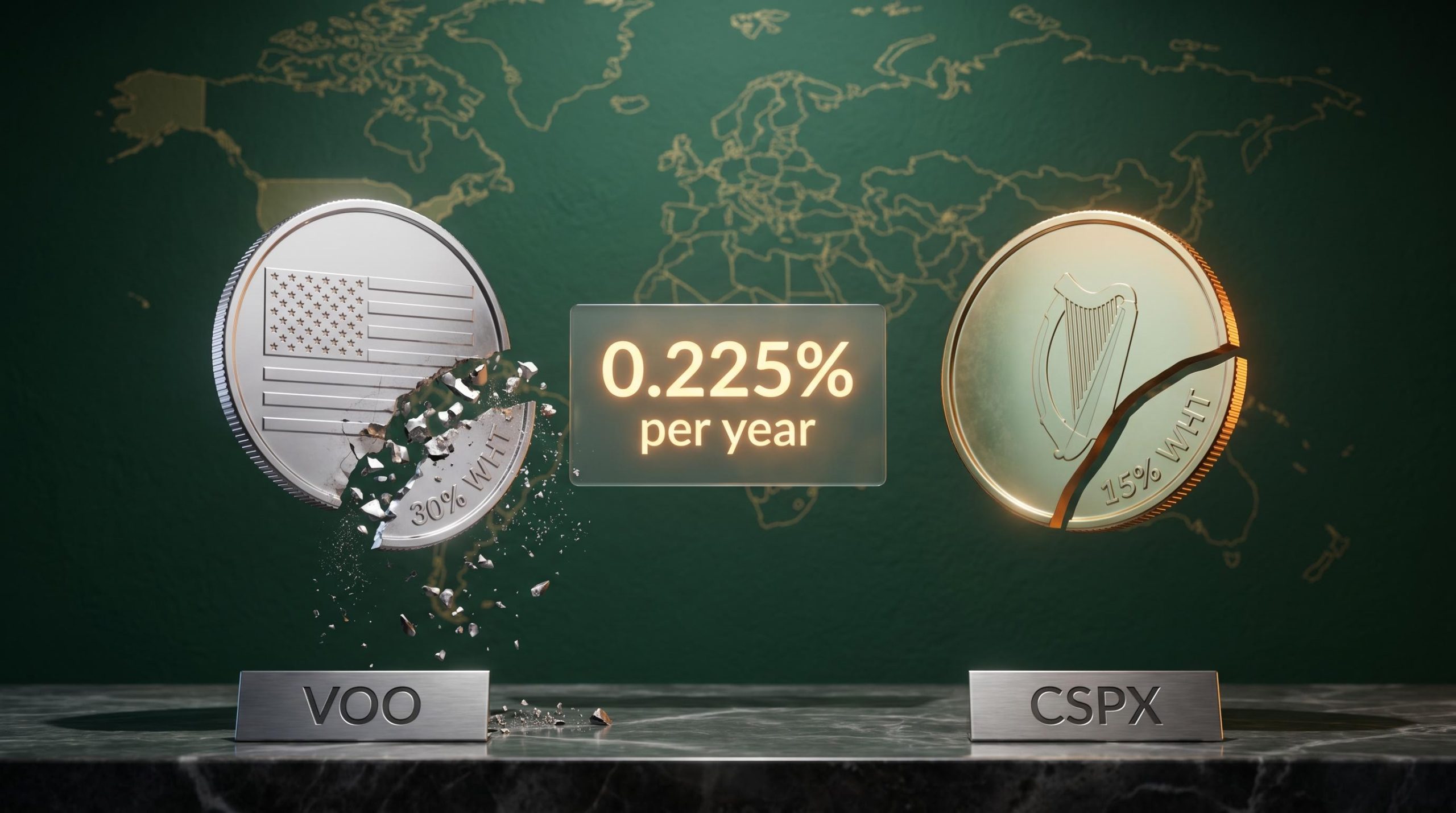
A non-US investor holding VOO instead of an Ireland-domiciled equivalent could lose roughly 0.225% of returns every single year purely to dividend withholding tax, before fees even enter the calculation. All five major S&P 500 ETFs covered here, SPY, IVV, VOO, CSPX, and SPYL, track the same index, hold the same stocks, and charge broadly similar fees. Yet the country where the fund is legally registered produces materially different after-tax outcomes for non-US investors, a structural difference that compounds significantly over multi-decade holding periods. This article explains exactly how Ireland-domiciled UCITS ETFs differ from US-listed funds in dividend withholding tax treatment, US estate tax exposure, and accumulation mechanics, then provides a clear framework for deciding which structure fits different investor profiles.
Why the same index can deliver different returns depending on where your ETF lives
SPY, IVV, VOO, CSPX, and SPYL all track the S&P 500 index. At the holdings level, they are structurally identical: the same 500 companies, weighted the same way, rebalanced on the same schedule.
The variable that changes investor outcomes is not stock selection. It is fund domicile, the legal jurisdiction where the ETF is registered. Two camps exist: US-domiciled funds listed on the NYSE (SPY, IVV, VOO) and Ireland-domiciled UCITS funds listed on the LSE (CSPX, SPYL).
The S&P 500 has historically carried a dividend yield of approximately 1.2-1.8%. That yield passes through a tax and structural framework that differs depending on where the fund sits. Three levers determine the size of the difference:
- Dividend withholding tax rate: The percentage of US dividends withheld before they reach the investor, which varies by domicile and applicable tax treaties
- US estate tax exposure: Whether the fund’s units are classified as US-situs assets, subjecting non-US holders to potential estate tax at death
- Share class type (accumulating vs distributing): Whether dividends are paid out as cash or reinvested within the fund, affecting compounding efficiency and taxable events
For a non-US investor making a decades-long commitment to S&P 500 exposure, this domicile decision is one of the highest-leverage structural choices available before a single dollar is invested. All data cited throughout this article is current as of June 2026.
When big ASX news breaks, our subscribers know first
How the dividend withholding tax gap actually works
The first signal a non-US investor notices is a smaller dividend than expected. The explanation sits in the withholding tax mechanics, and the path those dividends travel determines how much smaller.
The S&P 500 carries an approximate yield of 1.2-1.8%, but dividend yield mechanics at the fund level determine what fraction of that yield actually compounds for the investor after withholding tax; the gap between gross yield and net received amount is precisely what makes domicile selection consequential for non-US holders.
Path 1: US-listed ETF (SPY, IVV, or VOO)
- US companies pay dividends to the US-domiciled fund with no withholding, because the fund is a US person.
- When the fund distributes those dividends to a non-resident alien investor, 30% US withholding tax (WHT) is applied at the fund-to-investor level (absent a treaty reducing that rate).
A $100 dividend becomes $70.
Path 2: Ireland-domiciled UCITS ETF (CSPX or SPYL)
- US companies pay dividends to the Irish-domiciled fund at 15% WHT under the US-Ireland tax treaty, so the fund receives $85.
- Ireland imposes no additional WHT on non-Irish-resident investors. The $85 remains intact at the investor level.
A $100 dividend becomes $85.
The US-Ireland tax treaty sets the dividend withholding rate at 15% for Irish-domiciled funds receiving US-sourced income, compared to the 30% rate that applies to non-resident investors without treaty protection, making fund domicile a structurally significant variable rather than an administrative detail.
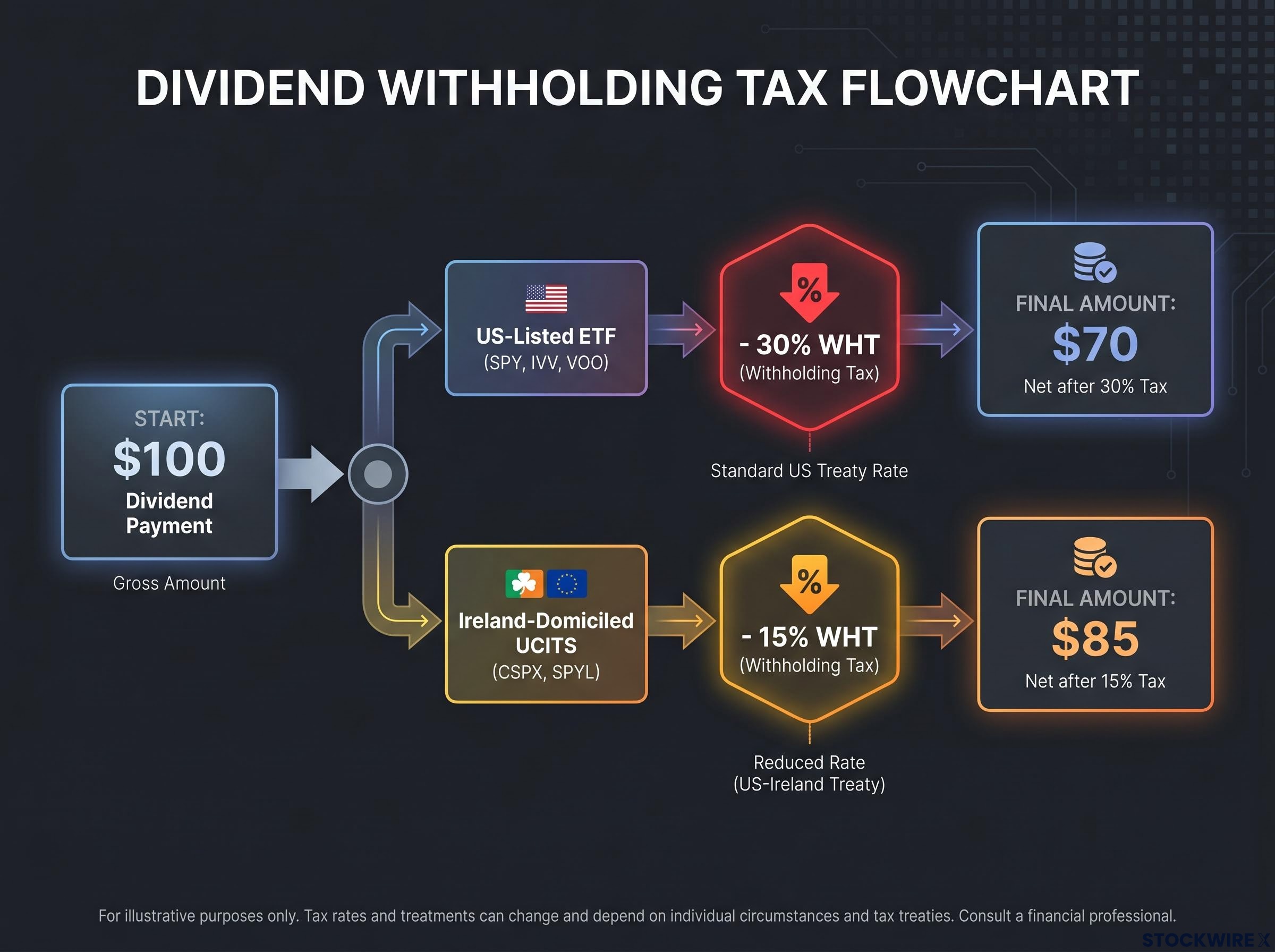
Both structures involve a single WHT layer. The Irish route does not eliminate a layer; it applies the single layer at a more favourable rate. Any further tax obligation comes from the investor’s home country, not from an additional US or Irish withholding.
On a 1.5% dividend yield, the difference between 30% and 15% WHT translates to approximately 0.225% per year in additional drag for the US-listed route.
The 0.225% annual WHT drag differential for non-treaty investors is substantially larger than the fee gap between any of the funds in this comparison, making withholding tax, not the expense ratio, the dominant variable in the domicile decision.
The fund comparison every non-US investor should see
The table below consolidates the structural variables across all five funds into a single reference point, removing the need to cross-reference multiple fund factsheets.
| Fund | Domicile / Exchange | TER | AUM (June 2026) | WHT at Fund Level / Share Class |
|---|---|---|---|---|
| SPY | USA / NYSE | 0.0945% | ~$780B | 30% (non-treaty NRA) / Distributing |
| IVV | USA / NYSE | 0.03% | ~$800B | 30% (non-treaty NRA) / Distributing |
| VOO | USA / NYSE | 0.03% | ~$1.7T | 30% (non-treaty NRA) / Distributing |
| CSPX | Ireland / LSE | 0.07% | ~$150B | 15% (US-Ireland treaty) / Accumulating |
| SPYL | Ireland / LSE | 0.03% | ~$18B | 15% (US-Ireland treaty) / Accumulating |
SPY operates under an older unit investment trust (UIT) structure that cannot reinvest dividends internally; dividends sit in cash until distributed, creating some cash drag. IVV, VOO, CSPX, and SPYL all operate under structures (open-end ETF or UCITS) that permit internal dividend reinvestment at the fund level. SPYL’s accumulating share class launched on 31 October 2023, giving it a shorter track record and smaller asset base than CSPX.
The estate tax risk that most non-US investors overlook
For investors focused on fees and dividend efficiency, estate tax can arrive as a genuine surprise. US-listed ETFs carry an exposure that Ireland-domiciled funds do not.
SPY, IVV, and VOO are classified as US-situs assets. For non-resident aliens without a US estate tax treaty, holdings above $60,000 can be subject to US estate tax of up to 40% at death.
The threshold is not indexed to inflation. A portfolio that grows over decades can cross it quickly.
- US-listed ETFs (SPY, IVV, VOO): Classified as US-situs assets. Non-resident aliens without an applicable estate tax treaty face potential US estate tax of up to 40% on holdings above $60,000.
- Ireland-domiciled UCITS (CSPX, SPYL): Units in Irish UCITS are not US-situs assets and fall entirely outside US estate tax scope. Ireland imposes no estate or inheritance tax on UCITS held by non-Irish residents.
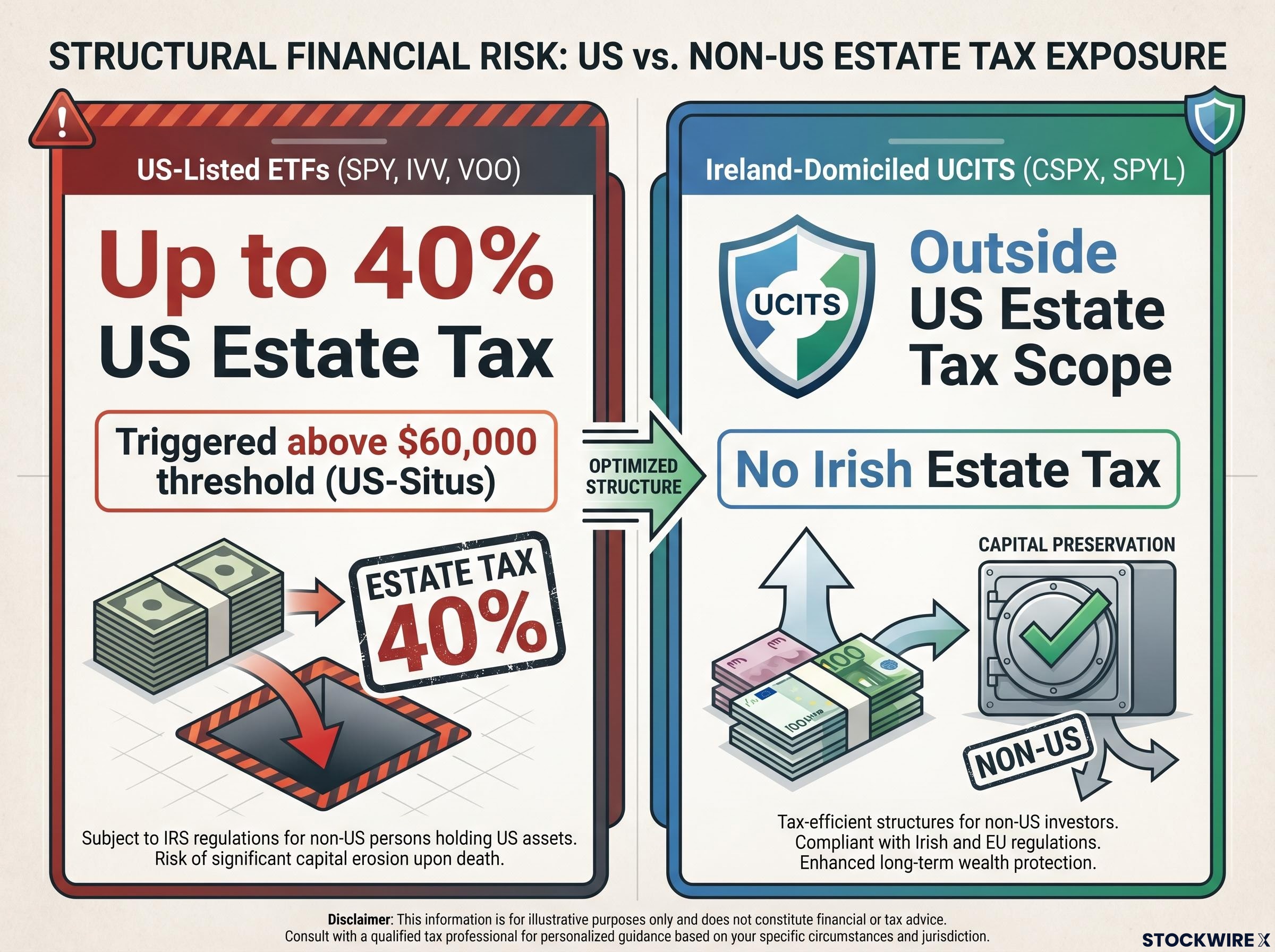
Some countries maintain bilateral US estate tax treaties that raise the threshold substantially or provide credits. However, most investors across Asia, Africa, and emerging markets do not benefit from such treaties. For those building substantial long-term wealth in S&P 500 ETFs, the estate tax differential between structures represents a potentially far larger wealth transfer risk than any fee or WHT consideration.
Understanding the accumulating share class advantage
A distributing ETF pays dividends out as cash. An accumulating ETF reinvests them within the fund, increasing the net asset value (NAV) per share rather than generating a cash payment. The distinction matters for non-US investors in two ways: tax efficiency and compounding friction.
CSPX and SPYL both use accumulating share classes. When US companies pay dividends into the Irish fund, 15% WHT is applied at the fund level under the US-Ireland treaty. The remaining 85 cents of every dollar is reinvested automatically. There is no further Irish WHT on non-resident investors and no periodic taxable distribution at the investor level.
SPY, IVV, and VOO are all distributing funds. Dividends are paid out and subject to WHT at each distribution cycle. For a non-treaty non-resident alien, 30 cents of every dollar is withheld, and only 70 cents arrives as cash, which must then be manually reinvested (incurring additional transaction costs each time).
Accumulating (CSPX / SPYL):
- Dividends reinvested within the fund automatically
- No periodic taxable distribution at the investor level
- WHT applied once at 15% when dividends enter the fund
- Compounding occurs on 85% of gross dividends
- No manual reinvestment or transaction cost friction
Distributing (SPY / IVV / VOO):
- Dividends paid out as cash each distribution cycle
- WHT of 30% applied per distribution for non-treaty investors
- Compounding occurs on 70% of gross dividends (before reinvestment costs)
- Requires manual reinvestment or DRIP enrolment
- Each distribution is a taxable event in many jurisdictions
Investors compound on 85 cents of every dollar of dividends under an Irish UCITS structure vs 70 cents under a US-listed ETF without a tax treaty.
Compounding on gross returns is the mechanism that makes the accumulating share class distinction most consequential over multi-decade horizons: the difference between reinvesting 85 cents and 70 cents of every dividend dollar is small in year one and substantial by year thirty, because each reinvested cent earns additional returns across all subsequent periods.
CSPX offers the advantages of scale (approximately $150B AUM), a longer track record, and established liquidity. SPYL competes on cost at 0.03% TER, matching IVV and VOO, and its lower per-share price facilitates dollar-cost averaging without requiring fractional shares.
Investors should verify their home country’s tax treatment of accumulating versus distributing funds with a local tax adviser, as this varies by jurisdiction.
Matching the right ETF structure to your investor profile
The preceding analysis points toward different conclusions depending on the investor’s circumstances. Four profiles cover the majority of cases:
- Non-treaty non-US investors (Asia, Africa, emerging markets): This is the clearest case for Ireland-domiciled UCITS. The 15% WHT rate (versus 30%), full estate tax insulation, and accumulating compounding advantage make CSPX or SPYL structurally superior for long-term, buy-and-hold investors, even where the headline TER is marginally higher.
- EU and UK retail investors: PRIIPs regulations prevent retail investors from purchasing US-listed ETFs that do not produce a Key Information Document (KID). For this group, CSPX and SPYL are not merely preferable; they are the only compliant option.
- Investors with strong US income and estate tax treaties: Where a treaty reduces US WHT to 15% on US-listed ETFs and raises the estate tax threshold, the Irish UCITS advantage shrinks or disappears. The decision shifts to accumulating versus distributing preference, brokerage access costs, and regulatory rules.
- Very active traders and institutions: SPY remains the preferred instrument regardless of WHT and estate tax disadvantages. Its unmatched liquidity, tightest spreads, and deep options market make execution quality the dominant variable for high-frequency or large-scale positioning.
For investors who have already chosen the Irish UCITS route, the CSPX vs SPYL decision comes down to priorities. SPYL offers the lowest TER at 0.03% and a lower per-share price suited to regular contributions. CSPX provides the advantages of larger scale, longer track record, and established liquidity. The fee gap between them (0.04%) is small in absolute terms.
Regardless of profile, every investor should verify four factors:
- Home country tax rules on accumulating versus distributing funds
- Applicable US income tax treaty rate for their country of residence
- Whether a US estate tax treaty applies and at what threshold
- Brokerage access costs and FX conversion spreads per exchange
For non-US investors, the ETF wrapper matters as much as the index
The structural advantages of Ireland-domiciled UCITS, 15% WHT versus 30%, no US estate tax exposure, and accumulating compounding, outweigh the marginal fee and liquidity differences relative to US-listed equivalents for most non-US investors without strong US tax and estate treaties. On a 1.5% dividend yield, the WHT drag differential alone amounts to approximately 0.225% per year, a figure that dwarfs the largest fee gap in this comparison.
The right answer remains profile-dependent. Treaty status, regulatory access, and brokerage costs can shift the calculus for specific investor groups. What does not change is that the domicile decision deserves at least as much attention as the fee comparison that typically dominates ETF selection.
The practical next step is straightforward: verify local tax treatment of accumulating funds and applicable treaty rates with a qualified local tax adviser before committing to a structure.
For investors building long-term S&P 500 exposure across multiple jurisdictions, our full explainer on the Netherlands unrealised gains tax covers how the 2026 Dutch legislation taxes paper profits on unsold assets at 36%, a policy development that illustrates why monitoring the tax treatment of accumulating fund structures in each investor’s home country is an ongoing obligation rather than a one-time check.
This article is for informational purposes only and should not be considered financial advice. Investors should conduct their own research and consult with financial professionals before making investment decisions. All fund data referenced is current as of June 2026.